







 Chat with AI

Deck 14: Nuclear Magnetic Resonance Spectroscopy
Full screen (f)

Question
How many different kinds of protons are present in each of the following compounds? 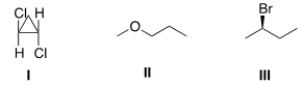
A) I = 2; II = 4; III = 6.
B) I = 2; II = 4; III = 4.
C) I = 3; II = 3; III = 5.
D) I = 2; II = 4; III = 5.
A) I = 2; II = 4; III = 6.
B) I = 2; II = 4; III = 4.
C) I = 3; II = 3; III = 5.
D) I = 2; II = 4; III = 5.

Question
How many peaks would be observed for each of the circled protons in the compounds below? 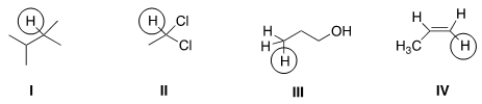
A) I = 8; II = 4; III = 3; IV = 3.
B) I = 7; II = 4; III = 3; IV = 4.
C) I = 7; II = 3; III = 3; IV = 3.
D) I = 7; II = 4; III = 2; IV = 4.
A) I = 8; II = 4; III = 3; IV = 3.
B) I = 7; II = 4; III = 3; IV = 4.
C) I = 7; II = 3; III = 3; IV = 3.
D) I = 7; II = 4; III = 2; IV = 4.
Question
Which of the labeled protons absorbs furthest upfield in the 1H NMR spectrum? 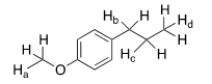
A) Ha
B) Hb
C) Hc
D) Hd
A) Ha
B) Hb
C) Hc
D) Hd
Question
Which of the indicated protons would absorb furthest downfield in a 1H NMR spectrum? 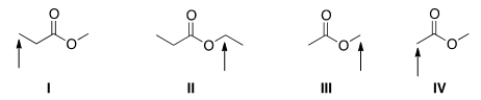
A) I
B) II
C) III
D) IV
A) I
B) II
C) III
D) IV
Question
Which compound does not give four sets of absorptions in its 1H NMR spectrum (i.e., which compound does not have four unique hydrogens)? 
A) I
B) II
C) III
D) IV
A) I
B) II
C) III
D) IV
Question
How many different kinds of protons are present in each of the following compounds? 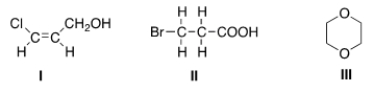
A) I = 4; II = 3; III = 1.
B) I = 4; II = 4; III = 1.
C) I = 4; II = 4; III = 2.
D) I = 3; II = 3; III = 1.
A) I = 4; II = 3; III = 1.
B) I = 4; II = 4; III = 1.
C) I = 4; II = 4; III = 2.
D) I = 3; II = 3; III = 1.
Question
How many peaks would be observed for each of the circled protons in the compounds below? 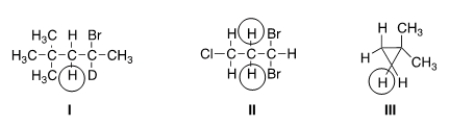
A) I = 2; II = 6; III = 1.
B) I = 3; II = 5; III = 2.
C) I = 1; II = 5; III = 1.
D) I = 2; II = 6; III = 2.
A) I = 2; II = 6; III = 1.
B) I = 3; II = 5; III = 2.
C) I = 1; II = 5; III = 1.
D) I = 2; II = 6; III = 2.
Question
How many peaks would be observed for each of the circled protons in the compounds below? 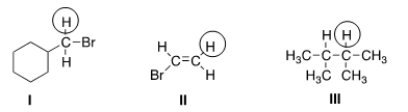
A) I = 1; II = 4; III = 7.
B) I = 3; II = 3; III = 7.
C) I = 2; II = 4; III = 7.
D) I = 2; II = 4; III = 6.
A) I = 1; II = 4; III = 7.
B) I = 3; II = 3; III = 7.
C) I = 2; II = 4; III = 7.
D) I = 2; II = 4; III = 6.
Question
How many different kinds of protons are present in each of the following compounds? 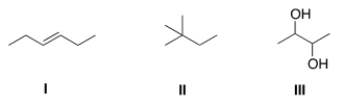
A) I = 2; II = 3; III = 4.
B) I = 2; II = 3; III = 3.
C) I = 3; II = 3; III = 3.
D) I = 3; II = 3; III = 4.
A) I = 2; II = 3; III = 4.
B) I = 2; II = 3; III = 3.
C) I = 3; II = 3; III = 3.
D) I = 3; II = 3; III = 4.
Question
How many peaks would be observed for each of the circled protons in the compounds below? 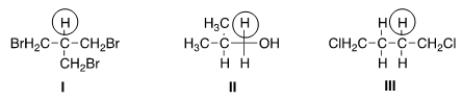
A) I = 6; II = 2; III = 3.
B) I = 7; II = 3; III = 3.
C) I = 7; II = 1; III = 3.
D) I = 7; II = 2; III = 3.
A) I = 6; II = 2; III = 3.
B) I = 7; II = 3; III = 3.
C) I = 7; II = 1; III = 3.
D) I = 7; II = 2; III = 3.
Question
How many different kinds of protons are present in each of the following molecules? 
A) I = 3; II = 5; III = 5; IV = 4; V = 3.
B) I = 4; II = 5; III = 4; IV = 4; V = 3.
C) I = 4; II = 5; III = 5; IV = 4; V = 3.
D) I = 4; II = 5; III = 5; IV = 3; V = 4.
A) I = 3; II = 5; III = 5; IV = 4; V = 3.
B) I = 4; II = 5; III = 4; IV = 4; V = 3.
C) I = 4; II = 5; III = 5; IV = 4; V = 3.
D) I = 4; II = 5; III = 5; IV = 3; V = 4.
Question
How many unique protons are present in each of the following compounds? 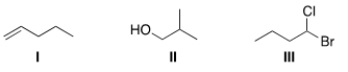
A) I = 6; II = 3; III = 6.
B) I = 5; II = 4; III = 6.
C) I = 6; II = 4; III = 4.
D) I = 6; II = 4; III = 6.
A) I = 6; II = 3; III = 6.
B) I = 5; II = 4; III = 6.
C) I = 6; II = 4; III = 4.
D) I = 6; II = 4; III = 6.
Question
How many different kinds of protons are present in each of the following molecules? 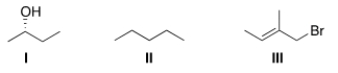
A) I = 6; II = 3; III = 4.
B) I = 5; II = 3; III = 4.
C) I = 6; II = 4; III = 5.
D) I = 6; II = 4; III = 4.
A) I = 6; II = 3; III = 4.
B) I = 5; II = 3; III = 4.
C) I = 6; II = 4; III = 5.
D) I = 6; II = 4; III = 4.
Question
Into how many peaks will each of the circled protons be split? 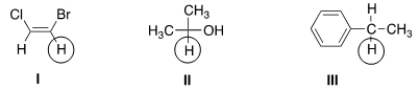
A) I = 3; II = 7; III = 4.
B) I = 2; II = 7; III = 4.
C) I = 2; II = 7; III = 3.
D) I = 2; II = 6; III = 4.
A) I = 3; II = 7; III = 4.
B) I = 2; II = 7; III = 4.
C) I = 2; II = 7; III = 3.
D) I = 2; II = 6; III = 4.
Question
Which of the indicated protons in the molecules below would absorb furthest downfield in a 1H NMR spectrum? 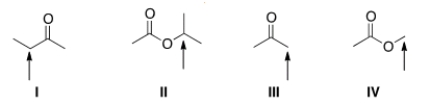
A) I
B) II
C) III
D) IV
A) I
B) II
C) III
D) IV
Question
How many different kinds of protons are present in each of the following compounds? 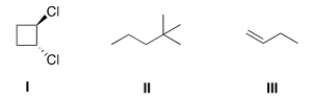
A) I = 4; II = 4; III = 4.
B) I = 4; II = 4; III = 5.
C) I = 3; II = 3; III = 5.
D) I = 3; II = 4; III = 5.
A) I = 4; II = 4; III = 4.
B) I = 4; II = 4; III = 5.
C) I = 3; II = 3; III = 5.
D) I = 3; II = 4; III = 5.
Question
How many different kinds of protons are present in each of the following compounds? 
A) I = 6; II = 5; III = 3.
B) I = 7; II = 5; III = 3.
C) I = 7; II = 6; III = 3.
D) I = 6; II = 6; III = 3.
A) I = 6; II = 5; III = 3.
B) I = 7; II = 5; III = 3.
C) I = 7; II = 6; III = 3.
D) I = 6; II = 6; III = 3.
Question
Into how many peaks will each of the circled protons be split? 
A) I = 3; II = 8; III = 1; IV = 4; V = 3.
B) I = 9; II = 8; III = 2; IV = 4; V = 4.
C) I = 4; II = 8; III = 2; IV = 4; V = 5.
D) I = 4; Ii = 7; III = 2; IV = 4; V = 3.
A) I = 3; II = 8; III = 1; IV = 4; V = 3.
B) I = 9; II = 8; III = 2; IV = 4; V = 4.
C) I = 4; II = 8; III = 2; IV = 4; V = 5.
D) I = 4; Ii = 7; III = 2; IV = 4; V = 3.
Question
Which of the labeled protons would absorb furthest downfield in a 1H NMR spectrum? 
A) I
B) II
C) III
D) IV
A) I
B) II
C) III
D) IV
Question
Which of the following compounds does not show only one signal in its 1H NMR spectrum? 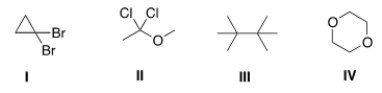
A) I
B) II
C) III
D) IV
A) I
B) II
C) III
D) IV
Question
How could spectroscopy be used to distinguish between the following compounds? 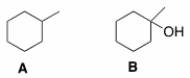
A) Compound A has a triplet in its 1H NMR spectrum at 1.0 ppm.
B) Compound B has a peak at 3200-3500 cm-1 in its IR spectrum.
C) Compound A has a peak in its IR spectrum at 2900 cm-1.
D) Compound A has a triplet in its 1H NMR spectrum at 1.0 ppm and compound B has a peak at 3200-3500 cm-1 in its IR spectrum.
A) Compound A has a triplet in its 1H NMR spectrum at 1.0 ppm.
B) Compound B has a peak at 3200-3500 cm-1 in its IR spectrum.
C) Compound A has a peak in its IR spectrum at 2900 cm-1.
D) Compound A has a triplet in its 1H NMR spectrum at 1.0 ppm and compound B has a peak at 3200-3500 cm-1 in its IR spectrum.
Question
Which of the indicated protons absorbs furthest downfield? 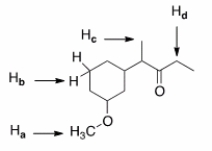
A) Ha
B) Hb
C) Hc
D) Hd
A) Ha
B) Hb
C) Hc
D) Hd
Question
An unknown compound X has the molecular formula C6H12O2. Compound X shows a strong peak in its IR spectrum at 1700 cm-1. The 1H NMR spectral data of compound X is given below. What is the structure of compound X? 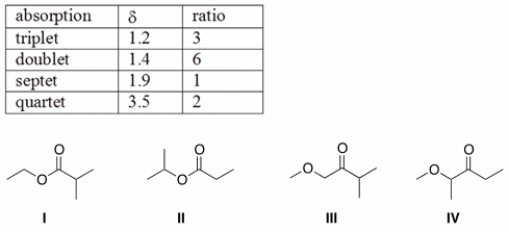
A) I
B) II
C) III
D) IV
A) I
B) II
C) III
D) IV
Question
What is the relationship between Ha and Hb in the following compound? 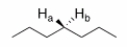
A) Homotopic
B) Enantiotopic
C) Diastereotopic
D) Mesotopic
A) Homotopic
B) Enantiotopic
C) Diastereotopic
D) Mesotopic
Question
An unknown compound A has the molecular formula C12H16O. Compound A absorbs strongly in the IR at 1700 cm-1. The NMR spectral data for compound A are given below. What is the structure of compound A? 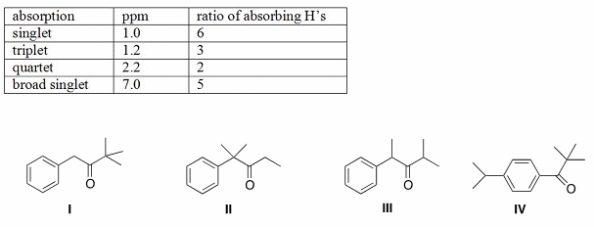
A) I
B) II
C) III
D) IV
A) I
B) II
C) III
D) IV
Question
An unknown compound X has the molecular formula C7H13OBr. Compound X shows a strong peak in its IR spectrum at 1700 cm-1. The 1H NMR spectral data of compound X is given below. What is the structure of compound X? 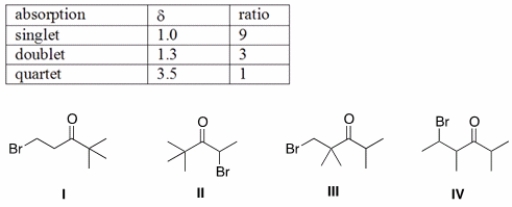
A) I
B) II
C) III
D) IV
A) I
B) II
C) III
D) IV
Question
Compound X has a molecular formula C8H10, and gives the 1H NMR spectrum below. What is the structure of X? 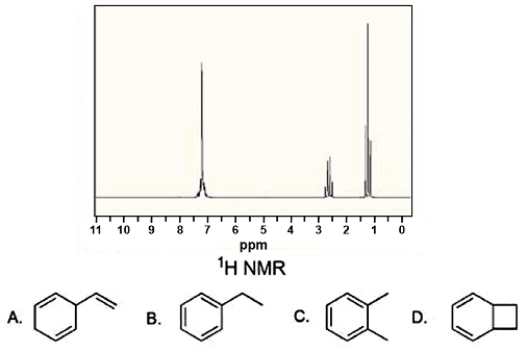
A) A
B) B
C) C
D) D
A) A
B) B
C) C
D) D
Question
An unknown compound X has the molecular formula C6H14O. Compound X shows a peak in its IR spectrum at 3200-3600 cm-1. The 1H NMR spectral data for compound X is given below. What is the structure of compound X? 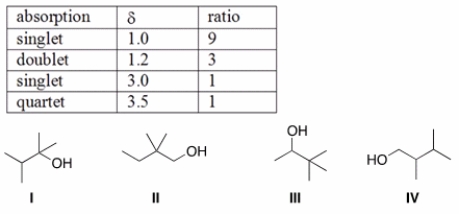
A) I
B) II
C) III
D) IV
A) I
B) II
C) III
D) IV
Question
Question
An unknown compound X has the empirical formula C3H6O and a molecular ion in its mass spectrum at 116. Compound X shows no IR absorption at 3200-3600 cm-1 but shows a peak at 1700 cm-1. The 1H NMR spectral data of X is shown below. What is the structure of compound X? 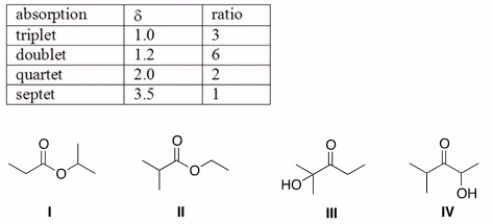
A) I
B) II
C) III
D) IV
A) I
B) II
C) III
D) IV
Question
An unknown compound X has the molecular formula C6H14O. Compound X shows a strong peak in its IR spectrum at 3000 cm-1. The 1H NMR spectral data of compound X is given below. What is the structure of compound X? 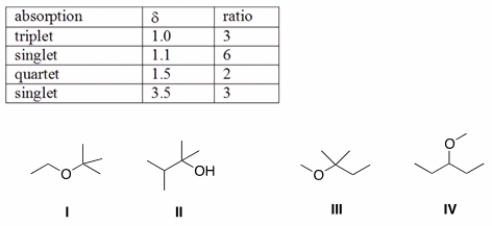
A) I
B) II
C) III
D) IV
A) I
B) II
C) III
D) IV
Question
Into how many peaks will the circled proton be split? 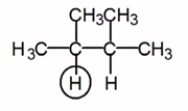
A) 5
B) 6
C) 7
D) 8
A) 5
B) 6
C) 7
D) 8
Question
Which of the following compounds would give rise to a 13C spectrum with 6 peaks? 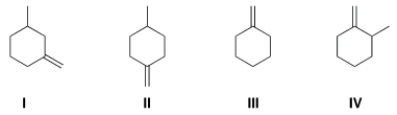
A) I
B) II
C) III
D) IV
A) I
B) II
C) III
D) IV
Question
An unknown compound X has the molecular formula C10H11O2Br. Compound X shows a strong absorption in its IR spectrum at 1700 cm-1. The 1H NMR spectral data for compound X is given below. What is the structure of compound X? 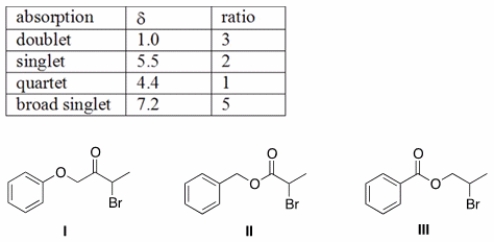
A) Only I
B) Only II
C) Only III
D) I or II
A) Only I
B) Only II
C) Only III
D) I or II
Question
How many different kinds of protons are present in each of the following compounds? 
A) a: 5; b: 6
B) a: 5; b: 5
C) a: 4; b: 6
D) a: 4; b: 5
A) a: 5; b: 6
B) a: 5; b: 5
C) a: 4; b: 6
D) a: 4; b: 5
Question
What is the relationship between Ha and Hb in the following compound? 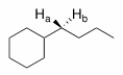
A) Homotopic
B) Enantiotopic
C) Diastereotopic
D) Mesotopic
A) Homotopic
B) Enantiotopic
C) Diastereotopic
D) Mesotopic
Question
For each of the following compounds, indicate how many 13C NMR signals will be seen. 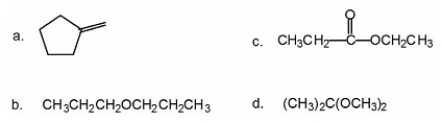
A) a: 3; b: 3; c: 5; d: 3
B) a: 4; b: 3; c: 5; d: 3
C) a: 3; b: 4; c: 5; d: 3
D) a: 4; b: 3; c: 3; d: 3
A) a: 3; b: 3; c: 5; d: 3
B) a: 4; b: 3; c: 5; d: 3
C) a: 3; b: 4; c: 5; d: 3
D) a: 4; b: 3; c: 3; d: 3
Question
Question
An unknown compound A has the molecular formula C7H14O2. Compound A absorbs strongly in the IR at 1700 cm-1. The 1H NMR spectral data for compound A are given below. What is the structure of compound A? 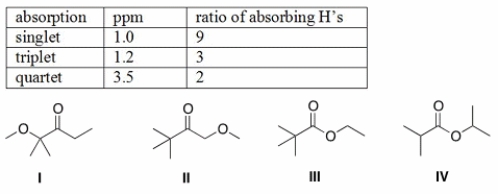
A) I
B) II
C) III
D) IV
A) I
B) II
C) III
D) IV
Question
For each of the following compounds, indicate how many 13C NMR signals will be observed. 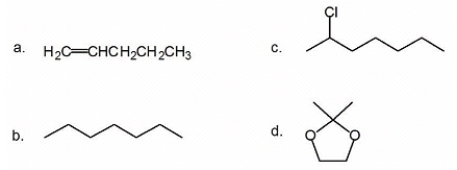
A) a: 4; b: 4; c: 7; d: 4
B) a: 5; b: 4; c: 7; d: 3
C) a: 4; b: 7; c: 7; d: 3
D) a: 5; b: 4; c: 6; d: 5
A) a: 4; b: 4; c: 7; d: 4
B) a: 5; b: 4; c: 7; d: 3
C) a: 4; b: 7; c: 7; d: 3
D) a: 5; b: 4; c: 6; d: 5
Question
Question
An unknown compound has the formula of C9H12. The following 1H NMR peaks were observed: Doublet at 1.22
Septet at 2.83
Multiplet at 7.09
From the data above, pick the compound below that fits the spectra data.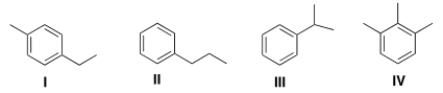
A) I
B) II
C) III
D) IV
Septet at 2.83
Multiplet at 7.09
From the data above, pick the compound below that fits the spectra data.
A) I
B) II
C) III
D) IV
Question

Unlock Deck
Sign up to unlock the cards in this deck!
Unlock Deck
Unlock Deck
1/43

Play

Full screen (f)
Deck 14: Nuclear Magnetic Resonance Spectroscopy
1
How many different kinds of protons are present in each of the following compounds?
A) I = 2; II = 4; III = 6.
B) I = 2; II = 4; III = 4.
C) I = 3; II = 3; III = 5.
D) I = 2; II = 4; III = 5.
A) I = 2; II = 4; III = 6.
B) I = 2; II = 4; III = 4.
C) I = 3; II = 3; III = 5.
D) I = 2; II = 4; III = 5.
I = 2; II = 4; III = 5.
2
How many peaks would be observed for each of the circled protons in the compounds below?
A) I = 8; II = 4; III = 3; IV = 3.
B) I = 7; II = 4; III = 3; IV = 4.
C) I = 7; II = 3; III = 3; IV = 3.
D) I = 7; II = 4; III = 2; IV = 4.
A) I = 8; II = 4; III = 3; IV = 3.
B) I = 7; II = 4; III = 3; IV = 4.
C) I = 7; II = 3; III = 3; IV = 3.
D) I = 7; II = 4; III = 2; IV = 4.
I = 7; II = 4; III = 3; IV = 4.
3
Which of the labeled protons absorbs furthest upfield in the 1H NMR spectrum?
A) Ha
B) Hb
C) Hc
D) Hd
A) Ha
B) Hb
C) Hc
D) Hd
Hd
4
Which of the indicated protons would absorb furthest downfield in a 1H NMR spectrum?
A) I
B) II
C) III
D) IV
A) I
B) II
C) III
D) IV
Unlock Deck
Unlock for access to all 43 flashcards in this deck.
Unlock Deck
k this deck
5
Which compound does not give four sets of absorptions in its 1H NMR spectrum (i.e., which compound does not have four unique hydrogens)?
A) I
B) II
C) III
D) IV
A) I
B) II
C) III
D) IV
Unlock Deck
Unlock for access to all 43 flashcards in this deck.
Unlock Deck
k this deck
6
How many different kinds of protons are present in each of the following compounds?
A) I = 4; II = 3; III = 1.
B) I = 4; II = 4; III = 1.
C) I = 4; II = 4; III = 2.
D) I = 3; II = 3; III = 1.
A) I = 4; II = 3; III = 1.
B) I = 4; II = 4; III = 1.
C) I = 4; II = 4; III = 2.
D) I = 3; II = 3; III = 1.
Unlock Deck
Unlock for access to all 43 flashcards in this deck.
Unlock Deck
k this deck
7
How many peaks would be observed for each of the circled protons in the compounds below?
A) I = 2; II = 6; III = 1.
B) I = 3; II = 5; III = 2.
C) I = 1; II = 5; III = 1.
D) I = 2; II = 6; III = 2.
A) I = 2; II = 6; III = 1.
B) I = 3; II = 5; III = 2.
C) I = 1; II = 5; III = 1.
D) I = 2; II = 6; III = 2.
Unlock Deck
Unlock for access to all 43 flashcards in this deck.
Unlock Deck
k this deck
8
How many peaks would be observed for each of the circled protons in the compounds below?
A) I = 1; II = 4; III = 7.
B) I = 3; II = 3; III = 7.
C) I = 2; II = 4; III = 7.
D) I = 2; II = 4; III = 6.
A) I = 1; II = 4; III = 7.
B) I = 3; II = 3; III = 7.
C) I = 2; II = 4; III = 7.
D) I = 2; II = 4; III = 6.
Unlock Deck
Unlock for access to all 43 flashcards in this deck.
Unlock Deck
k this deck
9
How many different kinds of protons are present in each of the following compounds?
A) I = 2; II = 3; III = 4.
B) I = 2; II = 3; III = 3.
C) I = 3; II = 3; III = 3.
D) I = 3; II = 3; III = 4.
A) I = 2; II = 3; III = 4.
B) I = 2; II = 3; III = 3.
C) I = 3; II = 3; III = 3.
D) I = 3; II = 3; III = 4.
Unlock Deck
Unlock for access to all 43 flashcards in this deck.
Unlock Deck
k this deck
10
How many peaks would be observed for each of the circled protons in the compounds below?
A) I = 6; II = 2; III = 3.
B) I = 7; II = 3; III = 3.
C) I = 7; II = 1; III = 3.
D) I = 7; II = 2; III = 3.
A) I = 6; II = 2; III = 3.
B) I = 7; II = 3; III = 3.
C) I = 7; II = 1; III = 3.
D) I = 7; II = 2; III = 3.
Unlock Deck
Unlock for access to all 43 flashcards in this deck.
Unlock Deck
k this deck
11
How many different kinds of protons are present in each of the following molecules?
A) I = 3; II = 5; III = 5; IV = 4; V = 3.
B) I = 4; II = 5; III = 4; IV = 4; V = 3.
C) I = 4; II = 5; III = 5; IV = 4; V = 3.
D) I = 4; II = 5; III = 5; IV = 3; V = 4.
A) I = 3; II = 5; III = 5; IV = 4; V = 3.
B) I = 4; II = 5; III = 4; IV = 4; V = 3.
C) I = 4; II = 5; III = 5; IV = 4; V = 3.
D) I = 4; II = 5; III = 5; IV = 3; V = 4.
Unlock Deck
Unlock for access to all 43 flashcards in this deck.
Unlock Deck
k this deck
12
How many unique protons are present in each of the following compounds?
A) I = 6; II = 3; III = 6.
B) I = 5; II = 4; III = 6.
C) I = 6; II = 4; III = 4.
D) I = 6; II = 4; III = 6.
A) I = 6; II = 3; III = 6.
B) I = 5; II = 4; III = 6.
C) I = 6; II = 4; III = 4.
D) I = 6; II = 4; III = 6.
Unlock Deck
Unlock for access to all 43 flashcards in this deck.
Unlock Deck
k this deck
13
How many different kinds of protons are present in each of the following molecules?
A) I = 6; II = 3; III = 4.
B) I = 5; II = 3; III = 4.
C) I = 6; II = 4; III = 5.
D) I = 6; II = 4; III = 4.
A) I = 6; II = 3; III = 4.
B) I = 5; II = 3; III = 4.
C) I = 6; II = 4; III = 5.
D) I = 6; II = 4; III = 4.
Unlock Deck
Unlock for access to all 43 flashcards in this deck.
Unlock Deck
k this deck
14
Into how many peaks will each of the circled protons be split?
A) I = 3; II = 7; III = 4.
B) I = 2; II = 7; III = 4.
C) I = 2; II = 7; III = 3.
D) I = 2; II = 6; III = 4.
A) I = 3; II = 7; III = 4.
B) I = 2; II = 7; III = 4.
C) I = 2; II = 7; III = 3.
D) I = 2; II = 6; III = 4.
Unlock Deck
Unlock for access to all 43 flashcards in this deck.
Unlock Deck
k this deck
15
Which of the indicated protons in the molecules below would absorb furthest downfield in a 1H NMR spectrum?
A) I
B) II
C) III
D) IV
A) I
B) II
C) III
D) IV
Unlock Deck
Unlock for access to all 43 flashcards in this deck.
Unlock Deck
k this deck
16
How many different kinds of protons are present in each of the following compounds?
A) I = 4; II = 4; III = 4.
B) I = 4; II = 4; III = 5.
C) I = 3; II = 3; III = 5.
D) I = 3; II = 4; III = 5.
A) I = 4; II = 4; III = 4.
B) I = 4; II = 4; III = 5.
C) I = 3; II = 3; III = 5.
D) I = 3; II = 4; III = 5.
Unlock Deck
Unlock for access to all 43 flashcards in this deck.
Unlock Deck
k this deck
17
How many different kinds of protons are present in each of the following compounds?
A) I = 6; II = 5; III = 3.
B) I = 7; II = 5; III = 3.
C) I = 7; II = 6; III = 3.
D) I = 6; II = 6; III = 3.
A) I = 6; II = 5; III = 3.
B) I = 7; II = 5; III = 3.
C) I = 7; II = 6; III = 3.
D) I = 6; II = 6; III = 3.
Unlock Deck
Unlock for access to all 43 flashcards in this deck.
Unlock Deck
k this deck
18
Into how many peaks will each of the circled protons be split?
A) I = 3; II = 8; III = 1; IV = 4; V = 3.
B) I = 9; II = 8; III = 2; IV = 4; V = 4.
C) I = 4; II = 8; III = 2; IV = 4; V = 5.
D) I = 4; Ii = 7; III = 2; IV = 4; V = 3.
A) I = 3; II = 8; III = 1; IV = 4; V = 3.
B) I = 9; II = 8; III = 2; IV = 4; V = 4.
C) I = 4; II = 8; III = 2; IV = 4; V = 5.
D) I = 4; Ii = 7; III = 2; IV = 4; V = 3.
Unlock Deck
Unlock for access to all 43 flashcards in this deck.
Unlock Deck
k this deck
19
Which of the labeled protons would absorb furthest downfield in a 1H NMR spectrum?
A) I
B) II
C) III
D) IV
A) I
B) II
C) III
D) IV
Unlock Deck
Unlock for access to all 43 flashcards in this deck.
Unlock Deck
k this deck
20
Which of the following compounds does not show only one signal in its 1H NMR spectrum?
A) I
B) II
C) III
D) IV
A) I
B) II
C) III
D) IV
Unlock Deck
Unlock for access to all 43 flashcards in this deck.
Unlock Deck
k this deck
21
How could spectroscopy be used to distinguish between the following compounds?
A) Compound A has a triplet in its 1H NMR spectrum at 1.0 ppm.
B) Compound B has a peak at 3200-3500 cm-1 in its IR spectrum.
C) Compound A has a peak in its IR spectrum at 2900 cm-1.
D) Compound A has a triplet in its 1H NMR spectrum at 1.0 ppm and compound B has a peak at 3200-3500 cm-1 in its IR spectrum.
A) Compound A has a triplet in its 1H NMR spectrum at 1.0 ppm.
B) Compound B has a peak at 3200-3500 cm-1 in its IR spectrum.
C) Compound A has a peak in its IR spectrum at 2900 cm-1.
D) Compound A has a triplet in its 1H NMR spectrum at 1.0 ppm and compound B has a peak at 3200-3500 cm-1 in its IR spectrum.
Unlock Deck
Unlock for access to all 43 flashcards in this deck.
Unlock Deck
k this deck
22
Which of the indicated protons absorbs furthest downfield?
A) Ha
B) Hb
C) Hc
D) Hd
A) Ha
B) Hb
C) Hc
D) Hd
Unlock Deck
Unlock for access to all 43 flashcards in this deck.
Unlock Deck
k this deck
23
An unknown compound X has the molecular formula C6H12O2. Compound X shows a strong peak in its IR spectrum at 1700 cm-1. The 1H NMR spectral data of compound X is given below. What is the structure of compound X?
A) I
B) II
C) III
D) IV
A) I
B) II
C) III
D) IV
Unlock Deck
Unlock for access to all 43 flashcards in this deck.
Unlock Deck
k this deck
24
What is the relationship between Ha and Hb in the following compound?
A) Homotopic
B) Enantiotopic
C) Diastereotopic
D) Mesotopic
A) Homotopic
B) Enantiotopic
C) Diastereotopic
D) Mesotopic
Unlock Deck
Unlock for access to all 43 flashcards in this deck.
Unlock Deck
k this deck
25
An unknown compound A has the molecular formula C12H16O. Compound A absorbs strongly in the IR at 1700 cm-1. The NMR spectral data for compound A are given below. What is the structure of compound A?
A) I
B) II
C) III
D) IV
A) I
B) II
C) III
D) IV
Unlock Deck
Unlock for access to all 43 flashcards in this deck.
Unlock Deck
k this deck
26
An unknown compound X has the molecular formula C7H13OBr. Compound X shows a strong peak in its IR spectrum at 1700 cm-1. The 1H NMR spectral data of compound X is given below. What is the structure of compound X?
A) I
B) II
C) III
D) IV
A) I
B) II
C) III
D) IV
Unlock Deck
Unlock for access to all 43 flashcards in this deck.
Unlock Deck
k this deck
27
Compound X has a molecular formula C8H10, and gives the 1H NMR spectrum below. What is the structure of X?
A) A
B) B
C) C
D) D
A) A
B) B
C) C
D) D
Unlock Deck
Unlock for access to all 43 flashcards in this deck.
Unlock Deck
k this deck
28
An unknown compound X has the molecular formula C6H14O. Compound X shows a peak in its IR spectrum at 3200-3600 cm-1. The 1H NMR spectral data for compound X is given below. What is the structure of compound X?
A) I
B) II
C) III
D) IV
A) I
B) II
C) III
D) IV
Unlock Deck
Unlock for access to all 43 flashcards in this deck.
Unlock Deck
k this deck
29
Which of the following statements about 13C NMR is not true?
A) "In 13C proton-decoupled NMR spectra, all peaks are singlets."
B) "13C NMR spectra display peaks for only carbons that bear hydrogen atoms."
C) "13C NMR chemical shifts occur over a greater range than 1H NMR chemical shifts."
D) "13C NMR easily differentiates between the different hybridized carbons (sp3, sp2 and sp hybridized carbons)."
A) "In 13C proton-decoupled NMR spectra, all peaks are singlets."
B) "13C NMR spectra display peaks for only carbons that bear hydrogen atoms."
C) "13C NMR chemical shifts occur over a greater range than 1H NMR chemical shifts."
D) "13C NMR easily differentiates between the different hybridized carbons (sp3, sp2 and sp hybridized carbons)."
Unlock Deck
Unlock for access to all 43 flashcards in this deck.
Unlock Deck
k this deck
30
An unknown compound X has the empirical formula C3H6O and a molecular ion in its mass spectrum at 116. Compound X shows no IR absorption at 3200-3600 cm-1 but shows a peak at 1700 cm-1. The 1H NMR spectral data of X is shown below. What is the structure of compound X?
A) I
B) II
C) III
D) IV
A) I
B) II
C) III
D) IV
Unlock Deck
Unlock for access to all 43 flashcards in this deck.
Unlock Deck
k this deck
31
An unknown compound X has the molecular formula C6H14O. Compound X shows a strong peak in its IR spectrum at 3000 cm-1. The 1H NMR spectral data of compound X is given below. What is the structure of compound X?
A) I
B) II
C) III
D) IV
A) I
B) II
C) III
D) IV
Unlock Deck
Unlock for access to all 43 flashcards in this deck.
Unlock Deck
k this deck
32
Into how many peaks will the circled proton be split?
A) 5
B) 6
C) 7
D) 8
A) 5
B) 6
C) 7
D) 8
Unlock Deck
Unlock for access to all 43 flashcards in this deck.
Unlock Deck
k this deck
33
Which of the following compounds would give rise to a 13C spectrum with 6 peaks?
A) I
B) II
C) III
D) IV
A) I
B) II
C) III
D) IV
Unlock Deck
Unlock for access to all 43 flashcards in this deck.
Unlock Deck
k this deck
34
An unknown compound X has the molecular formula C10H11O2Br. Compound X shows a strong absorption in its IR spectrum at 1700 cm-1. The 1H NMR spectral data for compound X is given below. What is the structure of compound X?
A) Only I
B) Only II
C) Only III
D) I or II
A) Only I
B) Only II
C) Only III
D) I or II
Unlock Deck
Unlock for access to all 43 flashcards in this deck.
Unlock Deck
k this deck
35
How many different kinds of protons are present in each of the following compounds?
A) a: 5; b: 6
B) a: 5; b: 5
C) a: 4; b: 6
D) a: 4; b: 5
A) a: 5; b: 6
B) a: 5; b: 5
C) a: 4; b: 6
D) a: 4; b: 5
Unlock Deck
Unlock for access to all 43 flashcards in this deck.
Unlock Deck
k this deck
36
What is the relationship between Ha and Hb in the following compound?
A) Homotopic
B) Enantiotopic
C) Diastereotopic
D) Mesotopic
A) Homotopic
B) Enantiotopic
C) Diastereotopic
D) Mesotopic
Unlock Deck
Unlock for access to all 43 flashcards in this deck.
Unlock Deck
k this deck
37
For each of the following compounds, indicate how many 13C NMR signals will be seen.
A) a: 3; b: 3; c: 5; d: 3
B) a: 4; b: 3; c: 5; d: 3
C) a: 3; b: 4; c: 5; d: 3
D) a: 4; b: 3; c: 3; d: 3
A) a: 3; b: 3; c: 5; d: 3
B) a: 4; b: 3; c: 5; d: 3
C) a: 3; b: 4; c: 5; d: 3
D) a: 4; b: 3; c: 3; d: 3
Unlock Deck
Unlock for access to all 43 flashcards in this deck.
Unlock Deck
k this deck
38
What region of the electromagnetic spectrum does nuclear magnet resonance spectroscopy use?
A) Radio frequency
B) Microwave frequency
C) Infrared frequency
D) Visible frequency
E) Ultraviolet frequency
A) Radio frequency
B) Microwave frequency
C) Infrared frequency
D) Visible frequency
E) Ultraviolet frequency
Unlock Deck
Unlock for access to all 43 flashcards in this deck.
Unlock Deck
k this deck
39
An unknown compound A has the molecular formula C7H14O2. Compound A absorbs strongly in the IR at 1700 cm-1. The 1H NMR spectral data for compound A are given below. What is the structure of compound A?
A) I
B) II
C) III
D) IV
A) I
B) II
C) III
D) IV
Unlock Deck
Unlock for access to all 43 flashcards in this deck.
Unlock Deck
k this deck
40
For each of the following compounds, indicate how many 13C NMR signals will be observed.
A) a: 4; b: 4; c: 7; d: 4
B) a: 5; b: 4; c: 7; d: 3
C) a: 4; b: 7; c: 7; d: 3
D) a: 5; b: 4; c: 6; d: 5
A) a: 4; b: 4; c: 7; d: 4
B) a: 5; b: 4; c: 7; d: 3
C) a: 4; b: 7; c: 7; d: 3
D) a: 5; b: 4; c: 6; d: 5
Unlock Deck
Unlock for access to all 43 flashcards in this deck.
Unlock Deck
k this deck
41
Which of the following spectroscopy methods does not involve the interaction of organic molecules with electromagnetic radiation?
A) Nuclear Magnetic Resonance
B) Infrared spectroscopy
C) Mass spectroscopy
D) Ultraviolet spectroscopy
A) Nuclear Magnetic Resonance
B) Infrared spectroscopy
C) Mass spectroscopy
D) Ultraviolet spectroscopy
Unlock Deck
Unlock for access to all 43 flashcards in this deck.
Unlock Deck
k this deck
42
An unknown compound has the formula of C9H12. The following 1H NMR peaks were observed: Doublet at 1.22
Septet at 2.83
Multiplet at 7.09
From the data above, pick the compound below that fits the spectra data.
A) I
B) II
C) III
D) IV
Septet at 2.83
Multiplet at 7.09
From the data above, pick the compound below that fits the spectra data.
A) I
B) II
C) III
D) IV
Unlock Deck
Unlock for access to all 43 flashcards in this deck.
Unlock Deck
k this deck
43
Which of the following statements is true about electromagnetic radiation?
A) All molecules absorb electromagnetic radiation at some frequency.
B) Frequency is directly proportional to wavelength.
C) NMR uses the microwave region of the electromagnetic spectrum.
D) The radio frequency region of the electromagnetic spectrum has the largest energy per photon.
E) Energy is inversely proportional to frequency.
A) All molecules absorb electromagnetic radiation at some frequency.
B) Frequency is directly proportional to wavelength.
C) NMR uses the microwave region of the electromagnetic spectrum.
D) The radio frequency region of the electromagnetic spectrum has the largest energy per photon.
E) Energy is inversely proportional to frequency.
Unlock Deck
Unlock for access to all 43 flashcards in this deck.
Unlock Deck
k this deck
Unlock Deck
Unlock for access to all 43 flashcards in this deck.






