







 Chat with AI

Deck 31: Infection, Inflammation, and Cirrhosis of the Liver
Full screen (f)

Question

Question
Question
Question
Question
Question
Question
Question
Question
Question
Question
Question
Question
Question
The laboratory report of a client is as given below. Which condition does the nurse suspect in the client? 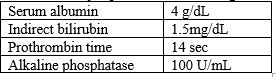
1) Coagulopathy
2) Biliary cirrhosis
3) Hypoalbuminemia
4) Gilbert's Disease
1) Coagulopathy
2) Biliary cirrhosis
3) Hypoalbuminemia
4) Gilbert's Disease
Question
Question
Question
Question
Question
Question
Question
Question
Question
Question
Question

Unlock Deck
Sign up to unlock the cards in this deck!
Unlock Deck
Unlock Deck
1/25

Play

Full screen (f)
Deck 31: Infection, Inflammation, and Cirrhosis of the Liver
1
Which condition is commonly seen in the case of protein loss in clients with liver cirrhosis?
1) Pruritus
2) Muscle wasting
3) Hypersplenism
4) Skin telangiectasias
1) Pruritus
2) Muscle wasting
3) Hypersplenism
4) Skin telangiectasias
3
2
What reason does the nurse suspect for the change of urine color in a client with liver disease?
1) Failure of bilirubin to reach intestine
2) Accumulation of bilirubin in the bloodstream
3) Accumulation of bile salts in the bloodstream
4) Infiltration of liver with fat
1) Failure of bilirubin to reach intestine
2) Accumulation of bilirubin in the bloodstream
3) Accumulation of bile salts in the bloodstream
4) Infiltration of liver with fat
2
3
While assessing a client who has liver dysfunction, the nurse finds that the client has shifting abdominal dullness. Which condition does the nurse suspect in the client?
1) Ascites
2) Splenomegaly
3) Spider angiomata
4) Esophageal varices
1) Ascites
2) Splenomegaly
3) Spider angiomata
4) Esophageal varices
1
4
After assessing a client with biliary cirrhosis, the nurse suspects xanthelasmas. Which laboratory test will support the nurse's conclusion?
1) Endoscopy
2) Lipid levels
3) Bilirubin levels
4) Prothrombin time
1) Endoscopy
2) Lipid levels
3) Bilirubin levels
4) Prothrombin time
Unlock Deck
Unlock for access to all 25 flashcards in this deck.
Unlock Deck
k this deck
5
The registered nurse is teaching a group of student nurses about the functions of the liver. Which response of the student nurse indicates the need for further teaching?
1) "The liver synthesizes glucagon."
2) "The liver synthesizes thrombopoietin."
3) "The liver synthesizes angiotensinogen."
4) "The liver synthesizes insulin-like growth factor 1."
1) "The liver synthesizes glucagon."
2) "The liver synthesizes thrombopoietin."
3) "The liver synthesizes angiotensinogen."
4) "The liver synthesizes insulin-like growth factor 1."
Unlock Deck
Unlock for access to all 25 flashcards in this deck.
Unlock Deck
k this deck
6
While reviewing the medical file of a client with cirrhosis, the nurse finds that the client has steatorrhea. What reason might the nurse suspect for this condition in the client?
1) Hyperbilirubinemia
2) Activation of stellate cells
3) Diminished synthesis of bile
4) Nitrogenous waste accumulation in the blood
1) Hyperbilirubinemia
2) Activation of stellate cells
3) Diminished synthesis of bile
4) Nitrogenous waste accumulation in the blood
Unlock Deck
Unlock for access to all 25 flashcards in this deck.
Unlock Deck
k this deck
7
What is the mode of transmission for the hepatitis D virus?
1) Blood transfusion
2) Oral-fecal route
3) Sexual contact
4) Both A and C
1) Blood transfusion
2) Oral-fecal route
3) Sexual contact
4) Both A and C
Unlock Deck
Unlock for access to all 25 flashcards in this deck.
Unlock Deck
k this deck
8
The client with alcoholic liver disease is experiencing bruising, nosebleed, and hematemesis. Which treatment option does the nurse suspect to be effective in this client?
1) Diuretics
2) Vitamin K
3) Band ligation
4) Phototherapy
1) Diuretics
2) Vitamin K
3) Band ligation
4) Phototherapy
Unlock Deck
Unlock for access to all 25 flashcards in this deck.
Unlock Deck
k this deck
9
What is the risk factor for nonalcoholic fatty liver disease (NAFLD)?
1) Hepatitis B
2) Exposure to isoniazid
3) Protein malnutrition
4) Cell mediated immunity
1) Hepatitis B
2) Exposure to isoniazid
3) Protein malnutrition
4) Cell mediated immunity
Unlock Deck
Unlock for access to all 25 flashcards in this deck.
Unlock Deck
k this deck
10
Which stage in the viral life cycle of hepatitis involves the production of antibodies?
1) Stage 1
2) Stage 2
3) Stage 3
4) Stage 4
1) Stage 1
2) Stage 2
3) Stage 3
4) Stage 4
Unlock Deck
Unlock for access to all 25 flashcards in this deck.
Unlock Deck
k this deck
11
Which virus helper function is needed for the replication of hepatitis D virus?
1) Hepatitis A virus (HAV)
2) Hepatitis B virus (HBV)
3) Hepatitis C virus (HCV)
4) Hepatitis E virus (HEV)
1) Hepatitis A virus (HAV)
2) Hepatitis B virus (HBV)
3) Hepatitis C virus (HCV)
4) Hepatitis E virus (HEV)
Unlock Deck
Unlock for access to all 25 flashcards in this deck.
Unlock Deck
k this deck
12
The primary health-care provider suggests the hepatitis C virus (HCV) genotyping test to a client with liver disease. What is the rationale for this?
1) To predict prognosis
2) To determine the severity of the disease
3) To predict the likelihood of response and the duration of treatment
4) To detect the presence of antibodies against two or more antigens
1) To predict prognosis
2) To determine the severity of the disease
3) To predict the likelihood of response and the duration of treatment
4) To detect the presence of antibodies against two or more antigens
Unlock Deck
Unlock for access to all 25 flashcards in this deck.
Unlock Deck
k this deck
13
The nurse suspects hepatic encephalopathy in a client with severe liver dysfunction. Which symptom may support the nurse's conclusion?
1) Stupor
2) Ascites
3) Hematemesis
4) Spider angiomata
1) Stupor
2) Ascites
3) Hematemesis
4) Spider angiomata
Unlock Deck
Unlock for access to all 25 flashcards in this deck.
Unlock Deck
k this deck
14
The laboratory report of a client is as given below. Which condition does the nurse suspect in the client?
1) Coagulopathy
2) Biliary cirrhosis
3) Hypoalbuminemia
4) Gilbert's Disease
1) Coagulopathy
2) Biliary cirrhosis
3) Hypoalbuminemia
4) Gilbert's Disease
Unlock Deck
Unlock for access to all 25 flashcards in this deck.
Unlock Deck
k this deck
15
Which type of hepatitis is caused by a deoxyribonucleic acid (DNA) virus?
1) Hepatitis A (HAV)
2) Hepatitis B (HBV)
3) Hepatitis C (HCV)
4) Hepatitis D (HDV)
1) Hepatitis A (HAV)
2) Hepatitis B (HBV)
3) Hepatitis C (HCV)
4) Hepatitis D (HDV)
Unlock Deck
Unlock for access to all 25 flashcards in this deck.
Unlock Deck
k this deck
16
The registered nurse is teaching about the pathophysiology of nonalcoholic fatty liver disease (NAFLD) to student nurses. Which statement made by the student nurse indicates effective learning?
1) "NAFLD is linked to metabolic syndrome."
2) "Exposure to vinyl chloride can cause NAFLD."
3) "Increased level of adiponectin is associated with NAFLD."
4) "NAFLD is caused by accumulation of fat in the adipose tissue."
1) "NAFLD is linked to metabolic syndrome."
2) "Exposure to vinyl chloride can cause NAFLD."
3) "Increased level of adiponectin is associated with NAFLD."
4) "NAFLD is caused by accumulation of fat in the adipose tissue."
Unlock Deck
Unlock for access to all 25 flashcards in this deck.
Unlock Deck
k this deck
17
While assessing a client with liver cirrhosis, the nurse observes that the client has asterixis. What is the reason for this condition of the client?
1) Osteoporosis
2) Iron overload
3) Coagulopathy
4) Encephalopathy
1) Osteoporosis
2) Iron overload
3) Coagulopathy
4) Encephalopathy
Unlock Deck
Unlock for access to all 25 flashcards in this deck.
Unlock Deck
k this deck
18
A client complains of fatigue and arthralgia to the nurse. On physical assessment, the nurse finds that the client has hyperpigmentation of the skin. Which lab test should the nurse suggest for safe and effective care of the client?
1) Bilirubin levels
2) Serum ferritin levels
3) Ceruloplasmin levels
4) Immunoglobulins level
1) Bilirubin levels
2) Serum ferritin levels
3) Ceruloplasmin levels
4) Immunoglobulins level
Unlock Deck
Unlock for access to all 25 flashcards in this deck.
Unlock Deck
k this deck
19
The registered nurse is teaching about portal hypertension to a group of student nurses. Which statement by the student nurse indicates the need for further teaching?
1) "Caput medusa is a sign of portal hypertension."
2) "Portal hypertension can cause hematemesis."
3) "Ascites is associated with portal hypertension."
4) "Portal hypertension causes coagulation abnormalities."
1) "Caput medusa is a sign of portal hypertension."
2) "Portal hypertension can cause hematemesis."
3) "Ascites is associated with portal hypertension."
4) "Portal hypertension causes coagulation abnormalities."
Unlock Deck
Unlock for access to all 25 flashcards in this deck.
Unlock Deck
k this deck
20
The nurse finds ursodiol in a client's prescription. Which condition does the nurse suspect in the client?
1) Gilbert's syndrome
2) Alcoholic liver disease
3) Crigler-Najjar syndrome
4) Primary biliary cirrhosis
1) Gilbert's syndrome
2) Alcoholic liver disease
3) Crigler-Najjar syndrome
4) Primary biliary cirrhosis
Unlock Deck
Unlock for access to all 25 flashcards in this deck.
Unlock Deck
k this deck
21
The laboratory reports of a client with alcoholic liver disease reveal low hemoglobin levels. What reasons might the nurse suspect for this condition?
1) Hypersplenism
2) Hemochromatosis
3) Hypoalbuminemia
4) Folic acid deficiency
5) Decreased levels of thrombopoietin
1) Hypersplenism
2) Hemochromatosis
3) Hypoalbuminemia
4) Folic acid deficiency
5) Decreased levels of thrombopoietin
Unlock Deck
Unlock for access to all 25 flashcards in this deck.
Unlock Deck
k this deck
22
Arrange the processes occurring in four developmental stages of primary biliary cirrhosis in their correct order (1-4).(Enter the number of each step in the proper sequence; do not use commas or spaces.)
A. Destruction of the liver cells, fibrotic tissue taking over hepatic cells, and loss of intralobular bile ducts
B. Progression of inflammation
C. Development of micronodular or macronodular cirrhosis
D. Inflammation of the portal triads and destruction of small and medium bile ducts
A. Destruction of the liver cells, fibrotic tissue taking over hepatic cells, and loss of intralobular bile ducts
B. Progression of inflammation
C. Development of micronodular or macronodular cirrhosis
D. Inflammation of the portal triads and destruction of small and medium bile ducts
Unlock Deck
Unlock for access to all 25 flashcards in this deck.
Unlock Deck
k this deck
23
The laboratory reports of an alcoholic client show hepatic encephalopathy and portal hypertension. Which nursing interventions will be beneficial for the client?
1) Provide a low-sodium diet.
2) Provide a low-calorie diet.
3) Provide a high-protein diet.
4) Administer calcium compounds.
5) Encourage the use of thiamine supplements.
1) Provide a low-sodium diet.
2) Provide a low-calorie diet.
3) Provide a high-protein diet.
4) Administer calcium compounds.
5) Encourage the use of thiamine supplements.
Unlock Deck
Unlock for access to all 25 flashcards in this deck.
Unlock Deck
k this deck
24
Which findings can the nurse observe in the laboratory reports of a client after 4 weeks of hepatitis A infection?
1) A rise in liver enzymes
2) Appearance of IgM antibodies
3) Appearance of IgG antibodies
4) Appearance of hepatitis A virus (HAV) in the stool
5) Presence of antimitochondrial antibodies (AMAs)
Other
1) A rise in liver enzymes
2) Appearance of IgM antibodies
3) Appearance of IgG antibodies
4) Appearance of hepatitis A virus (HAV) in the stool
5) Presence of antimitochondrial antibodies (AMAs)
Other
Unlock Deck
Unlock for access to all 25 flashcards in this deck.
Unlock Deck
k this deck
25
The nurse is caring for a client with glucuronyl transferase enzyme deficiency. The laboratory reports show elevated serum bilirubin levels. Which treatment does the nurse suspect to be effective in the client?
1) Phenobarbital
2) Phototherapy
3) Paracentesis
4) Desferoxamine
5) Penicillamine
1) Phenobarbital
2) Phototherapy
3) Paracentesis
4) Desferoxamine
5) Penicillamine
Unlock Deck
Unlock for access to all 25 flashcards in this deck.
Unlock Deck
k this deck
Unlock Deck
Unlock for access to all 25 flashcards in this deck.






