







 Chat with AI

Deck 4: Nursing Care of Patients Having Surgery
Full screen (f)

Question

Question
Question
Question
Question
Question
Question
Question
Question
Question
Question
Question
Question
Question
Question
Question
Question
Question
Question
Question
Question
Question
Question
Question
Question
Question
Question
Question
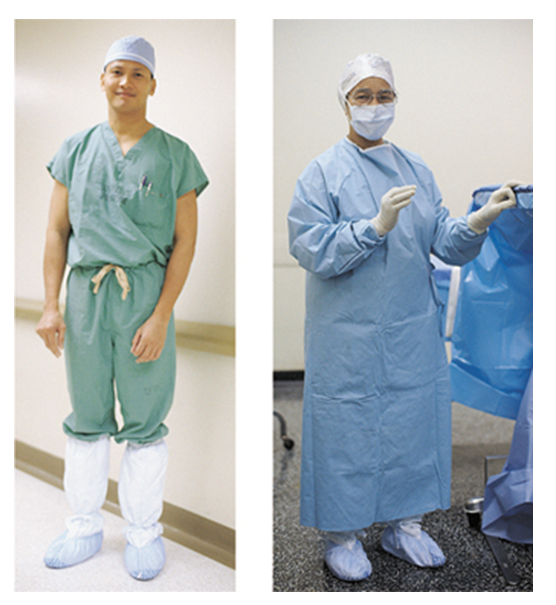
The nurse is assigned as the surgical scrub nurse for today's outpatient cases. Place on "X" on the picture that depicts how the nurse will dress today.
Question
Question
Question
Question
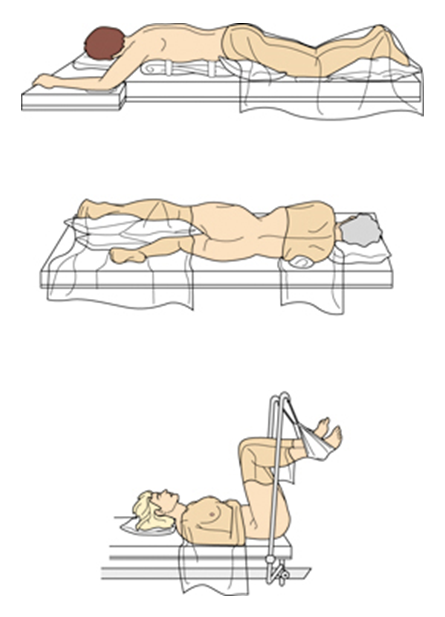
The patient is scheduled for a perineal surgery. Place on "X" on the position in which the nurse would place this patient for surgery.
Question
Question
Question
Question
Question
Question
Question
Question
Question
Question
Question
Question
The nurse is changing the surgical dressing on an elderly patient's abdomen and sees the item pictured in the above diagram. How should the nurse care for this device?  Select all that apply.
A)Plan to replace the precut gauze as part of the dressing change.
B)Cleanse around the tube with the cleanser ordered or according to protocol.
C)Use the safety pin to secure the outermost bandage to the dressing.
D)Remove the tube, culture the wound, and cleanse it with saline gauze
E)Remove the safety pin
Select all that apply.A)Plan to replace the precut gauze as part of the dressing change.
B)Cleanse around the tube with the cleanser ordered or according to protocol.
C)Use the safety pin to secure the outermost bandage to the dressing.
D)Remove the tube, culture the wound, and cleanse it with saline gauze
E)Remove the safety pin
Question
The nurse is changing the abdominal surgical dressing of an elderly patient who has developed pneumonia and a cough. Upon removing the dressing, the nurse notes the situation pictured above. What should be the nurse's intervention? 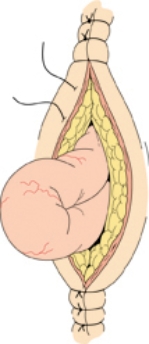 Select all that apply.
A)Place saline moistened sterile dressing over the incision.
B)Notify the patient's surgeon of the occurrence.
C)Don sterile gloves and insert the loop of bowel back into the abdomen.
D)Document the presence of a dehiscence in the medical record.
E)Replace the dressing and ask the oncoming shift to advise the physician about the situation when rounds are made.
Select all that apply.A)Place saline moistened sterile dressing over the incision.
B)Notify the patient's surgeon of the occurrence.
C)Don sterile gloves and insert the loop of bowel back into the abdomen.
D)Document the presence of a dehiscence in the medical record.
E)Replace the dressing and ask the oncoming shift to advise the physician about the situation when rounds are made.
Question
Question
Question
Question
Question

Unlock Deck
Sign up to unlock the cards in this deck!
Unlock Deck
Unlock Deck
1/50

Play

Full screen (f)
Deck 4: Nursing Care of Patients Having Surgery
1
After providing a patient with a preoperative sedative, the nurse notes that the surgical consent form has not been signed by the patient. Which of the following should the nurse do?
A)Contact the surgeon.
B)Ask the patient to sign the consent form.
C)Send the patient for surgery with an unsigned consent form.
D)Phone the operating room suite to notify the nurse that the patient has not signed the consent form.
A)Contact the surgeon.
B)Ask the patient to sign the consent form.
C)Send the patient for surgery with an unsigned consent form.
D)Phone the operating room suite to notify the nurse that the patient has not signed the consent form.
Contact the surgeon.
2
When caring for an elderly patient having surgery, the nurse avoids shaving the patient. This intervention would be appropriate to support which of the following body systems?
A)integument
B)sensory-perceptual
C)respiratory
D)cardiovascular
A)integument
B)sensory-perceptual
C)respiratory
D)cardiovascular
integument
3
A patient received Ativan as preoperative medication. Which of the following should the nurse assess when caring for this patient?
A)respiratory depression
B)nausea and vomiting
C)confusion
D)rash
A)respiratory depression
B)nausea and vomiting
C)confusion
D)rash
respiratory depression
4
The nurse is providing care to a patient during the preoperative phase of surgery. Which of the following interventions would be appropriate for the nurse to provide during this time?
A)assist with bathing
B)patient safety
C)assess level of consciousness
D)monitor intake and output
A)assist with bathing
B)patient safety
C)assess level of consciousness
D)monitor intake and output
Unlock Deck
Unlock for access to all 50 flashcards in this deck.
Unlock Deck
k this deck
5
The nurse is assessing a patient who has returned to the care area after surgery. Which of the following should the nurse do to ensure the patient receives appropriate care?
A)Check the physician's orders to see if all preoperative orders have been rewritten.
B)Schedule the patient for vital signs assessments every four hours.
C)Orient the patient to person, place, and time.
D)Assess the patient's mental status.
A)Check the physician's orders to see if all preoperative orders have been rewritten.
B)Schedule the patient for vital signs assessments every four hours.
C)Orient the patient to person, place, and time.
D)Assess the patient's mental status.
Unlock Deck
Unlock for access to all 50 flashcards in this deck.
Unlock Deck
k this deck
6
A patient being prepared for surgery has been diagnosed with dehydration. Which of the following laboratory values would indicate this diagnosis for the patient?
A)hemoglobin and hematocrit
B)glucose
C)white blood cell count
D)platelet count
A)hemoglobin and hematocrit
B)glucose
C)white blood cell count
D)platelet count
Unlock Deck
Unlock for access to all 50 flashcards in this deck.
Unlock Deck
k this deck
7
A patient, scheduled for outpatient surgery, asks the nurse why he will not be admitted to the hospital for the surgery. Which of the following can the nurse explain as an advantage of having outpatient surgery?
A)reduced risk of hospital-acquired infections
B)ability to use home care for post-operative care in the home
C)reduced use of postoperative medications
D)inadequate staffing on the surgical care areas
A)reduced risk of hospital-acquired infections
B)ability to use home care for post-operative care in the home
C)reduced use of postoperative medications
D)inadequate staffing on the surgical care areas
Unlock Deck
Unlock for access to all 50 flashcards in this deck.
Unlock Deck
k this deck
8
A patient, diagnosed with emphysema, is being prepared for surgery. Which of the following laboratory values would provide information about the patient's respiratory status?
A)carbon dioxide
B)white blood cell count
C)serum creatinine
D)blood urea nitrogen
A)carbon dioxide
B)white blood cell count
C)serum creatinine
D)blood urea nitrogen
Unlock Deck
Unlock for access to all 50 flashcards in this deck.
Unlock Deck
k this deck
9
A patient tells the nurse that he is having minor surgery since it will be done as an outpatient. With which of the following should the nurse respond to this patient?
A)"Every surgical procedure is serious and I will make sure you have information to have a successful recovery."
B)"You are right."
C)"If it were more serious, you would be admitted to the hospital."
D)"Your insurance plan does not cover inpatient surgical procedures.That's why your surgery is being done as an outpatient."
A)"Every surgical procedure is serious and I will make sure you have information to have a successful recovery."
B)"You are right."
C)"If it were more serious, you would be admitted to the hospital."
D)"Your insurance plan does not cover inpatient surgical procedures.That's why your surgery is being done as an outpatient."
Unlock Deck
Unlock for access to all 50 flashcards in this deck.
Unlock Deck
k this deck
10
A patient is scheduled for total hip replacement surgery. Which of the following medications should the nurse provide to the patient prior to the surgical procedure?
A)antibiotic
B)antacid
C)antiemetic
D)anticholinergic
A)antibiotic
B)antacid
C)antiemetic
D)anticholinergic
Unlock Deck
Unlock for access to all 50 flashcards in this deck.
Unlock Deck
k this deck
11
The nurse is caring for a patient recovering from surgery conducted in the previous 24 hours. Which of the following should the nurse do to assist this patient with pain control?
A)Administer prescribed analgesics around the clock.
B)Administer prescribed analgesics when the patient requests something for pain.
C)Assist the patient to a more comfortable position to reduce the amount of pain.
D)Offer the patient a back rub to reduce the amount of pain.
A)Administer prescribed analgesics around the clock.
B)Administer prescribed analgesics when the patient requests something for pain.
C)Assist the patient to a more comfortable position to reduce the amount of pain.
D)Offer the patient a back rub to reduce the amount of pain.
Unlock Deck
Unlock for access to all 50 flashcards in this deck.
Unlock Deck
k this deck
12
An elderly patient is recovering from a surgical procedure. Which of the following can the nurse do to ensure the patient is comfortable?
A)Provide warm blankets.
B)Limit movement to once every eight hours.
C)Explain all activities using a loud voice.
D)Limit fluids.
A)Provide warm blankets.
B)Limit movement to once every eight hours.
C)Explain all activities using a loud voice.
D)Limit fluids.
Unlock Deck
Unlock for access to all 50 flashcards in this deck.
Unlock Deck
k this deck
13
A patient being prepared for surgery is scheduled for an electrocardiogram. The nurse realizes this diagnostic test is being done because it is
A)routine for all patients having general anesthesia.
B)used to diagnose preexisting cardiac disease.
C)one way to validate laboratory values
D)a predictor of surgical procedure success.
A)routine for all patients having general anesthesia.
B)used to diagnose preexisting cardiac disease.
C)one way to validate laboratory values
D)a predictor of surgical procedure success.
Unlock Deck
Unlock for access to all 50 flashcards in this deck.
Unlock Deck
k this deck
14
An elderly patient, being prepared for surgery, has a low glomerular filtration rate. The nurse realizes that this finding will impact which of the following?
A)medication dosages
B)postoperative activity level
C)intraoperative bleeding
D)oxygenation status
A)medication dosages
B)postoperative activity level
C)intraoperative bleeding
D)oxygenation status
Unlock Deck
Unlock for access to all 50 flashcards in this deck.
Unlock Deck
k this deck
15
The nurse is preparing to discharge a patient after having outpatient surgery. Which of the following criteria would make a patient eligible for discharge after outpatient surgery? Select all that apply.
A)stable vital signs
B)no nausea or dizziness
C)pain controlled
D)adequate urine output
E)patient states he is ready to go home
A)stable vital signs
B)no nausea or dizziness
C)pain controlled
D)adequate urine output
E)patient states he is ready to go home
Unlock Deck
Unlock for access to all 50 flashcards in this deck.
Unlock Deck
k this deck
16
An elderly patient, recovering from surgery, is prescribed a soft diet. The nurse realizes that this diet supports which of the following age-related changes?
A)decline in gastric motility
B)reduced intestinal absorption
C)lactose intolerance
D)gall bladder insufficiency
A)decline in gastric motility
B)reduced intestinal absorption
C)lactose intolerance
D)gall bladder insufficiency
Unlock Deck
Unlock for access to all 50 flashcards in this deck.
Unlock Deck
k this deck
17
The nurse is planning care to support the cognitive-psychosocial status for an elderly patient having surgery. Which of the following interventions would be appropriate for this patient?
A)Support the patient's need for independence.
B)Set limits with the patient.
C)Tell the patient that his physician will make all care decisions.
D)Remind the patient that the call bell is for emergencies only.
A)Support the patient's need for independence.
B)Set limits with the patient.
C)Tell the patient that his physician will make all care decisions.
D)Remind the patient that the call bell is for emergencies only.
Unlock Deck
Unlock for access to all 50 flashcards in this deck.
Unlock Deck
k this deck
18
A patient with a history of sleep apnea is experiencing difficulty maintaining an airway during conscious sedation. Which of the following should the nurse do to assist this patient?
A)Prepare to administer a reversal agent.
B)Begin artificial ventilations.
C)Measure oxygen saturation.
D)Apply prescribed oxygen via face mask.
A)Prepare to administer a reversal agent.
B)Begin artificial ventilations.
C)Measure oxygen saturation.
D)Apply prescribed oxygen via face mask.
Unlock Deck
Unlock for access to all 50 flashcards in this deck.
Unlock Deck
k this deck
19
Prior to surgery, the nurse instructed the patient on exercises that should be done prior to and after surgery. The patient is currently recovering from surgery and is experiencing a deep vein thrombosis. Which of the following preoperative exercises were not adequate for this patient?
A)leg exercises
B)deep breathing and coughing
C)use of incentive spirometry
D)splinting when coughing
A)leg exercises
B)deep breathing and coughing
C)use of incentive spirometry
D)splinting when coughing
Unlock Deck
Unlock for access to all 50 flashcards in this deck.
Unlock Deck
k this deck
20
The nurse in the same day surgical care area is preparing a patient for surgery. Which of the following will the nurse need to do ensure this patient has a successful recovery from the surgery?
A)Provide teaching and additional resources to help the patient when at home.
B)Measure intake and output.
C)Assess vital signs.
D)Limit pain control measures since the patient will need to ambulate when leaving after the surgery.
A)Provide teaching and additional resources to help the patient when at home.
B)Measure intake and output.
C)Assess vital signs.
D)Limit pain control measures since the patient will need to ambulate when leaving after the surgery.
Unlock Deck
Unlock for access to all 50 flashcards in this deck.
Unlock Deck
k this deck
21
An elderly postoperative patient is given an antiemetic for nausea. Which of the following signs would indicate this patient is experiencing a possible reaction to the medication?
A)involuntary muscle movements
B)confusion
C)dry mouth
D)breakthrough vomiting
A)involuntary muscle movements
B)confusion
C)dry mouth
D)breakthrough vomiting
Unlock Deck
Unlock for access to all 50 flashcards in this deck.
Unlock Deck
k this deck
22
An elderly patient is receiving an NSAID for postoperative pain. Which of the following should the nurse assess in this patient?
A)urine output
B)blood pressure
C)respiratory rate
D)heart rate
A)urine output
B)blood pressure
C)respiratory rate
D)heart rate
Unlock Deck
Unlock for access to all 50 flashcards in this deck.
Unlock Deck
k this deck
23
During the assessment of a postoperative patient's bowel sounds, the nurse auscultates high-pitched sounds over all four abdominal quadrants. The nurse realizes this finding could indicate which of the following?
A)paralytic ileus
B)normal bowel function
C)the onset of flatus
D)the onset of stool
A)paralytic ileus
B)normal bowel function
C)the onset of flatus
D)the onset of stool
Unlock Deck
Unlock for access to all 50 flashcards in this deck.
Unlock Deck
k this deck
24
A patient is complaining of discomfort after a surgical procedure. The patient voices fear of addiction with taking analgesics as prescribed. What information should be provided to the patient regarding these concerns? Select all that apply.
A)"Addiction to opioid analgesics is rare when used for short-term postoperative pain management."
B)"Psychological tolerance is not commonly experienced by patients who take narcotic analgesics during the postoperative experience."
C)"Pain tolerance and the need for opioid analgesics are individualized."
D)"Patients should be screened for addiction potential prior to being given narcotics."
A)"Addiction to opioid analgesics is rare when used for short-term postoperative pain management."
B)"Psychological tolerance is not commonly experienced by patients who take narcotic analgesics during the postoperative experience."
C)"Pain tolerance and the need for opioid analgesics are individualized."
D)"Patients should be screened for addiction potential prior to being given narcotics."
Unlock Deck
Unlock for access to all 50 flashcards in this deck.
Unlock Deck
k this deck
25
The patient who is preparing for surgery asks the nurse to keep his glasses and hearing aid in place until he is under anesthesia. Which of the following statements by the nurse demonstrates accurate, therapeutic communication?
A)"I will contact the surgery department to discuss your requests."
B)"You cannot keep those in."
C)"The policies in the surgery unit will not allow it."
D)"Certainly, you can keep them for that time."
A)"I will contact the surgery department to discuss your requests."
B)"You cannot keep those in."
C)"The policies in the surgery unit will not allow it."
D)"Certainly, you can keep them for that time."
Unlock Deck
Unlock for access to all 50 flashcards in this deck.
Unlock Deck
k this deck
26
A patient who is recovering from abdominal surgery has a Penrose drain. Which of the following should the nurse include in the care of this patient?
A)Make sure there is a safety pin on the end of the drain.
B)Empty the drain every 30 minutes.
C)Clean the wound with normal saline every two hours.
D)Remove the drain four hours postoperatively.
A)Make sure there is a safety pin on the end of the drain.
B)Empty the drain every 30 minutes.
C)Clean the wound with normal saline every two hours.
D)Remove the drain four hours postoperatively.
Unlock Deck
Unlock for access to all 50 flashcards in this deck.
Unlock Deck
k this deck
27
The nurse takes the form pictured above to the patient's room in preparation for an emergency surgical procedure. The patient states, "Doc said he would tell me all about the surgery when he gets here. Do you know what they are going to do?" What is the nurse's best response? 11ea992e_0a96_033d_9f38_7d1ce9d8b95e
A)"Let's wait on signing this until your physician has talked to you."
B)"Let me go get a medical surgical textbook so I can use the pictures to explain the procedure."
C)"I am not certain; let me call the nursing supervisor to explain it to you."
D)"Go ahead and sign this so we will have that part done when the physician gets here."
A)"Let's wait on signing this until your physician has talked to you."
B)"Let me go get a medical surgical textbook so I can use the pictures to explain the procedure."
C)"I am not certain; let me call the nursing supervisor to explain it to you."
D)"Go ahead and sign this so we will have that part done when the physician gets here."
Unlock Deck
Unlock for access to all 50 flashcards in this deck.
Unlock Deck
k this deck
28
The nurse is assigned as the surgical scrub nurse for today's outpatient cases. Place on "X" on the picture that depicts how the nurse will dress today.
Unlock Deck
Unlock for access to all 50 flashcards in this deck.
Unlock Deck
k this deck
29
A patient recovering from surgery reports a pain level of 6 on a 0-10 pain scale but refuses additional pain medication since he does not want to "become addicted." The nurse's response should focus on which concept?
A)Physical dependence on pain medication is uncommon during the short-term postoperative use.
B)This patient already might have an addiction problem.
C)This patient might benefit from a placebo dose.
D)The physician should be notified to discuss pain management.
A)Physical dependence on pain medication is uncommon during the short-term postoperative use.
B)This patient already might have an addiction problem.
C)This patient might benefit from a placebo dose.
D)The physician should be notified to discuss pain management.
Unlock Deck
Unlock for access to all 50 flashcards in this deck.
Unlock Deck
k this deck
30
A patient is in his fifth postoperative day and has sanguineous drainage with a thick, reddish appearance. The nurse realizes this patient's wound is in which stage of healing?
A)Stage II
B)Stage I
C)Stage III
D)Stage IV
A)Stage II
B)Stage I
C)Stage III
D)Stage IV
Unlock Deck
Unlock for access to all 50 flashcards in this deck.
Unlock Deck
k this deck
31
The nurse is assisting a postoperative patient in using an incentive spirometer. Which of the following postoperative complications is this nurse attempting to avoid with this patient?
A)atelectasis
B)deep vein thrombosis
C)hemorrhage
D)pulmonary embolism
A)atelectasis
B)deep vein thrombosis
C)hemorrhage
D)pulmonary embolism
Unlock Deck
Unlock for access to all 50 flashcards in this deck.
Unlock Deck
k this deck
32
The patient is scheduled for a perineal surgery. Place on "X" on the position in which the nurse would place this patient for surgery.
Unlock Deck
Unlock for access to all 50 flashcards in this deck.
Unlock Deck
k this deck
33
A patient says that his condition must be getting worse since he was receiving 10 mg morphine sulfate through the IV for pain but now is prescribed Demerol 50 mg by mouth at home. Which of the following should the nurse respond to this patient?
A)"Oral doses need to be higher than those given through an IV.It does not mean your condition is worse."
B)"The doctor is making sure that you do not have any pain once you go home."
C)"I will get the doctor so he can explain what is going on with your condition."
D)"All patients have more pain when they go home so the doctor is making sure you have enough medication."
A)"Oral doses need to be higher than those given through an IV.It does not mean your condition is worse."
B)"The doctor is making sure that you do not have any pain once you go home."
C)"I will get the doctor so he can explain what is going on with your condition."
D)"All patients have more pain when they go home so the doctor is making sure you have enough medication."
Unlock Deck
Unlock for access to all 50 flashcards in this deck.
Unlock Deck
k this deck
34
An elderly patient is completing preoperative diagnostic testing. The nurse notes that the patient's carbon dioxide level is elevated. Which of the following nursing interventions would be indicated for this patient?
A)Monitor respiratory status and arterial blood gases.
B)Monitor serum potassium level.
C)Monitor serum sodium level.
D)Monitor intake and output.
A)Monitor respiratory status and arterial blood gases.
B)Monitor serum potassium level.
C)Monitor serum sodium level.
D)Monitor intake and output.
Unlock Deck
Unlock for access to all 50 flashcards in this deck.
Unlock Deck
k this deck
35
An elderly surgical patient is having an epidural catheter inserted for pain control. The nurse realizes that the advantages of this method of pain medication for the patient include which of the following?
A)improved bowel activity
B)faster wound healing
C)earlier ambulation
D)improved appetite
A)improved bowel activity
B)faster wound healing
C)earlier ambulation
D)improved appetite
Unlock Deck
Unlock for access to all 50 flashcards in this deck.
Unlock Deck
k this deck
36
A patient who is being admitted for surgery asks the nurse why information is being collected about the patient's use of herbal and natural supplements. Which of the following statements is an appropriate nursing response?
A)"Herbal supplements may interact with anesthetic agents."
B)"Herbal remedies may cause pain relievers to be ineffective."
C)"The physician is in charge of medications."
D)"There is no need to take these preparations."
A)"Herbal supplements may interact with anesthetic agents."
B)"Herbal remedies may cause pain relievers to be ineffective."
C)"The physician is in charge of medications."
D)"There is no need to take these preparations."
Unlock Deck
Unlock for access to all 50 flashcards in this deck.
Unlock Deck
k this deck
37
A patient is scheduled for removal of a cataract. The nurse realizes this patient's procedure is classified as being which of the following?
A)minor elective
B)minor diagnostic
C)major constructive
D)major elective
A)minor elective
B)minor diagnostic
C)major constructive
D)major elective
Unlock Deck
Unlock for access to all 50 flashcards in this deck.
Unlock Deck
k this deck
38
A patient is signing a surgical consent. Afterwards, the nurse also signs the form. What is the meaning of the nursing signature?
A)It means the patient was alert and aware of what was being signed.
B)It means the patient understood the procedure as described by the nurse.
C)It means the surgeon was too busy to wait for the patient to sign the form.
D)It means there is a likelihood of a successful outcome.
A)It means the patient was alert and aware of what was being signed.
B)It means the patient understood the procedure as described by the nurse.
C)It means the surgeon was too busy to wait for the patient to sign the form.
D)It means there is a likelihood of a successful outcome.
Unlock Deck
Unlock for access to all 50 flashcards in this deck.
Unlock Deck
k this deck
39
An elderly patient is being prepared for orthopedic surgery. The nurse realizes this patient is at risk for which of the following?
A)decreased tolerance of general anesthesia
B)prolonged effects of anesthesia because of herbal supplements
C)wound dehiscence
D)increased hypotensive effects of anesthesia
A)decreased tolerance of general anesthesia
B)prolonged effects of anesthesia because of herbal supplements
C)wound dehiscence
D)increased hypotensive effects of anesthesia
Unlock Deck
Unlock for access to all 50 flashcards in this deck.
Unlock Deck
k this deck
40
A patient is being transferred from the operating room to the recovery room. The nurse in the recovery room will be providing which phase of nursing care?
A)postoperative
B)preoperative
C)intraoperative
D)restorative
A)postoperative
B)preoperative
C)intraoperative
D)restorative
Unlock Deck
Unlock for access to all 50 flashcards in this deck.
Unlock Deck
k this deck
41
A patient is scheduled to have a hernia repair done today on an outpatient basis. The patient's sibling angrily says, "When I had this done 20 years ago, they kept me in the hospital nearly a week. Why can't my brother stay here where someone can take care of him?" What are appropriate responses by the nurse? Select all that apply.
A)"He will be at less risk of getting an infection at home."
B)"He will probably be more comfortable in his own bed at home."
C)"It is cheaper for the insurance company if he goes home today."
D)"The government won't let him stay."
E)"If you ask the physician, the hospital will probably let him stay."
A)"He will be at less risk of getting an infection at home."
B)"He will probably be more comfortable in his own bed at home."
C)"It is cheaper for the insurance company if he goes home today."
D)"The government won't let him stay."
E)"If you ask the physician, the hospital will probably let him stay."
Unlock Deck
Unlock for access to all 50 flashcards in this deck.
Unlock Deck
k this deck
42
Place these steps of diaphragmatic breathing in the order the nurse should teach the elderly preoperative patient. Click and drag the options below to move them up or down.
A)Sit up straight in bed.
B)Place your hands lightly on your abdomen.
C)Breathe in deeply through your nose.
D)Hold your breath for five seconds.
E)Completely exhale through pursed lips.
A)Sit up straight in bed.
B)Place your hands lightly on your abdomen.
C)Breathe in deeply through your nose.
D)Hold your breath for five seconds.
E)Completely exhale through pursed lips.
Unlock Deck
Unlock for access to all 50 flashcards in this deck.
Unlock Deck
k this deck
43
The nurse working in the postanesthesia recovery unit (PACU) suspects that a patient is developing malignant hyperthermia. Place these interventions in order they should be performed. Click and drag the options below to move them up or down.
A)Administer oxygen with a nonrebreather mask.
B)Check IV access.
C)Notify the anesthesia provider.
D)Administer Dantrolene.
A)Administer oxygen with a nonrebreather mask.
B)Check IV access.
C)Notify the anesthesia provider.
D)Administer Dantrolene.
Unlock Deck
Unlock for access to all 50 flashcards in this deck.
Unlock Deck
k this deck
44
The nurse is changing the surgical dressing on an elderly patient's abdomen and sees the item pictured in the above diagram. How should the nurse care for this device? Select all that apply.
A)Plan to replace the precut gauze as part of the dressing change.
B)Cleanse around the tube with the cleanser ordered or according to protocol.
C)Use the safety pin to secure the outermost bandage to the dressing.
D)Remove the tube, culture the wound, and cleanse it with saline gauze
E)Remove the safety pin
Select all that apply.A)Plan to replace the precut gauze as part of the dressing change.
B)Cleanse around the tube with the cleanser ordered or according to protocol.
C)Use the safety pin to secure the outermost bandage to the dressing.
D)Remove the tube, culture the wound, and cleanse it with saline gauze
E)Remove the safety pin
Unlock Deck
Unlock for access to all 50 flashcards in this deck.
Unlock Deck
k this deck
45
The nurse is changing the abdominal surgical dressing of an elderly patient who has developed pneumonia and a cough. Upon removing the dressing, the nurse notes the situation pictured above. What should be the nurse's intervention? Select all that apply.
A)Place saline moistened sterile dressing over the incision.
B)Notify the patient's surgeon of the occurrence.
C)Don sterile gloves and insert the loop of bowel back into the abdomen.
D)Document the presence of a dehiscence in the medical record.
E)Replace the dressing and ask the oncoming shift to advise the physician about the situation when rounds are made.
Select all that apply.A)Place saline moistened sterile dressing over the incision.
B)Notify the patient's surgeon of the occurrence.
C)Don sterile gloves and insert the loop of bowel back into the abdomen.
D)Document the presence of a dehiscence in the medical record.
E)Replace the dressing and ask the oncoming shift to advise the physician about the situation when rounds are made.
Unlock Deck
Unlock for access to all 50 flashcards in this deck.
Unlock Deck
k this deck
46
The patient who had an emergency abdominal surgery looks at his incision on the first postoperative day and says, "I sure hope this doesn't leave much of a scar. Is there some type of medicine or ointment I can put on it?" What should the nurse consider prior to responding to that comment? 11ea992e_0a96_7870_9f38_5dd8e577b161
A)This incision will heal by first intention and will probable leave a hairline scar even without additional ointment.
B)This incision will fill in with granulation tissue and leave a moderately big scar despite any medication applied.
C)This incision was done in an emergent fashion but continuous application of steroid creams will prevent scarring.
D)This incision will have to be reclosed later and will leave a large scar unless a topical antibiotic is used continuously.
E)This type of incision is prone to infection which will leave a larger scar, so antibiotic ointment should be applied twice daily.
A)This incision will heal by first intention and will probable leave a hairline scar even without additional ointment.
B)This incision will fill in with granulation tissue and leave a moderately big scar despite any medication applied.
C)This incision was done in an emergent fashion but continuous application of steroid creams will prevent scarring.
D)This incision will have to be reclosed later and will leave a large scar unless a topical antibiotic is used continuously.
E)This type of incision is prone to infection which will leave a larger scar, so antibiotic ointment should be applied twice daily.
Unlock Deck
Unlock for access to all 50 flashcards in this deck.
Unlock Deck
k this deck
47
While completing item number 4 in the preoperative preparation section of the form pictured above, the nurse notes that the patient depends on a hearing aid. What action should be taken by the nurse? 11ea992e_0a96_2a4e_9f38_fd03b5120803
A)Leave the device in the patient's ear and notify the OR nurse of its presence.
B)Remove the device and place it in a denture cup in the patient's room.
C)Remove the device and give it to the patient's family member.
D)Place a piece of tape across the patient's ear and the device.
A)Leave the device in the patient's ear and notify the OR nurse of its presence.
B)Remove the device and place it in a denture cup in the patient's room.
C)Remove the device and give it to the patient's family member.
D)Place a piece of tape across the patient's ear and the device.
Unlock Deck
Unlock for access to all 50 flashcards in this deck.
Unlock Deck
k this deck
48
The nursing student is assigned to accompany a patient to a diagnostic exam that will be done under fluoroscopy. What protective equipment is necessary for this student?
A)thyroid shield
B)sterile gloves
C)shoe covers
D)surgical gown
E)sterile scrub suit
A)thyroid shield
B)sterile gloves
C)shoe covers
D)surgical gown
E)sterile scrub suit
Unlock Deck
Unlock for access to all 50 flashcards in this deck.
Unlock Deck
k this deck
49
Which patient information is essential for the nurse to provide the physician who is preparing to administer conscious sedation to a patient? Select all that apply.
A)The patient has a history of snoring.
B)The patient drank a cup of coffee two hours ago.
C)The patient wants to be asleep for the procedure.
D)The patient's father was hypertensive.
E)The patient has a history of gout.
A)The patient has a history of snoring.
B)The patient drank a cup of coffee two hours ago.
C)The patient wants to be asleep for the procedure.
D)The patient's father was hypertensive.
E)The patient has a history of gout.
Unlock Deck
Unlock for access to all 50 flashcards in this deck.
Unlock Deck
k this deck
50
The nurse is reviewing the patient's current medications as a part of preparation for an elective surgery. Which instruction(s) to the patient are correct?
A)Continue to take your regular steroid medication up to the night before your surgery.
B)You may take your regular herbal supplements up until the day before surgery.
C)Discontinue your antihypertensive medications two days prior to surgery.
D)Stop taking your daily aspirin at least three days prior to surgery.
E)Be certain to continue your regular NSAIDs for your arthritis until the day of surgery.
A)Continue to take your regular steroid medication up to the night before your surgery.
B)You may take your regular herbal supplements up until the day before surgery.
C)Discontinue your antihypertensive medications two days prior to surgery.
D)Stop taking your daily aspirin at least three days prior to surgery.
E)Be certain to continue your regular NSAIDs for your arthritis until the day of surgery.
Unlock Deck
Unlock for access to all 50 flashcards in this deck.
Unlock Deck
k this deck
Unlock Deck
Unlock for access to all 50 flashcards in this deck.






