







 Chat with AI

Deck 18: Assessing the Endcrine System
Full screen (f)

Question

Question
Question
Question
Question
Question
Question
Question
Question
Question
Question
Question
Question
Question
Question
Question
Question
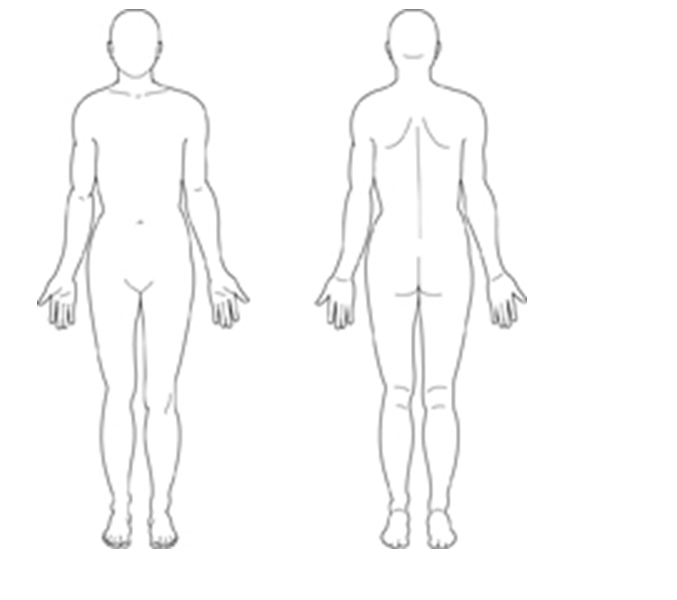
Using the diagram (see below), place an "X" over the site on the body location where the nurse would assess for Chvostek's sign.
Question
Question
Question
Question
Question
Question
Question
Question
Question
Question
Question
Question
Question
Question
Question
Question
Question
Question
Place an "X" over the location on the body where a nurse would observe and/or palpate for a goiter.
Question
Question
Question
Question
Place an "X" over the site of the site on the body where a nurse would assess stereognosis.
Question
Question
Question
Question

Unlock Deck
Sign up to unlock the cards in this deck!
Unlock Deck
Unlock Deck
1/43

Play

Full screen (f)
Deck 18: Assessing the Endcrine System
1
During a focused endocrine assessment, the patient states that her brother has Fragile X syndrome. The nurse realizes that this condition is which of the following?
A)an endocrine disorder having a genetic basis
B)not a relevant issue since the patient is female
C)a health condition separate from the endocrine system
D)a blood disorder
A)an endocrine disorder having a genetic basis
B)not a relevant issue since the patient is female
C)a health condition separate from the endocrine system
D)a blood disorder
an endocrine disorder having a genetic basis
2
Which of the following assessment techniques would the nurse use to assess the thyroid gland of an adult patient?
A)Stand behind the patient and palpate the thyroid.
B)Stand in front of the patient and palpate the thyroid.
C)Place the patient supine and palpate one side of the neck at a time.
D)Have the patient flex the neck forward and palpate the thyroid.
A)Stand behind the patient and palpate the thyroid.
B)Stand in front of the patient and palpate the thyroid.
C)Place the patient supine and palpate one side of the neck at a time.
D)Have the patient flex the neck forward and palpate the thyroid.
Stand behind the patient and palpate the thyroid.
3
Which of the following would the nurse assess in a patient who is demonstrating signs of exophthalmos?
A)enlarged thyroid gland
B)dry, thick nails
C)dry skin
D)decreased reflexes
A)enlarged thyroid gland
B)dry, thick nails
C)dry skin
D)decreased reflexes
enlarged thyroid gland
4
Which of the following should the nurse include when assessing a patient who is demonstrating signs of an endocrine disorder? Select all that apply.
A)height and weight
B)skin, hair, and nails
C)deep tendon reflexes
D)musculoskeletal system
E)respiratory system
A)height and weight
B)skin, hair, and nails
C)deep tendon reflexes
D)musculoskeletal system
E)respiratory system
Unlock Deck
Unlock for access to all 43 flashcards in this deck.
Unlock Deck
k this deck
5
When assessing the patient diagnosed with hypothyroidism, the health assessment interview question that provides information would be which of the following?
A)Do you have rough, dry skin?
B)Is your skin smooth or flushed?
C)Does your skin feel clammy?
D)Do you have brown, shiny patches on the lower extremities?
A)Do you have rough, dry skin?
B)Is your skin smooth or flushed?
C)Does your skin feel clammy?
D)Do you have brown, shiny patches on the lower extremities?
Unlock Deck
Unlock for access to all 43 flashcards in this deck.
Unlock Deck
k this deck
6
Which of the following statements would indicate that discharge instructions to a patient recovering from a total thyroidectomy were not effective?
A)"A blood test for aldosterone will be done in a month."
B)"My doctor will be checking my T3 and T4 levels in the near future."
C)"I know I will be on medication for the rest of my life."
D)"I'll be glad when I get my energy back."
A)"A blood test for aldosterone will be done in a month."
B)"My doctor will be checking my T3 and T4 levels in the near future."
C)"I know I will be on medication for the rest of my life."
D)"I'll be glad when I get my energy back."
Unlock Deck
Unlock for access to all 43 flashcards in this deck.
Unlock Deck
k this deck
7
When measuring the blood pressure of a patient with hypoparathyroidism, the nurse notes spasms of the patient's hand. The nurse documents this clinical manifestation as which of the following?
A)Trousseau's sign
B)Chvostek's sign
C)Turner's sign
D)Cullen's sign
A)Trousseau's sign
B)Chvostek's sign
C)Turner's sign
D)Cullen's sign
Unlock Deck
Unlock for access to all 43 flashcards in this deck.
Unlock Deck
k this deck
8
During an endocrine assessment, the nurse would ask a patient about weight changes since this would help determine the functioning of which of the following? Select all that apply.
A)adrenal
B)thyroid
C)pituitary
D)parathyroid
E)gonads
A)adrenal
B)thyroid
C)pituitary
D)parathyroid
E)gonads
Unlock Deck
Unlock for access to all 43 flashcards in this deck.
Unlock Deck
k this deck
9
Which of the following would the nurse identify as an appropriate nursing diagnosis for a patient with a positive Trousseau's sign?
A)Acute Pain
B)Excess Fluid Volume
C)Ineffective Breathing Pattern
D)Ineffective Peripheral Tissue Perfusion
A)Acute Pain
B)Excess Fluid Volume
C)Ineffective Breathing Pattern
D)Ineffective Peripheral Tissue Perfusion
Unlock Deck
Unlock for access to all 43 flashcards in this deck.
Unlock Deck
k this deck
10
An elderly adult patient tells the nurse she is ingesting a fat-soluble vitamin every day to boost her endocrine system. The nurse's realizes that the reason for the patient to ingest this type of vitamin would be because of which of the following?
A)The ability to absorb fat-soluble vitamins declines with aging.
B)Lipase production is increased and results in fat intolerance.
C)Older patients have increased resistance to insulin.
D)Indigestion increases with aging due to decreased lipase production.
A)The ability to absorb fat-soluble vitamins declines with aging.
B)Lipase production is increased and results in fat intolerance.
C)Older patients have increased resistance to insulin.
D)Indigestion increases with aging due to decreased lipase production.
Unlock Deck
Unlock for access to all 43 flashcards in this deck.
Unlock Deck
k this deck
11
Which of the following should the nurse ask a female patient during the assessment of the endocrine system?
A)"Is your menstrual cycle regular?"
B)"Do you have children?"
C)"Are you able to provide for your children?"
D)"How old were you when your menses first began?"
A)"Is your menstrual cycle regular?"
B)"Do you have children?"
C)"Are you able to provide for your children?"
D)"How old were you when your menses first began?"
Unlock Deck
Unlock for access to all 43 flashcards in this deck.
Unlock Deck
k this deck
12
Which of the following elements of a patient's health history would contribute to a disorder of the pituitary gland?
A)dwarfism
B)carpal spasms
C)enlarged thyroid nodule
D)hyperpigmentation of the skin
A)dwarfism
B)carpal spasms
C)enlarged thyroid nodule
D)hyperpigmentation of the skin
Unlock Deck
Unlock for access to all 43 flashcards in this deck.
Unlock Deck
k this deck
13
Which of the following statements by the patient would indicate that instruction regarding the 17-ketosteroid test has been effective?
A)"I will store the specimen container in the refrigerator."
B)"I shouldn't eat or drink anything before this test."
C)"I know this test will be helpful in diagnosing my thyroid problem."
D)"I will arrive early to have my blood drawn."
A)"I will store the specimen container in the refrigerator."
B)"I shouldn't eat or drink anything before this test."
C)"I know this test will be helpful in diagnosing my thyroid problem."
D)"I will arrive early to have my blood drawn."
Unlock Deck
Unlock for access to all 43 flashcards in this deck.
Unlock Deck
k this deck
14
A patient is experiencing severe hypertension. The nurse realizes that this finding might indicate a disorder in which endocrine gland?
A)adrenal
B)thyroid
C)parathyroid
D)gonads
A)adrenal
B)thyroid
C)parathyroid
D)gonads
Unlock Deck
Unlock for access to all 43 flashcards in this deck.
Unlock Deck
k this deck
15
Which of the following should the nurse ask a patient during the health assessment interview of the endocrine system? Select all that apply.
A)occupation
B)use of alcohol, drugs, and tobacco
C)lifestyle
D)exercise and sleep patterns
E)alterations in bowel habits
A)occupation
B)use of alcohol, drugs, and tobacco
C)lifestyle
D)exercise and sleep patterns
E)alterations in bowel habits
Unlock Deck
Unlock for access to all 43 flashcards in this deck.
Unlock Deck
k this deck
16
Which of the following Select all that apply.
A)"Do you have any family members with diabetes mellitus?"
B)"Is there a pattern of obesity in your family?"
C)"Has anyone in your family been diagnosed with Hashimoto's disease?"
D)"How do you cope with stress?"
E)"Have you noticed any changes in coloration of your skin?"
A)"Do you have any family members with diabetes mellitus?"
B)"Is there a pattern of obesity in your family?"
C)"Has anyone in your family been diagnosed with Hashimoto's disease?"
D)"How do you cope with stress?"
E)"Have you noticed any changes in coloration of your skin?"
Unlock Deck
Unlock for access to all 43 flashcards in this deck.
Unlock Deck
k this deck
17
Using the diagram (see below), place an "X" over the site on the body location where the nurse would assess for Chvostek's sign.
Unlock Deck
Unlock for access to all 43 flashcards in this deck.
Unlock Deck
k this deck
18
Which of the following age-related endocrine changes is seen in the elderly patient diagnosed with type 2 diabetes mellitus?
A)decreased sensitivity to insulin
B)more rapid insulin release
C)intolerance of fatty foods
D)lower and prolonged blood glucose levels
A)decreased sensitivity to insulin
B)more rapid insulin release
C)intolerance of fatty foods
D)lower and prolonged blood glucose levels
Unlock Deck
Unlock for access to all 43 flashcards in this deck.
Unlock Deck
k this deck
19
Which of the following laboratory values would the nurse assess in the patient diagnosed with Graves' disease?
A)thyroxine
B)urine-specific gravity
C)cortisol
D)calcium
A)thyroxine
B)urine-specific gravity
C)cortisol
D)calcium
Unlock Deck
Unlock for access to all 43 flashcards in this deck.
Unlock Deck
k this deck
20
Which of the following assessment findings are most likely to be seen in a patient diagnosed with a pituitary disorder?
A)enlargement of the hands and feet
B)thin, soft hair
C)excessive growth of facial hair
D)purple striae over the trunk
A)enlargement of the hands and feet
B)thin, soft hair
C)excessive growth of facial hair
D)purple striae over the trunk
Unlock Deck
Unlock for access to all 43 flashcards in this deck.
Unlock Deck
k this deck
21
A nurse is interviewing an adult female patient and focuses regarding the endocrine system. Which Select all that apply.
A)Have you had any difficulties with your pregnancies?
B)What was the pattern and characteristics of your menstrual cycle?
C)Did you have any problems related to menopause?
D)Have you noticed any changes in your breasts?
E)Have you noticed any changes in the color of your urine or feces?
A)Have you had any difficulties with your pregnancies?
B)What was the pattern and characteristics of your menstrual cycle?
C)Did you have any problems related to menopause?
D)Have you noticed any changes in your breasts?
E)Have you noticed any changes in the color of your urine or feces?
Unlock Deck
Unlock for access to all 43 flashcards in this deck.
Unlock Deck
k this deck
22
A female patient comes into the clinic to be seen for fatigue and a cold that "won't go away," which began when she started a new job and her mother moved in with her family. The nurse realizes that this patient might be experiencing which of the following?
A)an increase in glucocorticoid secretion
B)an increase in epinephrine secretion
C)a drop in mineralocorticoid secretion
D)a reduction in norepinephrine secretion
A)an increase in glucocorticoid secretion
B)an increase in epinephrine secretion
C)a drop in mineralocorticoid secretion
D)a reduction in norepinephrine secretion
Unlock Deck
Unlock for access to all 43 flashcards in this deck.
Unlock Deck
k this deck
23
A patient is demonstrating symptoms of dehydration and excessive urination. The nurse realizes the patient might be experiencing an alteration in which of the following hormones?
A)antidiuretic hormone (ADH)
B)adrenocorticotropic hormone (ACTH)
C)follicle stimulating hormone (FSH)
D)thyroid stimulating hormone (TSH)
A)antidiuretic hormone (ADH)
B)adrenocorticotropic hormone (ACTH)
C)follicle stimulating hormone (FSH)
D)thyroid stimulating hormone (TSH)
Unlock Deck
Unlock for access to all 43 flashcards in this deck.
Unlock Deck
k this deck
24
A patient is scheduled for surgery to remove a tumor of the anterior pituitary. The nurse realizes that which of the following hormones will be affected by this surgery? Select all that apply.
A)adrenocorticotropic hormone (ACTH)
B)thyroid stimulating hormone (TSH)
C)gonadotropin hormones
D)prolactin
E)oxytocin
A)adrenocorticotropic hormone (ACTH)
B)thyroid stimulating hormone (TSH)
C)gonadotropin hormones
D)prolactin
E)oxytocin
Unlock Deck
Unlock for access to all 43 flashcards in this deck.
Unlock Deck
k this deck
25
A patient is scheduled for a thyroidectomy. Which of the following should the nurse include when teaching this patient about recovery after the procedure?
A)There might be hormone replacement medications needed since the parathyroid glands will most likely also be removed.
B)Exercise will be restricted for up to six months after the surgery.
C)A low- or no-sodium diet will be prescribed.
D)Physical therapy sessions will need to be continued.
A)There might be hormone replacement medications needed since the parathyroid glands will most likely also be removed.
B)Exercise will be restricted for up to six months after the surgery.
C)A low- or no-sodium diet will be prescribed.
D)Physical therapy sessions will need to be continued.
Unlock Deck
Unlock for access to all 43 flashcards in this deck.
Unlock Deck
k this deck
26
During an assessment the nurse notes that the patient's eyes are extremely wide open and bulging. The nurse realizes that this finding is consistent with which of the following?
A)hyperthyroidism
B)diabetes mellitus
C)hypofunction of the adrenal glands
D)hypofunction of the anterior pituitary gland
A)hyperthyroidism
B)diabetes mellitus
C)hypofunction of the adrenal glands
D)hypofunction of the anterior pituitary gland
Unlock Deck
Unlock for access to all 43 flashcards in this deck.
Unlock Deck
k this deck
27
While instructing a patient on pain relief, the nurse uses the example of endorphins as endocrine hormones, which act locally at the site of injury. The nurse is explaining which route of hormone transport in the body?
A)paracrine method
B)direct release into the bloodstream
C)neuroendocrine route
D)nerve cell extension into the posterior pituitary
A)paracrine method
B)direct release into the bloodstream
C)neuroendocrine route
D)nerve cell extension into the posterior pituitary
Unlock Deck
Unlock for access to all 43 flashcards in this deck.
Unlock Deck
k this deck
28
A patient who is scheduled to have a hemoglobin A1C level drawn asks the nurse about the purpose of the test. Which of the following would be an appropriate response for the nurse to make to this patient?
A)"It's to check for pancreas functioning."
B)"It's a blood test to check for kidney functioning."
C)"It's to check for thyroid functions."
D)"It's a blood test to check for menopausal symptoms."
A)"It's to check for pancreas functioning."
B)"It's a blood test to check for kidney functioning."
C)"It's to check for thyroid functions."
D)"It's a blood test to check for menopausal symptoms."
Unlock Deck
Unlock for access to all 43 flashcards in this deck.
Unlock Deck
k this deck
29
The nurse is planning to conduct a physical assessment for a patient's endocrine functioning. Which of the following will the nurse be able to assess on this patient?
A)palpation of the thyroid gland
B)palpation of the pancreas
C)percussion of the adrenal glands
D)palpation of the parathyroid glands
A)palpation of the thyroid gland
B)palpation of the pancreas
C)percussion of the adrenal glands
D)palpation of the parathyroid glands
Unlock Deck
Unlock for access to all 43 flashcards in this deck.
Unlock Deck
k this deck
30
The nurse realizes an alteration in growth hormone can lead to changes in an individual's physical stature. The condition that can occur with abnormally high levels of growth hormone in adults is which of the following?
A)acromegaly
B)dwarfism
C)hirsutism
D)gynecomastia
A)acromegaly
B)dwarfism
C)hirsutism
D)gynecomastia
Unlock Deck
Unlock for access to all 43 flashcards in this deck.
Unlock Deck
k this deck
31
Hormone transport in the body by the __________ route would occur at a time when the patient is undergoing a stress response.
A)neuroendocrine
B)paracrine
C)portal
D)nerve cell extension
A)neuroendocrine
B)paracrine
C)portal
D)nerve cell extension
Unlock Deck
Unlock for access to all 43 flashcards in this deck.
Unlock Deck
k this deck
32
While completing an endocrine focused health assessment interview of an older adult, the nurse recognizes which of the following as an expected change related to thyroid function?
A)inability to tolerate heat and cold
B)indigestion and intolerance of fatty foods
C)increased facial hair
D)enlarged nose, hands and feet
A)inability to tolerate heat and cold
B)indigestion and intolerance of fatty foods
C)increased facial hair
D)enlarged nose, hands and feet
Unlock Deck
Unlock for access to all 43 flashcards in this deck.
Unlock Deck
k this deck
33
An elderly patient who is seen in the clinic has a palpable thyroid gland. The nurse realizes that this finding indicates which of the following?
A)nothing; this can be normal in the elderly patient
B)the onset of hypertension
C)the onset of diabetes mellitus
D)an explanation for a reduced urine output
A)nothing; this can be normal in the elderly patient
B)the onset of hypertension
C)the onset of diabetes mellitus
D)an explanation for a reduced urine output
Unlock Deck
Unlock for access to all 43 flashcards in this deck.
Unlock Deck
k this deck
34
Place the following steps in the correct order to assess for Trousseau's sign. Select all that apply.
A)Place a blood pressure cuff above the antecubital space.
B)Inflate the cuff.
C)Note a point greater than systolic blood pressure.
D)Wait 2-5 minutes.
E)Observe for carpal spasms in the patient's hands and fingers.
A)Place a blood pressure cuff above the antecubital space.
B)Inflate the cuff.
C)Note a point greater than systolic blood pressure.
D)Wait 2-5 minutes.
E)Observe for carpal spasms in the patient's hands and fingers.
Unlock Deck
Unlock for access to all 43 flashcards in this deck.
Unlock Deck
k this deck
35
Place an "X" over the location on the body where a nurse would observe and/or palpate for a goiter.
Unlock Deck
Unlock for access to all 43 flashcards in this deck.
Unlock Deck
k this deck
36
When reviewing the patient's record, the nurse sees the results of a recent blood chemistry profile. These results indicate the patient is being evaluated for which of the following? 11ea992e_0a64_1d81_9f38_919f838e9994
A)hyperparathyroidism
B)Cushing's syndrome
C)thyroiditis
D)hypothyroidism
A)hyperparathyroidism
B)Cushing's syndrome
C)thyroiditis
D)hypothyroidism
Unlock Deck
Unlock for access to all 43 flashcards in this deck.
Unlock Deck
k this deck
37
The results of a patient's oral glucose tolerance test are reviewed by the nurse (see oral glucose tolerance test results above). What is the correct interpretation of these results? 11ea992e_0a63_f670_9f38_93a2b04916c3
A)Results are within normal range.
B)The patient should be evaluated for diabetes mellitus.
C)The findings indicate hyperinsulinism.
D)The results are inconsistent; therefore the test will need to be repeated.
A)Results are within normal range.
B)The patient should be evaluated for diabetes mellitus.
C)The findings indicate hyperinsulinism.
D)The results are inconsistent; therefore the test will need to be repeated.
Unlock Deck
Unlock for access to all 43 flashcards in this deck.
Unlock Deck
k this deck
38
The nurse instructs a patient with low levels of circulating thyroid hormone to increase foods in the diet containing which of the following?
A)iodine
B)calcium
C)phosphorus
D)vitamin D
A)iodine
B)calcium
C)phosphorus
D)vitamin D
Unlock Deck
Unlock for access to all 43 flashcards in this deck.
Unlock Deck
k this deck
39
Place an "X" over the site of the site on the body where a nurse would assess stereognosis.
Unlock Deck
Unlock for access to all 43 flashcards in this deck.
Unlock Deck
k this deck
40
A patient comes into the clinic demonstrating symptoms of hypocalcemic tetany. Which of the following assessments should the nurse conduct to determine the patient's condition?
A)Tap a finger in front of the patient's ear at the angle of the jaw.
B)Place a tuning fork over one of the patient's fingers.
C)Measure the patient's blood pressure.
D)Measure capillary blood.
A)Tap a finger in front of the patient's ear at the angle of the jaw.
B)Place a tuning fork over one of the patient's fingers.
C)Measure the patient's blood pressure.
D)Measure capillary blood.
Unlock Deck
Unlock for access to all 43 flashcards in this deck.
Unlock Deck
k this deck
41
After the most recent physician's office visit and blood work, the patient learns that the oral glucose tolerance test scheduled for the next week is not needed. The patient says to the nurse, "This is good news if I don't need additional testing." The nurse realizes that the cancellation of this test could indicate which of the following?
A)consistently high fasting blood glucose levels
B)no evidence of type 1 diabetes mellitus
C)normal renal functioning
D)normal liver functioning
A)consistently high fasting blood glucose levels
B)no evidence of type 1 diabetes mellitus
C)normal renal functioning
D)normal liver functioning
Unlock Deck
Unlock for access to all 43 flashcards in this deck.
Unlock Deck
k this deck
42
A middle-aged female patient is found to have a decrease in her cortisol level. The nurse realizes that this finding is consistent with which of the following?
A)Addison's disease
B)hyperthyroidism
C)Cushing's syndrome
D)nothing
A)Addison's disease
B)hyperthyroidism
C)Cushing's syndrome
D)nothing
Unlock Deck
Unlock for access to all 43 flashcards in this deck.
Unlock Deck
k this deck
43
A patient being treated with medication for a seizure disorder is scheduled for a serum T3 and T4 level. The nurse realizes that this patient's results might be which of the following?
A)falsely reduced
B)falsely elevated
C)normal
D)indicative of pending parathyroid hormone disease
A)falsely reduced
B)falsely elevated
C)normal
D)indicative of pending parathyroid hormone disease
Unlock Deck
Unlock for access to all 43 flashcards in this deck.
Unlock Deck
k this deck
Unlock Deck
Unlock for access to all 43 flashcards in this deck.






