







 Chat with AI

Deck 13: Accounting for Legal Reorganizations and Liquidations
Full screen (f)

Question

Question
Quincy Corp., about to be liquidated, has the following amounts for its assets and liabilities: 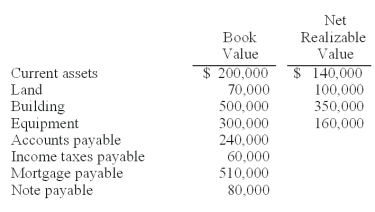 The mortgage is secured by the land and building, and the note payable is secured by the equipment. Quincy expects that the expenses of administering the liquidation will total $40,000.
How much should Quincy expect to pay on the accounts payable?
A) $240,000.
B) $128,000.
C) $120,000.
D) $96,000.
E) $146,000. Assets available for priority claims and unsecured creditors $220,000 - priority claims $100,000 = $120,000
$120,000/$300,000 unsecured = payment of 40% on unsecured dollars.
40% x $240,000 A/P = $96,000
The mortgage is secured by the land and building, and the note payable is secured by the equipment. Quincy expects that the expenses of administering the liquidation will total $40,000.How much should Quincy expect to pay on the accounts payable?
A) $240,000.
B) $128,000.
C) $120,000.
D) $96,000.
E) $146,000. Assets available for priority claims and unsecured creditors $220,000 - priority claims $100,000 = $120,000
$120,000/$300,000 unsecured = payment of 40% on unsecured dollars.
40% x $240,000 A/P = $96,000
Question
Question
Question
Question
Question
Question
Question
Question
Question
Question
Question
Question
Question
Question
Question
Question
Question
Question
Question
Question
Question
Question
Question
Question
Question
Mandich Co. had the following amounts for its assets, liabilities, and stockholders' equity accounts just before filing a bankruptcy petition and requesting liquidation: 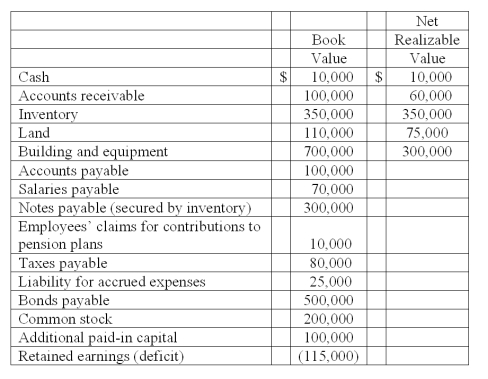 Of the salaries payable, $30,000 was owed to an officer of the company. The remaining amount was owed to salaried employees who had not been paid within the previous 80 days: John Webb was owed $10,600, Samantha Jones was owed $15,000, Sandra Johnson was owed $11,900, and Dennis Roberts was owed $2,500. The maximum owed for any one employee's claims for contributions to benefit plans was $800. Estimated expense for administering the liquidation amounted to $40,000.
What amount would the company have expected to pay for every dollar of unsecured liability without priority?
A) $.30.
B) $.40.
C) $.50.
D) $.60.
E) $.75. Assets available for priority claims and unsecured creditors $495,000 - Priority claims $165,000 = Assets available for nonpriority unsecured creditors $330,000.
$330,000/$660,000 unsecured liab. = $.50.
Of the salaries payable, $30,000 was owed to an officer of the company. The remaining amount was owed to salaried employees who had not been paid within the previous 80 days: John Webb was owed $10,600, Samantha Jones was owed $15,000, Sandra Johnson was owed $11,900, and Dennis Roberts was owed $2,500. The maximum owed for any one employee's claims for contributions to benefit plans was $800. Estimated expense for administering the liquidation amounted to $40,000.What amount would the company have expected to pay for every dollar of unsecured liability without priority?
A) $.30.
B) $.40.
C) $.50.
D) $.60.
E) $.75. Assets available for priority claims and unsecured creditors $495,000 - Priority claims $165,000 = Assets available for nonpriority unsecured creditors $330,000.
$330,000/$660,000 unsecured liab. = $.50.
Question
Question
Question
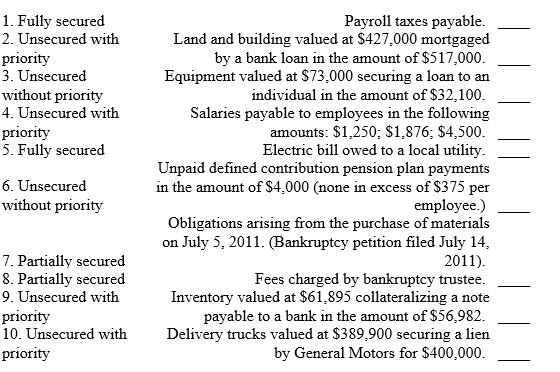
For each of the following situations, select the best answer concerning the classification of the liability.
Question
Mandich Co. had the following amounts for its assets, liabilities, and stockholders' equity accounts just before filing a bankruptcy petition and requesting liquidation: Of the salaries payable, $30,000 was owed to an officer of the company. The remaining amount was owed to salaried employees who had not been paid within the previous 80 days: John Webb was owed $10,600, Samantha Jones was owed $15,000, Sandra Johnson was owed $11,900, and Dennis Roberts was owed $2,500. The maximum owed for any one employee's claims for contributions to benefit plans was $800. Estimated expense for administering the liquidation amounted to $40,000.
On a statement of financial affairs, what amount would have been shown as assets available to pay liabilities with priority and unsecured creditors?
A) $390,000.
B) $445,000.
C) $495,000.
D) $660,000.
E) $795,000. Net realizable value of: Cash + A/R + Inventory net of note payable + Land + Building
Of the salaries payable, $30,000 was owed to an officer of the company. The remaining amount was owed to salaried employees who had not been paid within the previous 80 days: John Webb was owed $10,600, Samantha Jones was owed $15,000, Sandra Johnson was owed $11,900, and Dennis Roberts was owed $2,500. The maximum owed for any one employee's claims for contributions to benefit plans was $800. Estimated expense for administering the liquidation amounted to $40,000.On a statement of financial affairs, what amount would have been shown as assets available to pay liabilities with priority and unsecured creditors?
A) $390,000.
B) $445,000.
C) $495,000.
D) $660,000.
E) $795,000. Net realizable value of: Cash + A/R + Inventory net of note payable + Land + Building
Question
Mandich Co. had the following amounts for its assets, liabilities, and stockholders' equity accounts just before filing a bankruptcy petition and requesting liquidation: Of the salaries payable, $30,000 was owed to an officer of the company. The remaining amount was owed to salaried employees who had not been paid within the previous 80 days: John Webb was owed $10,600, Samantha Jones was owed $15,000, Sandra Johnson was owed $11,900, and Dennis Roberts was owed $2,500. The maximum owed for any one employee's claims for contributions to benefit plans was $800. Estimated expense for administering the liquidation amounted to $40,000.
What was the total amount of unsecured liabilities with priority?
A) $130,000.
B) $155,000.
C) $165,000.
D) $170,000.
E) $200,000. Pension $10,000 + Salaries $35,000 (= $10,600 + $10,950 + $10,950 + $2,500) + Taxes $80,000 + Liq. expenses $40,000 = $165,000.
Of the salaries payable, $30,000 was owed to an officer of the company. The remaining amount was owed to salaried employees who had not been paid within the previous 80 days: John Webb was owed $10,600, Samantha Jones was owed $15,000, Sandra Johnson was owed $11,900, and Dennis Roberts was owed $2,500. The maximum owed for any one employee's claims for contributions to benefit plans was $800. Estimated expense for administering the liquidation amounted to $40,000.What was the total amount of unsecured liabilities with priority?
A) $130,000.
B) $155,000.
C) $165,000.
D) $170,000.
E) $200,000. Pension $10,000 + Salaries $35,000 (= $10,600 + $10,950 + $10,950 + $2,500) + Taxes $80,000 + Liq. expenses $40,000 = $165,000.
Question
Question
Question
Question
Question
Question
Question
Question
Gongman Corp. owned the following assets when it came out of a Chapter 11 bankruptcy: 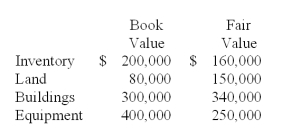
Gongman Corp. had a fresh start reorganization value of $1,000,000. What amount of goodwill should have been recognized in recording the reorganization?
A) $20,000.
B) $100,000.
C) $60,000.
D) $210,000.
E) $98,000.
Gongman Corp. had a fresh start reorganization value of $1,000,000. What amount of goodwill should have been recognized in recording the reorganization?
A) $20,000.
B) $100,000.
C) $60,000.
D) $210,000.
E) $98,000.
Question
Question
Question
A company that was to be liquidated had the following liabilities: 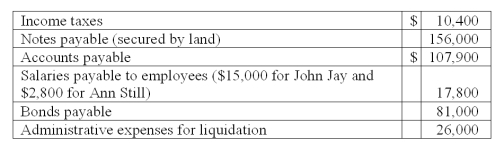 The company had the following assets: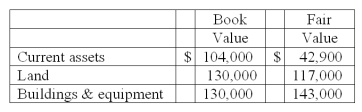
Total unsecured nonpriority liabilities are calculated to be what amount?
The company had the following assets: Total unsecured nonpriority liabilities are calculated to be what amount?
Question
A company that was to be liquidated had the following liabilities: The company had the following assets:
Total liabilities with priority are calculated to be what amount?
The company had the following assets: Total liabilities with priority are calculated to be what amount?
Question
Question
Question
Question
Question
Question
A company that was to be liquidated had the following liabilities: The company had the following assets:
Total payment on notes payable is calculated to be what amount? (Round the payout percentage to one decimal place)
The company had the following assets: Total payment on notes payable is calculated to be what amount? (Round the payout percentage to one decimal place)
Question
A company that was to be liquidated had the following liabilities: The company had the following assets:
Required:
Assets available for unsecured creditors after payment of liabilities with priority are calculated to be what amount?
The company had the following assets: Required:
Assets available for unsecured creditors after payment of liabilities with priority are calculated to be what amount?
Question
Question
Question
Question
Question
A company that was to be liquidated had the following liabilities: The company had the following assets:
Total assets available to pay liabilities with priority and unsecured creditors are calculated to be what amount?
The company had the following assets: Total assets available to pay liabilities with priority and unsecured creditors are calculated to be what amount?
Question
Question
Question
Question
Question
Question
Question
Question
Bazley Co. had severe financial difficulties and was considering the possibility of filing a bankruptcy petition. At that time, the company had the following assets (stated at net realizable value) and liabilities. 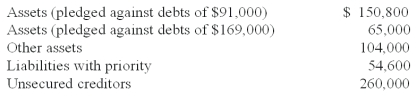
Assets that are available for unsecured creditors after payment of liabilities with priority are calculated to be what amount?
Assets that are available for unsecured creditors after payment of liabilities with priority are calculated to be what amount?
Question
Question
Lucky Co. had cash of $65,000, inventory worth $117,000, and a building worth $169,000. Unfortunately, the company also had accounts payable of $234,000, a note payable of $104,000 (secured by the inventory), liabilities with priority of $26,000, and a bond payable of $195,000 (secured by the building).
A statement of financial affairs created for an insolvent corporation that was beginning the liquidation process disclosed the following data (assets were shown at net realizable values):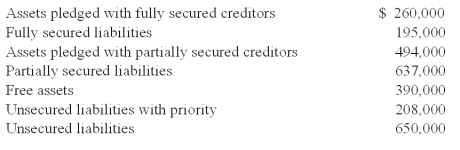
Required:
How much money appears to be available for unsecured creditors after payment of liabilities with priority?
A statement of financial affairs created for an insolvent corporation that was beginning the liquidation process disclosed the following data (assets were shown at net realizable values):
Required:
How much money appears to be available for unsecured creditors after payment of liabilities with priority?
Question
Mount Inc. was a hardware store that operated in Boise, Idaho. Management made some poor inventory acquisitions that loaded the store with unsalable merchandise. Due to the decline in revenues, the company became insolvent. Following is a trial balance as of March 15, 2011, the day the company filed for a Chapter 7 liquidation. 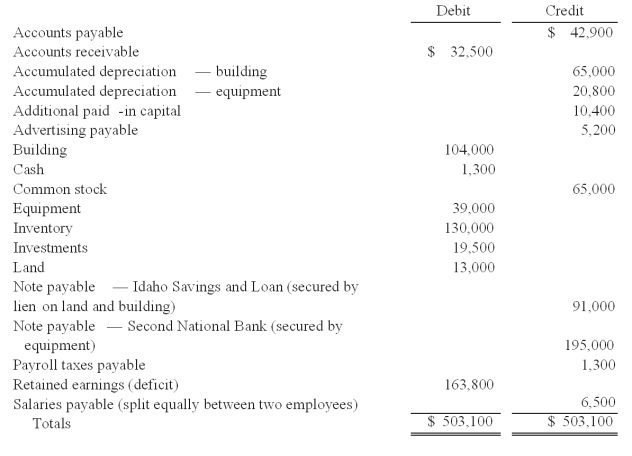
Company officials believed that sixty percent of the accounts receivable could be collected if the company was liquidated. The building and land had a fair value of $97,500, while the equipment was worth $24,700. The investments represented shares of a publicly traded company that could be sold at the time for $27,300. The entire inventory could be sold for only $42,900. Administrative expenses necessary to carry out a liquidation would have approximated $20,800.
-How much cash would have been paid to an unsecured nonpriority creditor who was owed a total of $1,300 by Mount Inc.? (Round the payout percentage to a whole number)
Company officials believed that sixty percent of the accounts receivable could be collected if the company was liquidated. The building and land had a fair value of $97,500, while the equipment was worth $24,700. The investments represented shares of a publicly traded company that could be sold at the time for $27,300. The entire inventory could be sold for only $42,900. Administrative expenses necessary to carry out a liquidation would have approximated $20,800.
-How much cash would have been paid to an unsecured nonpriority creditor who was owed a total of $1,300 by Mount Inc.? (Round the payout percentage to a whole number)
Question
Question
Hampton Company is trying to decide whether to seek liquidation or reorganization. Hampton has provided the following balance sheet: 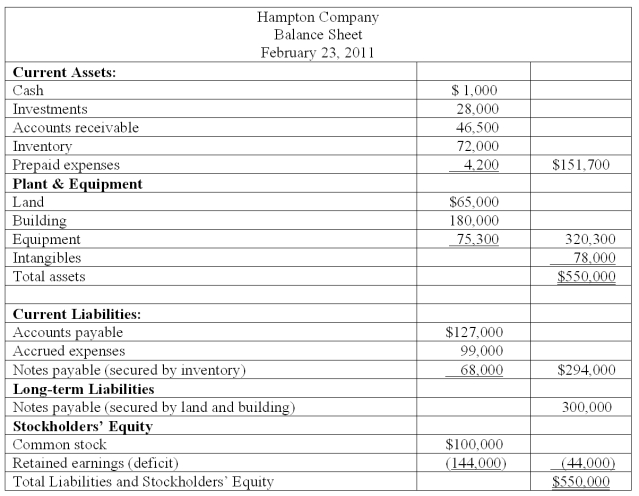 Additional information is as follows:
- The investments are currently worth $13,000.
- It is estimated that $32,000 of the accounts receivable are collectible.
- The inventory can be sold for $74,000.
- The prepaid expenses and the intangible assets have no net realizable value.
- The land and building are currently valued at $250,000.
- The equipment can be sold for $60,000.
- Administrative expenses (not yet recorded) are estimated to be $12,500.
- Accrued expenses include $17,000 of salaries payable ($11,000 to one employee and $3,000 each to two other employees).
- Accrued expenses include $7,000 of unpaid payroll taxes.
Compute the amount of unsecured liabilities without priority.
Additional information is as follows:- The investments are currently worth $13,000.
- It is estimated that $32,000 of the accounts receivable are collectible.
- The inventory can be sold for $74,000.
- The prepaid expenses and the intangible assets have no net realizable value.
- The land and building are currently valued at $250,000.
- The equipment can be sold for $60,000.
- Administrative expenses (not yet recorded) are estimated to be $12,500.
- Accrued expenses include $17,000 of salaries payable ($11,000 to one employee and $3,000 each to two other employees).
- Accrued expenses include $7,000 of unpaid payroll taxes.
Compute the amount of unsecured liabilities without priority.
Question
Mount Inc. was a hardware store that operated in Boise, Idaho. Management made some poor inventory acquisitions that loaded the store with unsalable merchandise. Due to the decline in revenues, the company became insolvent. Following is a trial balance as of March 15, 2011, the day the company filed for a Chapter 7 liquidation. Company officials believed that sixty percent of the accounts receivable could be collected if the company was liquidated. The building and land had a fair value of $97,500, while the equipment was worth $24,700. The investments represented shares of a publicly traded company that could be sold at the time for $27,300. The entire inventory could be sold for only $42,900. Administrative expenses necessary to carry out a liquidation would have approximated $20,800.
Required:
Prepare a statement of financial affairs for Mount Inc. as of March 15, 2011.
Company officials believed that sixty percent of the accounts receivable could be collected if the company was liquidated. The building and land had a fair value of $97,500, while the equipment was worth $24,700. The investments represented shares of a publicly traded company that could be sold at the time for $27,300. The entire inventory could be sold for only $42,900. Administrative expenses necessary to carry out a liquidation would have approximated $20,800.Required:
Prepare a statement of financial affairs for Mount Inc. as of March 15, 2011.
Question
Mount Inc. was a hardware store that operated in Boise, Idaho. Management made some poor inventory acquisitions that loaded the store with unsalable merchandise. Due to the decline in revenues, the company became insolvent. Following is a trial balance as of March 15, 2011, the day the company filed for a Chapter 7 liquidation. Company officials believed that sixty percent of the accounts receivable could be collected if the company was liquidated. The building and land had a fair value of $97,500, while the equipment was worth $24,700. The investments represented shares of a publicly traded company that could be sold at the time for $27,300. The entire inventory could be sold for only $42,900. Administrative expenses necessary to carry out a liquidation would have approximated $20,800.
Assume that the company was being liquidated and that the following transactions occurred:
Accounts receivable of $23,400 were collected.
All of the company's inventory was sold for $52,000.
Additional accounts payable of $13,000 incurred for various expenses such as utilities and maintenance were discovered.
The land and building were sold for $92,300.
The note payable due to the Idaho Savings and Loan was paid.
The equipment was sold at auction for only $14,300 with the proceeds applied to the note owed to the Second National Bank.
The investments were sold for $27,300.
Administrative expenses totaled $26,000 as of July 26, 2011, but no payment had yet been made.
Required:
Prepare a statement of realization and liquidation for the period from March 15 through July 26, 2011.
Company officials believed that sixty percent of the accounts receivable could be collected if the company was liquidated. The building and land had a fair value of $97,500, while the equipment was worth $24,700. The investments represented shares of a publicly traded company that could be sold at the time for $27,300. The entire inventory could be sold for only $42,900. Administrative expenses necessary to carry out a liquidation would have approximated $20,800.Assume that the company was being liquidated and that the following transactions occurred:
Accounts receivable of $23,400 were collected.
All of the company's inventory was sold for $52,000.
Additional accounts payable of $13,000 incurred for various expenses such as utilities and maintenance were discovered.
The land and building were sold for $92,300.
The note payable due to the Idaho Savings and Loan was paid.
The equipment was sold at auction for only $14,300 with the proceeds applied to the note owed to the Second National Bank.
The investments were sold for $27,300.
Administrative expenses totaled $26,000 as of July 26, 2011, but no payment had yet been made.
Required:
Prepare a statement of realization and liquidation for the period from March 15 through July 26, 2011.
Question
Bazley Co. had severe financial difficulties and was considering the possibility of filing a bankruptcy petition. At that time, the company had the following assets (stated at net realizable value) and liabilities.
In a liquidation, total assets available to pay liabilities with priority and unsecured creditors are calculated to be what amount?
In a liquidation, total assets available to pay liabilities with priority and unsecured creditors are calculated to be what amount?
Question
Hampton Company is trying to decide whether to seek liquidation or reorganization. Hampton has provided the following balance sheet: Additional information is as follows:
- The investments are currently worth $13,000.
- It is estimated that $32,000 of the accounts receivable are collectible.
- The inventory can be sold for $74,000.
- The prepaid expenses and the intangible assets have no net realizable value.
- The land and building are currently valued at $250,000.
- The equipment can be sold for $60,000.
- Administrative expenses (not yet recorded) are estimated to be $12,500.
- Accrued expenses include $17,000 of salaries payable ($11,000 to one employee and $3,000 each to two other employees).
- Accrued expenses include $7,000 of unpaid payroll taxes.
Compute the amount of total liabilities with priority.
Additional information is as follows:- The investments are currently worth $13,000.
- It is estimated that $32,000 of the accounts receivable are collectible.
- The inventory can be sold for $74,000.
- The prepaid expenses and the intangible assets have no net realizable value.
- The land and building are currently valued at $250,000.
- The equipment can be sold for $60,000.
- Administrative expenses (not yet recorded) are estimated to be $12,500.
- Accrued expenses include $17,000 of salaries payable ($11,000 to one employee and $3,000 each to two other employees).
- Accrued expenses include $7,000 of unpaid payroll taxes.
Compute the amount of total liabilities with priority.
Question
Hampton Company is trying to decide whether to seek liquidation or reorganization. Hampton has provided the following balance sheet: Additional information is as follows:
- The investments are currently worth $13,000.
- It is estimated that $32,000 of the accounts receivable are collectible.
- The inventory can be sold for $74,000.
- The prepaid expenses and the intangible assets have no net realizable value.
- The land and building are currently valued at $250,000.
- The equipment can be sold for $60,000.
- Administrative expenses (not yet recorded) are estimated to be $12,500.
- Accrued expenses include $17,000 of salaries payable ($11,000 to one employee and $3,000 each to two other employees).
- Accrued expenses include $7,000 of unpaid payroll taxes.
Compute the amount of assets available for unsecured creditors after payment of liabilities with priority.
Additional information is as follows:- The investments are currently worth $13,000.
- It is estimated that $32,000 of the accounts receivable are collectible.
- The inventory can be sold for $74,000.
- The prepaid expenses and the intangible assets have no net realizable value.
- The land and building are currently valued at $250,000.
- The equipment can be sold for $60,000.
- Administrative expenses (not yet recorded) are estimated to be $12,500.
- Accrued expenses include $17,000 of salaries payable ($11,000 to one employee and $3,000 each to two other employees).
- Accrued expenses include $7,000 of unpaid payroll taxes.
Compute the amount of assets available for unsecured creditors after payment of liabilities with priority.
Question
Question
Bazley Co. had severe financial difficulties and was considering the possibility of filing a bankruptcy petition. At that time, the company had the following assets (stated at net realizable value) and liabilities.
Total payment on partially secured debt is calculated to be what amount?
Total payment on partially secured debt is calculated to be what amount?
Question
Bazley Co. had severe financial difficulties and was considering the possibility of filing a bankruptcy petition. At that time, the company had the following assets (stated at net realizable value) and liabilities.
Total unsecured liabilities are calculated to be what amount?
Total unsecured liabilities are calculated to be what amount?
Question
Question
Hampton Company is trying to decide whether to seek liquidation or reorganization. Hampton has provided the following balance sheet: Additional information is as follows:
- The investments are currently worth $13,000.
- It is estimated that $32,000 of the accounts receivable are collectible.
- The inventory can be sold for $74,000.
- The prepaid expenses and the intangible assets have no net realizable value.
- The land and building are currently valued at $250,000.
- The equipment can be sold for $60,000.
- Administrative expenses (not yet recorded) are estimated to be $12,500.
- Accrued expenses include $17,000 of salaries payable ($11,000 to one employee and $3,000 each to two other employees).
- Accrued expenses include $7,000 of unpaid payroll taxes.
Compute the amount of total assets available to pay liabilities with priority and unsecured creditors.
Additional information is as follows:- The investments are currently worth $13,000.
- It is estimated that $32,000 of the accounts receivable are collectible.
- The inventory can be sold for $74,000.
- The prepaid expenses and the intangible assets have no net realizable value.
- The land and building are currently valued at $250,000.
- The equipment can be sold for $60,000.
- Administrative expenses (not yet recorded) are estimated to be $12,500.
- Accrued expenses include $17,000 of salaries payable ($11,000 to one employee and $3,000 each to two other employees).
- Accrued expenses include $7,000 of unpaid payroll taxes.
Compute the amount of total assets available to pay liabilities with priority and unsecured creditors.
Question

Unlock Deck
Sign up to unlock the cards in this deck!
Unlock Deck
Unlock Deck
1/82

Play

Full screen (f)
Deck 13: Accounting for Legal Reorganizations and Liquidations
1
On a statement of financial affairs, a specific liability may be classified as
A) current or long-term.
B) secured or unsecured.
C) monetary or nonmonetary.
D) direct or indirect.
E) past due or not yet due.
A) current or long-term.
B) secured or unsecured.
C) monetary or nonmonetary.
D) direct or indirect.
E) past due or not yet due.
B
2
Quincy Corp., about to be liquidated, has the following amounts for its assets and liabilities: The mortgage is secured by the land and building, and the note payable is secured by the equipment. Quincy expects that the expenses of administering the liquidation will total $40,000.
How much should Quincy expect to pay on the accounts payable?
A) $240,000.
B) $128,000.
C) $120,000.
D) $96,000.
E) $146,000. Assets available for priority claims and unsecured creditors $220,000 - priority claims $100,000 = $120,000
$120,000/$300,000 unsecured = payment of 40% on unsecured dollars.
40% x $240,000 A/P = $96,000
The mortgage is secured by the land and building, and the note payable is secured by the equipment. Quincy expects that the expenses of administering the liquidation will total $40,000.How much should Quincy expect to pay on the accounts payable?
A) $240,000.
B) $128,000.
C) $120,000.
D) $96,000.
E) $146,000. Assets available for priority claims and unsecured creditors $220,000 - priority claims $100,000 = $120,000
$120,000/$300,000 unsecured = payment of 40% on unsecured dollars.
40% x $240,000 A/P = $96,000
D
3
During a reorganization, cash reserves tend to grow. How should interest earned on these reserves be reported on the financial statements?
A) As an unearned revenue until the reorganization is complete.
B) As a credit directly to retained earnings.
C) On the balance sheet as a long-term liability.
D) On the income statement, but not classified as a reorganization item.
E) On the income statement as a reorganization item.
A) As an unearned revenue until the reorganization is complete.
B) As a credit directly to retained earnings.
C) On the balance sheet as a long-term liability.
D) On the income statement, but not classified as a reorganization item.
E) On the income statement as a reorganization item.
E
4
Which one of the following is a requirement that must be met before an involuntary bankruptcy petition can be filed when there are at least 12 unsecured creditors?
A) The petition must be filed by all creditor(s) to whom the debtor owes at least $13,475.
B) The petition must be signed by creditor(s) with unsecured debts of at least $5,000.
C) The petition must be signed by a majority of the creditor(s).
D) The petition must be signed by creditor(s) to whom the debtor owes more than half of its debts.
E) The petition must be signed by at least three creditors with unsecured debts of at least $13,475.
A) The petition must be filed by all creditor(s) to whom the debtor owes at least $13,475.
B) The petition must be signed by creditor(s) with unsecured debts of at least $5,000.
C) The petition must be signed by a majority of the creditor(s).
D) The petition must be signed by creditor(s) to whom the debtor owes more than half of its debts.
E) The petition must be signed by at least three creditors with unsecured debts of at least $13,475.
Unlock Deck
Unlock for access to all 82 flashcards in this deck.
Unlock Deck
k this deck
5
Sparkman Co. filed a bankruptcy petition and liquidated its noncash assets. Sparkman was paying forty cents on the dollar for unsecured claims. Bailey Co. held a mortgage of $150,000 on land that was sold for $110,000. The total amount of payment that Bailey should have received is calculated to be
A) $110,000.
B) $44,000.
C) $126,000.
D) $150,000.
E) $60,000. Sale of land $110,000 + 40% of remaining $40,000 owed = $126,000
A) $110,000.
B) $44,000.
C) $126,000.
D) $150,000.
E) $60,000. Sale of land $110,000 + 40% of remaining $40,000 owed = $126,000
Unlock Deck
Unlock for access to all 82 flashcards in this deck.
Unlock Deck
k this deck
6
How should the fresh start reorganization value normally be determined?
A) As the sum of current replacement cost of the company's assets.
B) By discounting future cash flows for the entity that will emerge.
C) As the sum of the historical cost of net assets.
D) As the sum of the net realizable value of identifiable assets.
E) By adjusting current cash flows for the entity as it emerges from reorganization.
A) As the sum of current replacement cost of the company's assets.
B) By discounting future cash flows for the entity that will emerge.
C) As the sum of the historical cost of net assets.
D) As the sum of the net realizable value of identifiable assets.
E) By adjusting current cash flows for the entity as it emerges from reorganization.
Unlock Deck
Unlock for access to all 82 flashcards in this deck.
Unlock Deck
k this deck
7
Where should a company undergoing reorganization report the gains and losses resulting from the reorganization?
A) On the statement of retained earnings.
B) On the income statement, combined with the gains and losses from operations.
C) On the statement of stockholders' equity.
D) On the income statement, separate from other gains and losses.
E) On the statement of cash flows.
A) On the statement of retained earnings.
B) On the income statement, combined with the gains and losses from operations.
C) On the statement of stockholders' equity.
D) On the income statement, separate from other gains and losses.
E) On the statement of cash flows.
Unlock Deck
Unlock for access to all 82 flashcards in this deck.
Unlock Deck
k this deck
8
What are free assets?
A) Assets for which net realizable value is greater than historical cost.
B) Assets for which no market exists.
C) Assets for which replacement cost is greater than historical cost.
D) Assets available to be distributed for liabilities with priority and for other unsecured obligations.
E) Assets available to be distributed to stockholders.
A) Assets for which net realizable value is greater than historical cost.
B) Assets for which no market exists.
C) Assets for which replacement cost is greater than historical cost.
D) Assets available to be distributed for liabilities with priority and for other unsecured obligations.
E) Assets available to be distributed to stockholders.
Unlock Deck
Unlock for access to all 82 flashcards in this deck.
Unlock Deck
k this deck
9
Lawyer's fees incurred during a reorganization are accounted for as:
A) an expense.
B) an intangible asset, Reorganization Cost, which would normally be amortized over a five-year period.
C) additional paid-in capital.
D) retained earnings.
E) a prepaid asset until the entity emerges from reorganization.
A) an expense.
B) an intangible asset, Reorganization Cost, which would normally be amortized over a five-year period.
C) additional paid-in capital.
D) retained earnings.
E) a prepaid asset until the entity emerges from reorganization.
Unlock Deck
Unlock for access to all 82 flashcards in this deck.
Unlock Deck
k this deck
10
The statement of financial affairs should be prepared
A) under the going concern assumption.
B) under the concept of conservatism.
C) under the assumption that liquidation will occur.
D) under the continuity concept.
E) only for a company in Chapter 7 bankruptcy.
A) under the going concern assumption.
B) under the concept of conservatism.
C) under the assumption that liquidation will occur.
D) under the continuity concept.
E) only for a company in Chapter 7 bankruptcy.
Unlock Deck
Unlock for access to all 82 flashcards in this deck.
Unlock Deck
k this deck
11
On its balance sheet, a company undergoing reorganization should
A) report its assets at fair value, so that financial statement users can estimate whether creditors' claims will be met.
B) report its assets at net realizable value because there is reason to doubt that the organization is a going concern.
C) report its assets as pledged or free.
D) report its assets at current replacement cost.
E) continue to report its assets at book value.
A) report its assets at fair value, so that financial statement users can estimate whether creditors' claims will be met.
B) report its assets at net realizable value because there is reason to doubt that the organization is a going concern.
C) report its assets as pledged or free.
D) report its assets at current replacement cost.
E) continue to report its assets at book value.
Unlock Deck
Unlock for access to all 82 flashcards in this deck.
Unlock Deck
k this deck
12
In a statement of financial affairs, assets are classified
A) according to whether they are pledged with particular creditors.
B) as current or noncurrent.
C) as monetary or nonmonetary.
D) as operating or nonoperating.
E) as direct or indirect.
A) according to whether they are pledged with particular creditors.
B) as current or noncurrent.
C) as monetary or nonmonetary.
D) as operating or nonoperating.
E) as direct or indirect.
Unlock Deck
Unlock for access to all 82 flashcards in this deck.
Unlock Deck
k this deck
13
During a reorganization, how should interest expense be reported on the financial statements?
A) On the income statement, but not classified as a reorganization item.
B) On the income statement as a separate reorganization item.
C) On the balance sheet as a prepaid expense.
D) As a debit directly to retained earnings.
E) On the balance sheet as an intangible asset.
A) On the income statement, but not classified as a reorganization item.
B) On the income statement as a separate reorganization item.
C) On the balance sheet as a prepaid expense.
D) As a debit directly to retained earnings.
E) On the balance sheet as an intangible asset.
Unlock Deck
Unlock for access to all 82 flashcards in this deck.
Unlock Deck
k this deck
14
How should liabilities (except for deferred income taxes) be reported by a company using fresh start accounting?
A) At the undiscounted sum of future cash payments.
B) At book value prior to the reorganization.
C) As partially secured liabilities.
D) At the present value of future cash payments.
E) As unsecured liabilities.
A) At the undiscounted sum of future cash payments.
B) At book value prior to the reorganization.
C) As partially secured liabilities.
D) At the present value of future cash payments.
E) As unsecured liabilities.
Unlock Deck
Unlock for access to all 82 flashcards in this deck.
Unlock Deck
k this deck
15
Which one of the following unsecured liabilities has the highest priority when an insolvent company is about to be liquidated?
A) Federal income taxes payable.
B) Claims for expenses of administering the bankruptcy.
C) Loans made to the company by its stockholders.
D) Employees' claims for salaries.
E) Bank loans.
A) Federal income taxes payable.
B) Claims for expenses of administering the bankruptcy.
C) Loans made to the company by its stockholders.
D) Employees' claims for salaries.
E) Bank loans.
Unlock Deck
Unlock for access to all 82 flashcards in this deck.
Unlock Deck
k this deck
16
A Chapter 7 bankruptcy is a(n)
A) involuntary reorganization.
B) bankruptcy forced by a company's creditors.
C) liquidation.
D) bankruptcy in which all creditors receive payment in full.
E) voluntary reorganization.
A) involuntary reorganization.
B) bankruptcy forced by a company's creditors.
C) liquidation.
D) bankruptcy in which all creditors receive payment in full.
E) voluntary reorganization.
Unlock Deck
Unlock for access to all 82 flashcards in this deck.
Unlock Deck
k this deck
17
On a statement of financial affairs, a company's liabilities should be valued at
A) the present value of future cash flows.
B) net realizable value.
C) the amount required for settlement.
D) replacement cost.
E) the amount expected to be paid if the company could honor its debts.
A) the present value of future cash flows.
B) net realizable value.
C) the amount required for settlement.
D) replacement cost.
E) the amount expected to be paid if the company could honor its debts.
Unlock Deck
Unlock for access to all 82 flashcards in this deck.
Unlock Deck
k this deck
18
Which of the following is not one of the more common reorganization plan elements?
A) Plans for plant expansion.
B) Plans for generating additional monetary resources.
C) Plans to settle the debts of the company that existed when the order for relief was entered.
D) Plans proposing changes in the company's operations.
E) Plans for changes in the management of the company.
A) Plans for plant expansion.
B) Plans for generating additional monetary resources.
C) Plans to settle the debts of the company that existed when the order for relief was entered.
D) Plans proposing changes in the company's operations.
E) Plans for changes in the management of the company.
Unlock Deck
Unlock for access to all 82 flashcards in this deck.
Unlock Deck
k this deck
19
What is normally required before a reorganization plan can be implemented?
A) The plan must be presented by the company and confirmed by the court.
B) The plan must be approved by each class of creditors and each class of stockholders, and confirmed by the court.
C) The plan must be presented by the company, approved by two-thirds of each class of stockholders, and confirmed by the court.
D) The plan must be presented by the company, approved by three-fourths of each class of stockholders, and confirmed by the court.
E) The plan must be approved by two-thirds of each class of creditors, approved by two-thirds of each class of stockholders, and confirmed by the court.
A) The plan must be presented by the company and confirmed by the court.
B) The plan must be approved by each class of creditors and each class of stockholders, and confirmed by the court.
C) The plan must be presented by the company, approved by two-thirds of each class of stockholders, and confirmed by the court.
D) The plan must be presented by the company, approved by three-fourths of each class of stockholders, and confirmed by the court.
E) The plan must be approved by two-thirds of each class of creditors, approved by two-thirds of each class of stockholders, and confirmed by the court.
Unlock Deck
Unlock for access to all 82 flashcards in this deck.
Unlock Deck
k this deck
20
On a statement of financial affairs, a company's assets should be valued at
A) historical cost.
B) net realizable value, if lower than historical cost.
C) replacement cost.
D) net realizable value, if higher than historical cost.
E) net realizable value, whether higher or lower than historical cost.
A) historical cost.
B) net realizable value, if lower than historical cost.
C) replacement cost.
D) net realizable value, if higher than historical cost.
E) net realizable value, whether higher or lower than historical cost.
Unlock Deck
Unlock for access to all 82 flashcards in this deck.
Unlock Deck
k this deck
21
Which statement is false regarding the acceptance and confirmation of a reorganization plan?
A) The plan must be voted on by the creditors and the stockholders of the company.
B) A separate vote is required of each class of stockholders.
C) Any class of creditors that is not damaged by a reorganization is assumed to have accepted the plan without voting.
D) Even if creditors and stockholders approve of the plan, the court can reject the plan.
E) Acceptance of the plan requires the approval of two-thirds in number of claims and one-half in dollar amount of creditors that cast votes.
A) The plan must be voted on by the creditors and the stockholders of the company.
B) A separate vote is required of each class of stockholders.
C) Any class of creditors that is not damaged by a reorganization is assumed to have accepted the plan without voting.
D) Even if creditors and stockholders approve of the plan, the court can reject the plan.
E) Acceptance of the plan requires the approval of two-thirds in number of claims and one-half in dollar amount of creditors that cast votes.
Unlock Deck
Unlock for access to all 82 flashcards in this deck.
Unlock Deck
k this deck
22
A company that was to be liquidated had the following liabilities:
-Assets available for unsecured creditors after payments of liabilities with priority are calculated to be what amount?
A) $226,000.
B) $247,050.
C) $251,000.
D) $252,050.
E) $275,000. $295,000 assets available to pay liabilities with priority and unsecured creditors - $42,950 liabilities with priority
-Assets available for unsecured creditors after payments of liabilities with priority are calculated to be what amount?
A) $226,000.
B) $247,050.
C) $251,000.
D) $252,050.
E) $275,000. $295,000 assets available to pay liabilities with priority and unsecured creditors - $42,950 liabilities with priority
Unlock Deck
Unlock for access to all 82 flashcards in this deck.
Unlock Deck
k this deck
23
What is meant by a "fully secured liability"?
Unlock Deck
Unlock for access to all 82 flashcards in this deck.
Unlock Deck
k this deck
24
Which statement is false regarding a plan for reorganization?
A) The plan is the heart of every Chapter 7 bankruptcy.
B) The provisions of the plan specify the treatment of all creditors and equity holders upon approval by the Court.
C) The plan shapes the financial structure of the entity that emerges.
D) The plan may contain numerous provisions as solutions to financial difficulties.
E) The plan may contain provisions for changes in the management of the company.
A) The plan is the heart of every Chapter 7 bankruptcy.
B) The provisions of the plan specify the treatment of all creditors and equity holders upon approval by the Court.
C) The plan shapes the financial structure of the entity that emerges.
D) The plan may contain numerous provisions as solutions to financial difficulties.
E) The plan may contain provisions for changes in the management of the company.
Unlock Deck
Unlock for access to all 82 flashcards in this deck.
Unlock Deck
k this deck
25
What is the difference between a liquidation and a reorganization?
Unlock Deck
Unlock for access to all 82 flashcards in this deck.
Unlock Deck
k this deck
26
Assuming all of the following expenses have priority, in what order are they prioritized?
A) Administrative expenses, employee claims for wages, unpaid taxes, claims for the return of customer deposits.
B) Employee claims for wages, unpaid taxes, administrative expenses, claims for the return of customer deposits.
C) Unpaid taxes, administrative expenses, employee claims for wages, return of customer deposits.
D) Administrative expenses, employee claims for wages, claims for the return of customer deposits, unpaid taxes.
E) Unpaid taxes, return of customer deposits, employee claims for wages, administrative expenses.
A) Administrative expenses, employee claims for wages, unpaid taxes, claims for the return of customer deposits.
B) Employee claims for wages, unpaid taxes, administrative expenses, claims for the return of customer deposits.
C) Unpaid taxes, administrative expenses, employee claims for wages, return of customer deposits.
D) Administrative expenses, employee claims for wages, claims for the return of customer deposits, unpaid taxes.
E) Unpaid taxes, return of customer deposits, employee claims for wages, administrative expenses.
Unlock Deck
Unlock for access to all 82 flashcards in this deck.
Unlock Deck
k this deck
27
Mandich Co. had the following amounts for its assets, liabilities, and stockholders' equity accounts just before filing a bankruptcy petition and requesting liquidation: Of the salaries payable, $30,000 was owed to an officer of the company. The remaining amount was owed to salaried employees who had not been paid within the previous 80 days: John Webb was owed $10,600, Samantha Jones was owed $15,000, Sandra Johnson was owed $11,900, and Dennis Roberts was owed $2,500. The maximum owed for any one employee's claims for contributions to benefit plans was $800. Estimated expense for administering the liquidation amounted to $40,000.
What amount would the company have expected to pay for every dollar of unsecured liability without priority?
A) $.30.
B) $.40.
C) $.50.
D) $.60.
E) $.75. Assets available for priority claims and unsecured creditors $495,000 - Priority claims $165,000 = Assets available for nonpriority unsecured creditors $330,000.
$330,000/$660,000 unsecured liab. = $.50.
Of the salaries payable, $30,000 was owed to an officer of the company. The remaining amount was owed to salaried employees who had not been paid within the previous 80 days: John Webb was owed $10,600, Samantha Jones was owed $15,000, Sandra Johnson was owed $11,900, and Dennis Roberts was owed $2,500. The maximum owed for any one employee's claims for contributions to benefit plans was $800. Estimated expense for administering the liquidation amounted to $40,000.What amount would the company have expected to pay for every dollar of unsecured liability without priority?
A) $.30.
B) $.40.
C) $.50.
D) $.60.
E) $.75. Assets available for priority claims and unsecured creditors $495,000 - Priority claims $165,000 = Assets available for nonpriority unsecured creditors $330,000.
$330,000/$660,000 unsecured liab. = $.50.
Unlock Deck
Unlock for access to all 82 flashcards in this deck.
Unlock Deck
k this deck
28
What are the three categories of assets in a Statement of Financial Affairs?
Unlock Deck
Unlock for access to all 82 flashcards in this deck.
Unlock Deck
k this deck
29
Which of the following is not a responsibility of the bankruptcy trustee?
A) Recover all property belonging to the insolvent company.
B) Liquidate common stock of the company.
C) Preserve the estate from any further deterioration.
D) Make distributions to the proper claimants.
E) Void preferences made by the debtor within 90 days prior to the filing of the bankruptcy petition if the company was already insolvent.
A) Recover all property belonging to the insolvent company.
B) Liquidate common stock of the company.
C) Preserve the estate from any further deterioration.
D) Make distributions to the proper claimants.
E) Void preferences made by the debtor within 90 days prior to the filing of the bankruptcy petition if the company was already insolvent.
Unlock Deck
Unlock for access to all 82 flashcards in this deck.
Unlock Deck
k this deck
30
For each of the following situations, select the best answer concerning the classification of the liability.
Unlock Deck
Unlock for access to all 82 flashcards in this deck.
Unlock Deck
k this deck
31
Mandich Co. had the following amounts for its assets, liabilities, and stockholders' equity accounts just before filing a bankruptcy petition and requesting liquidation: Of the salaries payable, $30,000 was owed to an officer of the company. The remaining amount was owed to salaried employees who had not been paid within the previous 80 days: John Webb was owed $10,600, Samantha Jones was owed $15,000, Sandra Johnson was owed $11,900, and Dennis Roberts was owed $2,500. The maximum owed for any one employee's claims for contributions to benefit plans was $800. Estimated expense for administering the liquidation amounted to $40,000.
On a statement of financial affairs, what amount would have been shown as assets available to pay liabilities with priority and unsecured creditors?
A) $390,000.
B) $445,000.
C) $495,000.
D) $660,000.
E) $795,000. Net realizable value of: Cash + A/R + Inventory net of note payable + Land + Building
Of the salaries payable, $30,000 was owed to an officer of the company. The remaining amount was owed to salaried employees who had not been paid within the previous 80 days: John Webb was owed $10,600, Samantha Jones was owed $15,000, Sandra Johnson was owed $11,900, and Dennis Roberts was owed $2,500. The maximum owed for any one employee's claims for contributions to benefit plans was $800. Estimated expense for administering the liquidation amounted to $40,000.On a statement of financial affairs, what amount would have been shown as assets available to pay liabilities with priority and unsecured creditors?
A) $390,000.
B) $445,000.
C) $495,000.
D) $660,000.
E) $795,000. Net realizable value of: Cash + A/R + Inventory net of note payable + Land + Building
Unlock Deck
Unlock for access to all 82 flashcards in this deck.
Unlock Deck
k this deck
32
Mandich Co. had the following amounts for its assets, liabilities, and stockholders' equity accounts just before filing a bankruptcy petition and requesting liquidation: Of the salaries payable, $30,000 was owed to an officer of the company. The remaining amount was owed to salaried employees who had not been paid within the previous 80 days: John Webb was owed $10,600, Samantha Jones was owed $15,000, Sandra Johnson was owed $11,900, and Dennis Roberts was owed $2,500. The maximum owed for any one employee's claims for contributions to benefit plans was $800. Estimated expense for administering the liquidation amounted to $40,000.
What was the total amount of unsecured liabilities with priority?
A) $130,000.
B) $155,000.
C) $165,000.
D) $170,000.
E) $200,000. Pension $10,000 + Salaries $35,000 (= $10,600 + $10,950 + $10,950 + $2,500) + Taxes $80,000 + Liq. expenses $40,000 = $165,000.
Of the salaries payable, $30,000 was owed to an officer of the company. The remaining amount was owed to salaried employees who had not been paid within the previous 80 days: John Webb was owed $10,600, Samantha Jones was owed $15,000, Sandra Johnson was owed $11,900, and Dennis Roberts was owed $2,500. The maximum owed for any one employee's claims for contributions to benefit plans was $800. Estimated expense for administering the liquidation amounted to $40,000.What was the total amount of unsecured liabilities with priority?
A) $130,000.
B) $155,000.
C) $165,000.
D) $170,000.
E) $200,000. Pension $10,000 + Salaries $35,000 (= $10,600 + $10,950 + $10,950 + $2,500) + Taxes $80,000 + Liq. expenses $40,000 = $165,000.
Unlock Deck
Unlock for access to all 82 flashcards in this deck.
Unlock Deck
k this deck
33
What information is conveyed by the Statement of Realization and Liquidation?
A) Account balances reported by the company at the date of the filing of the bankruptcy petition.
B) Cash receipts generated by the sale of the debtor's property.
C) Write up of assets.
D) Recognition of recorded liabilities.
E) Assets and liabilities but not stockholders' equity.
A) Account balances reported by the company at the date of the filing of the bankruptcy petition.
B) Cash receipts generated by the sale of the debtor's property.
C) Write up of assets.
D) Recognition of recorded liabilities.
E) Assets and liabilities but not stockholders' equity.
Unlock Deck
Unlock for access to all 82 flashcards in this deck.
Unlock Deck
k this deck
34
A company that was to be liquidated had the following liabilities:
-Total unsecured nonpriority liabilities are calculated to be what amount?
A) $44,000.
B) $51,050.
C) $76,050.
D) $85,000.
E) $194,000. Excess of salaries $1,050 + notes pay in excess of security $25,000+ accounts pay $50,000
-Total unsecured nonpriority liabilities are calculated to be what amount?
A) $44,000.
B) $51,050.
C) $76,050.
D) $85,000.
E) $194,000. Excess of salaries $1,050 + notes pay in excess of security $25,000+ accounts pay $50,000
Unlock Deck
Unlock for access to all 82 flashcards in this deck.
Unlock Deck
k this deck
35
How much should the mortgage holder expect to collect from the liquidation?
A) $474,000
B) $510,000
C) $450,000
D) $480,000
E) $478,000 Land and building sold for $450,000 leaves $60,000 unsecured still owing.
40% x $60,000 = $24,000
Mortgage holder expects $450,000 + $24,000 = $474,000
A) $474,000
B) $510,000
C) $450,000
D) $480,000
E) $478,000 Land and building sold for $450,000 leaves $60,000 unsecured still owing.
40% x $60,000 = $24,000
Mortgage holder expects $450,000 + $24,000 = $474,000
Unlock Deck
Unlock for access to all 82 flashcards in this deck.
Unlock Deck
k this deck
36
All of the following items are liabilities with priority except:
A) Obligations arising between the date an order of relief is issued and the date of final realization of assets.
B) Employee claims for contributions to benefit plans earned more than 180 days preceding the filing of a petition, limited to $10,950 per individual.
C) Government claims for unpaid taxes.
D) Claims for the return of deposits made by customers to acquire property or services, which were never delivered or provided by the debtor, limited to $2,425.
E) Claims for administrative expenses in preserving and liquidating the company.
A) Obligations arising between the date an order of relief is issued and the date of final realization of assets.
B) Employee claims for contributions to benefit plans earned more than 180 days preceding the filing of a petition, limited to $10,950 per individual.
C) Government claims for unpaid taxes.
D) Claims for the return of deposits made by customers to acquire property or services, which were never delivered or provided by the debtor, limited to $2,425.
E) Claims for administrative expenses in preserving and liquidating the company.
Unlock Deck
Unlock for access to all 82 flashcards in this deck.
Unlock Deck
k this deck
37
What is meant by a "partially secured liability"?
Unlock Deck
Unlock for access to all 82 flashcards in this deck.
Unlock Deck
k this deck
38
A company that was to be liquidated had the following liabilities:
-Total assets, available to pay liabilities with priority and unsecured creditors, are calculated to be what amount?
A) $ 75,000.
B) $270,000.
C) $275,000.
D) $295,000.
E) $370,000. (200,000+95,000)
-Total assets, available to pay liabilities with priority and unsecured creditors, are calculated to be what amount?
A) $ 75,000.
B) $270,000.
C) $275,000.
D) $295,000.
E) $370,000. (200,000+95,000)
Unlock Deck
Unlock for access to all 82 flashcards in this deck.
Unlock Deck
k this deck
39
A company that was to be liquidated had the following liabilities:
-Total liabilities with priority are calculated to be what amount?
A) $19,000.
B) $37,950.
C) $42,950.
D) $44,000.
E) $144,000. ($10,950 + $2,000 + $20,000 + $10,000)
-Total liabilities with priority are calculated to be what amount?
A) $19,000.
B) $37,950.
C) $42,950.
D) $44,000.
E) $144,000. ($10,950 + $2,000 + $20,000 + $10,000)
Unlock Deck
Unlock for access to all 82 flashcards in this deck.
Unlock Deck
k this deck
40
Gongman Corp. owned the following assets when it came out of a Chapter 11 bankruptcy:
Gongman Corp. had a fresh start reorganization value of $1,000,000. What amount of goodwill should have been recognized in recording the reorganization?
A) $20,000.
B) $100,000.
C) $60,000.
D) $210,000.
E) $98,000.
Gongman Corp. had a fresh start reorganization value of $1,000,000. What amount of goodwill should have been recognized in recording the reorganization?
A) $20,000.
B) $100,000.
C) $60,000.
D) $210,000.
E) $98,000.
Unlock Deck
Unlock for access to all 82 flashcards in this deck.
Unlock Deck
k this deck
41
What information is included on the statement of realization and liquidation?
Unlock Deck
Unlock for access to all 82 flashcards in this deck.
Unlock Deck
k this deck
42
What is the role of the trustee in the liquidation of a company?
Unlock Deck
Unlock for access to all 82 flashcards in this deck.
Unlock Deck
k this deck
43
A company that was to be liquidated had the following liabilities: The company had the following assets:
Total unsecured nonpriority liabilities are calculated to be what amount?
The company had the following assets: Total unsecured nonpriority liabilities are calculated to be what amount?
Unlock Deck
Unlock for access to all 82 flashcards in this deck.
Unlock Deck
k this deck
44
A company that was to be liquidated had the following liabilities: The company had the following assets:
Total liabilities with priority are calculated to be what amount?
The company had the following assets: Total liabilities with priority are calculated to be what amount?
Unlock Deck
Unlock for access to all 82 flashcards in this deck.
Unlock Deck
k this deck
45
What are duties of the creditors committee in Chapter 7 liquidation?
Unlock Deck
Unlock for access to all 82 flashcards in this deck.
Unlock Deck
k this deck
46
To what does the term Chapter 11 bankruptcy refer?
Unlock Deck
Unlock for access to all 82 flashcards in this deck.
Unlock Deck
k this deck
47
How is the presentation of a balance sheet during a reorganization different from a normal balance sheet?
Unlock Deck
Unlock for access to all 82 flashcards in this deck.
Unlock Deck
k this deck
48
How is the presentation of an income statement during a reorganization different from a normal income statement?
Unlock Deck
Unlock for access to all 82 flashcards in this deck.
Unlock Deck
k this deck
49
What are some of the common elements that can be included in a reorganization proposal?
Unlock Deck
Unlock for access to all 82 flashcards in this deck.
Unlock Deck
k this deck
50
A company that was to be liquidated had the following liabilities: The company had the following assets:
Total payment on notes payable is calculated to be what amount? (Round the payout percentage to one decimal place)
The company had the following assets: Total payment on notes payable is calculated to be what amount? (Round the payout percentage to one decimal place)
Unlock Deck
Unlock for access to all 82 flashcards in this deck.
Unlock Deck
k this deck
51
A company that was to be liquidated had the following liabilities: The company had the following assets:
Required:
Assets available for unsecured creditors after payment of liabilities with priority are calculated to be what amount?
The company had the following assets: Required:
Assets available for unsecured creditors after payment of liabilities with priority are calculated to be what amount?
Unlock Deck
Unlock for access to all 82 flashcards in this deck.
Unlock Deck
k this deck
52
What is an order for relief?
Unlock Deck
Unlock for access to all 82 flashcards in this deck.
Unlock Deck
k this deck
53
Who must accept and confirm the Reorganization plan?
Unlock Deck
Unlock for access to all 82 flashcards in this deck.
Unlock Deck
k this deck
54
What occurs in the accounting records for fresh start accounting when a bank agrees to accept less than the debtor's book value of a note payable?
Unlock Deck
Unlock for access to all 82 flashcards in this deck.
Unlock Deck
k this deck
55
What term is used for a bankruptcy forced upon a debtor by its creditors?
Unlock Deck
Unlock for access to all 82 flashcards in this deck.
Unlock Deck
k this deck
56
A company that was to be liquidated had the following liabilities: The company had the following assets:
Total assets available to pay liabilities with priority and unsecured creditors are calculated to be what amount?
The company had the following assets: Total assets available to pay liabilities with priority and unsecured creditors are calculated to be what amount?
Unlock Deck
Unlock for access to all 82 flashcards in this deck.
Unlock Deck
k this deck
57
What are the four categories of debts in a Statement of Financial Affairs?
Unlock Deck
Unlock for access to all 82 flashcards in this deck.
Unlock Deck
k this deck
58
What is the meaning of the phrase debtor in possession?
Unlock Deck
Unlock for access to all 82 flashcards in this deck.
Unlock Deck
k this deck
59
To what does the term Chapter 7 bankruptcy refer?
Unlock Deck
Unlock for access to all 82 flashcards in this deck.
Unlock Deck
k this deck
60
What is the purpose of Chapter 7 of the Bankruptcy Reform Act?
Unlock Deck
Unlock for access to all 82 flashcards in this deck.
Unlock Deck
k this deck
61
What is the payout percentage to unsecured creditors? (Round the percentage to a whole number and two decimal places)
Unlock Deck
Unlock for access to all 82 flashcards in this deck.
Unlock Deck
k this deck
62
Lucky Co. had cash of $65,000, inventory worth $117,000, and a building worth $169,000. Unfortunately, the company also had accounts payable of $234,000, a note payable of $104,000 (secured by the inventory), liabilities with priority of $26,000, and a bond payable of $195,000 (secured by the building).
Assets available for unsecured creditors after payment of liabilities with priority are calculated to be what amount?
Assets available for unsecured creditors after payment of liabilities with priority are calculated to be what amount?
Unlock Deck
Unlock for access to all 82 flashcards in this deck.
Unlock Deck
k this deck
63
How much will Hampton's creditor of an unsecured accounts payable of $4,000 receive?
Unlock Deck
Unlock for access to all 82 flashcards in this deck.
Unlock Deck
k this deck
64
Bazley Co. had severe financial difficulties and was considering the possibility of filing a bankruptcy petition. At that time, the company had the following assets (stated at net realizable value) and liabilities.
Assets that are available for unsecured creditors after payment of liabilities with priority are calculated to be what amount?
Assets that are available for unsecured creditors after payment of liabilities with priority are calculated to be what amount?
Unlock Deck
Unlock for access to all 82 flashcards in this deck.
Unlock Deck
k this deck
65
Lucky Co. had cash of $65,000, inventory worth $117,000, and a building worth $169,000. Unfortunately, the company also had accounts payable of $234,000, a note payable of $104,000 (secured by the inventory), liabilities with priority of $26,000, and a bond payable of $195,000 (secured by the building).
Total payment on the bond is calculated to be what amount?
Total payment on the bond is calculated to be what amount?
Unlock Deck
Unlock for access to all 82 flashcards in this deck.
Unlock Deck
k this deck
66
Lucky Co. had cash of $65,000, inventory worth $117,000, and a building worth $169,000. Unfortunately, the company also had accounts payable of $234,000, a note payable of $104,000 (secured by the inventory), liabilities with priority of $26,000, and a bond payable of $195,000 (secured by the building).
A statement of financial affairs created for an insolvent corporation that was beginning the liquidation process disclosed the following data (assets were shown at net realizable values):
Required:
How much money appears to be available for unsecured creditors after payment of liabilities with priority?
A statement of financial affairs created for an insolvent corporation that was beginning the liquidation process disclosed the following data (assets were shown at net realizable values):
Required:
How much money appears to be available for unsecured creditors after payment of liabilities with priority?
Unlock Deck
Unlock for access to all 82 flashcards in this deck.
Unlock Deck
k this deck
67
Mount Inc. was a hardware store that operated in Boise, Idaho. Management made some poor inventory acquisitions that loaded the store with unsalable merchandise. Due to the decline in revenues, the company became insolvent. Following is a trial balance as of March 15, 2011, the day the company filed for a Chapter 7 liquidation.
Company officials believed that sixty percent of the accounts receivable could be collected if the company was liquidated. The building and land had a fair value of $97,500, while the equipment was worth $24,700. The investments represented shares of a publicly traded company that could be sold at the time for $27,300. The entire inventory could be sold for only $42,900. Administrative expenses necessary to carry out a liquidation would have approximated $20,800.
-How much cash would have been paid to an unsecured nonpriority creditor who was owed a total of $1,300 by Mount Inc.? (Round the payout percentage to a whole number)
Company officials believed that sixty percent of the accounts receivable could be collected if the company was liquidated. The building and land had a fair value of $97,500, while the equipment was worth $24,700. The investments represented shares of a publicly traded company that could be sold at the time for $27,300. The entire inventory could be sold for only $42,900. Administrative expenses necessary to carry out a liquidation would have approximated $20,800.
-How much cash would have been paid to an unsecured nonpriority creditor who was owed a total of $1,300 by Mount Inc.? (Round the payout percentage to a whole number)
Unlock Deck
Unlock for access to all 82 flashcards in this deck.
Unlock Deck
k this deck
68
Lucky Co. had cash of $65,000, inventory worth $117,000, and a building worth $169,000. Unfortunately, the company also had accounts payable of $234,000, a note payable of $104,000 (secured by the inventory), liabilities with priority of $26,000, and a bond payable of $195,000 (secured by the building).
Total unsecured liabilities are calculated to be what amount?
Total unsecured liabilities are calculated to be what amount?
Unlock Deck
Unlock for access to all 82 flashcards in this deck.
Unlock Deck
k this deck
69
Hampton Company is trying to decide whether to seek liquidation or reorganization. Hampton has provided the following balance sheet: Additional information is as follows:
- The investments are currently worth $13,000.
- It is estimated that $32,000 of the accounts receivable are collectible.
- The inventory can be sold for $74,000.
- The prepaid expenses and the intangible assets have no net realizable value.
- The land and building are currently valued at $250,000.
- The equipment can be sold for $60,000.
- Administrative expenses (not yet recorded) are estimated to be $12,500.
- Accrued expenses include $17,000 of salaries payable ($11,000 to one employee and $3,000 each to two other employees).
- Accrued expenses include $7,000 of unpaid payroll taxes.
Compute the amount of unsecured liabilities without priority.
Additional information is as follows:- The investments are currently worth $13,000.
- It is estimated that $32,000 of the accounts receivable are collectible.
- The inventory can be sold for $74,000.
- The prepaid expenses and the intangible assets have no net realizable value.
- The land and building are currently valued at $250,000.
- The equipment can be sold for $60,000.
- Administrative expenses (not yet recorded) are estimated to be $12,500.
- Accrued expenses include $17,000 of salaries payable ($11,000 to one employee and $3,000 each to two other employees).
- Accrued expenses include $7,000 of unpaid payroll taxes.
Compute the amount of unsecured liabilities without priority.
Unlock Deck
Unlock for access to all 82 flashcards in this deck.
Unlock Deck
k this deck
70
Mount Inc. was a hardware store that operated in Boise, Idaho. Management made some poor inventory acquisitions that loaded the store with unsalable merchandise. Due to the decline in revenues, the company became insolvent. Following is a trial balance as of March 15, 2011, the day the company filed for a Chapter 7 liquidation. Company officials believed that sixty percent of the accounts receivable could be collected if the company was liquidated. The building and land had a fair value of $97,500, while the equipment was worth $24,700. The investments represented shares of a publicly traded company that could be sold at the time for $27,300. The entire inventory could be sold for only $42,900. Administrative expenses necessary to carry out a liquidation would have approximated $20,800.
Required:
Prepare a statement of financial affairs for Mount Inc. as of March 15, 2011.
Company officials believed that sixty percent of the accounts receivable could be collected if the company was liquidated. The building and land had a fair value of $97,500, while the equipment was worth $24,700. The investments represented shares of a publicly traded company that could be sold at the time for $27,300. The entire inventory could be sold for only $42,900. Administrative expenses necessary to carry out a liquidation would have approximated $20,800.Required:
Prepare a statement of financial affairs for Mount Inc. as of March 15, 2011.
Unlock Deck
Unlock for access to all 82 flashcards in this deck.
Unlock Deck
k this deck
71
Mount Inc. was a hardware store that operated in Boise, Idaho. Management made some poor inventory acquisitions that loaded the store with unsalable merchandise. Due to the decline in revenues, the company became insolvent. Following is a trial balance as of March 15, 2011, the day the company filed for a Chapter 7 liquidation. Company officials believed that sixty percent of the accounts receivable could be collected if the company was liquidated. The building and land had a fair value of $97,500, while the equipment was worth $24,700. The investments represented shares of a publicly traded company that could be sold at the time for $27,300. The entire inventory could be sold for only $42,900. Administrative expenses necessary to carry out a liquidation would have approximated $20,800.
Assume that the company was being liquidated and that the following transactions occurred:
Accounts receivable of $23,400 were collected.
All of the company's inventory was sold for $52,000.
Additional accounts payable of $13,000 incurred for various expenses such as utilities and maintenance were discovered.
The land and building were sold for $92,300.
The note payable due to the Idaho Savings and Loan was paid.
The equipment was sold at auction for only $14,300 with the proceeds applied to the note owed to the Second National Bank.
The investments were sold for $27,300.
Administrative expenses totaled $26,000 as of July 26, 2011, but no payment had yet been made.
Required:
Prepare a statement of realization and liquidation for the period from March 15 through July 26, 2011.
Company officials believed that sixty percent of the accounts receivable could be collected if the company was liquidated. The building and land had a fair value of $97,500, while the equipment was worth $24,700. The investments represented shares of a publicly traded company that could be sold at the time for $27,300. The entire inventory could be sold for only $42,900. Administrative expenses necessary to carry out a liquidation would have approximated $20,800.Assume that the company was being liquidated and that the following transactions occurred:
Accounts receivable of $23,400 were collected.
All of the company's inventory was sold for $52,000.
Additional accounts payable of $13,000 incurred for various expenses such as utilities and maintenance were discovered.
The land and building were sold for $92,300.
The note payable due to the Idaho Savings and Loan was paid.
The equipment was sold at auction for only $14,300 with the proceeds applied to the note owed to the Second National Bank.
The investments were sold for $27,300.
Administrative expenses totaled $26,000 as of July 26, 2011, but no payment had yet been made.
Required:
Prepare a statement of realization and liquidation for the period from March 15 through July 26, 2011.
Unlock Deck
Unlock for access to all 82 flashcards in this deck.
Unlock Deck
k this deck
72
Bazley Co. had severe financial difficulties and was considering the possibility of filing a bankruptcy petition. At that time, the company had the following assets (stated at net realizable value) and liabilities.
In a liquidation, total assets available to pay liabilities with priority and unsecured creditors are calculated to be what amount?
In a liquidation, total assets available to pay liabilities with priority and unsecured creditors are calculated to be what amount?
Unlock Deck
Unlock for access to all 82 flashcards in this deck.
Unlock Deck
k this deck
73
Hampton Company is trying to decide whether to seek liquidation or reorganization. Hampton has provided the following balance sheet: Additional information is as follows:
- The investments are currently worth $13,000.
- It is estimated that $32,000 of the accounts receivable are collectible.
- The inventory can be sold for $74,000.
- The prepaid expenses and the intangible assets have no net realizable value.
- The land and building are currently valued at $250,000.
- The equipment can be sold for $60,000.
- Administrative expenses (not yet recorded) are estimated to be $12,500.
- Accrued expenses include $17,000 of salaries payable ($11,000 to one employee and $3,000 each to two other employees).
- Accrued expenses include $7,000 of unpaid payroll taxes.
Compute the amount of total liabilities with priority.
Additional information is as follows:- The investments are currently worth $13,000.
- It is estimated that $32,000 of the accounts receivable are collectible.
- The inventory can be sold for $74,000.
- The prepaid expenses and the intangible assets have no net realizable value.
- The land and building are currently valued at $250,000.
- The equipment can be sold for $60,000.
- Administrative expenses (not yet recorded) are estimated to be $12,500.
- Accrued expenses include $17,000 of salaries payable ($11,000 to one employee and $3,000 each to two other employees).
- Accrued expenses include $7,000 of unpaid payroll taxes.
Compute the amount of total liabilities with priority.
Unlock Deck
Unlock for access to all 82 flashcards in this deck.
Unlock Deck
k this deck
74
Hampton Company is trying to decide whether to seek liquidation or reorganization. Hampton has provided the following balance sheet: Additional information is as follows:
- The investments are currently worth $13,000.
- It is estimated that $32,000 of the accounts receivable are collectible.
- The inventory can be sold for $74,000.
- The prepaid expenses and the intangible assets have no net realizable value.
- The land and building are currently valued at $250,000.
- The equipment can be sold for $60,000.
- Administrative expenses (not yet recorded) are estimated to be $12,500.
- Accrued expenses include $17,000 of salaries payable ($11,000 to one employee and $3,000 each to two other employees).
- Accrued expenses include $7,000 of unpaid payroll taxes.
Compute the amount of assets available for unsecured creditors after payment of liabilities with priority.
Additional information is as follows:- The investments are currently worth $13,000.
- It is estimated that $32,000 of the accounts receivable are collectible.
- The inventory can be sold for $74,000.
- The prepaid expenses and the intangible assets have no net realizable value.
- The land and building are currently valued at $250,000.
- The equipment can be sold for $60,000.
- Administrative expenses (not yet recorded) are estimated to be $12,500.
- Accrued expenses include $17,000 of salaries payable ($11,000 to one employee and $3,000 each to two other employees).
- Accrued expenses include $7,000 of unpaid payroll taxes.
Compute the amount of assets available for unsecured creditors after payment of liabilities with priority.
Unlock Deck
Unlock for access to all 82 flashcards in this deck.
Unlock Deck
k this deck
75
Prepare a Statement of Financial Affairs.
Unlock Deck
Unlock for access to all 82 flashcards in this deck.
Unlock Deck
k this deck
76
Bazley Co. had severe financial difficulties and was considering the possibility of filing a bankruptcy petition. At that time, the company had the following assets (stated at net realizable value) and liabilities.
Total payment on partially secured debt is calculated to be what amount?
Total payment on partially secured debt is calculated to be what amount?
Unlock Deck
Unlock for access to all 82 flashcards in this deck.
Unlock Deck
k this deck
77
Bazley Co. had severe financial difficulties and was considering the possibility of filing a bankruptcy petition. At that time, the company had the following assets (stated at net realizable value) and liabilities.
Total unsecured liabilities are calculated to be what amount?
Total unsecured liabilities are calculated to be what amount?
Unlock Deck
Unlock for access to all 82 flashcards in this deck.
Unlock Deck
k this deck
78
How much will be paid to the holder of the note payable secured by the land and building?
(Round your payout percentage to the nearest whole number)
(Round your payout percentage to the nearest whole number)
Unlock Deck
Unlock for access to all 82 flashcards in this deck.
Unlock Deck
k this deck
79
Hampton Company is trying to decide whether to seek liquidation or reorganization. Hampton has provided the following balance sheet: Additional information is as follows:
- The investments are currently worth $13,000.
- It is estimated that $32,000 of the accounts receivable are collectible.
- The inventory can be sold for $74,000.
- The prepaid expenses and the intangible assets have no net realizable value.
- The land and building are currently valued at $250,000.
- The equipment can be sold for $60,000.
- Administrative expenses (not yet recorded) are estimated to be $12,500.
- Accrued expenses include $17,000 of salaries payable ($11,000 to one employee and $3,000 each to two other employees).
- Accrued expenses include $7,000 of unpaid payroll taxes.
Compute the amount of total assets available to pay liabilities with priority and unsecured creditors.
Additional information is as follows:- The investments are currently worth $13,000.
- It is estimated that $32,000 of the accounts receivable are collectible.
- The inventory can be sold for $74,000.
- The prepaid expenses and the intangible assets have no net realizable value.
- The land and building are currently valued at $250,000.
- The equipment can be sold for $60,000.
- Administrative expenses (not yet recorded) are estimated to be $12,500.
- Accrued expenses include $17,000 of salaries payable ($11,000 to one employee and $3,000 each to two other employees).
- Accrued expenses include $7,000 of unpaid payroll taxes.
Compute the amount of total assets available to pay liabilities with priority and unsecured creditors.
Unlock Deck
Unlock for access to all 82 flashcards in this deck.
Unlock Deck
k this deck
80
Lucky Co. had cash of $65,000, inventory worth $117,000, and a building worth $169,000. Unfortunately, the company also had accounts payable of $234,000, a note payable of $104,000 (secured by the inventory), liabilities with priority of $26,000, and a bond payable of $195,000 (secured by the building).
In a Chapter 7 bankruptcy, total assets available to pay liabilities with priority and unsecured creditors are calculated to be what amount?
In a Chapter 7 bankruptcy, total assets available to pay liabilities with priority and unsecured creditors are calculated to be what amount?
Unlock Deck
Unlock for access to all 82 flashcards in this deck.
Unlock Deck
k this deck
Unlock Deck
Unlock for access to all 82 flashcards in this deck.






