







 Chat with AI

Deck 9: Financial Planning and Analysis: the Master Budget
Full screen (f)

Question

Question
Which of the following choices correctly denotes managerial functions that are commonly associated with budgeting? 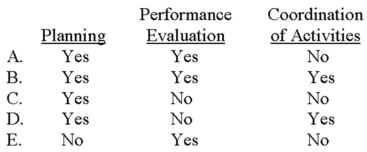
A) Choice A
B) Choice B
C) Choice C
D) Choice D
E) Choice E
A) Choice A
B) Choice B
C) Choice C
D) Choice D
E) Choice E
Question
Question
Question
Question
Question
Question
Question
Question
Question
Question
Question
Question
Question
Question
Question
Question
Question
Question
Question
Question
Question
The master budget contains the following components, among others: (1) direct-material budget, (2) budgeted balance sheet, (3) production budget, and (4) cash budget. Which of these components would be prepared first and which would be prepared last? 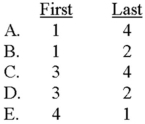
A) Choice A
B) Choice B
C) Choice C
D) Choice D
E) Choice E
A) Choice A
B) Choice B
C) Choice C
D) Choice D
E) Choice E
Question
Question
Swamp Fox has the following sales forecasts for its hip waders next year:  What is Swamp Fox's estimated sales in units for next year?
A) 41,485 pairs.
B) 38,300 pairs.
C) 40,000 pairs.
D) 40,685 pairs.
E) None of the other answers are correct.
What is Swamp Fox's estimated sales in units for next year?A) 41,485 pairs.
B) 38,300 pairs.
C) 40,000 pairs.
D) 40,685 pairs.
E) None of the other answers are correct.
Question
Question
Question
Question
Swamp Fox has the following sales forecasts for its hip waders next year:  What is Swamp Fox's estimated sales revenue for next year if each pair sells for an average of $30?
A) $1,149,000.
B) $1,200,000.
C) $1,220,550.
D) $1,244,550.
E) None of the other answers are correct.
What is Swamp Fox's estimated sales revenue for next year if each pair sells for an average of $30?A) $1,149,000.
B) $1,200,000.
C) $1,220,550.
D) $1,244,550.
E) None of the other answers are correct.
Question
Question
Question
Question
Question
Question
Question
Question
Question
Question
Which of the following would be considered when preparing a company's sales forecast? 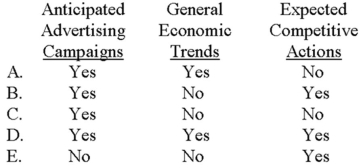
A) Choice A
B) Choice B
C) Choice C
D) Choice D
E) Choice E
A) Choice A
B) Choice B
C) Choice C
D) Choice D
E) Choice E
Question
Question
Question
Northcutt's production data for a new deluxe product were taken from the most recent quarterly production budget:  In addition, Northcutt produces 5,000 units a month of its standard product. It takes two direct labor hours to produce each standard unit and 2.25 direct labor hours to produce each deluxe unit. Northwest's cost per labor hour is $15. Direct labor cost for the quarter would be budgeted at:
A) $519,075.
B) $533,125.
C) $547,750.
D) $553,950.
E) None of the other answers are correct.
In addition, Northcutt produces 5,000 units a month of its standard product. It takes two direct labor hours to produce each standard unit and 2.25 direct labor hours to produce each deluxe unit. Northwest's cost per labor hour is $15. Direct labor cost for the quarter would be budgeted at:A) $519,075.
B) $533,125.
C) $547,750.
D) $553,950.
E) None of the other answers are correct.
Question
Question
Question
Question
Northwest manufactures a product requiring 0.5 ounces of platinum per unit. The cost of platinum is approximately $360 per ounce; the company maintains an ending platinum inventory equal to 10% of the following month's production usage. The following data were taken from the most recent quarterly production budget:  The cost of platinum to be purchased to support August production is:
A) $195,840.
B) $198,000.
C) $200,160.
D) $391,680.
E) None of the other answers are correct.
The cost of platinum to be purchased to support August production is:A) $195,840.
B) $198,000.
C) $200,160.
D) $391,680.
E) None of the other answers are correct.
Question
Northcutt's production data for a new deluxe product were taken from the most recent quarterly production budget:  In addition, Northcutt produces 5,000 units a month of its standard product. It takes two direct labor hours to produce each standard unit and 2.25 direct labor hours to produce each deluxe unit. Northwest's cost per labor hour is $15. Direct labor cost for July would be budgeted at:
A) $183,750.
B) $187,125.
C) $189,125.
D) $194,750.
E) None of the other answers are correct.
In addition, Northcutt produces 5,000 units a month of its standard product. It takes two direct labor hours to produce each standard unit and 2.25 direct labor hours to produce each deluxe unit. Northwest's cost per labor hour is $15. Direct labor cost for July would be budgeted at:A) $183,750.
B) $187,125.
C) $189,125.
D) $194,750.
E) None of the other answers are correct.
Question
Northwest's production data for one of its products were taken from the most recent quarterly production budget:  If it takes two direct labor hours to produce each unit and Northwest's cost per labor hour is $15, direct labor cost for August would be budgeted at:
A) $16,500.
B) $31,200.
C) $33,000.
D) $34,800.
E) None of the other answers are correct.
If it takes two direct labor hours to produce each unit and Northwest's cost per labor hour is $15, direct labor cost for August would be budgeted at:A) $16,500.
B) $31,200.
C) $33,000.
D) $34,800.
E) None of the other answers are correct.
Question
Tidewater plans to sell 85,000 units of product no. 794 in May, and each of these units requires three units of raw material. Pertinent data follow.  On the basis of the information presented, how many units of raw material should Tidewater purchase for use in May production?
A) 228,000.
B) 246,000.
C) 264,000.
D) 282,000.
E) None of the other answers are correct.
On the basis of the information presented, how many units of raw material should Tidewater purchase for use in May production?A) 228,000.
B) 246,000.
C) 264,000.
D) 282,000.
E) None of the other answers are correct.
Question
Nguyen plans to sell 40,000 units of product no. 75 in June, and each of these units requires five square feet of raw material. Pertinent data follow.  If the company purchases 201,000 square feet of raw material during the month, the estimated raw-material inventory on June 30 would be:
A) 11,000 square feet.
B) 13,000 square feet.
C) 23,000 square feet.
D) 25,000 square feet.
E) None of the other answers are correct.
If the company purchases 201,000 square feet of raw material during the month, the estimated raw-material inventory on June 30 would be:A) 11,000 square feet.
B) 13,000 square feet.
C) 23,000 square feet.
D) 25,000 square feet.
E) None of the other answers are correct.
Question
Northcutt's production data for a new deluxe product were taken from the most recent quarterly production budget:  In addition, Northcutt produces 5,000 units a month of its standard product. It takes two direct labor hours to produce each standard unit and 2.25 direct labor hours to produce each deluxe unit. Northwest's cost per labor hour is $15. Direct labor cost for August would be budgeted at:
A) $187,125.
B) $194,750.
C) $197,107.
D) $183,250.
E) None of the other answers are correct.
In addition, Northcutt produces 5,000 units a month of its standard product. It takes two direct labor hours to produce each standard unit and 2.25 direct labor hours to produce each deluxe unit. Northwest's cost per labor hour is $15. Direct labor cost for August would be budgeted at:A) $187,125.
B) $194,750.
C) $197,107.
D) $183,250.
E) None of the other answers are correct.
Question
Question
Question
Dragon makes all sales on account, subject to the following collection pattern: 30% are collected in the month of sale; 60% are collected in the first month after sale; and 10% are collected in the second month after sale. If sales for June, July, and August were $120,000, $160,000, and $220,000, respectively, what were the firm's budgeted collections for August and the company's budgeted receivables balance on August 31? 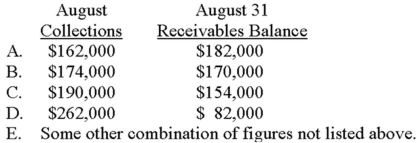
A) Choice A
B) Choice B
C) Choice C
D) Choice D
E) Choice E
A) Choice A
B) Choice B
C) Choice C
D) Choice D
E) Choice E
Question
Northcutt's production data for a new deluxe product were taken from the most recent quarterly production budget:  In addition, Northcutt produces 5,000 units a month of its standard product. It takes two direct labor hours to produce each standard unit and 2.25 direct labor hours to produce each deluxe unit. Northwest's cost per labor hour is $15. Direct labor cost for September would be budgeted at:
A) $187,125.
B) $183,075.
C) $194,750.
D) $197,075.
E) None of the other answers are correct.
In addition, Northcutt produces 5,000 units a month of its standard product. It takes two direct labor hours to produce each standard unit and 2.25 direct labor hours to produce each deluxe unit. Northwest's cost per labor hour is $15. Direct labor cost for September would be budgeted at:A) $187,125.
B) $183,075.
C) $194,750.
D) $197,075.
E) None of the other answers are correct.
Question
Question
Question
Question
Question
Question
Question
Question
Question
Question
Question
Question
If a manager builds slack into a budget, how would that manager handle estimates of revenues and expenses? 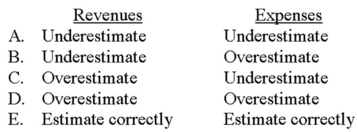
A) Choice A
B) Choice B
C) Choice C
D) Choice D
E) Choice E
A) Choice A
B) Choice B
C) Choice C
D) Choice D
E) Choice E
Question
Question
Question
Question
Question
Question
Question
Question
Question
Question
Question
Question
Question

Unlock Deck
Sign up to unlock the cards in this deck!
Unlock Deck
Unlock Deck
1/95

Play

Full screen (f)
Deck 9: Financial Planning and Analysis: the Master Budget
1
Wilmar Corporation is budgeting its equipment needs on an on-going basis, with a new quarter being added to the budget as the current quarter is completed. This type of budget is most commonly known as a:
A) capital budget.
B) rolling budget.
C) revised budget.
D) pro-forma budget.
E) financial budget.
A) capital budget.
B) rolling budget.
C) revised budget.
D) pro-forma budget.
E) financial budget.
B
2
Which of the following choices correctly denotes managerial functions that are commonly associated with budgeting?
A) Choice A
B) Choice B
C) Choice C
D) Choice D
E) Choice E
A) Choice A
B) Choice B
C) Choice C
D) Choice D
E) Choice E
B
3
James Corporation, headquartered in Chicago, has a manufacturing plant in Dallas. Plant managers desire to participate in the company's budget efforts, which, for the past 10 years, have been handled solely by top executives in Chicago. Dallas managers feel that by becoming involved, they can make great strides in terms of improving operating performance of their aging facility.
Required:
Briefly discuss this situation, focusing on the benefits and problems of letting Dallas managers participate in the company's budgetary efforts.
Required:
Briefly discuss this situation, focusing on the benefits and problems of letting Dallas managers participate in the company's budgetary efforts.
Chapter 09 Financial Planning and
4
A company's plan for the acquisition of long-lived assets, such as buildings and equipment, is commonly called a:
A) pro-forma budget.
B) master budget.
C) financial budget.
D) profit plan.
E) capital budget.
A) pro-forma budget.
B) master budget.
C) financial budget.
D) profit plan.
E) capital budget.
Unlock Deck
Unlock for access to all 95 flashcards in this deck.
Unlock Deck
k this deck
5
That employees make little effort to achieve budgetary goals is an outcome sometimes associated with participative budgeting.
Unlock Deck
Unlock for access to all 95 flashcards in this deck.
Unlock Deck
k this deck
6
A company's sales forecast would likely not consider general economic and industry trends.
Unlock Deck
Unlock for access to all 95 flashcards in this deck.
Unlock Deck
k this deck
7
A budget serves as a benchmark against which:
A) actual results can be compared.
B) allocated results can be compared.
C) actual results become inconsequential.
D) allocated results become inconsequential.
E) cash balances can be compared to expense totals.
A) actual results can be compared.
B) allocated results can be compared.
C) actual results become inconsequential.
D) allocated results become inconsequential.
E) cash balances can be compared to expense totals.
Unlock Deck
Unlock for access to all 95 flashcards in this deck.
Unlock Deck
k this deck
8
Sainte Claire Corporation has a highly automated production facility. Production volume and management judgment are the two factors that would likely have the most direct influence on the company's manufacturing overhead budget.
Unlock Deck
Unlock for access to all 95 flashcards in this deck.
Unlock Deck
k this deck
9
A company's plan for the issuance of stock or incurrence of debt is commonly called a:
A) pro-forma budget.
B) master budget.
C) financial budget.
D) profit plan.
E) capital budget.
A) pro-forma budget.
B) master budget.
C) financial budget.
D) profit plan.
E) capital budget.
Unlock Deck
Unlock for access to all 95 flashcards in this deck.
Unlock Deck
k this deck
10
An organization's budgets will often be prepared to cover:
A) one month.
B) one quarter.
C) one year.
D) periods longer than one year.
E) all of the other answers are correct.
A) one month.
B) one quarter.
C) one year.
D) periods longer than one year.
E) all of the other answers are correct.
Unlock Deck
Unlock for access to all 95 flashcards in this deck.
Unlock Deck
k this deck
11
The budgeted income statement, budgeted balance sheet, and budgeted statement of cash flows comprise:
A) the final portion of the master budget.
B) the depiction of an organization's overall actual financial results.
C) the first step of the master budget.
D) the portion of the master budget prepared after the sales forecast and before the remainder of the operational budgets.
E) the second step of the master budget.
A) the final portion of the master budget.
B) the depiction of an organization's overall actual financial results.
C) the first step of the master budget.
D) the portion of the master budget prepared after the sales forecast and before the remainder of the operational budgets.
E) the second step of the master budget.
Unlock Deck
Unlock for access to all 95 flashcards in this deck.
Unlock Deck
k this deck
12
The comprehensive set of budgets that serves as a company's overall financial plan is commonly known as the financial budget.
Unlock Deck
Unlock for access to all 95 flashcards in this deck.
Unlock Deck
k this deck
13
Generally speaking, budgets are not used to:
A) identify a company's most profitable products.
B) evaluate performance.
C) create a plan of action.
D) assist in the control of profit and operations.
E) facilitate communication and coordinate activities.
A) identify a company's most profitable products.
B) evaluate performance.
C) create a plan of action.
D) assist in the control of profit and operations.
E) facilitate communication and coordinate activities.
Unlock Deck
Unlock for access to all 95 flashcards in this deck.
Unlock Deck
k this deck
14
The budgeting technique that helps managers assess the company's future and know if they are reaching their performance goals is called life-cycle budgeting.
Unlock Deck
Unlock for access to all 95 flashcards in this deck.
Unlock Deck
k this deck
15
Which of the following budgets is prepared at the end of the budget-construction cycle?
A) Sales budget.
B) Production budget.
C) Budgeted financial statements.
D) Cash budget.
E) Overhead budget.
A) Sales budget.
B) Production budget.
C) Budgeted financial statements.
D) Cash budget.
E) Overhead budget.
Unlock Deck
Unlock for access to all 95 flashcards in this deck.
Unlock Deck
k this deck
16
A formal budget program will almost always result in:
A) higher sales.
B) more cash inflows than cash outflows.
C) decreased expenses.
D) improved profits.
E) a detailed plan against which actual results can be compared.
A) higher sales.
B) more cash inflows than cash outflows.
C) decreased expenses.
D) improved profits.
E) a detailed plan against which actual results can be compared.
Unlock Deck
Unlock for access to all 95 flashcards in this deck.
Unlock Deck
k this deck
17
The comprehensive set of budgets that serves as a company's overall financial plan is commonly known as:
A) an integrated budget.
B) a pro-forma budget.
C) a master budget.
D) a financial budget.
E) a rolling budget.
A) an integrated budget.
B) a pro-forma budget.
C) a master budget.
D) a financial budget.
E) a rolling budget.
Unlock Deck
Unlock for access to all 95 flashcards in this deck.
Unlock Deck
k this deck
18
A manufacturing firm would begin preparation of its master budget by constructing a:
A) sales budget.
B) production budget.
C) cash budget.
D) capital budget.
E) set of pro-forma financial statements.
A) sales budget.
B) production budget.
C) cash budget.
D) capital budget.
E) set of pro-forma financial statements.
Unlock Deck
Unlock for access to all 95 flashcards in this deck.
Unlock Deck
k this deck
19
A company's expected receipts from sales and planned disbursements to pay bills is commonly called a:
A) pro-forma budget.
B) master budget.
C) financial budget.
D) profit plan.
E) cash budget.
A) pro-forma budget.
B) master budget.
C) financial budget.
D) profit plan.
E) cash budget.
Unlock Deck
Unlock for access to all 95 flashcards in this deck.
Unlock Deck
k this deck
20
Which of the following budgets is based on many other master-budget components?
A) Direct labor budget.
B) Overhead budget.
C) Sales budget.
D) Cash budget.
E) Selling and administrative expense budget.
A) Direct labor budget.
B) Overhead budget.
C) Sales budget.
D) Cash budget.
E) Selling and administrative expense budget.
Unlock Deck
Unlock for access to all 95 flashcards in this deck.
Unlock Deck
k this deck
21
Yorkley Corporation plans to sell 41,000 units of its single product in March. The company has 2,800 units in its March 1 finished-goods inventory and anticipates having 2,400 completed units in inventory on March 31. On the basis of this information, how many units does Yorkley plan to produce during March?
A) 40,600.
B) 41,400.
C) 43,800.
D) 46,200.
E) None of the other answers are correct.
A) 40,600.
B) 41,400.
C) 43,800.
D) 46,200.
E) None of the other answers are correct.
Unlock Deck
Unlock for access to all 95 flashcards in this deck.
Unlock Deck
k this deck
22
Which of the following would have no effect, either direct or indirect, on an organization's cash budget?
A) Sales revenues.
B) Outlays for professional labor.
C) Advertising expenditures.
D) Raw material purchases.
E) None of the other answers are correct, since all of these items would have some influence.
A) Sales revenues.
B) Outlays for professional labor.
C) Advertising expenditures.
D) Raw material purchases.
E) None of the other answers are correct, since all of these items would have some influence.
Unlock Deck
Unlock for access to all 95 flashcards in this deck.
Unlock Deck
k this deck
23
The master budget contains the following components, among others: (1) direct-material budget, (2) budgeted balance sheet, (3) production budget, and (4) cash budget. Which of these components would be prepared first and which would be prepared last?
A) Choice A
B) Choice B
C) Choice C
D) Choice D
E) Choice E
A) Choice A
B) Choice B
C) Choice C
D) Choice D
E) Choice E
Unlock Deck
Unlock for access to all 95 flashcards in this deck.
Unlock Deck
k this deck
24
Mayze Production Company, which uses activity-based budgeting, is in the process of preparing a manufacturing overhead budget. Which of the following would likely appear on that budget?
A) Batch-level costs: Production setup.
B) Unit-level costs: Depreciation.
C) Unit-level costs: Maintenance.
D) Product-level costs: Insurance and property taxes.
E) Facility and general operations-level costs: Indirect material.
A) Batch-level costs: Production setup.
B) Unit-level costs: Depreciation.
C) Unit-level costs: Maintenance.
D) Product-level costs: Insurance and property taxes.
E) Facility and general operations-level costs: Indirect material.
Unlock Deck
Unlock for access to all 95 flashcards in this deck.
Unlock Deck
k this deck
25
Swamp Fox has the following sales forecasts for its hip waders next year: What is Swamp Fox's estimated sales in units for next year?
A) 41,485 pairs.
B) 38,300 pairs.
C) 40,000 pairs.
D) 40,685 pairs.
E) None of the other answers are correct.
What is Swamp Fox's estimated sales in units for next year?A) 41,485 pairs.
B) 38,300 pairs.
C) 40,000 pairs.
D) 40,685 pairs.
E) None of the other answers are correct.
Unlock Deck
Unlock for access to all 95 flashcards in this deck.
Unlock Deck
k this deck
26
Activity-based budgeting:
A) begins with a forecast of products and services to be produced, and customers served.
B) ends with a forecast of products and services to be produced, and customers served.
C) parallels the flow of analysis that is associated with activity-based costing.
D) reverses the flow of analysis that is associated with activity-based costing.
E) None of the other answers are correct.
A) begins with a forecast of products and services to be produced, and customers served.
B) ends with a forecast of products and services to be produced, and customers served.
C) parallels the flow of analysis that is associated with activity-based costing.
D) reverses the flow of analysis that is associated with activity-based costing.
E) None of the other answers are correct.
Unlock Deck
Unlock for access to all 95 flashcards in this deck.
Unlock Deck
k this deck
27
A company's sales forecast would likely consider all of the following factors except:
A) past sales levels and trends.
B) the company's intended pricing policy.
C) the company's product costing policy.
D) market research studies.
E) planned advertising and promotions.
A) past sales levels and trends.
B) the company's intended pricing policy.
C) the company's product costing policy.
D) market research studies.
E) planned advertising and promotions.
Unlock Deck
Unlock for access to all 95 flashcards in this deck.
Unlock Deck
k this deck
28
A company's sales forecast would likely consider all of the following factors except:
A) political and legal events.
B) advertising and pricing policies.
C) general economic and industry trends.
D) top management's attitude toward decentralized operating structures.
E) competition.
A) political and legal events.
B) advertising and pricing policies.
C) general economic and industry trends.
D) top management's attitude toward decentralized operating structures.
E) competition.
Unlock Deck
Unlock for access to all 95 flashcards in this deck.
Unlock Deck
k this deck
29
Swamp Fox has the following sales forecasts for its hip waders next year: What is Swamp Fox's estimated sales revenue for next year if each pair sells for an average of $30?
A) $1,149,000.
B) $1,200,000.
C) $1,220,550.
D) $1,244,550.
E) None of the other answers are correct.
What is Swamp Fox's estimated sales revenue for next year if each pair sells for an average of $30?A) $1,149,000.
B) $1,200,000.
C) $1,220,550.
D) $1,244,550.
E) None of the other answers are correct.
Unlock Deck
Unlock for access to all 95 flashcards in this deck.
Unlock Deck
k this deck
30
Sainte Claire Corporation has a highly automated production facility. Which of the following correctly shows the two factors that would likely have the most direct influence on the company's manufacturing overhead budget?
A) Sales volume and labor hours.
B) Contribution margin and cash payments.
C) Production volume and management judgment.
D) Labor hours and management judgment.
E) Management judgment and indirect labor cost.
A) Sales volume and labor hours.
B) Contribution margin and cash payments.
C) Production volume and management judgment.
D) Labor hours and management judgment.
E) Management judgment and indirect labor cost.
Unlock Deck
Unlock for access to all 95 flashcards in this deck.
Unlock Deck
k this deck
31
Which of the following would depict the logical order for preparing (1) a production budget, (2) a cash budget, (3) a sales budget, and (4) a direct-labor budget?
A) 1-3-4-2.
B) 2-3-1-4.
C) 2-1-3-4.
D) 3-1-4-2.
E) 3-1-2-4.
A) 1-3-4-2.
B) 2-3-1-4.
C) 2-1-3-4.
D) 3-1-4-2.
E) 3-1-2-4.
Unlock Deck
Unlock for access to all 95 flashcards in this deck.
Unlock Deck
k this deck
32
Which of the following statements best describes the relationship between the sales-forecasting process and the master-budgeting process?
A) The sales forecast is typically completed after completion of the master budget.
B) The sales forecast is typically completed approximately halfway through the master-budget process.
C) The sales forecast is typically completed before the master budget and has no impact on the master budget.
D) The sales forecast is typically completed before the master budget and has little impact on the master budget.
E) The sales forecast is typically completed before the master budget and has significant impact on the master budget.
A) The sales forecast is typically completed after completion of the master budget.
B) The sales forecast is typically completed approximately halfway through the master-budget process.
C) The sales forecast is typically completed before the master budget and has no impact on the master budget.
D) The sales forecast is typically completed before the master budget and has little impact on the master budget.
E) The sales forecast is typically completed before the master budget and has significant impact on the master budget.
Unlock Deck
Unlock for access to all 95 flashcards in this deck.
Unlock Deck
k this deck
33
Bird plans to sell 5,000 units each quarter next year. During the first two quarters each unit will sell for $12; during the last two quarters the sales price will increase $1.50 per unit. What is Bird's estimated sales revenue for next year?
A) $240,000.
B) $255,000.
C) $270,000.
D) $244,000.
E) None of the other answers are correct.
A) $240,000.
B) $255,000.
C) $270,000.
D) $244,000.
E) None of the other answers are correct.
Unlock Deck
Unlock for access to all 95 flashcards in this deck.
Unlock Deck
k this deck
34
Swansong plans to sell 10,000 units of a particular product during July, and expects sales to increase at the rate of 10% per month during the remainder of the year. The June 30 and September 30 ending inventories are anticipated to be 1,100 units and 950 units, respectively. On the basis of this information, how many units should Swansong purchase for the quarter ended September 30?
A) 31,850.
B) 32,150.
C) 32,950.
D) 33,250.
E) None of the other answers are correct.
A) 31,850.
B) 32,150.
C) 32,950.
D) 33,250.
E) None of the other answers are correct.
Unlock Deck
Unlock for access to all 95 flashcards in this deck.
Unlock Deck
k this deck
35
Which of the following organizations is not likely to use budgets?
A) Manufacturing firms.
B) Merchandising firms.
C) Firms in service industries.
D) Nonprofit organizations.
E) none of the other answers are correct, because all are likely to use budgets.
A) Manufacturing firms.
B) Merchandising firms.
C) Firms in service industries.
D) Nonprofit organizations.
E) none of the other answers are correct, because all are likely to use budgets.
Unlock Deck
Unlock for access to all 95 flashcards in this deck.
Unlock Deck
k this deck
36
Nonprofit organizations begin their budgeting process with:
A) a sales budget.
B) anticipated funding.
C) proforma financial statements.
D) services to be provided.
E) a cash budget.
A) a sales budget.
B) anticipated funding.
C) proforma financial statements.
D) services to be provided.
E) a cash budget.
Unlock Deck
Unlock for access to all 95 flashcards in this deck.
Unlock Deck
k this deck
37
A company that uses activity-based budgeting performs the following:
1-Plans activities for the budget period.
2-Forecasts the demand for products and services as well as the customers to be served.
3-Budgets the resources necessary to carry out activities.
Which of the following denotes the proper order of the preceding activities?
A) 1-2-3.
B) 2-1-3.
C) 2-3-1.
D) 3-1-2.
E) 3-2-1.
1-Plans activities for the budget period.
2-Forecasts the demand for products and services as well as the customers to be served.
3-Budgets the resources necessary to carry out activities.
Which of the following denotes the proper order of the preceding activities?
A) 1-2-3.
B) 2-1-3.
C) 2-3-1.
D) 3-1-2.
E) 3-2-1.
Unlock Deck
Unlock for access to all 95 flashcards in this deck.
Unlock Deck
k this deck
38
Bison Sporting Goods sells bicycles throughout the northeastern United States. The following data were taken from the most recent quarterly sales forecast: On the basis of the information presented, how many bicycles should the company purchase in August?
A) 1,860.
B) 1,950.
C) 2,040.
D) 2,250.
E) None of the other answers are correct.
A) 1,860.
B) 1,950.
C) 2,040.
D) 2,250.
E) None of the other answers are correct.
Unlock Deck
Unlock for access to all 95 flashcards in this deck.
Unlock Deck
k this deck
39
Which of the following would be considered when preparing a company's sales forecast?
A) Choice A
B) Choice B
C) Choice C
D) Choice D
E) Choice E
A) Choice A
B) Choice B
C) Choice C
D) Choice D
E) Choice E
Unlock Deck
Unlock for access to all 95 flashcards in this deck.
Unlock Deck
k this deck
40
FastTec sells electronics in retail outlets and on the Internet. It uses activity-based budgeting in the preparation of its selling, general, and administrative expense budget. Which of the following costs would the company likely classify as a unit-level expense on its budget?
A) Media advertising.
B) Retail outlet sales commissions.
C) Salaries of web-site maintenance personnel.
D) Administrative salaries.
E) Salary of the sales manager employed at store no. 23.
A) Media advertising.
B) Retail outlet sales commissions.
C) Salaries of web-site maintenance personnel.
D) Administrative salaries.
E) Salary of the sales manager employed at store no. 23.
Unlock Deck
Unlock for access to all 95 flashcards in this deck.
Unlock Deck
k this deck
41
Coleman, Inc. anticipates sales of 50,000 units, 48,000 units, and 51,000 units in July, August, and September, respectively. Company policy is to maintain an ending finished-goods inventory equal to 40% of the following month's sales. On the basis of this information, how many units would the company plan to produce in July?
A) 46,800.
B) 49,200.
C) 49,800.
D) 52,200.
E) None of the other answers are correct.
A) 46,800.
B) 49,200.
C) 49,800.
D) 52,200.
E) None of the other answers are correct.
Unlock Deck
Unlock for access to all 95 flashcards in this deck.
Unlock Deck
k this deck
42
Northcutt's production data for a new deluxe product were taken from the most recent quarterly production budget: In addition, Northcutt produces 5,000 units a month of its standard product. It takes two direct labor hours to produce each standard unit and 2.25 direct labor hours to produce each deluxe unit. Northwest's cost per labor hour is $15. Direct labor cost for the quarter would be budgeted at:
A) $519,075.
B) $533,125.
C) $547,750.
D) $553,950.
E) None of the other answers are correct.
In addition, Northcutt produces 5,000 units a month of its standard product. It takes two direct labor hours to produce each standard unit and 2.25 direct labor hours to produce each deluxe unit. Northwest's cost per labor hour is $15. Direct labor cost for the quarter would be budgeted at:A) $519,075.
B) $533,125.
C) $547,750.
D) $553,950.
E) None of the other answers are correct.
Unlock Deck
Unlock for access to all 95 flashcards in this deck.
Unlock Deck
k this deck
43
Quattro began operations in April of this year. It makes all sales on account, subject to the following collection pattern: 30% are collected in the month of sale; 60% are collected in the first month after sale; and 10% are collected in the second month after sale. If sales for April, May, and June were $60,000, $80,000, and $70,000, respectively, what were the firm's budgeted collections for June?
A) $21,000.
B) $60,000.
C) $69,000.
D) $75,000.
E) None of the other answers are correct.
A) $21,000.
B) $60,000.
C) $69,000.
D) $75,000.
E) None of the other answers are correct.
Unlock Deck
Unlock for access to all 95 flashcards in this deck.
Unlock Deck
k this deck
44
Coleman, Inc. anticipates sales of 50,000 units, 48,000 units, and 51,000 units in July, August, and September, respectively. Company policy is to maintain an ending finished-goods inventory equal to 40% of the following month's sales. On the basis of this information, how many units would the company plan to produce in August?
A) 48,000.
B) 49,200.
C) 49,800.
D) 50,600.
E) None of the other answers are correct.
A) 48,000.
B) 49,200.
C) 49,800.
D) 50,600.
E) None of the other answers are correct.
Unlock Deck
Unlock for access to all 95 flashcards in this deck.
Unlock Deck
k this deck
45
Quattro began operations in April of this year. It makes all sales on account, subject to the following collection pattern: 30% are collected in the month of sale; 60% are collected in the first month after sale; and 10% are collected in the second month after sale. If sales for April, May, and June were $60,000, $80,000, and $70,000, respectively, what were the firm's budgeted collections for April?
A) $18,000.
B) $21,000.
C) $60,000.
D) $65,000.
E) None of the other answers are correct.
A) $18,000.
B) $21,000.
C) $60,000.
D) $65,000.
E) None of the other answers are correct.
Unlock Deck
Unlock for access to all 95 flashcards in this deck.
Unlock Deck
k this deck
46
Northwest manufactures a product requiring 0.5 ounces of platinum per unit. The cost of platinum is approximately $360 per ounce; the company maintains an ending platinum inventory equal to 10% of the following month's production usage. The following data were taken from the most recent quarterly production budget: The cost of platinum to be purchased to support August production is:
A) $195,840.
B) $198,000.
C) $200,160.
D) $391,680.
E) None of the other answers are correct.
The cost of platinum to be purchased to support August production is:A) $195,840.
B) $198,000.
C) $200,160.
D) $391,680.
E) None of the other answers are correct.
Unlock Deck
Unlock for access to all 95 flashcards in this deck.
Unlock Deck
k this deck
47
Northcutt's production data for a new deluxe product were taken from the most recent quarterly production budget: In addition, Northcutt produces 5,000 units a month of its standard product. It takes two direct labor hours to produce each standard unit and 2.25 direct labor hours to produce each deluxe unit. Northwest's cost per labor hour is $15. Direct labor cost for July would be budgeted at:
A) $183,750.
B) $187,125.
C) $189,125.
D) $194,750.
E) None of the other answers are correct.
In addition, Northcutt produces 5,000 units a month of its standard product. It takes two direct labor hours to produce each standard unit and 2.25 direct labor hours to produce each deluxe unit. Northwest's cost per labor hour is $15. Direct labor cost for July would be budgeted at:A) $183,750.
B) $187,125.
C) $189,125.
D) $194,750.
E) None of the other answers are correct.
Unlock Deck
Unlock for access to all 95 flashcards in this deck.
Unlock Deck
k this deck
48
Northwest's production data for one of its products were taken from the most recent quarterly production budget: If it takes two direct labor hours to produce each unit and Northwest's cost per labor hour is $15, direct labor cost for August would be budgeted at:
A) $16,500.
B) $31,200.
C) $33,000.
D) $34,800.
E) None of the other answers are correct.
If it takes two direct labor hours to produce each unit and Northwest's cost per labor hour is $15, direct labor cost for August would be budgeted at:A) $16,500.
B) $31,200.
C) $33,000.
D) $34,800.
E) None of the other answers are correct.
Unlock Deck
Unlock for access to all 95 flashcards in this deck.
Unlock Deck
k this deck
49
Tidewater plans to sell 85,000 units of product no. 794 in May, and each of these units requires three units of raw material. Pertinent data follow. On the basis of the information presented, how many units of raw material should Tidewater purchase for use in May production?
A) 228,000.
B) 246,000.
C) 264,000.
D) 282,000.
E) None of the other answers are correct.
On the basis of the information presented, how many units of raw material should Tidewater purchase for use in May production?A) 228,000.
B) 246,000.
C) 264,000.
D) 282,000.
E) None of the other answers are correct.
Unlock Deck
Unlock for access to all 95 flashcards in this deck.
Unlock Deck
k this deck
50
Nguyen plans to sell 40,000 units of product no. 75 in June, and each of these units requires five square feet of raw material. Pertinent data follow. If the company purchases 201,000 square feet of raw material during the month, the estimated raw-material inventory on June 30 would be:
A) 11,000 square feet.
B) 13,000 square feet.
C) 23,000 square feet.
D) 25,000 square feet.
E) None of the other answers are correct.
If the company purchases 201,000 square feet of raw material during the month, the estimated raw-material inventory on June 30 would be:A) 11,000 square feet.
B) 13,000 square feet.
C) 23,000 square feet.
D) 25,000 square feet.
E) None of the other answers are correct.
Unlock Deck
Unlock for access to all 95 flashcards in this deck.
Unlock Deck
k this deck
51
Northcutt's production data for a new deluxe product were taken from the most recent quarterly production budget: In addition, Northcutt produces 5,000 units a month of its standard product. It takes two direct labor hours to produce each standard unit and 2.25 direct labor hours to produce each deluxe unit. Northwest's cost per labor hour is $15. Direct labor cost for August would be budgeted at:
A) $187,125.
B) $194,750.
C) $197,107.
D) $183,250.
E) None of the other answers are correct.
In addition, Northcutt produces 5,000 units a month of its standard product. It takes two direct labor hours to produce each standard unit and 2.25 direct labor hours to produce each deluxe unit. Northwest's cost per labor hour is $15. Direct labor cost for August would be budgeted at:A) $187,125.
B) $194,750.
C) $197,107.
D) $183,250.
E) None of the other answers are correct.
Unlock Deck
Unlock for access to all 95 flashcards in this deck.
Unlock Deck
k this deck
52
Verna's makes all sales on account, subject to the following collection pattern: 20% are collected in the month of sale; 70% are collected in the first month after sale; and 10% are collected in the second month after sale. If sales for October, November, and December were $70,000, $60,000, and $50,000, respectively, what was the budgeted receivables balance on December 31?
A) $40,000.
B) $46,000.
C) $49,000.
D) $59,000.
E) None of the other answers are correct.
A) $40,000.
B) $46,000.
C) $49,000.
D) $59,000.
E) None of the other answers are correct.
Unlock Deck
Unlock for access to all 95 flashcards in this deck.
Unlock Deck
k this deck
53
Coleman, Inc. anticipates sales of 50,000 units, 48,000 units, 51,000 units and 50,000 units in July, August, September and October, respectively. Company policy is to maintain an ending finished-goods inventory equal to 40% of the following month's sales. On the basis of this information, how many units would the company plan to produce in September?
A) 46,800.
B) 49,200.
C) 49,800.
D) 50,600.
E) None of the other answers are correct.
A) 46,800.
B) 49,200.
C) 49,800.
D) 50,600.
E) None of the other answers are correct.
Unlock Deck
Unlock for access to all 95 flashcards in this deck.
Unlock Deck
k this deck
54
Dragon makes all sales on account, subject to the following collection pattern: 30% are collected in the month of sale; 60% are collected in the first month after sale; and 10% are collected in the second month after sale. If sales for June, July, and August were $120,000, $160,000, and $220,000, respectively, what were the firm's budgeted collections for August and the company's budgeted receivables balance on August 31?
A) Choice A
B) Choice B
C) Choice C
D) Choice D
E) Choice E
A) Choice A
B) Choice B
C) Choice C
D) Choice D
E) Choice E
Unlock Deck
Unlock for access to all 95 flashcards in this deck.
Unlock Deck
k this deck
55
Northcutt's production data for a new deluxe product were taken from the most recent quarterly production budget: In addition, Northcutt produces 5,000 units a month of its standard product. It takes two direct labor hours to produce each standard unit and 2.25 direct labor hours to produce each deluxe unit. Northwest's cost per labor hour is $15. Direct labor cost for September would be budgeted at:
A) $187,125.
B) $183,075.
C) $194,750.
D) $197,075.
E) None of the other answers are correct.
In addition, Northcutt produces 5,000 units a month of its standard product. It takes two direct labor hours to produce each standard unit and 2.25 direct labor hours to produce each deluxe unit. Northwest's cost per labor hour is $15. Direct labor cost for September would be budgeted at:A) $187,125.
B) $183,075.
C) $194,750.
D) $197,075.
E) None of the other answers are correct.
Unlock Deck
Unlock for access to all 95 flashcards in this deck.
Unlock Deck
k this deck
56
Quattro began operations in April of this year. It makes all sales on account, subject to the following collection pattern: 30% are collected in the month of sale; 60% are collected in the first month after sale; and 10% are collected in the second month after sale. If sales for April, May, and June were $60,000, $80,000, and $70,000, respectively, what were the firm's budgeted collections for the quarter?
A) $121,000.
B) $140,000.
C) $153,000.
D) $175,000.
E) None of the other answers are correct.
A) $121,000.
B) $140,000.
C) $153,000.
D) $175,000.
E) None of the other answers are correct.
Unlock Deck
Unlock for access to all 95 flashcards in this deck.
Unlock Deck
k this deck
57
Telfair & Company had 3,000 units in finished-goods inventory on December 31. The following data are available for the upcoming year: The number of units the company expects to sell in January is:
A) 6,900.
B) 8,900.
C) 9,400.
D) 9,900.
E) 11,900.
A) 6,900.
B) 8,900.
C) 9,400.
D) 9,900.
E) 11,900.
Unlock Deck
Unlock for access to all 95 flashcards in this deck.
Unlock Deck
k this deck
58
An examination of Shorter Corporation's inventory accounts revealed the following information:
Raw materials, June 1: 46,000 units
Raw materials, June 30: 51,000 units
Purchases of raw materials during June: 185,000 units
Shorter's finished product requires four units of raw materials. On the basis of this information, how many finished products were manufactured during June?
A) 45,000.
B) 47,500.
C) 57,750.
D) 70,500.
E) None of the other answers are correct.
Raw materials, June 1: 46,000 units
Raw materials, June 30: 51,000 units
Purchases of raw materials during June: 185,000 units
Shorter's finished product requires four units of raw materials. On the basis of this information, how many finished products were manufactured during June?
A) 45,000.
B) 47,500.
C) 57,750.
D) 70,500.
E) None of the other answers are correct.
Unlock Deck
Unlock for access to all 95 flashcards in this deck.
Unlock Deck
k this deck
59
To derive the raw material to purchase during an accounting period, an accountant would calculate the raw material required for production and then:
A) add the beginning raw-material inventory and the desired ending raw-material inventory.
B) subtract the beginning raw-material inventory and the desired ending raw-material inventory.
C) add the beginning raw-material inventory and subtract the desired ending raw-material inventory.
D) add the desired ending raw-material inventory and subtract the beginning raw-material inventory.
E) add the desired ending raw-material inventory and subtract both the beginning raw-material inventory and the expected units to be sold.
A) add the beginning raw-material inventory and the desired ending raw-material inventory.
B) subtract the beginning raw-material inventory and the desired ending raw-material inventory.
C) add the beginning raw-material inventory and subtract the desired ending raw-material inventory.
D) add the desired ending raw-material inventory and subtract the beginning raw-material inventory.
E) add the desired ending raw-material inventory and subtract both the beginning raw-material inventory and the expected units to be sold.
Unlock Deck
Unlock for access to all 95 flashcards in this deck.
Unlock Deck
k this deck
60
Quattro began operations in April of this year. It makes all sales on account, subject to the following collection pattern: 30% are collected in the month of sale; 60% are collected in the first month after sale; and 10% are collected in the second month after sale. If sales for April, May, and June were $60,000, $80,000, and $70,000, respectively, what were the firm's budgeted collections for May?
A) $21,000.
B) $60,000.
C) $69,000.
D) $75,000.
E) None of the other answers are correct.
A) $21,000.
B) $60,000.
C) $69,000.
D) $75,000.
E) None of the other answers are correct.
Unlock Deck
Unlock for access to all 95 flashcards in this deck.
Unlock Deck
k this deck
61
The following events took place when Managers A, B, and C were preparing budgets for the upcoming period:
I) Manager A increased property tax expenditures by 2% when she was informed of a recent rate hike by local authorities.
II) Manager B reduced sales revenues by 4% when informed of recent aggressive actions by a new competitor.
III) Manager C, who supervises employees with widely varying skill levels, used the highest wage rate in the department when preparing the labor budget.
Assuming that the percentage amounts given are reasonable, which of the preceding cases is (are) an example of building slack in budgets?
A) I only.
B) II only.
C) III only.
D) I and II.
E) II and III.
I) Manager A increased property tax expenditures by 2% when she was informed of a recent rate hike by local authorities.
II) Manager B reduced sales revenues by 4% when informed of recent aggressive actions by a new competitor.
III) Manager C, who supervises employees with widely varying skill levels, used the highest wage rate in the department when preparing the labor budget.
Assuming that the percentage amounts given are reasonable, which of the preceding cases is (are) an example of building slack in budgets?
A) I only.
B) II only.
C) III only.
D) I and II.
E) II and III.
Unlock Deck
Unlock for access to all 95 flashcards in this deck.
Unlock Deck
k this deck
62
The Gingham Company's budgeted income statement reflects the following amounts: Sales are collected 50% in the month of sale, 30% in the month following sale, and 19% in the second month following sale. One percent of sales is uncollectible and expensed at the end of the year.
Gingham pays for all purchases in the month following purchase and takes advantage of a 3% discount. The following balances are as of January 1:
*Of this balance, $35,000 will be collected in January and the remaining amount will be collected in February.
The monthly expense figures include $5,000 of depreciation. The expenses are paid in the month incurred.
Gingham's expected cash balance at the end of February is:
A) $87,000.
B) $89,160.
C) $92,000.
D) $94,160.
E) $113,300.
Gingham pays for all purchases in the month following purchase and takes advantage of a 3% discount. The following balances are as of January 1:
*Of this balance, $35,000 will be collected in January and the remaining amount will be collected in February.
The monthly expense figures include $5,000 of depreciation. The expenses are paid in the month incurred.
Gingham's expected cash balance at the end of February is:
A) $87,000.
B) $89,160.
C) $92,000.
D) $94,160.
E) $113,300.
Unlock Deck
Unlock for access to all 95 flashcards in this deck.
Unlock Deck
k this deck
63
End-of-period figures for accounts receivable and payables to suppliers would be found on the:
A) cash budget.
B) budgeted schedule of cost of goods manufactured.
C) budgeted income statement.
D) budgeted balance sheet.
E) budgeted statement of cash flows.
A) cash budget.
B) budgeted schedule of cost of goods manufactured.
C) budgeted income statement.
D) budgeted balance sheet.
E) budgeted statement of cash flows.
Unlock Deck
Unlock for access to all 95 flashcards in this deck.
Unlock Deck
k this deck
64
Consider the following statements about budgetary slack:
I) Managers build slack into a budget so that they stand a greater chance of receiving favorable performance evaluations.
II) Budgetary slack is used by managers to guard against uncertainty and unforeseen events.
III) Budgetary slack is used by managers to guard against dollar cuts by top management in the resource allocation process.
Which of the above statements is (are) true?
A) I only.
B) II only.
C) I and II.
D) II and III.
E) I, II, and III.
I) Managers build slack into a budget so that they stand a greater chance of receiving favorable performance evaluations.
II) Budgetary slack is used by managers to guard against uncertainty and unforeseen events.
III) Budgetary slack is used by managers to guard against dollar cuts by top management in the resource allocation process.
Which of the above statements is (are) true?
A) I only.
B) II only.
C) I and II.
D) II and III.
E) I, II, and III.
Unlock Deck
Unlock for access to all 95 flashcards in this deck.
Unlock Deck
k this deck
65
Virginia State University (VSU) is preparing its master budget for the upcoming academic year (an academic year consists of two semesters). Currently, 12,000 students are enrolled on campus; however, the admissions office is forecasting a 5% growth in the student body despite a tuition hike to $80 per credit hour. The following additional information has been gathered from an examination of university records and conversations with university officials:
• VSU is planning to award 150 tuition-free scholarships.
• The average class has 30 students, and the typical student takes 15 credit hours each semester.
• Each class is three credit hours.
• Each faculty member teaches five classes during the academic year.
Required:
A. Compute the budgeted tuition revenue for the upcoming academic year.
B. Determine the number of faculty members needed to cover classes.
C. In preparing the university's master budget, should the administration begin with a forecast of students or a forecast of faculty members? Briefly explain.
• VSU is planning to award 150 tuition-free scholarships.
• The average class has 30 students, and the typical student takes 15 credit hours each semester.
• Each class is three credit hours.
• Each faculty member teaches five classes during the academic year.
Required:
A. Compute the budgeted tuition revenue for the upcoming academic year.
B. Determine the number of faculty members needed to cover classes.
C. In preparing the university's master budget, should the administration begin with a forecast of students or a forecast of faculty members? Briefly explain.
Unlock Deck
Unlock for access to all 95 flashcards in this deck.
Unlock Deck
k this deck
66
The difference between the revenue or cost projection that a person provides, and a realistic estimate of the revenue or cost, is called:
A) passing the buck.
B) budgetary slack.
C) false budgeting.
D) participative budgeting.
E) resource allocation processing.
A) passing the buck.
B) budgetary slack.
C) false budgeting.
D) participative budgeting.
E) resource allocation processing.
Unlock Deck
Unlock for access to all 95 flashcards in this deck.
Unlock Deck
k this deck
67
If a manager builds slack into a budget, how would that manager handle estimates of revenues and expenses?
A) Choice A
B) Choice B
C) Choice C
D) Choice D
E) Choice E
A) Choice A
B) Choice B
C) Choice C
D) Choice D
E) Choice E
Unlock Deck
Unlock for access to all 95 flashcards in this deck.
Unlock Deck
k this deck
68
Brooke-lyn makes all purchases on account, subject to the following payment pattern:
Paid in the month of purchase: 30%
Paid in the first month following purchase: 65%
Paid in the second month following purchase: 5%
If purchases for April, May, and June were $200,000, $160,000, and $250,000, respectively, what was the firm's budgeted payables balance on June 30?
A) $175,000.
B) $179,000.
C) $183,000.
D) $189,000.
E) None of the other answers are correct.
Paid in the month of purchase: 30%
Paid in the first month following purchase: 65%
Paid in the second month following purchase: 5%
If purchases for April, May, and June were $200,000, $160,000, and $250,000, respectively, what was the firm's budgeted payables balance on June 30?
A) $175,000.
B) $179,000.
C) $183,000.
D) $189,000.
E) None of the other answers are correct.
Unlock Deck
Unlock for access to all 95 flashcards in this deck.
Unlock Deck
k this deck
69
When an organization involves its many employees in the budgeting process in a meaningful way, the organization is said to be using an approach most commonly known as:
A) budgetary slack.
B) participative budgeting.
C) budget padding.
D) imposed budgeting.
E) employee-based budgeting.
A) budgetary slack.
B) participative budgeting.
C) budget padding.
D) imposed budgeting.
E) employee-based budgeting.
Unlock Deck
Unlock for access to all 95 flashcards in this deck.
Unlock Deck
k this deck
70
Digregory makes all purchases on account, subject to the following payment pattern:
Paid in the month of purchase: 30%
Paid in the first month following purchase: 60%
Paid in the second month following purchase: 10%
If purchases for January, February, and March were $200,000, $180,000, and $230,000, respectively, what were the firm's budgeted payments in March?
A) $69,000.
B) $138,000.
C) $177,000.
D) $197,000.
E) None of the other answers are correct.
Paid in the month of purchase: 30%
Paid in the first month following purchase: 60%
Paid in the second month following purchase: 10%
If purchases for January, February, and March were $200,000, $180,000, and $230,000, respectively, what were the firm's budgeted payments in March?
A) $69,000.
B) $138,000.
C) $177,000.
D) $197,000.
E) None of the other answers are correct.
Unlock Deck
Unlock for access to all 95 flashcards in this deck.
Unlock Deck
k this deck
71
Which of the following outcomes is (are) sometimes associated with participative budgeting?
A) Employees make little effort to achieve budgetary goals.
B) Budget preparation time can be somewhat lengthy.
C) The problem of budget padding may arise.
D) Financial modeling becomes much more difficult to undertake.
E) Budget preparation time can be somewhat lengthy and the problem of budget padding may arise.
A) Employees make little effort to achieve budgetary goals.
B) Budget preparation time can be somewhat lengthy.
C) The problem of budget padding may arise.
D) Financial modeling becomes much more difficult to undertake.
E) Budget preparation time can be somewhat lengthy and the problem of budget padding may arise.
Unlock Deck
Unlock for access to all 95 flashcards in this deck.
Unlock Deck
k this deck
72
The Gingham Company's budgeted income statement reflects the following amounts: Sales are collected 50% in the month of sale, 30% in the month following sale, and 19% in the second month following sale. One percent of sales is uncollectible and expensed at the end of the year.
Gingham pays for all purchases in the month following purchase and takes advantage of a 3% discount. The following balances are as of January 1:
*Of this balance, $35,000 will be collected in January and the remaining amount will be collected in February.
The monthly expense figures include $5,000 of depreciation. The expenses are paid in the month incurred.
Gingham's expected cash balance at the end of January is:
A) $87,000.
B) $89,160.
C) $92,000.
D) $94,160.
E) $113,160.
Gingham pays for all purchases in the month following purchase and takes advantage of a 3% discount. The following balances are as of January 1:
*Of this balance, $35,000 will be collected in January and the remaining amount will be collected in February.
The monthly expense figures include $5,000 of depreciation. The expenses are paid in the month incurred.
Gingham's expected cash balance at the end of January is:
A) $87,000.
B) $89,160.
C) $92,000.
D) $94,160.
E) $113,160.
Unlock Deck
Unlock for access to all 95 flashcards in this deck.
Unlock Deck
k this deck
73
Consider the following statements about companies that are involved with international operations:
I) Budgeting for these firms is often very involved because of fluctuating values in foreign currencies.
II) Multinational firms may encounter hyperinflationary economies.
III) Such organizations often face changing laws and political climates that affect business activity.
Which of the above statements is (are) true?
A) I only.
B) III only.
C) I and II.
D) II and III.
E) I, II, and III.
I) Budgeting for these firms is often very involved because of fluctuating values in foreign currencies.
II) Multinational firms may encounter hyperinflationary economies.
III) Such organizations often face changing laws and political climates that affect business activity.
Which of the above statements is (are) true?
A) I only.
B) III only.
C) I and II.
D) II and III.
E) I, II, and III.
Unlock Deck
Unlock for access to all 95 flashcards in this deck.
Unlock Deck
k this deck
74
The Gingham Company's budgeted income statement reflects the following amounts: Sales are collected 50% in the month of sale, 30% in the month following sale, and 19% in the second month following sale. One percent of sales is uncollectible and expensed at the end of the year.
Gingham pays for all purchases in the month following purchase and takes advantage of a 3% discount. The following balances are as of January 1:
*Of this balance, $35,000 will be collected in January and the remaining amount will be collected in February.
The monthly expense figures include $5,000 of depreciation. The expenses are paid in the month incurred.
Gingham's budgeted cash payments in February are:
A) $75,660.
B) $94,860.
C) $97,200.
D) $99,860.
E) $102,200.
Gingham pays for all purchases in the month following purchase and takes advantage of a 3% discount. The following balances are as of January 1:
*Of this balance, $35,000 will be collected in January and the remaining amount will be collected in February.
The monthly expense figures include $5,000 of depreciation. The expenses are paid in the month incurred.
Gingham's budgeted cash payments in February are:
A) $75,660.
B) $94,860.
C) $97,200.
D) $99,860.
E) $102,200.
Unlock Deck
Unlock for access to all 95 flashcards in this deck.
Unlock Deck
k this deck
75
Which of the following statements concerning the budget director is false?
A) The budget director is often an organization's controller.
B) The budget director has the responsibility of specifying the process by which budget data will be gathered.
C) The budget director collects information and participates in preparing the master budget.
D) The budget director communicates budget procedures and deadlines to employees throughout an organization.
E) The budget director usually has the authority to give final approval to the master budget.
A) The budget director is often an organization's controller.
B) The budget director has the responsibility of specifying the process by which budget data will be gathered.
C) The budget director collects information and participates in preparing the master budget.
D) The budget director communicates budget procedures and deadlines to employees throughout an organization.
E) The budget director usually has the authority to give final approval to the master budget.
Unlock Deck
Unlock for access to all 95 flashcards in this deck.
Unlock Deck
k this deck
76
Consider the following statements about budget administration:
I) The budgeting process is a very formal process in all organizations regardless of an organization's size.
II) The budget manual is prepared to communicate budget procedures and deadlines to employees throughout an organization.
III) Effective internal control procedures require that the budget director be an individual other than the controller.
Which of the above statements is (are) true?
A) I only.
B) II only.
C) III only.
D) I and II.
E) I and III.
I) The budgeting process is a very formal process in all organizations regardless of an organization's size.
II) The budget manual is prepared to communicate budget procedures and deadlines to employees throughout an organization.
III) Effective internal control procedures require that the budget director be an individual other than the controller.
Which of the above statements is (are) true?
A) I only.
B) II only.
C) III only.
D) I and II.
E) I and III.
Unlock Deck
Unlock for access to all 95 flashcards in this deck.
Unlock Deck
k this deck
77
The Gingham Company's budgeted income statement reflects the following amounts: Sales are collected 50% in the month of sale, 30% in the month following sale, and 19% in the second month following sale. One percent of sales is uncollectible and expensed at the end of the year.
Gingham pays for all purchases in the month following purchase and takes advantage of a 3% discount. The following balances are as of January 1:
*Of this balance, $35,000 will be collected in January and the remaining amount will be collected in February.
The monthly expense figures include $5,000 of depreciation. The expenses are paid in the month incurred.
Gingham's budgeted cash receipts in February are:
A) $91,000.
B) $95,000.
C) $113,090.
D) $113,640.
E) $114,000.
Gingham pays for all purchases in the month following purchase and takes advantage of a 3% discount. The following balances are as of January 1:
*Of this balance, $35,000 will be collected in January and the remaining amount will be collected in February.
The monthly expense figures include $5,000 of depreciation. The expenses are paid in the month incurred.
Gingham's budgeted cash receipts in February are:
A) $91,000.
B) $95,000.
C) $113,090.
D) $113,640.
E) $114,000.
Unlock Deck
Unlock for access to all 95 flashcards in this deck.
Unlock Deck
k this deck
78
The following selected data pertain to Phineus Corporation: July's cash disbursements are expected to be:
A) $404,000.
B) $464,000.
C) $674,000.
D) $734,000.
E) None of the other answers are correct.
A) $404,000.
B) $464,000.
C) $674,000.
D) $734,000.
E) None of the other answers are correct.
Unlock Deck
Unlock for access to all 95 flashcards in this deck.
Unlock Deck
k this deck
79
Which of the following statements about financial planning models (FPMs) is (are) false?
A) FPMs express a company's financial and operating relationships in mathematical terms.
B) FPMs allow a user to explore the impact of changes in variables.
C) FPMs are commonly known as "what-if" models.
D) FPMs have become less popular in recent years because of computers and spreadsheets.
E) Both FPMs are commonly known as "what-if" models and FPMs have become less popular in recent years because of computers and spreadsheets.
A) FPMs express a company's financial and operating relationships in mathematical terms.
B) FPMs allow a user to explore the impact of changes in variables.
C) FPMs are commonly known as "what-if" models.
D) FPMs have become less popular in recent years because of computers and spreadsheets.
E) Both FPMs are commonly known as "what-if" models and FPMs have become less popular in recent years because of computers and spreadsheets.
Unlock Deck
Unlock for access to all 95 flashcards in this deck.
Unlock Deck
k this deck
80
Wolverine, Inc. began operations on January 1 of the current year with a $12,000 cash balance. Forty percent of sales are collected in the month of sale; 60% are collected in the month following sale. Similarly, 20% of purchases are paid in the month of purchase, and 80% are paid in the month following purchase. The following data apply to January and February: If operating expenses are paid in the month incurred and include monthly depreciation charges of $2,500, determine the change in Wolverine's cash balance during February.
A) $2,000 increase.
B) $4,500 increase.
C) $5,000 increase.
D) $7,500 increase.
E) None of the other answers are correct.
A) $2,000 increase.
B) $4,500 increase.
C) $5,000 increase.
D) $7,500 increase.
E) None of the other answers are correct.
Unlock Deck
Unlock for access to all 95 flashcards in this deck.
Unlock Deck
k this deck
Unlock Deck
Unlock for access to all 95 flashcards in this deck.






