







 Chat with AI

Deck 4: Market Failures: Public Goods and Externalities
Full screen (f)

Question

Question
Question
Question
The equilibrium point in the market is where S and D curve intersect. 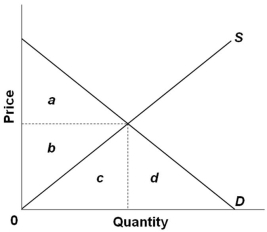 Refer to the graph above. At equilibrium, consumer surplus would be represented by the area:
A) a + b
B) a + b + c
C) a
D) b + c
Refer to the graph above. At equilibrium, consumer surplus would be represented by the area:A) a + b
B) a + b + c
C) a
D) b + c
Question
The equilibrium point in the market is where S and D curve intersect. 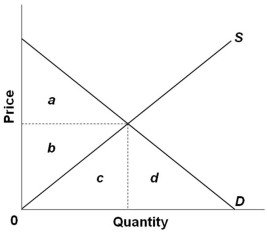 Refer to the graph above. At equilibrium, the total maximum amount that consumers would have been willing to pay for the product is represented by the area:
A) a + b
B) a + b + c
C) a
D) b + c
Refer to the graph above. At equilibrium, the total maximum amount that consumers would have been willing to pay for the product is represented by the area:A) a + b
B) a + b + c
C) a
D) b + c
Question
Question
Question
Question
Question
Question
Question
Question
Question
Question
Question
Question
Question
The equilibrium point in the market is where S and D curve intersect. 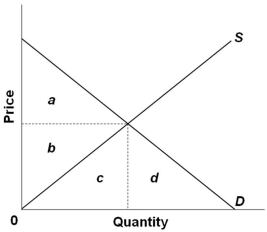 Refer to the graph above. At equilibrium, the total amount of spending that consumers would be paying for the product is represented by the area:
A) a + b
B) a + b + c
C) a
D) b + c
Refer to the graph above. At equilibrium, the total amount of spending that consumers would be paying for the product is represented by the area:A) a + b
B) a + b + c
C) a
D) b + c
Question
Question
Question
Question
Question
Question
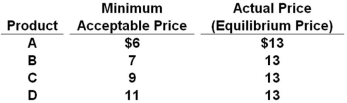 Refer to the above table. If the equilibrium price increases, then the:
A) Producer surplus will decrease
B) Consumer surplus will increase
C) Producer surplus will increase
D) Allocative efficiency will increase
Question
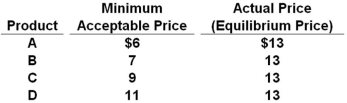 Refer to the above table. The producer surplus is $4 for producer:
A) A
B) B
C) C
D) D
Question
Question
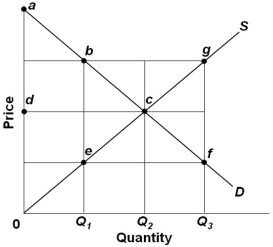 Refer to the above graph. If the output level increases from Q2 to Q3, then the:
A) Marginal cost of the product becomes closer to its marginal benefit
B) Marginal cost of the product increases while its marginal benefit decreases
C) Marginal cost of the product decreases while its marginal benefit increases
D) Marginal cost of the product stays constant while its marginal benefit increases
Question
Question
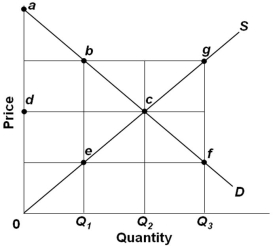 Refer to the above graph. If the output level is Q2, then there will be:
A) Allocative efficiency
B) Maximum deadweight losses
C) Maximum consumer surplus
D) Greater marginal benefits than marginal costs of the product
Question
The equilibrium point in the market is where S and D curve intersect. 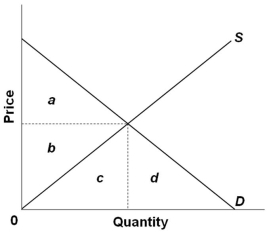 Refer to the graph above. At equilibrium, the producer surplus would be represented by the area:
A) b
B) b + c
C) a + b
D) b + c + d
Refer to the graph above. At equilibrium, the producer surplus would be represented by the area:A) b
B) b + c
C) a + b
D) b + c + d
Question
Question
The equilibrium point in the market is where S and D curve intersect. 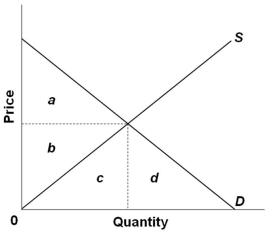 Refer to the graph above. At equilibrium, the total revenues received by sellers would be represented by the area:
A) b
B) b + c
C) a + b
D) b + c + d
Refer to the graph above. At equilibrium, the total revenues received by sellers would be represented by the area:A) b
B) b + c
C) a + b
D) b + c + d
Question
Question
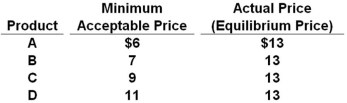 Refer to the above table. What is the producer surplus for all producers A, B, C, and D?
A) $6
B) $13
C) $19
D) $24
Question
Question
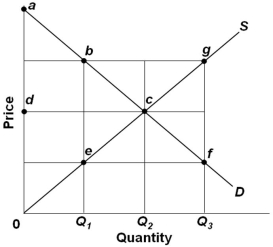 Refer to the above graph. If the output level is Q1, then the sum of the consumer and producer surplus is:
A) bce
B) ac0
C) 0abe
D) 0eQ1
Question
The equilibrium point in the market is where S and D curve intersect. 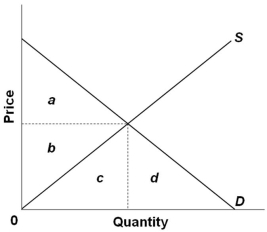 Refer to the graph above. At equilibrium, the minimum acceptable revenue that sellers would have been willing to receive is represented by the area:
A) b
B) b + c
C) a + b
D) c
Refer to the graph above. At equilibrium, the minimum acceptable revenue that sellers would have been willing to receive is represented by the area:A) b
B) b + c
C) a + b
D) c
Question
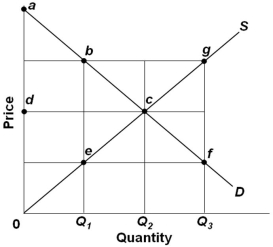 Refer to the above graph. If the output level is Q1, then there are efficiency losses indicated by the area:
A) 0abe
B) bce
C) 0eQ1
D) ecf
Question
Question
Question
Question
Question
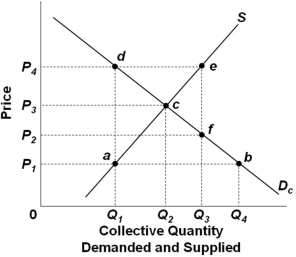 Refer to the above supply and demand graph for a public good. Point c on the graph shows where the:
A) Total benefit equals the total cost of the public good
B) Marginal benefit equals the marginal cost of the public good
C) Average benefit equals the average cost of the public good
D) Total benefit of the public good is at the maximum
Question
Question
Answer the question based on the following information. Normal University has found it necessary to institute a crime-control program on its campus to deal with the high costs of theft and vandalism. The university is now considering several alternative levels of crime control. This table shows the expected annual costs and benefits of these alternatives. 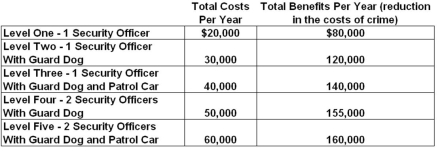 Refer to the above information. The marginal benefits of crime control for Level Two are:
A) $10,000
B) $40,000
C) $50,000
D) $200,000
Refer to the above information. The marginal benefits of crime control for Level Two are:A) $10,000
B) $40,000
C) $50,000
D) $200,000
Question
Answer the question on the basis of the following information is for public good. Pa and Pb represent the prices that citizens (a) and (b), the only two people in this nation, are willing to pay for additional units of a quantity (Qc) of the public good. Qs represents the quantity of the public good supplied by government at each of the collective prices. 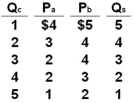 Refer to the above information. If only 1 unit of this public good is produced, then the marginal benefit is:
A) $3 and the marginal cost is $9
B) $4 and the marginal cost is $7
C) $6 and the marginal cost is $3
D) $9 and the marginal cost is $3
Refer to the above information. If only 1 unit of this public good is produced, then the marginal benefit is:A) $3 and the marginal cost is $9
B) $4 and the marginal cost is $7
C) $6 and the marginal cost is $3
D) $9 and the marginal cost is $3
Question
Question
Answer the question based on the following information. Normal University has found it necessary to institute a crime-control program on its campus to deal with the high costs of theft and vandalism. The university is now considering several alternative levels of crime control. This table shows the expected annual costs and benefits of these alternatives. 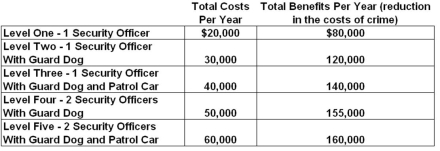 Refer to the above information. Based on cost-benefit analysis, Normal University should undertake Level:
A) Two
B) Three
C) Four
D) Five
Refer to the above information. Based on cost-benefit analysis, Normal University should undertake Level:A) Two
B) Three
C) Four
D) Five
Question
Question
Assume that a government is considering a new social program and may choose to include in this program any number of four progressively larger projects. The marginal cost and the marginal benefits of each of the four projects are given in the table. 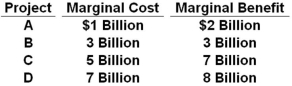 Refer to the above table and information. What project should the government select to achieve the maximum net benefit?
A) A
B) B
C) C
D) D
Refer to the above table and information. What project should the government select to achieve the maximum net benefit?A) A
B) B
C) C
D) D
Question
Question
Answer the question on the basis of the following information is for public good. Pa and Pb represent the prices that citizens (a) and (b), the only two people in this nation, are willing to pay for additional units of a quantity (Qc) of the public good. Qs represents the quantity of the public good supplied by government at each of the collective prices. 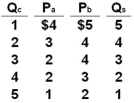 Refer to the above information. In equilibrium, the marginal benefit and cost of the public good will be:
A) $7
B) $6
C) $5
D) $3
Refer to the above information. In equilibrium, the marginal benefit and cost of the public good will be:A) $7
B) $6
C) $5
D) $3
Question
Answer the question on the basis of the following information is for public good. Pa and Pb represent the prices that citizens (a) and (b), the only two people in this nation, are willing to pay for additional units of a quantity (Qc) of the public good. Qs represents the quantity of the public good supplied by government at each of the collective prices. 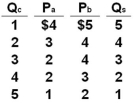 Refer to the above information. The collective willingness of this nation to pay for the fourth unit of the public good is:
A) $7
B) $6
C) $5
D) $3
Refer to the above information. The collective willingness of this nation to pay for the fourth unit of the public good is:A) $7
B) $6
C) $5
D) $3
Question
Question
Question
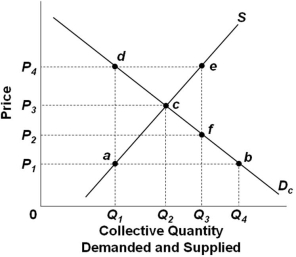 Refer to the above supply and demand graph for a public good. If Q1 units of the public good are produced, then:
A) Users are willing to pay more for the public good than it costs to produce it
B) Users are willing to pay less for the public good than it costs to produce it
C) There is an over-allocation of resources towards producing this public good
D) Allocative efficiency is achieved in the market
Question
Assume that a government is considering a new social program and may choose to include in this program any number of four progressively larger projects. The marginal cost and the marginal benefits of each of the four projects are given in the table. 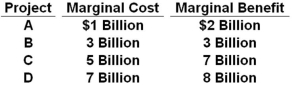 Refer to the above table and information. What is the total cost and total benefit of doing projects A, B, and C?
A) Total cost is $5 billion and total benefit is $7 billion
B) Total cost is $4 billion and total benefit is $7 billion
C) Total cost is $9 billion and total benefit is $12 billion
D) Total cost is $16 billion and total benefit is $20 billion
Refer to the above table and information. What is the total cost and total benefit of doing projects A, B, and C?A) Total cost is $5 billion and total benefit is $7 billion
B) Total cost is $4 billion and total benefit is $7 billion
C) Total cost is $9 billion and total benefit is $12 billion
D) Total cost is $16 billion and total benefit is $20 billion
Question
Question
Answer the question based on the following information. Normal University has found it necessary to institute a crime-control program on its campus to deal with the high costs of theft and vandalism. The university is now considering several alternative levels of crime control. This table shows the expected annual costs and benefits of these alternatives. 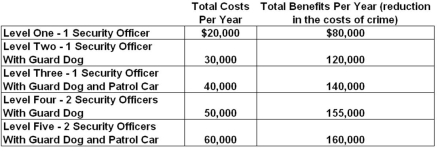 Refer to the above information. If Normal University undertakes program Level Three:
A) Total benefits will be less than total costs
B) Marginal costs will exceed marginal benefits
C) There would be an under-allocation of resources to crime control
D) There would be an over-allocation of resources to crime control
Refer to the above information. If Normal University undertakes program Level Three:A) Total benefits will be less than total costs
B) Marginal costs will exceed marginal benefits
C) There would be an under-allocation of resources to crime control
D) There would be an over-allocation of resources to crime control
Question
 Refer to the above supply and demand graph for a public good. Which line segment would indicate the amount by which the marginal benefit of this public good exceeds the marginal cost at a certain quantity?
A) de
B) da
C) ef
D) ab
Question
A government is considering undertaking one or more construction projects. The estimated marginal costs and benefits of each project are given in the table. 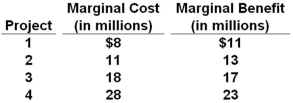 Refer to the above table and information. What is the total cost and total benefit of projects 1, 2, and 3?
A) Total cost is $18 million and total benefit is $19 million
B) Total cost is $24 million and total benefit is $27 million
C) Total cost is $37 million and total benefit is $41 million
D) Total cost is $65 million and total benefit is $66 million
Refer to the above table and information. What is the total cost and total benefit of projects 1, 2, and 3?A) Total cost is $18 million and total benefit is $19 million
B) Total cost is $24 million and total benefit is $27 million
C) Total cost is $37 million and total benefit is $41 million
D) Total cost is $65 million and total benefit is $66 million
Question
Question
Question
Question
Question
Question
Assume that a government is considering a new social program and may choose to include in this program any number of four progressively larger projects. The marginal cost and the marginal benefits of each of the four projects are given in the table. 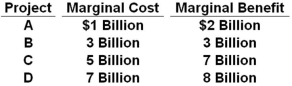 Refer to the above table and information. What is the net benefit of project D?
A) $1 billion
B) $3 billion
C) $4 billion
D) $20 billion
Refer to the above table and information. What is the net benefit of project D?A) $1 billion
B) $3 billion
C) $4 billion
D) $20 billion
Question
A government is considering undertaking one or more construction projects. The estimated marginal costs and benefits of each project are given in the table. 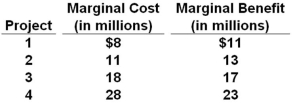 Refer to the above table and information. What is the net benefit of project 2?
A) $2 million
B) $3 million
C) $4 million
D) $5 million
Refer to the above table and information. What is the net benefit of project 2?A) $2 million
B) $3 million
C) $4 million
D) $5 million
Question
Question
Question
A government is considering undertaking one or more construction projects. The estimated marginal costs and benefits of each project are given in the table. 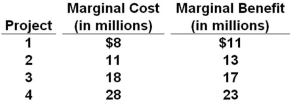 Refer to the above table and information. What is the total amount that the government should spend on construction projects?
A) $8 million
B) $14 million
C) $19 million
D) $37 million
Refer to the above table and information. What is the total amount that the government should spend on construction projects?A) $8 million
B) $14 million
C) $19 million
D) $37 million
Question
Question
Question
Question
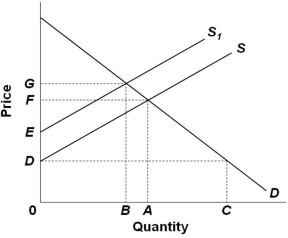 Refer to the above supply and demand graph. In the graph, line S is the current supply of this product, while line S1 is the optimal supply from the society's perspective. This figure suggests that there is (are):
A) External benefits from the production of this product
B) External costs in the production of this product
C) Currently an underallocation of resources toward producing this good
D) Positive externalities from producing the good
Question
Question
Question
Question
Question

Unlock Deck
Sign up to unlock the cards in this deck!
Unlock Deck
Unlock Deck
1/155

Play

Full screen (f)
Deck 4: Market Failures: Public Goods and Externalities
1
Which of the following is an example of a market failure?
A) There are not enough tickets available to concerts of extremely popular performers and artists
B) The price of medical care has risen dramatically as a result of the introduction of sophisticated equipment and procedures
C) Successful public schools provide benefits to the students who attend them, as well as to the community as a whole including those who don't go to those public schools
D) Extensive decreases in the prices of electronic equipment resulted in large numbers of bankruptcies in the computer industry
A) There are not enough tickets available to concerts of extremely popular performers and artists
B) The price of medical care has risen dramatically as a result of the introduction of sophisticated equipment and procedures
C) Successful public schools provide benefits to the students who attend them, as well as to the community as a whole including those who don't go to those public schools
D) Extensive decreases in the prices of electronic equipment resulted in large numbers of bankruptcies in the computer industry
Successful public schools provide benefits to the students who attend them, as well as to the community as a whole including those who don't go to those public schools
2
Consumer surplus arises in a market because:
A) At the current market price, quantity supplied is greater than quantity demanded
B) At the current market price, quantity demanded is greater than quantity supplied
C) The market price is below what some consumers are willing to pay for the product
D) The market price is higher than what some consumers are willing to pay for the product
A) At the current market price, quantity supplied is greater than quantity demanded
B) At the current market price, quantity demanded is greater than quantity supplied
C) The market price is below what some consumers are willing to pay for the product
D) The market price is higher than what some consumers are willing to pay for the product
The market price is below what some consumers are willing to pay for the product
3
In the market for a particular pair of shoes, Jena is willing to pay $75 for a pair while Jane is willing to pay $85 for a pair. The actual price that each has to pay for a pair of shoes is $65. What is the combined amount of consumer surplus of Jena and Jane?
A) $10
B) $30
C) $130
D) $215
A) $10
B) $30
C) $130
D) $215
$30
4
The equilibrium point in the market is where S and D curve intersect. Refer to the graph above. At equilibrium, consumer surplus would be represented by the area:
A) a + b
B) a + b + c
C) a
D) b + c
Refer to the graph above. At equilibrium, consumer surplus would be represented by the area:A) a + b
B) a + b + c
C) a
D) b + c
Unlock Deck
Unlock for access to all 155 flashcards in this deck.
Unlock Deck
k this deck
5
The equilibrium point in the market is where S and D curve intersect. Refer to the graph above. At equilibrium, the total maximum amount that consumers would have been willing to pay for the product is represented by the area:
A) a + b
B) a + b + c
C) a
D) b + c
Refer to the graph above. At equilibrium, the total maximum amount that consumers would have been willing to pay for the product is represented by the area:A) a + b
B) a + b + c
C) a
D) b + c
Unlock Deck
Unlock for access to all 155 flashcards in this deck.
Unlock Deck
k this deck
6
Charlie is willing to pay $10 for a T-shirt that is priced at $9. If Charlie buys the T-shirt, then his consumer surplus is
A) $19.
B) $0.90.
C) $90.
D) $1.
A) $19.
B) $0.90.
C) $90.
D) $1.
Unlock Deck
Unlock for access to all 155 flashcards in this deck.
Unlock Deck
k this deck
7
The minimum acceptable price for a product that producer Sam is willing to receive is $15. The price he could get for the product in the market is $18. How much is Sam's producer surplus?
A) $3
B) $33
C) $45
D) $270
A) $3
B) $33
C) $45
D) $270
Unlock Deck
Unlock for access to all 155 flashcards in this deck.
Unlock Deck
k this deck
8
Which of the following statements about market failure is not true:
A) Market failure causes an inefficient allocation of resources, even in a competitive market
B) Market failure can come from causes on the demand-side or the supply-side of a market
C) Market failure always results from some government action or policy in a market
D) Market failure can result from the number of sellers in a market being too few to ensure competition
A) Market failure causes an inefficient allocation of resources, even in a competitive market
B) Market failure can come from causes on the demand-side or the supply-side of a market
C) Market failure always results from some government action or policy in a market
D) Market failure can result from the number of sellers in a market being too few to ensure competition
Unlock Deck
Unlock for access to all 155 flashcards in this deck.
Unlock Deck
k this deck
9
The value that consumers get (from consuming a product) over and above that they actually paid for the product is called:
A) Consumer utility
B) Consumption expenditures
C) Consumer surplus
D) Consumer demand
A) Consumer utility
B) Consumption expenditures
C) Consumer surplus
D) Consumer demand
Unlock Deck
Unlock for access to all 155 flashcards in this deck.
Unlock Deck
k this deck
10
When producers do not produce the efficient amount of a product because they are unable to charge consumers what they are willing to pay for it, then we have a:
A) Demand-side market failure
B) Supply-side market failure
C) Competitive market
D) Monopolistic market
A) Demand-side market failure
B) Supply-side market failure
C) Competitive market
D) Monopolistic market
Unlock Deck
Unlock for access to all 155 flashcards in this deck.
Unlock Deck
k this deck
11
Which of the following situations is not an example of market failure:
A) Ben's Department Store cannot charge passers-by for using the sidewalk outside the store
B) Ben cannot afford to buy a high-end Mercedes Benz luxury car
C) Ben's Place is the only restaurant in town and thus he has significant power to set menu prices
D) Ben's Industries is dumping its wastewater into the unregulated river behind the factory
A) Ben's Department Store cannot charge passers-by for using the sidewalk outside the store
B) Ben cannot afford to buy a high-end Mercedes Benz luxury car
C) Ben's Place is the only restaurant in town and thus he has significant power to set menu prices
D) Ben's Industries is dumping its wastewater into the unregulated river behind the factory
Unlock Deck
Unlock for access to all 155 flashcards in this deck.
Unlock Deck
k this deck
12
When producers (say, of roads) are not able to make all consumers pay for enjoying their product (i.e., the roads), they tend to see a:
A) Marginal cost of production that is too low, and there is a supply-side market failure
B) Marginal benefit of production that is too high, and there is a demand-side market failure
C) Marginal cost of production that is too high, and there is a supply-side market failure
D) Marginal benefit of production that is too low, and there is a demand-side market failure
A) Marginal cost of production that is too low, and there is a supply-side market failure
B) Marginal benefit of production that is too high, and there is a demand-side market failure
C) Marginal cost of production that is too high, and there is a supply-side market failure
D) Marginal benefit of production that is too low, and there is a demand-side market failure
Unlock Deck
Unlock for access to all 155 flashcards in this deck.
Unlock Deck
k this deck
13
If the unit price of a product is P, then the amount of spending that the buyers would need to pay for a given quantity Q is equal to:
A) P x Q
B) P + Q
C) P - Q
D) Q - P
A) P x Q
B) P + Q
C) P - Q
D) Q - P
Unlock Deck
Unlock for access to all 155 flashcards in this deck.
Unlock Deck
k this deck
14
If many people in a community get flu shots, the whole community benefits including those that did not get flu shots. Therefore, not enough people may decide to get the shots. This is one illustration of:
A) The market allocating resources efficiently
B) Monopoly power due to lack of competition
C) Supply-side market failure
D) Demand-side market failure
A) The market allocating resources efficiently
B) Monopoly power due to lack of competition
C) Supply-side market failure
D) Demand-side market failure
Unlock Deck
Unlock for access to all 155 flashcards in this deck.
Unlock Deck
k this deck
15
The difference between the actual price that a producer receives and the minimum acceptable price the producer is willing to accept is called the producer:
A) Revenues
B) Surplus
C) Costs
D) Utility
A) Revenues
B) Surplus
C) Costs
D) Utility
Unlock Deck
Unlock for access to all 155 flashcards in this deck.
Unlock Deck
k this deck
16
The difference between the maximum price a consumer is willing to pay for a product and the actual price the consumer pays is called:
A) Utility
B) Consumer Surplus
C) Consumer Demand
D) Market failure
A) Utility
B) Consumer Surplus
C) Consumer Demand
D) Market failure
Unlock Deck
Unlock for access to all 155 flashcards in this deck.
Unlock Deck
k this deck
17
A competitive market can produce economically efficient outcomes if these conditions are met, except:
A) The market produces only units for which benefits are at least equal to cost
B) The market demand curve reflects the buyers' full willingness to pay
C) The market supply curve reflects all costs of production
D) The market produces only units for which costs are at least equal to benefits
A) The market produces only units for which benefits are at least equal to cost
B) The market demand curve reflects the buyers' full willingness to pay
C) The market supply curve reflects all costs of production
D) The market produces only units for which costs are at least equal to benefits
Unlock Deck
Unlock for access to all 155 flashcards in this deck.
Unlock Deck
k this deck
18
The equilibrium point in the market is where S and D curve intersect. Refer to the graph above. At equilibrium, the total amount of spending that consumers would be paying for the product is represented by the area:
A) a + b
B) a + b + c
C) a
D) b + c
Refer to the graph above. At equilibrium, the total amount of spending that consumers would be paying for the product is represented by the area:A) a + b
B) a + b + c
C) a
D) b + c
Unlock Deck
Unlock for access to all 155 flashcards in this deck.
Unlock Deck
k this deck
19
When producers do not have to pay the full cost of producing a product, they tend to:
A) Over-produce the product because of a demand-side market failure
B) Under-produce the product because of a demand-side market failure
C) Under-produce the product because of a supply-side market failure
D) Over-produce the product because of a supply-side market failure
A) Over-produce the product because of a demand-side market failure
B) Under-produce the product because of a demand-side market failure
C) Under-produce the product because of a supply-side market failure
D) Over-produce the product because of a supply-side market failure
Unlock Deck
Unlock for access to all 155 flashcards in this deck.
Unlock Deck
k this deck
20
If the price of a product increases:
A) Consumer surplus will decrease
B) Consumer surplus will increase
C) Total revenue will definitely increase
D) Total revenue will definitely decrease
A) Consumer surplus will decrease
B) Consumer surplus will increase
C) Total revenue will definitely increase
D) Total revenue will definitely decrease
Unlock Deck
Unlock for access to all 155 flashcards in this deck.
Unlock Deck
k this deck
21
The amount of revenues that sellers actually receive over and above the minimum acceptable amount that they are willing to receive for selling a product is called:
A) Production costs
B) Producers' supply
C) Producer surplus
D) Surplus production
A) Production costs
B) Producers' supply
C) Producer surplus
D) Surplus production
Unlock Deck
Unlock for access to all 155 flashcards in this deck.
Unlock Deck
k this deck
22
At equilibrium in a market for a product, the total revenues received by sellers equal the:
A) Market producer surplus
B) Total amount spent by buyers on the product
C) Total profits of sellers
D) Market consumer surplus
A) Market producer surplus
B) Total amount spent by buyers on the product
C) Total profits of sellers
D) Market consumer surplus
Unlock Deck
Unlock for access to all 155 flashcards in this deck.
Unlock Deck
k this deck
23
The market supply curve indicates the:
A) Minimum acceptable prices that sellers are willing to accept for the product
B) Maximum prices that buyers are willing and able to pay for the product
C) Total revenues that sellers would receive from selling various quantities of the product
D) Total amount that buyers will pay in buying a given quantity of the product
A) Minimum acceptable prices that sellers are willing to accept for the product
B) Maximum prices that buyers are willing and able to pay for the product
C) Total revenues that sellers would receive from selling various quantities of the product
D) Total amount that buyers will pay in buying a given quantity of the product
Unlock Deck
Unlock for access to all 155 flashcards in this deck.
Unlock Deck
k this deck
24
Refer to the above table. If the equilibrium price increases, then the:A) Producer surplus will decrease
B) Consumer surplus will increase
C) Producer surplus will increase
D) Allocative efficiency will increase
Unlock Deck
Unlock for access to all 155 flashcards in this deck.
Unlock Deck
k this deck
25
Refer to the above table. The producer surplus is $4 for producer:A) A
B) B
C) C
D) D
Unlock Deck
Unlock for access to all 155 flashcards in this deck.
Unlock Deck
k this deck
26
When there is overproduction of a good:
A) The marginal benefit of the good exceeds its marginal cost
B) The marginal cost of the good exceeds its marginal benefit
C) The net benefit of producing extra units if the good is positive
D) The allocative efficiency is enhanced
A) The marginal benefit of the good exceeds its marginal cost
B) The marginal cost of the good exceeds its marginal benefit
C) The net benefit of producing extra units if the good is positive
D) The allocative efficiency is enhanced
Unlock Deck
Unlock for access to all 155 flashcards in this deck.
Unlock Deck
k this deck
27
Refer to the above graph. If the output level increases from Q2 to Q3, then the:A) Marginal cost of the product becomes closer to its marginal benefit
B) Marginal cost of the product increases while its marginal benefit decreases
C) Marginal cost of the product decreases while its marginal benefit increases
D) Marginal cost of the product stays constant while its marginal benefit increases
Unlock Deck
Unlock for access to all 155 flashcards in this deck.
Unlock Deck
k this deck
28
When the marginal benefit of an output exceeds the marginal cost:
A) Production of that output should be increased, in order to achieve efficiency
B) Production of that output should be decreased, in order to achieve efficiency
C) Increasing the production of that output would increase the deadweight loss
D) Reducing the production of that output would reduce efficiency losses
A) Production of that output should be increased, in order to achieve efficiency
B) Production of that output should be decreased, in order to achieve efficiency
C) Increasing the production of that output would increase the deadweight loss
D) Reducing the production of that output would reduce efficiency losses
Unlock Deck
Unlock for access to all 155 flashcards in this deck.
Unlock Deck
k this deck
29
Refer to the above graph. If the output level is Q2, then there will be:A) Allocative efficiency
B) Maximum deadweight losses
C) Maximum consumer surplus
D) Greater marginal benefits than marginal costs of the product
Unlock Deck
Unlock for access to all 155 flashcards in this deck.
Unlock Deck
k this deck
30
The equilibrium point in the market is where S and D curve intersect. Refer to the graph above. At equilibrium, the producer surplus would be represented by the area:
A) b
B) b + c
C) a + b
D) b + c + d
Refer to the graph above. At equilibrium, the producer surplus would be represented by the area:A) b
B) b + c
C) a + b
D) b + c + d
Unlock Deck
Unlock for access to all 155 flashcards in this deck.
Unlock Deck
k this deck
31
Deadweight losses occur when the quantity of an output produced is:
A) less than, but not when it is greater than, the competitive equilibrium quantity
B) greater than, but not when it is less than, the competitive equilibrium quantity
C) less than or greater than the competitive equilibrium quantity
D) such that the marginal benefit of the output is just equal to the marginal cost
A) less than, but not when it is greater than, the competitive equilibrium quantity
B) greater than, but not when it is less than, the competitive equilibrium quantity
C) less than or greater than the competitive equilibrium quantity
D) such that the marginal benefit of the output is just equal to the marginal cost
Unlock Deck
Unlock for access to all 155 flashcards in this deck.
Unlock Deck
k this deck
32
The equilibrium point in the market is where S and D curve intersect. Refer to the graph above. At equilibrium, the total revenues received by sellers would be represented by the area:
A) b
B) b + c
C) a + b
D) b + c + d
Refer to the graph above. At equilibrium, the total revenues received by sellers would be represented by the area:A) b
B) b + c
C) a + b
D) b + c + d
Unlock Deck
Unlock for access to all 155 flashcards in this deck.
Unlock Deck
k this deck
33
If the unit price of a product is P and buyers buy a given quantity Q, then sellers would collect total revenues equal to:
A) P x Q
B) P + Q
C) P - Q
D) Q - P
A) P x Q
B) P + Q
C) P - Q
D) Q - P
Unlock Deck
Unlock for access to all 155 flashcards in this deck.
Unlock Deck
k this deck
34
Refer to the above table. What is the producer surplus for all producers A, B, C, and D?A) $6
B) $13
C) $19
D) $24
Unlock Deck
Unlock for access to all 155 flashcards in this deck.
Unlock Deck
k this deck
35
When economic efficiency is attained, it implies all of the following, except:
A) Per-unit cost of output produced is at minimum
B) Allocative efficiency is achieved
C) Total consumer and producer surplus is at a maximum
D) The gap between marginal benefits and marginal costs of production is at maximum
A) Per-unit cost of output produced is at minimum
B) Allocative efficiency is achieved
C) Total consumer and producer surplus is at a maximum
D) The gap between marginal benefits and marginal costs of production is at maximum
Unlock Deck
Unlock for access to all 155 flashcards in this deck.
Unlock Deck
k this deck
36
Refer to the above graph. If the output level is Q1, then the sum of the consumer and producer surplus is:A) bce
B) ac0
C) 0abe
D) 0eQ1
Unlock Deck
Unlock for access to all 155 flashcards in this deck.
Unlock Deck
k this deck
37
The equilibrium point in the market is where S and D curve intersect. Refer to the graph above. At equilibrium, the minimum acceptable revenue that sellers would have been willing to receive is represented by the area:
A) b
B) b + c
C) a + b
D) c
Refer to the graph above. At equilibrium, the minimum acceptable revenue that sellers would have been willing to receive is represented by the area:A) b
B) b + c
C) a + b
D) c
Unlock Deck
Unlock for access to all 155 flashcards in this deck.
Unlock Deck
k this deck
38
Refer to the above graph. If the output level is Q1, then there are efficiency losses indicated by the area:A) 0abe
B) bce
C) 0eQ1
D) ecf
Unlock Deck
Unlock for access to all 155 flashcards in this deck.
Unlock Deck
k this deck
39
What are the two characteristics that differentiate private goods from public goods?
A) Rivalry and excludability
B) Negative externality and positive externality
C) Marginal cost and marginal benefit
D) Ownership and usage
A) Rivalry and excludability
B) Negative externality and positive externality
C) Marginal cost and marginal benefit
D) Ownership and usage
Unlock Deck
Unlock for access to all 155 flashcards in this deck.
Unlock Deck
k this deck
40
When a competitive market achieves allocative efficiency, it implies that:
A) The marginal benefit of having the product is greater than the marginal cost
B) The buyers are getting the maximum consumer surplus from the product
C) The combined consumer and producer surplus is maximized
D) The quantity demanded is lower than the quantity supplied
A) The marginal benefit of having the product is greater than the marginal cost
B) The buyers are getting the maximum consumer surplus from the product
C) The combined consumer and producer surplus is maximized
D) The quantity demanded is lower than the quantity supplied
Unlock Deck
Unlock for access to all 155 flashcards in this deck.
Unlock Deck
k this deck
41
Among the following examples, the one that best illustrates a public good is:
A) The laptops used by students in a college or university
B) The movies produced by Hollywood companies
C) The bike paths around a city or town
D) The airline tickets bought by vacationers
A) The laptops used by students in a college or university
B) The movies produced by Hollywood companies
C) The bike paths around a city or town
D) The airline tickets bought by vacationers
Unlock Deck
Unlock for access to all 155 flashcards in this deck.
Unlock Deck
k this deck
42
Which of the following statements concerning a pure public good is false?
A) It is impossible to exclude non-taxpayers from the enjoyment of the public good
B) All benefits associated with the production and use of a public good are received by the government
C) The availability of a public good to one person simultaneously makes it available to all members of society
D) The private sector does not have an economic incentive to produce a socially optimal amount of a public good
A) It is impossible to exclude non-taxpayers from the enjoyment of the public good
B) All benefits associated with the production and use of a public good are received by the government
C) The availability of a public good to one person simultaneously makes it available to all members of society
D) The private sector does not have an economic incentive to produce a socially optimal amount of a public good
Unlock Deck
Unlock for access to all 155 flashcards in this deck.
Unlock Deck
k this deck
43
Refer to the above supply and demand graph for a public good. Point c on the graph shows where the:A) Total benefit equals the total cost of the public good
B) Marginal benefit equals the marginal cost of the public good
C) Average benefit equals the average cost of the public good
D) Total benefit of the public good is at the maximum
Unlock Deck
Unlock for access to all 155 flashcards in this deck.
Unlock Deck
k this deck
44
Assume there is no way to prevent someone from using an interstate highway, regardless of whether or not he or she helps pay for it. This characteristic is called:
A) Nonrivalry
B) Nonexcludability
C) Nontaxability
D) Nondiscrimination
A) Nonrivalry
B) Nonexcludability
C) Nontaxability
D) Nondiscrimination
Unlock Deck
Unlock for access to all 155 flashcards in this deck.
Unlock Deck
k this deck
45
Answer the question based on the following information. Normal University has found it necessary to institute a crime-control program on its campus to deal with the high costs of theft and vandalism. The university is now considering several alternative levels of crime control. This table shows the expected annual costs and benefits of these alternatives. Refer to the above information. The marginal benefits of crime control for Level Two are:
A) $10,000
B) $40,000
C) $50,000
D) $200,000
Refer to the above information. The marginal benefits of crime control for Level Two are:A) $10,000
B) $40,000
C) $50,000
D) $200,000
Unlock Deck
Unlock for access to all 155 flashcards in this deck.
Unlock Deck
k this deck
46
Answer the question on the basis of the following information is for public good. Pa and Pb represent the prices that citizens (a) and (b), the only two people in this nation, are willing to pay for additional units of a quantity (Qc) of the public good. Qs represents the quantity of the public good supplied by government at each of the collective prices. Refer to the above information. If only 1 unit of this public good is produced, then the marginal benefit is:
A) $3 and the marginal cost is $9
B) $4 and the marginal cost is $7
C) $6 and the marginal cost is $3
D) $9 and the marginal cost is $3
Refer to the above information. If only 1 unit of this public good is produced, then the marginal benefit is:A) $3 and the marginal cost is $9
B) $4 and the marginal cost is $7
C) $6 and the marginal cost is $3
D) $9 and the marginal cost is $3
Unlock Deck
Unlock for access to all 155 flashcards in this deck.
Unlock Deck
k this deck
47
For the music industry, the rise of Internet file-sharing of music has:
A) Worsened the free-rider problem
B) Diminished or alleviated the free-rider problem
C) Reduced the options for musicians to have their music heard
D) Eliminated the problem of digital piracy
A) Worsened the free-rider problem
B) Diminished or alleviated the free-rider problem
C) Reduced the options for musicians to have their music heard
D) Eliminated the problem of digital piracy
Unlock Deck
Unlock for access to all 155 flashcards in this deck.
Unlock Deck
k this deck
48
Answer the question based on the following information. Normal University has found it necessary to institute a crime-control program on its campus to deal with the high costs of theft and vandalism. The university is now considering several alternative levels of crime control. This table shows the expected annual costs and benefits of these alternatives. Refer to the above information. Based on cost-benefit analysis, Normal University should undertake Level:
A) Two
B) Three
C) Four
D) Five
Refer to the above information. Based on cost-benefit analysis, Normal University should undertake Level:A) Two
B) Three
C) Four
D) Five
Unlock Deck
Unlock for access to all 155 flashcards in this deck.
Unlock Deck
k this deck
49
The market demand curve for a public good:
A) Is derived in the same manner as demand curves for private goods
B) Is derived by horizontally summing all individual demand curves
C) Shows the total value that all individuals place on each additional unit of the good
D) Shows the total number of units that would be produced by the public sector at each possible price
A) Is derived in the same manner as demand curves for private goods
B) Is derived by horizontally summing all individual demand curves
C) Shows the total value that all individuals place on each additional unit of the good
D) Shows the total number of units that would be produced by the public sector at each possible price
Unlock Deck
Unlock for access to all 155 flashcards in this deck.
Unlock Deck
k this deck
50
Assume that a government is considering a new social program and may choose to include in this program any number of four progressively larger projects. The marginal cost and the marginal benefits of each of the four projects are given in the table. Refer to the above table and information. What project should the government select to achieve the maximum net benefit?
A) A
B) B
C) C
D) D
Refer to the above table and information. What project should the government select to achieve the maximum net benefit?A) A
B) B
C) C
D) D
Unlock Deck
Unlock for access to all 155 flashcards in this deck.
Unlock Deck
k this deck
51
Government can reallocate resources away from private goods towards public goods, usually through:
A) Import tariffs and quotas
B) The laws of supply and demand
C) Taxes and government spending
D) Positive and negative externalities
A) Import tariffs and quotas
B) The laws of supply and demand
C) Taxes and government spending
D) Positive and negative externalities
Unlock Deck
Unlock for access to all 155 flashcards in this deck.
Unlock Deck
k this deck
52
Answer the question on the basis of the following information is for public good. Pa and Pb represent the prices that citizens (a) and (b), the only two people in this nation, are willing to pay for additional units of a quantity (Qc) of the public good. Qs represents the quantity of the public good supplied by government at each of the collective prices. Refer to the above information. In equilibrium, the marginal benefit and cost of the public good will be:
A) $7
B) $6
C) $5
D) $3
Refer to the above information. In equilibrium, the marginal benefit and cost of the public good will be:A) $7
B) $6
C) $5
D) $3
Unlock Deck
Unlock for access to all 155 flashcards in this deck.
Unlock Deck
k this deck
53
Answer the question on the basis of the following information is for public good. Pa and Pb represent the prices that citizens (a) and (b), the only two people in this nation, are willing to pay for additional units of a quantity (Qc) of the public good. Qs represents the quantity of the public good supplied by government at each of the collective prices. Refer to the above information. The collective willingness of this nation to pay for the fourth unit of the public good is:
A) $7
B) $6
C) $5
D) $3
Refer to the above information. The collective willingness of this nation to pay for the fourth unit of the public good is:A) $7
B) $6
C) $5
D) $3
Unlock Deck
Unlock for access to all 155 flashcards in this deck.
Unlock Deck
k this deck
54
Street entertainers face the free-rider problem when they perform because of the:
A) Law of Demand
B) Diminishing marginal utility
C) Nonexcludability characteristic
D) Rivalry characteristic
A) Law of Demand
B) Diminishing marginal utility
C) Nonexcludability characteristic
D) Rivalry characteristic
Unlock Deck
Unlock for access to all 155 flashcards in this deck.
Unlock Deck
k this deck
55
A public good:
A) Generally results in substantial negative externalities
B) Can never be provided by a nongovernmental organization
C) Costs essentially nothing to produce and is thus provided by the government at a zero price
D) Can't be provided to one person without making it available to others as well
A) Generally results in substantial negative externalities
B) Can never be provided by a nongovernmental organization
C) Costs essentially nothing to produce and is thus provided by the government at a zero price
D) Can't be provided to one person without making it available to others as well
Unlock Deck
Unlock for access to all 155 flashcards in this deck.
Unlock Deck
k this deck
56
Refer to the above supply and demand graph for a public good. If Q1 units of the public good are produced, then:A) Users are willing to pay more for the public good than it costs to produce it
B) Users are willing to pay less for the public good than it costs to produce it
C) There is an over-allocation of resources towards producing this public good
D) Allocative efficiency is achieved in the market
Unlock Deck
Unlock for access to all 155 flashcards in this deck.
Unlock Deck
k this deck
57
Assume that a government is considering a new social program and may choose to include in this program any number of four progressively larger projects. The marginal cost and the marginal benefits of each of the four projects are given in the table. Refer to the above table and information. What is the total cost and total benefit of doing projects A, B, and C?
A) Total cost is $5 billion and total benefit is $7 billion
B) Total cost is $4 billion and total benefit is $7 billion
C) Total cost is $9 billion and total benefit is $12 billion
D) Total cost is $16 billion and total benefit is $20 billion
Refer to the above table and information. What is the total cost and total benefit of doing projects A, B, and C?A) Total cost is $5 billion and total benefit is $7 billion
B) Total cost is $4 billion and total benefit is $7 billion
C) Total cost is $9 billion and total benefit is $12 billion
D) Total cost is $16 billion and total benefit is $20 billion
Unlock Deck
Unlock for access to all 155 flashcards in this deck.
Unlock Deck
k this deck
58
Private firms can hardly produce a public good profitably because of:
A) Liability rules and lawsuits
B) The free-rider problem
C) Shortages and surpluses
D) Moral hazard and adverse selection
A) Liability rules and lawsuits
B) The free-rider problem
C) Shortages and surpluses
D) Moral hazard and adverse selection
Unlock Deck
Unlock for access to all 155 flashcards in this deck.
Unlock Deck
k this deck
59
Answer the question based on the following information. Normal University has found it necessary to institute a crime-control program on its campus to deal with the high costs of theft and vandalism. The university is now considering several alternative levels of crime control. This table shows the expected annual costs and benefits of these alternatives. Refer to the above information. If Normal University undertakes program Level Three:
A) Total benefits will be less than total costs
B) Marginal costs will exceed marginal benefits
C) There would be an under-allocation of resources to crime control
D) There would be an over-allocation of resources to crime control
Refer to the above information. If Normal University undertakes program Level Three:A) Total benefits will be less than total costs
B) Marginal costs will exceed marginal benefits
C) There would be an under-allocation of resources to crime control
D) There would be an over-allocation of resources to crime control
Unlock Deck
Unlock for access to all 155 flashcards in this deck.
Unlock Deck
k this deck
60
Refer to the above supply and demand graph for a public good. Which line segment would indicate the amount by which the marginal benefit of this public good exceeds the marginal cost at a certain quantity?A) de
B) da
C) ef
D) ab
Unlock Deck
Unlock for access to all 155 flashcards in this deck.
Unlock Deck
k this deck
61
A government is considering undertaking one or more construction projects. The estimated marginal costs and benefits of each project are given in the table. Refer to the above table and information. What is the total cost and total benefit of projects 1, 2, and 3?
A) Total cost is $18 million and total benefit is $19 million
B) Total cost is $24 million and total benefit is $27 million
C) Total cost is $37 million and total benefit is $41 million
D) Total cost is $65 million and total benefit is $66 million
Refer to the above table and information. What is the total cost and total benefit of projects 1, 2, and 3?A) Total cost is $18 million and total benefit is $19 million
B) Total cost is $24 million and total benefit is $27 million
C) Total cost is $37 million and total benefit is $41 million
D) Total cost is $65 million and total benefit is $66 million
Unlock Deck
Unlock for access to all 155 flashcards in this deck.
Unlock Deck
k this deck
62
In a market where negative externalities are associated with consumption and production, the equilibrium will not be efficient because:
A) Too few resources will be allocated towards producing the good
B) Firms will shut down until costs are reduced
C) Costs of production will, on average, be too high
D) Too many resources will be allocated towards producing the good
A) Too few resources will be allocated towards producing the good
B) Firms will shut down until costs are reduced
C) Costs of production will, on average, be too high
D) Too many resources will be allocated towards producing the good
Unlock Deck
Unlock for access to all 155 flashcards in this deck.
Unlock Deck
k this deck
63
If a good that generates negative externalities were priced to take these negative externalities into account, then its:
A) Price would decrease and its output would increase
B) Output would increase but its price would remain constant
C) Price would increase and its output would decrease
D) Price would increase but its output would remain constant
A) Price would decrease and its output would increase
B) Output would increase but its price would remain constant
C) Price would increase and its output would decrease
D) Price would increase but its output would remain constant
Unlock Deck
Unlock for access to all 155 flashcards in this deck.
Unlock Deck
k this deck
64
If there are external benefits associated with the consumption of a good or service:
A) The private demand curve will overestimate the true demand curve
B) The private demand curve will underestimate the true demand curve
C) Consumers will be willing to pay for all these benefits in private markets
D) The market demand curve will be the vertical summation of the individual demand costs
A) The private demand curve will overestimate the true demand curve
B) The private demand curve will underestimate the true demand curve
C) Consumers will be willing to pay for all these benefits in private markets
D) The market demand curve will be the vertical summation of the individual demand costs
Unlock Deck
Unlock for access to all 155 flashcards in this deck.
Unlock Deck
k this deck
65
It is the custom for paper mills located alongside the Layzee River to discharge waste products into the river. As a result, operators of hydroelectric power-generating plants downstream along the river find that they must clean up the river's water before it flows through their equipment. If the government intervenes and corrects the externality in the situation described above, we would expect:
A) The output of the paper mills to increase
B) The price of paper from the mills to decrease
C) Production of the hydroelectric power plants to decrease
D) Production in the paper mills to decrease
A) The output of the paper mills to increase
B) The price of paper from the mills to decrease
C) Production of the hydroelectric power plants to decrease
D) Production in the paper mills to decrease
Unlock Deck
Unlock for access to all 155 flashcards in this deck.
Unlock Deck
k this deck
66
It is the custom for paper mills located alongside the Layzee River to discharge waste products into the river. As a result, operators of hydroelectric power-generating plants downstream along the river find that they must clean up the river's water before it flows through their equipment. In the situation described above, we would expect an:
A) Overproduction of paper in the mills
B) Underproduction of paper in the mills
C) External cost resulting from the production of hydroelectric power
D) Attainment of allocative efficiency in the market
A) Overproduction of paper in the mills
B) Underproduction of paper in the mills
C) External cost resulting from the production of hydroelectric power
D) Attainment of allocative efficiency in the market
Unlock Deck
Unlock for access to all 155 flashcards in this deck.
Unlock Deck
k this deck
67
Assume that a government is considering a new social program and may choose to include in this program any number of four progressively larger projects. The marginal cost and the marginal benefits of each of the four projects are given in the table. Refer to the above table and information. What is the net benefit of project D?
A) $1 billion
B) $3 billion
C) $4 billion
D) $20 billion
Refer to the above table and information. What is the net benefit of project D?A) $1 billion
B) $3 billion
C) $4 billion
D) $20 billion
Unlock Deck
Unlock for access to all 155 flashcards in this deck.
Unlock Deck
k this deck
68
A government is considering undertaking one or more construction projects. The estimated marginal costs and benefits of each project are given in the table. Refer to the above table and information. What is the net benefit of project 2?
A) $2 million
B) $3 million
C) $4 million
D) $5 million
Refer to the above table and information. What is the net benefit of project 2?A) $2 million
B) $3 million
C) $4 million
D) $5 million
Unlock Deck
Unlock for access to all 155 flashcards in this deck.
Unlock Deck
k this deck
69
If the production of a product or service involves external benefits, then the government can improve efficiency in the market by:
A) Providing a subsidy to correct for an overallocation of resources
B) Providing a subsidy to correct for an underallocation of resources
C) Imposing a corrective tax to correct for an overallocation of resources
D) Imposing a corrective tax to correct for an underallocation of resources
A) Providing a subsidy to correct for an overallocation of resources
B) Providing a subsidy to correct for an underallocation of resources
C) Imposing a corrective tax to correct for an overallocation of resources
D) Imposing a corrective tax to correct for an underallocation of resources
Unlock Deck
Unlock for access to all 155 flashcards in this deck.
Unlock Deck
k this deck
70
Where there are spillover (or external) benefits from having a particular product in a society, the government can make the quantity of the product approach the socially optimal level by doing the following except:
A) Subsiding the buyers of the product
B) Taxing the sellers of the product
C) Subsidizing the sellers of the product
D) Providing the product itself
A) Subsiding the buyers of the product
B) Taxing the sellers of the product
C) Subsidizing the sellers of the product
D) Providing the product itself
Unlock Deck
Unlock for access to all 155 flashcards in this deck.
Unlock Deck
k this deck
71
A government is considering undertaking one or more construction projects. The estimated marginal costs and benefits of each project are given in the table. Refer to the above table and information. What is the total amount that the government should spend on construction projects?
A) $8 million
B) $14 million
C) $19 million
D) $37 million
Refer to the above table and information. What is the total amount that the government should spend on construction projects?A) $8 million
B) $14 million
C) $19 million
D) $37 million
Unlock Deck
Unlock for access to all 155 flashcards in this deck.
Unlock Deck
k this deck
72
In a situation where an externality occurs, the "third party" refers to those who:
A) Buy the product from others
B) Produce the product for others
C) Trade the product with others outside the nation or community
D) Are not directly involved in the transaction or activity
A) Buy the product from others
B) Produce the product for others
C) Trade the product with others outside the nation or community
D) Are not directly involved in the transaction or activity
Unlock Deck
Unlock for access to all 155 flashcards in this deck.
Unlock Deck
k this deck
73
It is the custom for paper mills located alongside the Layzee River to discharge waste products into the river. As a result, operators of hydroelectric power-generating plants downstream along the river find that they must clean up the river's water before it flows through their equipment. If the government intervenes and corrects the externality in the situation described above, we would expect:
A) The supply of the output from the hydroelectric power plants to decrease
B) The supply of the output from the hydroelectric power plants to increase
C) The demand for the output from the hydroelectric power plants to decrease
D) The demand for the output from the hydroelectric power plants to increase
A) The supply of the output from the hydroelectric power plants to decrease
B) The supply of the output from the hydroelectric power plants to increase
C) The demand for the output from the hydroelectric power plants to decrease
D) The demand for the output from the hydroelectric power plants to increase
Unlock Deck
Unlock for access to all 155 flashcards in this deck.
Unlock Deck
k this deck
74
External benefits in consumption refer to benefits accruing to:
A) Those who are selling the product to the consumers
B) Those who bought and consumed the product
C) Those other than the ones who consumed the product
D) Those who are consuming the product abroad
A) Those who are selling the product to the consumers
B) Those who bought and consumed the product
C) Those other than the ones who consumed the product
D) Those who are consuming the product abroad
Unlock Deck
Unlock for access to all 155 flashcards in this deck.
Unlock Deck
k this deck
75
Refer to the above supply and demand graph. In the graph, line S is the current supply of this product, while line S1 is the optimal supply from the society's perspective. This figure suggests that there is (are):A) External benefits from the production of this product
B) External costs in the production of this product
C) Currently an underallocation of resources toward producing this good
D) Positive externalities from producing the good
Unlock Deck
Unlock for access to all 155 flashcards in this deck.
Unlock Deck
k this deck
76
Which of the following is an example of a negative externality?
A) An increase in the value of land you own when a nearby development is completed
B) The costs paid by a company to build an automated factory
C) Falling property values in a neighborhood where a disreputable nightclub is operating
D) The higher price you pay when you buy a heavily advertised product
A) An increase in the value of land you own when a nearby development is completed
B) The costs paid by a company to build an automated factory
C) Falling property values in a neighborhood where a disreputable nightclub is operating
D) The higher price you pay when you buy a heavily advertised product
Unlock Deck
Unlock for access to all 155 flashcards in this deck.
Unlock Deck
k this deck
77
When the production of a good generates external costs, the firm's supply curve will be:
A) Below the true-cost supply curve
B) Above the true-cost supply curve
C) Vertical
D) Horizontal
A) Below the true-cost supply curve
B) Above the true-cost supply curve
C) Vertical
D) Horizontal
Unlock Deck
Unlock for access to all 155 flashcards in this deck.
Unlock Deck
k this deck
78
If some activity creates external benefits as well as private benefits, then economic theory suggests that the activity ought to be:
A) Taxed
B) Prohibited
C) Subsidized
D) Left alone
A) Taxed
B) Prohibited
C) Subsidized
D) Left alone
Unlock Deck
Unlock for access to all 155 flashcards in this deck.
Unlock Deck
k this deck
79
It is the custom for paper mills located alongside the Layzee River to discharge waste products into the river. As a result, operators of hydroelectric power-generating plants downstream along the river find that they must clean up the river's water before it flows through their equipment. Refer to the above information. Which of the following policies would be most appropriate for dealing with this problem?
A) Levy a tax on the consumers of paper products and use the tax revenues to conduct research on new energy sources
B) Levy a tax on the consumers of electricity and use the tax revenues to subsidize the consumers of paper products
C) Levy a tax on the producers of electricity and use the tax revenues to clean up the river
D) Levy a tax on the producers of paper products and use the tax revenues to clean up the river
A) Levy a tax on the consumers of paper products and use the tax revenues to conduct research on new energy sources
B) Levy a tax on the consumers of electricity and use the tax revenues to subsidize the consumers of paper products
C) Levy a tax on the producers of electricity and use the tax revenues to clean up the river
D) Levy a tax on the producers of paper products and use the tax revenues to clean up the river
Unlock Deck
Unlock for access to all 155 flashcards in this deck.
Unlock Deck
k this deck
80
In a free-market economy, a product which entails a positive externality will be:
A) Overproduced
B) Underproduced
C) Produced at the optimal level
D) Provided solely by the government
A) Overproduced
B) Underproduced
C) Produced at the optimal level
D) Provided solely by the government
Unlock Deck
Unlock for access to all 155 flashcards in this deck.
Unlock Deck
k this deck
Unlock Deck
Unlock for access to all 155 flashcards in this deck.






