







 Chat with AI

Deck 59: Conservation Biology
Full screen (f)

Question

Question
Question
Question
Question
Question
Question
Question
Question
Question
Question
Question
Question
Question
Question
Question
Question
Question
Question
Question
Question
Question
Question
Question
Question
Question
Question
Question
Question
Question
Question
Question
Question
Question
Question
Question
Question
Question
Question
Question
Question
Question
Question
Question
Question
Question
Question
Question
Question
Question
Question
Question
Question
Question
Question
Question
Question
Question
Question
Question
Question
Question
Question
Question
Question
Question
Question
Question
Use the following to answer questions :
Refer to the diagram below, representing a suitable habitat established for a hypothetical threatened species of pocket gophers.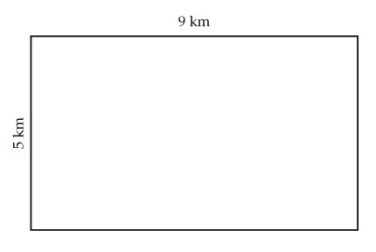
-Research has shown that land less than 1 km from unsuitable habitat is subject to edge effects for a pocket gopher. In the land diagrammed above, what is the size of the habitat area that is not subject to edge effects?
Refer to the diagram below, representing a suitable habitat established for a hypothetical threatened species of pocket gophers.
-Research has shown that land less than 1 km from unsuitable habitat is subject to edge effects for a pocket gopher. In the land diagrammed above, what is the size of the habitat area that is not subject to edge effects?
Question
Question
Question
Question
Question
Use the following to answer questions :
Refer to the diagram below, representing a suitable habitat established for a hypothetical threatened species of pocket gophers.
What is the total area of the suitable habitat?
Refer to the diagram below, representing a suitable habitat established for a hypothetical threatened species of pocket gophers.
What is the total area of the suitable habitat?
Question
Question
Question
Which of the graphs below best illustrates the number of species planted in the Tijuana Estuary habitat restoration studies, as well as the degree of restoration achieved (as measured by the proportion of the ground covered by plants)? 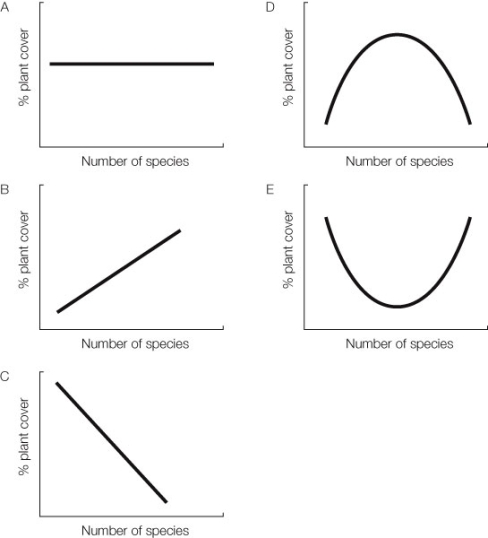
A) Graph A
B) Graph B
C) Graph C
D) Graph D
E) Graph E
A) Graph A
B) Graph B
C) Graph C
D) Graph D
E) Graph E
Question
Question
Question
Question

Unlock Deck
Sign up to unlock the cards in this deck!
Unlock Deck
Unlock Deck
1/116

Play

Full screen (f)
Deck 59: Conservation Biology
1
Global warming is a concern because
A) the rate of change in climate is projected to be faster than the rate at which many species can shift their ranges.
B) it is already too hot in the tropics.
C) climates have been so stable for thousands of years that many species lack the ability to tolerate variable temperatures.
D) climate change will be especially harmful to rare species.
E) None of the above
A) the rate of change in climate is projected to be faster than the rate at which many species can shift their ranges.
B) it is already too hot in the tropics.
C) climates have been so stable for thousands of years that many species lack the ability to tolerate variable temperatures.
D) climate change will be especially harmful to rare species.
E) None of the above
A
2
The most important cause of endangerment of species in the United States currently is
A) climate change.
B) invasive species.
C) overexploitation.
D) habitat loss.
E) loss of mutualists.
A) climate change.
B) invasive species.
C) overexploitation.
D) habitat loss.
E) loss of mutualists.
habitat loss.
3
Scientists can determine the historical frequency of fires in an area by
A) examining charcoal in sites of ancient villages.
B) measuring carbon in soils.
C) radioactively dating fallen tree trunks.
D) examining fire scars in growth rings of living trees.
E) determining the age structure of forests.
A) examining charcoal in sites of ancient villages.
B) measuring carbon in soils.
C) radioactively dating fallen tree trunks.
D) examining fire scars in growth rings of living trees.
E) determining the age structure of forests.
D
4
As a habitat patch gets smaller, it
A) cannot support populations of species that require large areas.
B) supports only small populations of many species.
C) is influenced to an increasing degree by edge effects.
D) is invaded by species from surrounding habitats.
E) All of the above
A) cannot support populations of species that require large areas.
B) supports only small populations of many species.
C) is influenced to an increasing degree by edge effects.
D) is invaded by species from surrounding habitats.
E) All of the above
Unlock Deck
Unlock for access to all 116 flashcards in this deck.
Unlock Deck
k this deck
5
Which of the following statements about conservation biology is true?
A) In the past there was often tension between conservation biologists who believed in conserving natural resources for economic reasons and those who were interested in the intrinsic value of nature.
B) Conservation biology is an applied science.
C) Human interests have no place in conservation biology.
D) Both a and b
E) Both b and c
A) In the past there was often tension between conservation biologists who believed in conserving natural resources for economic reasons and those who were interested in the intrinsic value of nature.
B) Conservation biology is an applied science.
C) Human interests have no place in conservation biology.
D) Both a and b
E) Both b and c
Unlock Deck
Unlock for access to all 116 flashcards in this deck.
Unlock Deck
k this deck
6
Captive propagation is a useful conservation tool, when
A) there is space in zoos, aquariums, and botanical gardens for breeding a few individuals.
B) the areas of origin of the captive individuals are known.
C) the threats that endangered the species are being alleviated so that captive-reared individuals can later be released back into the wild.
D) there are sufficient caretakers.
E) None of the above; captive propagation should never be used because it directs attention away from the need to protect the species in their natural habitats.
A) there is space in zoos, aquariums, and botanical gardens for breeding a few individuals.
B) the areas of origin of the captive individuals are known.
C) the threats that endangered the species are being alleviated so that captive-reared individuals can later be released back into the wild.
D) there are sufficient caretakers.
E) None of the above; captive propagation should never be used because it directs attention away from the need to protect the species in their natural habitats.
Unlock Deck
Unlock for access to all 116 flashcards in this deck.
Unlock Deck
k this deck
7
Which of the following statements about the Blackburn sphinx moth is false?
A) It recently went extinct.
B) It is the likely natural pollinator of the Hawaiian alula plant.
C) It is the largest native insect of the Hawaiian Islands.
D) It is closely related to the tobacco hornworm.
E) All of the above are true; none is false.
A) It recently went extinct.
B) It is the likely natural pollinator of the Hawaiian alula plant.
C) It is the largest native insect of the Hawaiian Islands.
D) It is closely related to the tobacco hornworm.
E) All of the above are true; none is false.
Unlock Deck
Unlock for access to all 116 flashcards in this deck.
Unlock Deck
k this deck
8
Which of the following is not a basic guiding principle of conservation biology?
A) Evolution is the process that unites all of biology.
B) The ecological world is dynamic.
C) Human beings are part of ecosystems.
D) There is a static balance of nature that serves as a goal for conservation efforts.
E) All of the above are basic guiding principles.
A) Evolution is the process that unites all of biology.
B) The ecological world is dynamic.
C) Human beings are part of ecosystems.
D) There is a static balance of nature that serves as a goal for conservation efforts.
E) All of the above are basic guiding principles.
Unlock Deck
Unlock for access to all 116 flashcards in this deck.
Unlock Deck
k this deck
9
Soon after contact with humans, most large mammals went extinct in
A) North America.
B) Australia.
C) Hawaii.
D) All of the above
E) None of the above
A) North America.
B) Australia.
C) Hawaii.
D) All of the above
E) None of the above
Unlock Deck
Unlock for access to all 116 flashcards in this deck.
Unlock Deck
k this deck
10
Species extinctions matter to human society because
A) more than a quarter of the medical prescriptions written in the United States contain a plant product.
B) people derive aesthetic pleasure from interacting with other organisms.
C) causing species extinctions raises serious ethical issues.
D) biodiversity helps maintain valuable ecosystem services.
E) All of the above
A) more than a quarter of the medical prescriptions written in the United States contain a plant product.
B) people derive aesthetic pleasure from interacting with other organisms.
C) causing species extinctions raises serious ethical issues.
D) biodiversity helps maintain valuable ecosystem services.
E) All of the above
Unlock Deck
Unlock for access to all 116 flashcards in this deck.
Unlock Deck
k this deck
11
The case of the ivory-billed woodpecker best illustrates
A) the potential medicinal value of biodiversity.
B) how global warming has led to species extinctions.
C) the difficulty of determining when a species has actually gone extinct.
D) the complexity of biological interactions.
E) the destructive power of an invasive species.
A) the potential medicinal value of biodiversity.
B) how global warming has led to species extinctions.
C) the difficulty of determining when a species has actually gone extinct.
D) the complexity of biological interactions.
E) the destructive power of an invasive species.
Unlock Deck
Unlock for access to all 116 flashcards in this deck.
Unlock Deck
k this deck
12
Which of the following statements about extinctions is true?
A) The background extinction rate is that which occurs during a mass extinction.
B) Extinctions are occurring now at rates comparable to those of the five mass extinctions.
C) Most of the species that have ever existed are extinct.
D) Both a and b
E) Both b and c
A) The background extinction rate is that which occurs during a mass extinction.
B) Extinctions are occurring now at rates comparable to those of the five mass extinctions.
C) Most of the species that have ever existed are extinct.
D) Both a and b
E) Both b and c
Unlock Deck
Unlock for access to all 116 flashcards in this deck.
Unlock Deck
k this deck
13
Which of the following would not be considered a measure of biodiversity?
A) Six alleles are present at the alcohol dehydrogenase gene in a population of Drosophila melanogaster.
B) In a population of minnows, 47 percent of the loci are polymorphic.
C) In a human population, 24 percent of individuals are polymorphic at the Y76Y locus.
D) A sample of water taken from the Hudson River has 369 different algal species.
E) All of the above are measures of biodiversity.
A) Six alleles are present at the alcohol dehydrogenase gene in a population of Drosophila melanogaster.
B) In a population of minnows, 47 percent of the loci are polymorphic.
C) In a human population, 24 percent of individuals are polymorphic at the Y76Y locus.
D) A sample of water taken from the Hudson River has 369 different algal species.
E) All of the above are measures of biodiversity.
Unlock Deck
Unlock for access to all 116 flashcards in this deck.
Unlock Deck
k this deck
14
Which of the following is not currently a major cause of species extinctions?
A) Habitat destruction
B) Rising sea levels
C) Overexploitation
D) Introduction of exotic predators
E) Introduction of exotic pathogens
A) Habitat destruction
B) Rising sea levels
C) Overexploitation
D) Introduction of exotic predators
E) Introduction of exotic pathogens
Unlock Deck
Unlock for access to all 116 flashcards in this deck.
Unlock Deck
k this deck
15
Which of the following statements is true?
A) Biologists have a good idea of the number of species on Earth.
B) One factor that limits our ability to predict the number of species that will go extinct in the next 50 years is our lack of knowledge about the geographic ranges of species.
C) If humans did not exist, no species would go extinct in the next 100 years.
D) The process of determining whether a species is extinct is not difficult.
E) None of the above
A) Biologists have a good idea of the number of species on Earth.
B) One factor that limits our ability to predict the number of species that will go extinct in the next 50 years is our lack of knowledge about the geographic ranges of species.
C) If humans did not exist, no species would go extinct in the next 100 years.
D) The process of determining whether a species is extinct is not difficult.
E) None of the above
Unlock Deck
Unlock for access to all 116 flashcards in this deck.
Unlock Deck
k this deck
16
Which of the following statements about the value of biodiversity is false?
A) Although a worthy goal, preserving the aesthetic benefits of biodiversity has no economic value.
B) More than a quarter of medical prescriptions either contain or are based on plant products.
C) Species loss can damage the functioning of ecosystems.
D) A wide variety of microbes increase the nutritional value of food.
E) All of the above are true; none is false.
A) Although a worthy goal, preserving the aesthetic benefits of biodiversity has no economic value.
B) More than a quarter of medical prescriptions either contain or are based on plant products.
C) Species loss can damage the functioning of ecosystems.
D) A wide variety of microbes increase the nutritional value of food.
E) All of the above are true; none is false.
Unlock Deck
Unlock for access to all 116 flashcards in this deck.
Unlock Deck
k this deck
17
Which of the following initiatives would not be included in modern conservation biology's efforts to preserve biodiversity?
A) Preserving the economic value gained from commercial fisheries
B) Protecting a species of butterfly for its intrinsic beauty
C) Protecting a woody shrub because of its medicinal applications
D) Protecting a sea otter because the community as a whole is more stable with that species present
E) All of the above would be efforts of modern conservation biology.
A) Preserving the economic value gained from commercial fisheries
B) Protecting a species of butterfly for its intrinsic beauty
C) Protecting a woody shrub because of its medicinal applications
D) Protecting a sea otter because the community as a whole is more stable with that species present
E) All of the above would be efforts of modern conservation biology.
Unlock Deck
Unlock for access to all 116 flashcards in this deck.
Unlock Deck
k this deck
18
The field of reconciliation ecology has developed because
A) all other methods of preserving biodiversity have failed.
B) protected areas should be able to maintain biodiversity.
C) protected areas alone are insufficient to maintain biodiversity.
D) scientists are unable to control diseases today.
E) we are not reconciled with other species.
A) all other methods of preserving biodiversity have failed.
B) protected areas should be able to maintain biodiversity.
C) protected areas alone are insufficient to maintain biodiversity.
D) scientists are unable to control diseases today.
E) we are not reconciled with other species.
Unlock Deck
Unlock for access to all 116 flashcards in this deck.
Unlock Deck
k this deck
19
Restoration ecology is an important field because
A) many areas have been highly degraded.
B) many areas are vulnerable to global climate change.
C) many species suffer from demographic stochasticity.
D) many species are genetically impoverished.
E) fire is a threat to many areas.
A) many areas have been highly degraded.
B) many areas are vulnerable to global climate change.
C) many species suffer from demographic stochasticity.
D) many species are genetically impoverished.
E) fire is a threat to many areas.
Unlock Deck
Unlock for access to all 116 flashcards in this deck.
Unlock Deck
k this deck
20
A plant species is most likely to become invasive when introduced to a new area if it
A) grows tall.
B) has become invasive in other places where it has been introduced.
C) is closely related to species living in the area where it has been introduced.
D) has specialized disseminators of its seeds.
E) has a long life span.
A) grows tall.
B) has become invasive in other places where it has been introduced.
C) is closely related to species living in the area where it has been introduced.
D) has specialized disseminators of its seeds.
E) has a long life span.
Unlock Deck
Unlock for access to all 116 flashcards in this deck.
Unlock Deck
k this deck
21
In the Hawaiian Islands, _______, which is an introduced disease, has been responsible for wiping out nearly all endemic bird species living below an elevation of 1,500 meters
A) avian malaria
B) avian flu
C) avian smallpox
D) avian Ebola
E) None of the above
A) avian malaria
B) avian flu
C) avian smallpox
D) avian Ebola
E) None of the above
Unlock Deck
Unlock for access to all 116 flashcards in this deck.
Unlock Deck
k this deck
22
According to the species-area relationship, a 90 percent loss of habitat will result in _______ loss of the species that live in that habitat.
A) no
B) a 10 percent
C) a 50 percent
D) a 90 percent
E) None of the above
A) no
B) a 10 percent
C) a 50 percent
D) a 90 percent
E) None of the above
Unlock Deck
Unlock for access to all 116 flashcards in this deck.
Unlock Deck
k this deck
23
Which of the following statements about habitat corridors is true?
A) They are places where an endangered species can live and breed.
B) They are usually used in captive breeding studies.
C) Their presence mitigates the deleterious effects of habitat fragmentation.
D) They are most effective as a conservation measure for species that disperse little.
E) None of the above
A) They are places where an endangered species can live and breed.
B) They are usually used in captive breeding studies.
C) Their presence mitigates the deleterious effects of habitat fragmentation.
D) They are most effective as a conservation measure for species that disperse little.
E) None of the above
Unlock Deck
Unlock for access to all 116 flashcards in this deck.
Unlock Deck
k this deck
24
Which of the following statements about introduced species is true?
A) Zebra mussels were deliberately introduced into the United States.
B) Nearly half of the small- to medium-sized marsupials of Australia went extinct in the last 100 years due to introduced species.
C) Native plants usually devote less energy to combating native herbivores than introduced plants do.
D) Both a and b
E) Both a and c
A) Zebra mussels were deliberately introduced into the United States.
B) Nearly half of the small- to medium-sized marsupials of Australia went extinct in the last 100 years due to introduced species.
C) Native plants usually devote less energy to combating native herbivores than introduced plants do.
D) Both a and b
E) Both a and c
Unlock Deck
Unlock for access to all 116 flashcards in this deck.
Unlock Deck
k this deck
25
Conservation biologists rely heavily on _______ to estimate how many species will be lost due to habitat loss.
A) the CITES guidelines
B) the principles of species-area relationships
C) captive breeding programs
D) the principles of natural selection
E) None of the above
A) the CITES guidelines
B) the principles of species-area relationships
C) captive breeding programs
D) the principles of natural selection
E) None of the above
Unlock Deck
Unlock for access to all 116 flashcards in this deck.
Unlock Deck
k this deck
26
Suppose a lumber company proposes to clear-cut a large area of forest, but it aims to leave small patches of forest to provide habitat for forest animals. Which of the following is a weakness of this method of conservation?
A) Small patches cannot support populations of species that require large areas.
B) Small patches can harbor only small populations of the species that can survive there.
C) Due to edge effects, small patches have higher temperatures, stronger winds, and lower humidity levels than larger forest tracts.
D) Species that live in the clear-cut areas often invade the edges of the patches and compete with or prey on the species living there.
E) All of the above
A) Small patches cannot support populations of species that require large areas.
B) Small patches can harbor only small populations of the species that can survive there.
C) Due to edge effects, small patches have higher temperatures, stronger winds, and lower humidity levels than larger forest tracts.
D) Species that live in the clear-cut areas often invade the edges of the patches and compete with or prey on the species living there.
E) All of the above
Unlock Deck
Unlock for access to all 116 flashcards in this deck.
Unlock Deck
k this deck
27
Which of the following statements about the tropical forest of Central America is true?
A) Nearly all of the forest that existed in 1950 still existed in 1985.
B) Less than half of the forest that existed in 1950 still existed in 1985, and most of what remained existed in small patches.
C) Less than half of the forest that existed in 1950 still existed in 1985, and most of what remained was in one large region in the northern part of Central America.
D) Less than half of the forest that existed in 1950 still existed in 1985, and most of what remained was in one large region in the southern part of Central America.
E) Virtually all of the forest is gone.
A) Nearly all of the forest that existed in 1950 still existed in 1985.
B) Less than half of the forest that existed in 1950 still existed in 1985, and most of what remained existed in small patches.
C) Less than half of the forest that existed in 1950 still existed in 1985, and most of what remained was in one large region in the northern part of Central America.
D) Less than half of the forest that existed in 1950 still existed in 1985, and most of what remained was in one large region in the southern part of Central America.
E) Virtually all of the forest is gone.
Unlock Deck
Unlock for access to all 116 flashcards in this deck.
Unlock Deck
k this deck
28
Our ability to predict how many species will go extinct is limited because of our limited knowledge about
A) how many species exist.
B) where species live.
C) all the connections among species.
D) All of the above
E) None of the above
A) how many species exist.
B) where species live.
C) all the connections among species.
D) All of the above
E) None of the above
Unlock Deck
Unlock for access to all 116 flashcards in this deck.
Unlock Deck
k this deck
29
Introduced species that spread widely and become unduly abundant are known as _______ species.
A) spreader
B) invasive
C) super
D) extravagant
E) hammerhead
A) spreader
B) invasive
C) super
D) extravagant
E) hammerhead
Unlock Deck
Unlock for access to all 116 flashcards in this deck.
Unlock Deck
k this deck
30
Various species are either extinct or threatened in the United States, including certain freshwater mussels, flowering plants, and mammals. Which of the following represents the correct ranking (from most endangered to least endangered) of these groups of organisms?
A) Mussels, plants, mammals
B) Mussels, mammals, plants
C) Plants, mammals, mussels
D) Plants, mussels, mammals
E) Mammals, mussels, plants
A) Mussels, plants, mammals
B) Mussels, mammals, plants
C) Plants, mammals, mussels
D) Plants, mussels, mammals
E) Mammals, mussels, plants
Unlock Deck
Unlock for access to all 116 flashcards in this deck.
Unlock Deck
k this deck
31
The most significant cause of species endangerment in the United States is
A) air pollution.
B) climate change.
C) the introduction of exotic species.
D) habitat loss.
E) acid rain.
A) air pollution.
B) climate change.
C) the introduction of exotic species.
D) habitat loss.
E) acid rain.
Unlock Deck
Unlock for access to all 116 flashcards in this deck.
Unlock Deck
k this deck
32
Compared to the area inside a forest, the areas at the edge of a forest have
A) stronger winds.
B) higher humidity.
C) lower light levels.
D) lower temperatures.
E) All of the above
A) stronger winds.
B) higher humidity.
C) lower light levels.
D) lower temperatures.
E) All of the above
Unlock Deck
Unlock for access to all 116 flashcards in this deck.
Unlock Deck
k this deck
33
According to the basic rule of thumb of conservation biology, if 300 species of grasshoppers reside in a habitat of 20,000 ha, about _______ species of grasshoppers should persist if that habitat is reduced to 2,000 ha.
A) 30
B) 60
C) 90
D) 150
E) 270
A) 30
B) 60
C) 90
D) 150
E) 270
Unlock Deck
Unlock for access to all 116 flashcards in this deck.
Unlock Deck
k this deck
34
Invasive plant species would be expected to
A) devote a higher-than-average allocation of resources to reproduction.
B) have higher-than-average concentrations of secondary compounds.
C) be susceptible to a greater-than-average number of herbivores.
D) Both a and b
E) None of the above
A) devote a higher-than-average allocation of resources to reproduction.
B) have higher-than-average concentrations of secondary compounds.
C) be susceptible to a greater-than-average number of herbivores.
D) Both a and b
E) None of the above
Unlock Deck
Unlock for access to all 116 flashcards in this deck.
Unlock Deck
k this deck
35
Which of the following statements about habitat is true?
A) Small patches of habitat are qualitatively similar to patches of larger size.
B) Edge effects increase as habitat size increases.
C) Habitat loss has no effect on neighboring areas of remaining habitat.
D) All of the above
E) None of the above
A) Small patches of habitat are qualitatively similar to patches of larger size.
B) Edge effects increase as habitat size increases.
C) Habitat loss has no effect on neighboring areas of remaining habitat.
D) All of the above
E) None of the above
Unlock Deck
Unlock for access to all 116 flashcards in this deck.
Unlock Deck
k this deck
36
If tropical rainforests continue to be lost at the present rate, about _______ species are in danger of going extinct during this century.
A) 100,000
B) 300,000
C) 600,000
D) 750,000
E) 1,000,000
A) 100,000
B) 300,000
C) 600,000
D) 750,000
E) 1,000,000
Unlock Deck
Unlock for access to all 116 flashcards in this deck.
Unlock Deck
k this deck
37
Which of the following statements about the tropical rainforest is true?
A) It is Earth's most species-rich biome.
B) Its area has been relatively constant during the last 50 years.
C) It is being lost at a rate of about 2 percent of the remaining forest each year.
D) Both a and b
E) Both a and c
A) It is Earth's most species-rich biome.
B) Its area has been relatively constant during the last 50 years.
C) It is being lost at a rate of about 2 percent of the remaining forest each year.
D) Both a and b
E) Both a and c
Unlock Deck
Unlock for access to all 116 flashcards in this deck.
Unlock Deck
k this deck
38
Which of the following is not a reason for the dramatic increase in the number of species driven to extinction in recent years?
A) Overexploitation
B) Habitat destruction
C) Introduction of predators
D) Natural predation
E) Introduction of diseases
A) Overexploitation
B) Habitat destruction
C) Introduction of predators
D) Natural predation
E) Introduction of diseases
Unlock Deck
Unlock for access to all 116 flashcards in this deck.
Unlock Deck
k this deck
39
Which of the following statements about human predation is true?
A) Although an important threat to species in the past, overexploitation no longer threatens any species.
B) The Banggai cardinalfish has benefited from the pet trade.
C) The hunting of tigers for the medicinal use of their body parts is a primary threat to their survival.
D) Both a and b
E) None of the above
A) Although an important threat to species in the past, overexploitation no longer threatens any species.
B) The Banggai cardinalfish has benefited from the pet trade.
C) The hunting of tigers for the medicinal use of their body parts is a primary threat to their survival.
D) Both a and b
E) None of the above
Unlock Deck
Unlock for access to all 116 flashcards in this deck.
Unlock Deck
k this deck
40
Forest fragmentation has led to increases in cowbird populations because fragmentation has
A) caused the demise of a predator of cowbirds.
B) caused cowbirds to be exposed to species of birds previously unknown to them.
C) increased the food supply for cowbirds.
D) decreased the range of the cowbirds' parasites.
E) None of the above
A) caused the demise of a predator of cowbirds.
B) caused cowbirds to be exposed to species of birds previously unknown to them.
C) increased the food supply for cowbirds.
D) decreased the range of the cowbirds' parasites.
E) None of the above
Unlock Deck
Unlock for access to all 116 flashcards in this deck.
Unlock Deck
k this deck
41
A ban on the trade of elephant ivory has been enacted by
A) UNESCO.
B) the USDA.
C) CITES.
D) NATO.
E) the AFL-CIO.
A) UNESCO.
B) the USDA.
C) CITES.
D) NATO.
E) the AFL-CIO.
Unlock Deck
Unlock for access to all 116 flashcards in this deck.
Unlock Deck
k this deck
42
Studies of the Tijuana Estuary showed that
A) increased nitrogen in the soil led to greater species richness.
B) increased plant cover led to greater species richness.
C) increased species richness led to increased plant cover.
D) decreased species richness led to increased plant cover.
E) decreased nitrogen in the soil led to greater species richness.
A) increased nitrogen in the soil led to greater species richness.
B) increased plant cover led to greater species richness.
C) increased species richness led to increased plant cover.
D) decreased species richness led to increased plant cover.
E) decreased nitrogen in the soil led to greater species richness.
Unlock Deck
Unlock for access to all 116 flashcards in this deck.
Unlock Deck
k this deck
43
The practice of using exploited lands in ways that sustain biodiversity is known as
A) restoration ecology.
B) reconciliation ecology.
C) reparative ecology.
D) fragmentation ecology.
E) Kubrick's principle.
A) restoration ecology.
B) reconciliation ecology.
C) reparative ecology.
D) fragmentation ecology.
E) Kubrick's principle.
Unlock Deck
Unlock for access to all 116 flashcards in this deck.
Unlock Deck
k this deck
44
The American Prairie Foundation's practice of buying up ranches in Montana with the aim of reintroducing bison and other species is an example of
A) habitat preservation.
B) restoration ecology.
C) invasive ecology.
D) biocontrol.
E) None of the above
A) habitat preservation.
B) restoration ecology.
C) invasive ecology.
D) biocontrol.
E) None of the above
Unlock Deck
Unlock for access to all 116 flashcards in this deck.
Unlock Deck
k this deck
45
Which of the following statements is false?
A) Conservation biologists select areas to be protected based solely on the number of species in the area.
B) Over 70 percent of all terrestrial vertebrate species live in hotspots that occupy less than one-sixth of Earth's land surface.
C) The tropics of South America are a hotspot for avian biodiversity.
D) Hotspots do not represent all of Earth's biodiversity.
E) All of the above are true; none is false.
A) Conservation biologists select areas to be protected based solely on the number of species in the area.
B) Over 70 percent of all terrestrial vertebrate species live in hotspots that occupy less than one-sixth of Earth's land surface.
C) The tropics of South America are a hotspot for avian biodiversity.
D) Hotspots do not represent all of Earth's biodiversity.
E) All of the above are true; none is false.
Unlock Deck
Unlock for access to all 116 flashcards in this deck.
Unlock Deck
k this deck
46
The booming industry of ecotourism best illustrates that
A) there is a balance of nature, which must be preserved.
B) economic and environmental interests need not always be in conflict.
C) humans depend on thousands of species for food.
D) our knowledge of biodiversity is incomplete.
E) None of the above
A) there is a balance of nature, which must be preserved.
B) economic and environmental interests need not always be in conflict.
C) humans depend on thousands of species for food.
D) our knowledge of biodiversity is incomplete.
E) None of the above
Unlock Deck
Unlock for access to all 116 flashcards in this deck.
Unlock Deck
k this deck
47
Deoxygenating ballast water
A) helps eliminate the transoceanic transport of invasive species.
B) would be economically costly to the shippers.
C) extends the life of ballast tanks.
D) Both a and b
E) Both a and c
A) helps eliminate the transoceanic transport of invasive species.
B) would be economically costly to the shippers.
C) extends the life of ballast tanks.
D) Both a and b
E) Both a and c
Unlock Deck
Unlock for access to all 116 flashcards in this deck.
Unlock Deck
k this deck
48
Samuel Wasser and his colleagues made use of _______ to determine the source of ivory in the ivory trade.
A) radiotelemetry
B) sonar
C) DNA markers
D) radioisotopes
E) None of the above
A) radiotelemetry
B) sonar
C) DNA markers
D) radioisotopes
E) None of the above
Unlock Deck
Unlock for access to all 116 flashcards in this deck.
Unlock Deck
k this deck
49
Which of the following statements is true?
A) Captive breeding is an effective, permanent measure for protecting endangered species.
B) The California condor program is an example of a successful captive breeding program.
C) Lead poisoning is no longer a problem for the California condor.
D) There is enough space in zoos, aquariums, and botanical gardens to hold most of Earth's endangered and rare species.
E) The California condor went extinct during the 1980s.
A) Captive breeding is an effective, permanent measure for protecting endangered species.
B) The California condor program is an example of a successful captive breeding program.
C) Lead poisoning is no longer a problem for the California condor.
D) There is enough space in zoos, aquariums, and botanical gardens to hold most of Earth's endangered and rare species.
E) The California condor went extinct during the 1980s.
Unlock Deck
Unlock for access to all 116 flashcards in this deck.
Unlock Deck
k this deck
50
The processes of climate change are likely to lead to entirely new climates
A) in the highlands of the temperate zone.
B) in the lowlands of the temperate zone.
C) in the lowland tropics.
D) in the alpine tropics.
E) near the Arctic circle.
A) in the highlands of the temperate zone.
B) in the lowlands of the temperate zone.
C) in the lowland tropics.
D) in the alpine tropics.
E) near the Arctic circle.
Unlock Deck
Unlock for access to all 116 flashcards in this deck.
Unlock Deck
k this deck
51
Which of the following statements is true?
A) Ecotourism is a major source of income for many developing countries.
B) Hundreds of thousands of visitors flock to the Western Cape Province of South Africa each year to see the endemic plants.
C) Most tourists visiting South Africa would pay more money for the opportunity to see the wild dogs.
D) All of the above
E) None of the above
A) Ecotourism is a major source of income for many developing countries.
B) Hundreds of thousands of visitors flock to the Western Cape Province of South Africa each year to see the endemic plants.
C) Most tourists visiting South Africa would pay more money for the opportunity to see the wild dogs.
D) All of the above
E) None of the above
Unlock Deck
Unlock for access to all 116 flashcards in this deck.
Unlock Deck
k this deck
52
Centers of imminent extinction are clustered in the continents of _______ and _______.
A) North America; South America
B) North America; Europe
C) North America; Asia
D) North America; Australia
E) South America; Asia
A) North America; South America
B) North America; Europe
C) North America; Asia
D) North America; Australia
E) South America; Asia
Unlock Deck
Unlock for access to all 116 flashcards in this deck.
Unlock Deck
k this deck
53
Which of the following statements about elephants is true?
A) Poaching of elephants continues throughout the world.
B) In some countries of southern Africa, elephants are so common that government officials need to kill many of them to control their numbers.
C) The demand for ivory from elephants is particularly strong in Japan and China.
D) All of the above
E) None of the above
A) Poaching of elephants continues throughout the world.
B) In some countries of southern Africa, elephants are so common that government officials need to kill many of them to control their numbers.
C) The demand for ivory from elephants is particularly strong in Japan and China.
D) All of the above
E) None of the above
Unlock Deck
Unlock for access to all 116 flashcards in this deck.
Unlock Deck
k this deck
54
A plant species is more likely to become invasive if it has
A) a long generation time.
B) a close relative in the region to which it is introduced.
C) large seeds.
D) a slow rate of growth.
E) None of the above
A) a long generation time.
B) a close relative in the region to which it is introduced.
C) large seeds.
D) a slow rate of growth.
E) None of the above
Unlock Deck
Unlock for access to all 116 flashcards in this deck.
Unlock Deck
k this deck
55
Which of the following is not one of the few remaining areas of unbroken rainforest?
A) The island of New Guinea
B) The Congo Basin of Africa
C) Western Australia
D) The South American Amazonia
E) All of the above are unbroken areas of rainforest.
A) The island of New Guinea
B) The Congo Basin of Africa
C) Western Australia
D) The South American Amazonia
E) All of the above are unbroken areas of rainforest.
Unlock Deck
Unlock for access to all 116 flashcards in this deck.
Unlock Deck
k this deck
56
A fynbos is
A) a type of wild African dog faced with extinction due to habitat loss.
B) a type of antelope hunted for its horns.
C) an environmentally friendly brand of coffee grown in Kenya.
D) a community of hardy shrubs in South Africa that provides water.
E) the leader of CITES.
A) a type of wild African dog faced with extinction due to habitat loss.
B) a type of antelope hunted for its horns.
C) an environmentally friendly brand of coffee grown in Kenya.
D) a community of hardy shrubs in South Africa that provides water.
E) the leader of CITES.
Unlock Deck
Unlock for access to all 116 flashcards in this deck.
Unlock Deck
k this deck
57
Which of the following statements about "centers of imminent extinction" is true?
A) Most are legally protected.
B) Most are surrounded by rapid human development.
C) Most are in Australia.
D) Most are found in the temperate zone.
E) None of the above
A) Most are legally protected.
B) Most are surrounded by rapid human development.
C) Most are in Australia.
D) Most are found in the temperate zone.
E) None of the above
Unlock Deck
Unlock for access to all 116 flashcards in this deck.
Unlock Deck
k this deck
58
The best predictor of whether a species will become invasive in its area is
A) its generation time.
B) the size of its seeds.
C) whether it is invasive elsewhere.
D) how many predators it has.
E) the size of its native range.
A) its generation time.
B) the size of its seeds.
C) whether it is invasive elsewhere.
D) how many predators it has.
E) the size of its native range.
Unlock Deck
Unlock for access to all 116 flashcards in this deck.
Unlock Deck
k this deck
59
Which of the following statements about forest fires is true?
A) Some plant species require periodic fires to establish themselves.
B) The current official policy of the U.S. Forest Service is to suppress all forest fires.
C) Scars in the annual growth rings of trees are evidence of past forest fires.
D) Both a and b
E) Both a and c
A) Some plant species require periodic fires to establish themselves.
B) The current official policy of the U.S. Forest Service is to suppress all forest fires.
C) Scars in the annual growth rings of trees are evidence of past forest fires.
D) Both a and b
E) Both a and c
Unlock Deck
Unlock for access to all 116 flashcards in this deck.
Unlock Deck
k this deck
60
Which of the following statements about climate change is true?
A) Scientists predict that the average temperatures in North America will increase by less than 1°C over the next century.
B) Organisms that disperse easily have the best chance of surviving climate change (all else being equal).
C) The earthworms in much of northern U.S. and Canada were wiped out by glaciers; the worms we see now were introduced from Europe.
D) Both a and b
E) Both b and c
A) Scientists predict that the average temperatures in North America will increase by less than 1°C over the next century.
B) Organisms that disperse easily have the best chance of surviving climate change (all else being equal).
C) The earthworms in much of northern U.S. and Canada were wiped out by glaciers; the worms we see now were introduced from Europe.
D) Both a and b
E) Both b and c
Unlock Deck
Unlock for access to all 116 flashcards in this deck.
Unlock Deck
k this deck
61
Winter moth, a species of moth that was introduced to United States from Europe, has spread widely and become a threat to many trees. For this reason, winter moth is considered to be a(n) _______ species.
Unlock Deck
Unlock for access to all 116 flashcards in this deck.
Unlock Deck
k this deck
62
One tool that is used to estimate the probability of extinction resulting from habitat destruction is the _______ relationship.
Unlock Deck
Unlock for access to all 116 flashcards in this deck.
Unlock Deck
k this deck
63
Because it uses knowledge about the natural world to solve specific problems, conservation biology is viewed as a(n) _______ science.
Unlock Deck
Unlock for access to all 116 flashcards in this deck.
Unlock Deck
k this deck
64
New Guinea is a region of the world where species richness is particularly high. For this reason it is called a(n) _______.
Unlock Deck
Unlock for access to all 116 flashcards in this deck.
Unlock Deck
k this deck
65
The legal mechanism for prohibiting the exploitation of endangered species is an international agreement known as _______.
Unlock Deck
Unlock for access to all 116 flashcards in this deck.
Unlock Deck
k this deck
66
Birds will likely be able to shift their ranges to keep up with climate change because they _______ easily.
Unlock Deck
Unlock for access to all 116 flashcards in this deck.
Unlock Deck
k this deck
67
_______ ecology is the intentional transformation of a degraded habitat to a more natural state.
Unlock Deck
Unlock for access to all 116 flashcards in this deck.
Unlock Deck
k this deck
68
Use the following to answer questions :
Refer to the diagram below, representing a suitable habitat established for a hypothetical threatened species of pocket gophers.
-Research has shown that land less than 1 km from unsuitable habitat is subject to edge effects for a pocket gopher. In the land diagrammed above, what is the size of the habitat area that is not subject to edge effects?
Refer to the diagram below, representing a suitable habitat established for a hypothetical threatened species of pocket gophers.
-Research has shown that land less than 1 km from unsuitable habitat is subject to edge effects for a pocket gopher. In the land diagrammed above, what is the size of the habitat area that is not subject to edge effects?
Unlock Deck
Unlock for access to all 116 flashcards in this deck.
Unlock Deck
k this deck
69
A species may persist in a small patch of habitat if that patch is connected to others through habitat _______.
Unlock Deck
Unlock for access to all 116 flashcards in this deck.
Unlock Deck
k this deck
70
The most likely cause of the extinctions of many large mammals in North America in the last 14,000 years is
A) rapid climate change associated with glaciation.
B) overhunting by humans.
C) the formation of land bridges to neighboring continents that allowed many new species of competitors and predators to invade these regions.
D) massive volcanism that caused destruction of the food supply for these mammals.
E) pathogens introduced by humans.
A) rapid climate change associated with glaciation.
B) overhunting by humans.
C) the formation of land bridges to neighboring continents that allowed many new species of competitors and predators to invade these regions.
D) massive volcanism that caused destruction of the food supply for these mammals.
E) pathogens introduced by humans.
Unlock Deck
Unlock for access to all 116 flashcards in this deck.
Unlock Deck
k this deck
71
The native vegetation of the Western Cape Province in South Africa, a community of shrubs known as _______, is vital to maintaining the region's water supply.
Unlock Deck
Unlock for access to all 116 flashcards in this deck.
Unlock Deck
k this deck
72
In the United States, the groups of organisms with the highest proportion of endangered or extinct species live in
A) grasslands.
B) the deciduous forest biome.
C) freshwater habitats.
D) deserts.
E) temperate evergreen forest.
A) grasslands.
B) the deciduous forest biome.
C) freshwater habitats.
D) deserts.
E) temperate evergreen forest.
Unlock Deck
Unlock for access to all 116 flashcards in this deck.
Unlock Deck
k this deck
73
Use the following to answer questions :
Refer to the diagram below, representing a suitable habitat established for a hypothetical threatened species of pocket gophers.
What is the total area of the suitable habitat?
Refer to the diagram below, representing a suitable habitat established for a hypothetical threatened species of pocket gophers.
What is the total area of the suitable habitat?
Unlock Deck
Unlock for access to all 116 flashcards in this deck.
Unlock Deck
k this deck
74
The concepts of conservation biology come mainly from all of the following fields except
A) ecology.
B) evolutionary biology.
C) population genetics.
D) immunology.
E) ethology.
A) ecology.
B) evolutionary biology.
C) population genetics.
D) immunology.
E) ethology.
Unlock Deck
Unlock for access to all 116 flashcards in this deck.
Unlock Deck
k this deck
75
In the Hawaiian Islands, the blood disease _______ has wiped out nearly all low-elevation endemic birds.
Unlock Deck
Unlock for access to all 116 flashcards in this deck.
Unlock Deck
k this deck
76
Which of the graphs below best illustrates the number of species planted in the Tijuana Estuary habitat restoration studies, as well as the degree of restoration achieved (as measured by the proportion of the ground covered by plants)?
A) Graph A
B) Graph B
C) Graph C
D) Graph D
E) Graph E
A) Graph A
B) Graph B
C) Graph C
D) Graph D
E) Graph E
Unlock Deck
Unlock for access to all 116 flashcards in this deck.
Unlock Deck
k this deck
77
The Plimsoll line
A) helped reestablish the California condor.
B) is used to keep elephants out of crops in Africa.
C) resulted in a dramatic reduction in the rate at which British ships were lost at sea.
D) is a useful tool to predict the strength of edge effects.
E) is being used by Tucson, Arizona, to protect the bats that roost there.
A) helped reestablish the California condor.
B) is used to keep elephants out of crops in Africa.
C) resulted in a dramatic reduction in the rate at which British ships were lost at sea.
D) is a useful tool to predict the strength of edge effects.
E) is being used by Tucson, Arizona, to protect the bats that roost there.
Unlock Deck
Unlock for access to all 116 flashcards in this deck.
Unlock Deck
k this deck
78
Based on species-area relationships, ecologists predict that
A) about one million tropical evergreen forest species may become extinct in the next hundred years.
B) a 90 percent loss of habitat will result in loss of about 9 percent of the species living there.
C) the area required by most species will need to be reduced.
D) extinction is inevitable.
E) None of the above
A) about one million tropical evergreen forest species may become extinct in the next hundred years.
B) a 90 percent loss of habitat will result in loss of about 9 percent of the species living there.
C) the area required by most species will need to be reduced.
D) extinction is inevitable.
E) None of the above
Unlock Deck
Unlock for access to all 116 flashcards in this deck.
Unlock Deck
k this deck
79
Species that are threatened by extinction in the near future are labeled _______ species.
Unlock Deck
Unlock for access to all 116 flashcards in this deck.
Unlock Deck
k this deck
80
The practice of using exploited lands in ways that sustain biodiversity is known as _______.
Unlock Deck
Unlock for access to all 116 flashcards in this deck.
Unlock Deck
k this deck
Unlock Deck
Unlock for access to all 116 flashcards in this deck.






