







 Chat with AI

Deck 22: Carbohydrates
Full screen (f)

Question

Question
What compounds (other than methanol)would be formed in the solution if the glycoside presented below was treated with dilute aqueous hydrochloric acid and the solution allowed to stand? 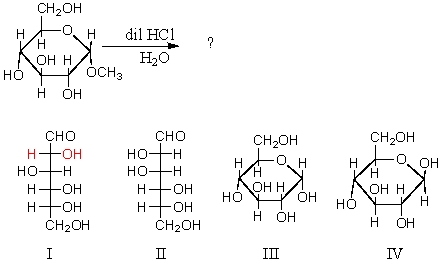
A)I and II
B)I and III
C)II and III
D)I,III,and IV
E)II,III,and IV
A)I and II
B)I and III
C)II and III
D)I,III,and IV
E)II,III,and IV
Question
Which of these is α-d-glucopyranose? 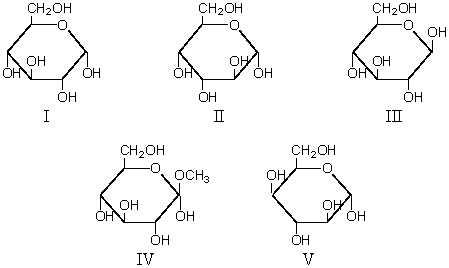
A)I
B)II
C)III
D)IV
E)V
A)I
B)II
C)III
D)IV
E)V
Question
Which of the following structures represent enantiomers? 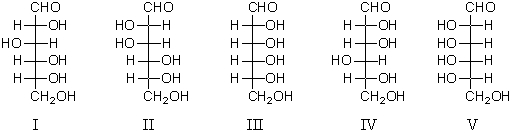
A)I and II
B)II and III
C)III and IV
D)III and V
E)IV and V
A)I and II
B)II and III
C)III and IV
D)III and V
E)IV and V
Question
Which of the following is an l-aldotetrose? 
A)I
B)II
C)III
D)IV
E)V
A)I
B)II
C)III
D)IV
E)V
Question
Consider the structures shown below.Which structure represents -d-glucopyranose? 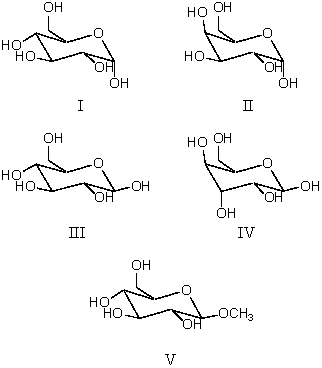
A)I
B)II
C)III
D)IV
E)V
A)I
B)II
C)III
D)IV
E)V
Question
What are the correct designations for the stereogenic centers in this aldose: 
A)2R,3S,4R
B)2R,3S,4S
C)2S,3R,4R
D)2S,3S,4R
E)2R,3R,4S
A)2R,3S,4R
B)2R,3S,4S
C)2S,3R,4R
D)2S,3S,4R
E)2R,3R,4S
Question
Which would undergo mutarotation in neutral aqueous solution? 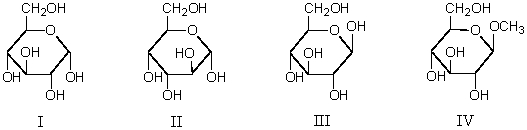
A)I
B)II
C)III
D)IV
E)I,II and III
A)I
B)II
C)III
D)IV
E)I,II and III
Question
Sugars that undergo mutarotation in neutral aqueous solution are: 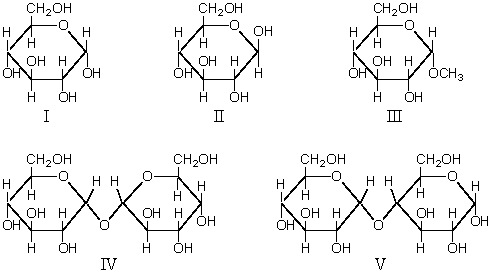
A)I and III
B)III and IV
C)II,III,and IV
D)I,II,and V
E)I and IV
A)I and III
B)III and IV
C)II,III,and IV
D)I,II,and V
E)I and IV
Question
Which are the anomers? 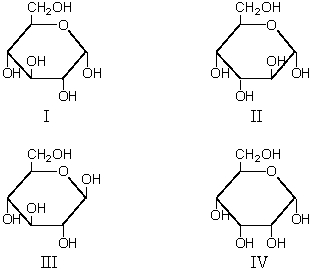
A)I and II
B)I and III
C)II and III
D)II and IV
E)III and IV
A)I and II
B)I and III
C)II and III
D)II and IV
E)III and IV
Question
What are carbohydrates? 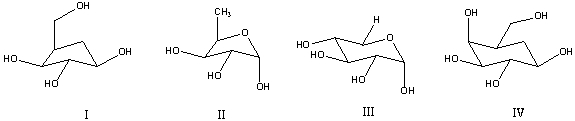
A)I,II,III
B)I,II
C)II,III
D)I,II,III,IV
E)III,IV
A)I,II,III
B)I,II
C)II,III
D)I,II,III,IV
E)III,IV
Question
Question
Which of the following is a d-aldotetrose? 
A)I
B)II
C)III
D)IV
E)V
A)I
B)II
C)III
D)IV
E)V
Question
Which reagent would cause the following conversion to take place? 
A)Excess CH3OH and KOH
B)Excess CH3OH and HCl
C)Excess (CH3)2SO4 and OH-
D)Excess CH3I and H3O+
E)Excess (CH3CO)2O
A)Excess CH3OH and KOH
B)Excess CH3OH and HCl
C)Excess (CH3)2SO4 and OH-
D)Excess CH3I and H3O+
E)Excess (CH3CO)2O
Question
Which of these is a glycoside? 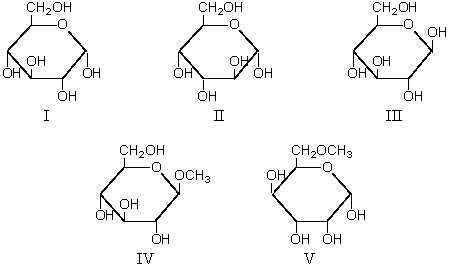
A)I
B)II
C)III
D)IV
E)V
A)I
B)II
C)III
D)IV
E)V
Question
Question
Which reagent would be used for the following transformation? 
A)CH3I,KOH
B)
C)CH3OH,HCl
D)(CH3)2SO4,NaOH
E)
A)CH3I,KOH
B)
C)CH3OH,HCl
D)(CH3)2SO4,NaOH
E)
Question
Question
Refer to the structures below.Which are l-sugars? 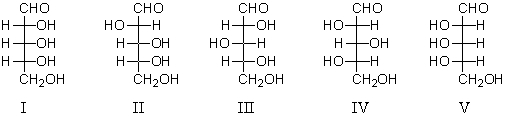
A)II and IV
B)I,II,and III
C)I and V
D)III,IV,and V
E)IV and V
A)II and IV
B)I,II,and III
C)I and V
D)III,IV,and V
E)IV and V
Question
Question
Which of these compounds,I,II,III,IV,is a reducing disaccharide? 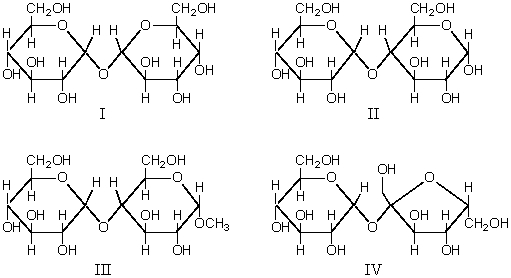
A)I alone
B)II alone
C)III alone
D)IV alone
E)I,II,III,and IV
A)I alone
B)II alone
C)III alone
D)IV alone
E)I,II,III,and IV
Question
Which of the following would give a positive test with Benedict's solution? 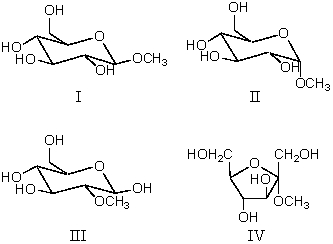
A)I
B)II
C)III
D)IV
E)All of these choices.
A)I
B)II
C)III
D)IV
E)All of these choices.
Question
Consider the structures shown below.Which compound is not a reducing sugar? 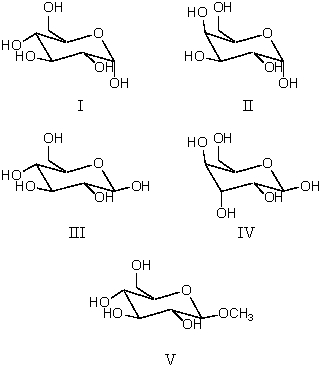
A)I
B)II
C)III
D)IV
E)V
A)I
B)II
C)III
D)IV
E)V
Question
Which compound will not reduce Ag(NH3)2+ ? 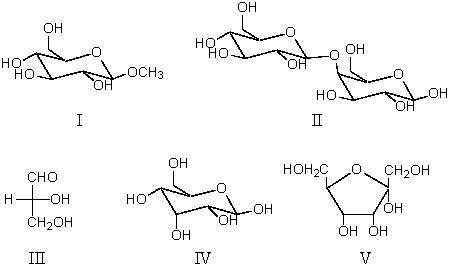
A)I
B)II
C)III
D)IV
E)V
A)I
B)II
C)III
D)IV
E)V
Question
Which reagent would be used for the following transformation? 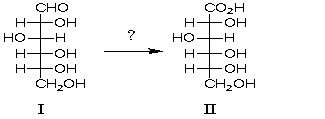
A)Ag(NH3)2+
B)HNO3
C)Br2/H2O
D)HCl
E)Ag(NH3)2+ and Br2/H2O
A)Ag(NH3)2+
B)HNO3
C)Br2/H2O
D)HCl
E)Ag(NH3)2+ and Br2/H2O
Question
An aldonic acid is represented by: 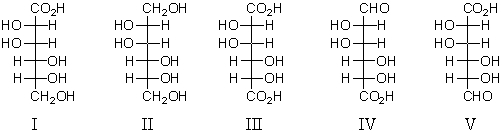
A)I
B)II
C)III
D)IV
E)V
A)I
B)II
C)III
D)IV
E)V
Question
Which of these is a non-reducing monosaccharide? 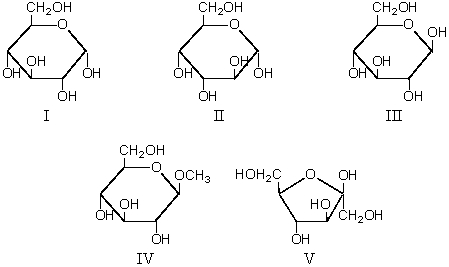
A)I
B)II
C)III
D)IV
E)V
A)I
B)II
C)III
D)IV
E)V
Question
Question
Which of these pyranose forms of an aldohexose can react with two equivalents of acetone in the presence of acid ? 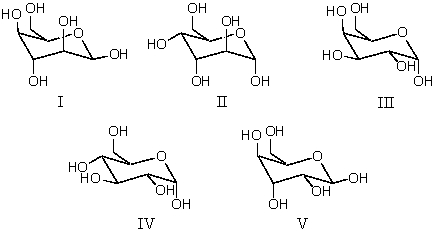
A)I
B)II
C)III
D)IV
E)V
A)I
B)II
C)III
D)IV
E)V
Question
Which of the following substances will afford a meso product upon reaction with Br2/H2O? 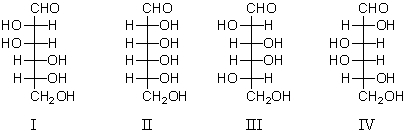
A)I
B)II
C)III and IV
D)II,III and IV
E)None of these choices.
A)I
B)II
C)III and IV
D)II,III and IV
E)None of these choices.
Question
An aldaric acid is represented by: 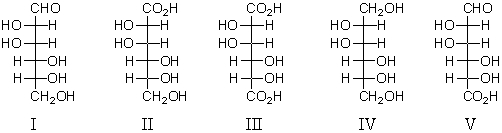
A)I
B)II
C)III
D)IV
E)V
A)I
B)II
C)III
D)IV
E)V
Question
Which is an l-monosaccharide that would yield an optically active aldaric acid on oxidation by nitric acid? 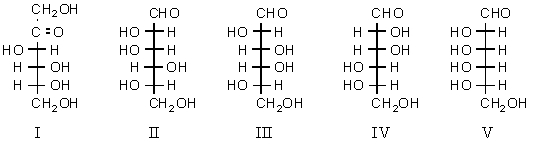
A)I
B)II
C)III
D)II and IV
E)V
A)I
B)II
C)III
D)II and IV
E)V
Question
Refer to the structures below.Which sugar(s)would yield an optically active aldaric acid on oxidation with nitric acid? 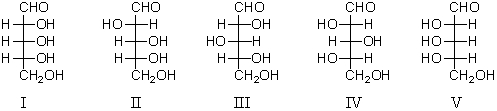
A)I and III
B)I,II,III,and V
C)II
D)III and IV
E)I and V
A)I and III
B)I,II,III,and V
C)II
D)III and IV
E)I and V
Question
Question
Which aldohexose would yield an optically active aldaric acid when treated with nitric acid? 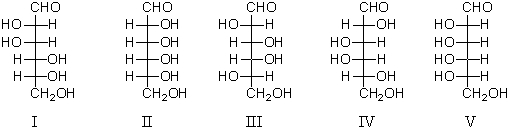
A)I
B)II
C)III
D)IV
E)V
A)I
B)II
C)III
D)IV
E)V
Question
Consider the structures below.Which monosaccharides would yield an optically active aldonic acid when oxidized with bromine water? 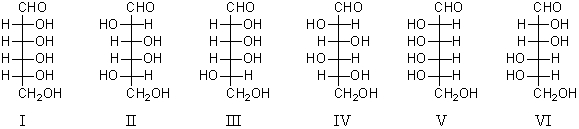
A)I,II,and III
B)I,II,and V
C)III,IV,and VI
D)II,III,and IV
E)All of these choices.
A)I,II,and III
B)I,II,and V
C)III,IV,and VI
D)II,III,and IV
E)All of these choices.
Question
Reaction of the following substance with nitric acid would yield: 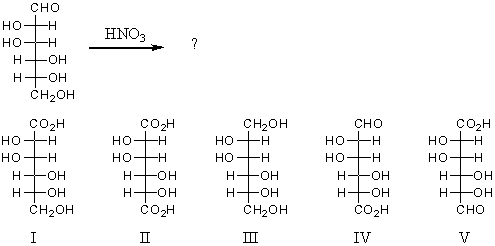
A)I
B)II
C)III
D)IV
E)V
A)I
B)II
C)III
D)IV
E)V
Question
Reaction of the following substance with bromine water would yield: 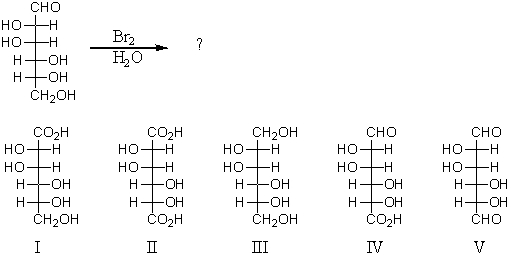
A)I
B)II
C)III
D)IV
E)V
A)I
B)II
C)III
D)IV
E)V
Question
Which of these is a component of the mixture formed when d-galactose is placed in aqueous base (de Bruyn-van Ekenstein transformation)? 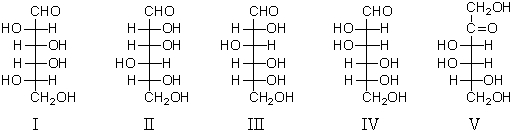
A)I
B)II
C)III
D)IV
E)V
A)I
B)II
C)III
D)IV
E)V
Question
Question
Consider the structures below.Which of the structures II-VI are epimers of I? 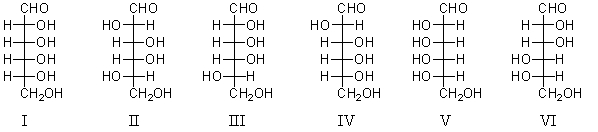
A)II
B)III and IV
C)IV
D)V
E)VI
A)II
B)III and IV
C)IV
D)V
E)VI
Question
A d-aldohexose X,is subjected to a Ruff degradation.The degradation product is treated with nitric acid to yield an optically inactive aldaric acid.A possible structure for X is: 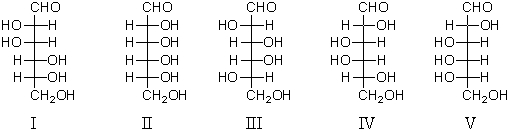
A)I
B)II
C)III and IV
D)IV
E)II and V
A)I
B)II
C)III and IV
D)IV
E)II and V
Question
What is the ratio of products formed by the reaction of periodic acid with the following compound? 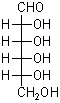 H2C=O HCO2H CO2 I 5 1 0
II 3 3 0
III 1 5 0
IV 1 4 1
V 0 4 2
A)I
B)II
C)III
D)IV
E)V
H2C=O HCO2H CO2 I 5 1 0II 3 3 0
III 1 5 0
IV 1 4 1
V 0 4 2
A)I
B)II
C)III
D)IV
E)V
Question
Question
Question
Reaction of the following substance with sodium borohydride (NaBH4)would yield: 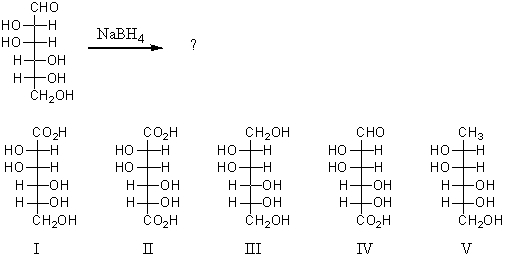
A)I
B)II
C)III
D)IV
E)V
A)I
B)II
C)III
D)IV
E)V
Question
Refer to the structures below.Which sugars would react with phenylhydrazine to yield the same phenylosazone? 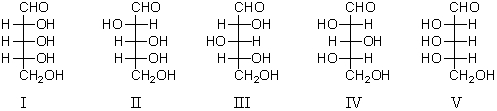
A)I and II
B)III and IV
C)I and V
D)II and III
E)III and V
A)I and II
B)III and IV
C)I and V
D)II and III
E)III and V
Question
Which of the following structures represent epimers? 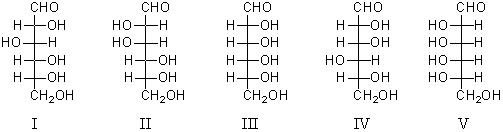
A)I and II
B)III and V
C)III and IV
D)I and III
E)Pairs in more than one of these choices.
A)I and II
B)III and V
C)III and IV
D)I and III
E)Pairs in more than one of these choices.
Question
Question
Consider the structures above.Which monosaccharides would yield the same phenylosazone when treated with excess phenylhydrazine? 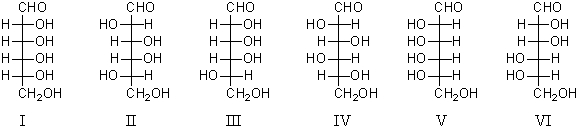
A)I and V
B)I and III
C)II and III
D)III and VI
E)IV and V
A)I and V
B)I and III
C)II and III
D)III and VI
E)IV and V
Question
A compound X reacts with 3 mol of HIO4 to yield 2 mol of HCO2H and 2 mol of HCHO.What is the structure of X? 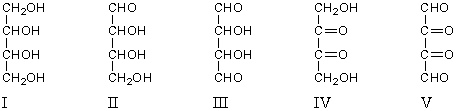
A)I
B)II
C)III
D)IV
E)V
A)I
B)II
C)III
D)IV
E)V
Question
Which reagent would be used for the following transformation? 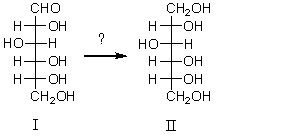
A)NaBH4
B)AgNO3/C2H5OH
C)Br2/CCl4
D)HCl
E)Hot KMnO4
A)NaBH4
B)AgNO3/C2H5OH
C)Br2/CCl4
D)HCl
E)Hot KMnO4
Question
Refer to the following structures.Which d-aldohexose would react with NaBH4 to yield an optically inactive alditol? 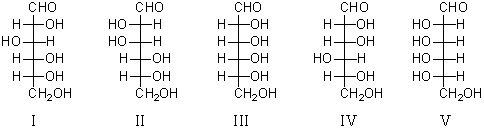
A)I
B)II
C)III
D)IV
E)V
A)I
B)II
C)III
D)IV
E)V
Question
Question
Consider the structures below: what term(s)describe(s)the relationship between them? 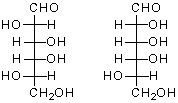
A)Enantiomers
B)Epimers
C)Diastereomers
D)Anomers
E)More than one of these choices.
A)Enantiomers
B)Epimers
C)Diastereomers
D)Anomers
E)More than one of these choices.
Question
Which of the following substances will afford an optically inactive product upon reaction with nitric acid? 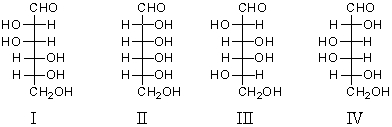
A)I
B)II
C)III and IV
D)II,III and IV
E)All of these choices.
A)I
B)II
C)III and IV
D)II,III and IV
E)All of these choices.
Question
Epimers are represented by: 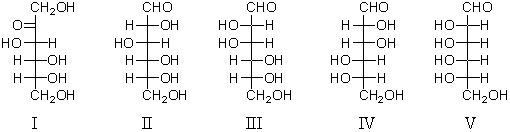
A)I and II
B)II and III
C)I,II,and III
D)III and IV
E)I,II,and V
A)I and II
B)II and III
C)I,II,and III
D)III and IV
E)I,II,and V
Question
Sugars that would yield the same phenylosazone are: 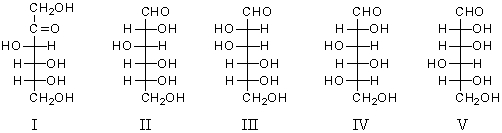
A)I and II
B)II and III
C)I,II,and III
D)III and IV
E)I,II,and V
A)I and II
B)II and III
C)I,II,and III
D)III and IV
E)I,II,and V
Question
Question
What is the ratio of products formed by the reaction of periodic acid with the following compound? 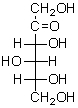 H2C=O HCO2H CO2 I 5 1 0
II 3 3 0
III 1 5 0
IV 2 3 1
V 0 4 2
A)I
B)II
C)III
D)IV
E)V
H2C=O HCO2H CO2 I 5 1 0II 3 3 0
III 1 5 0
IV 2 3 1
V 0 4 2
A)I
B)II
C)III
D)IV
E)V
Question
Question
Question
Which compound or compounds would be formed when d-glucose is dissolved in methanol and then treated with anhydrous acid? 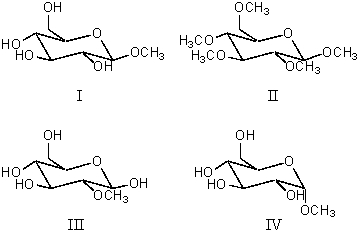
A)I
B)II
C)III
D)IV
E)I and IV
A)I
B)II
C)III
D)IV
E)I and IV
Question
Refer to the following structures.Which aldohexose when subjected to Fischer's end-group interchange would be converted to a compound identical with itself? 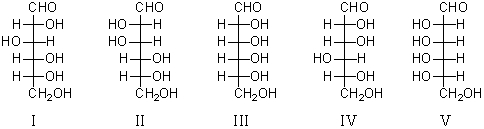
A)I
B)II
C)III
D)IV
E)V
A)I
B)II
C)III
D)IV
E)V
Question
Question
An aldopentose,X,is subjected to a Kiliani-Fischer synthesis to produce two aldohexoses,Y and Z.Both Y and Z,when oxidized with nitric acid,yield optically active aldaric acids.Which structure represents X? 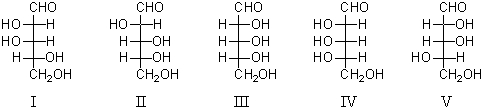
A)I
B)II
C)III
D)IV
E)V
A)I
B)II
C)III
D)IV
E)V
Question
Which of the following would yield d-glucose and d-mannose when subjected to a Kiliani-Fischer synthesis? 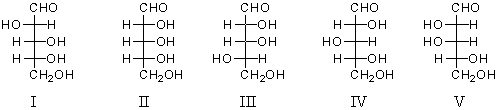
A)I
B)II
C)III
D)IV
E)V
A)I
B)II
C)III
D)IV
E)V
Question
Question
Which compound is d-galactose? 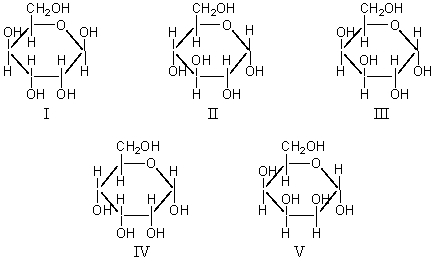
A)I
B)II
C)III
D)IV
E)V
A)I
B)II
C)III
D)IV
E)V
Question
Question
Question
Compound X is a reducing sugar which,on hydrolysis,affords two molar equivalents of d-glucose.This hydrolysis is catalyzed by an enzyme specific for glucosides of this type: 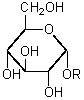 What is the identity of X?
A)Sucrose
B)Lactose
C)Maltose
D)Cellobiose
E)None of these choices.
What is the identity of X?A)Sucrose
B)Lactose
C)Maltose
D)Cellobiose
E)None of these choices.
Question
A d-aldohexose,Z,is subjected to a Ruff degradation.The degradation product is treated with nitric acid to yield an optically active aldaric acid.A possible structure for Z is: 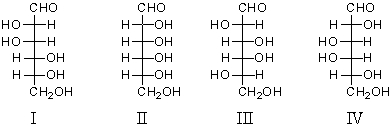
A)I
B)II
C)III
D)IV
E)I,IV
A)I
B)II
C)III
D)IV
E)I,IV
Question
Question
Consider the structure of d-allose below: 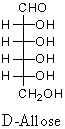 Which of the following structures represents l-allose?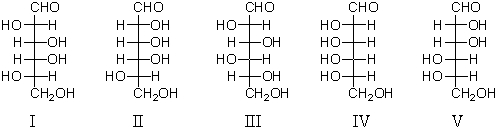
A)I
B)II
C)III
D)IV
E)V
Which of the following structures represents l-allose? A)I
B)II
C)III
D)IV
E)V
Question
Consider the structures below.An l-aldohexose,X,is treated with nitric acid to yield an optically inactive aldaric acid.The same l-aldohexose,X,is subjected to a Ruff degradation and the degradation product is oxidized with nitric acid to produce an optically inactive aldaric acid.Which is a possible structure for X? 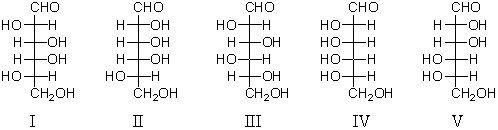
A)I
B)II
C)III
D)IV
E)V
A)I
B)II
C)III
D)IV
E)V
Question
Question
Which of the following is the structure of d-galacturonic acid? 
A)I
B)II
C)III
D)IV
E)V
A)I
B)II
C)III
D)IV
E)V
Question
Question

Unlock Deck
Sign up to unlock the cards in this deck!
Unlock Deck
Unlock Deck
1/124

Play

Full screen (f)
Deck 22: Carbohydrates
1
When the name of a monosaccharide is preceded only by (+),it can be said,correctly,that:
A)The compound is the α-anomer.
B)The compound exists in the pyranose form.
C)The compound is dextrorotatory.
D)The compound has the same stereochemistry at the penultimate carbon as d-(+)-glucose.
E)The compound exists only in open-chain form.
A)The compound is the α-anomer.
B)The compound exists in the pyranose form.
C)The compound is dextrorotatory.
D)The compound has the same stereochemistry at the penultimate carbon as d-(+)-glucose.
E)The compound exists only in open-chain form.
The compound is dextrorotatory.
2
What compounds (other than methanol)would be formed in the solution if the glycoside presented below was treated with dilute aqueous hydrochloric acid and the solution allowed to stand?
A)I and II
B)I and III
C)II and III
D)I,III,and IV
E)II,III,and IV
A)I and II
B)I and III
C)II and III
D)I,III,and IV
E)II,III,and IV
I,III,and IV
3
Which of these is α-d-glucopyranose?
A)I
B)II
C)III
D)IV
E)V
A)I
B)II
C)III
D)IV
E)V
I
4
Which of the following structures represent enantiomers?
A)I and II
B)II and III
C)III and IV
D)III and V
E)IV and V
A)I and II
B)II and III
C)III and IV
D)III and V
E)IV and V
Unlock Deck
Unlock for access to all 124 flashcards in this deck.
Unlock Deck
k this deck
5
Which of the following is an l-aldotetrose?
A)I
B)II
C)III
D)IV
E)V
A)I
B)II
C)III
D)IV
E)V
Unlock Deck
Unlock for access to all 124 flashcards in this deck.
Unlock Deck
k this deck
6
Consider the structures shown below.Which structure represents -d-glucopyranose?
A)I
B)II
C)III
D)IV
E)V
A)I
B)II
C)III
D)IV
E)V
Unlock Deck
Unlock for access to all 124 flashcards in this deck.
Unlock Deck
k this deck
7
What are the correct designations for the stereogenic centers in this aldose:
A)2R,3S,4R
B)2R,3S,4S
C)2S,3R,4R
D)2S,3S,4R
E)2R,3R,4S
A)2R,3S,4R
B)2R,3S,4S
C)2S,3R,4R
D)2S,3S,4R
E)2R,3R,4S
Unlock Deck
Unlock for access to all 124 flashcards in this deck.
Unlock Deck
k this deck
8
Which would undergo mutarotation in neutral aqueous solution?
A)I
B)II
C)III
D)IV
E)I,II and III
A)I
B)II
C)III
D)IV
E)I,II and III
Unlock Deck
Unlock for access to all 124 flashcards in this deck.
Unlock Deck
k this deck
9
Sugars that undergo mutarotation in neutral aqueous solution are:
A)I and III
B)III and IV
C)II,III,and IV
D)I,II,and V
E)I and IV
A)I and III
B)III and IV
C)II,III,and IV
D)I,II,and V
E)I and IV
Unlock Deck
Unlock for access to all 124 flashcards in this deck.
Unlock Deck
k this deck
10
Which are the anomers?
A)I and II
B)I and III
C)II and III
D)II and IV
E)III and IV
A)I and II
B)I and III
C)II and III
D)II and IV
E)III and IV
Unlock Deck
Unlock for access to all 124 flashcards in this deck.
Unlock Deck
k this deck
11
What are carbohydrates?
A)I,II,III
B)I,II
C)II,III
D)I,II,III,IV
E)III,IV
A)I,II,III
B)I,II
C)II,III
D)I,II,III,IV
E)III,IV
Unlock Deck
Unlock for access to all 124 flashcards in this deck.
Unlock Deck
k this deck
12
What compounds are formed upon oxidation of glucose?
A)CO2,H2O,CH3OH
B)CH2OH(CHOH)4COOH
C)CO,H2O
D)CO2,H2O
E)C6H12O6
A)CO2,H2O,CH3OH
B)CH2OH(CHOH)4COOH
C)CO,H2O
D)CO2,H2O
E)C6H12O6
Unlock Deck
Unlock for access to all 124 flashcards in this deck.
Unlock Deck
k this deck
13
Which of the following is a d-aldotetrose?
A)I
B)II
C)III
D)IV
E)V
A)I
B)II
C)III
D)IV
E)V
Unlock Deck
Unlock for access to all 124 flashcards in this deck.
Unlock Deck
k this deck
14
Which reagent would cause the following conversion to take place?
A)Excess CH3OH and KOH
B)Excess CH3OH and HCl
C)Excess (CH3)2SO4 and OH-
D)Excess CH3I and H3O+
E)Excess (CH3CO)2O
A)Excess CH3OH and KOH
B)Excess CH3OH and HCl
C)Excess (CH3)2SO4 and OH-
D)Excess CH3I and H3O+
E)Excess (CH3CO)2O
Unlock Deck
Unlock for access to all 124 flashcards in this deck.
Unlock Deck
k this deck
15
Which of these is a glycoside?
A)I
B)II
C)III
D)IV
E)V
A)I
B)II
C)III
D)IV
E)V
Unlock Deck
Unlock for access to all 124 flashcards in this deck.
Unlock Deck
k this deck
16
Which is a ketohexose?
A)d-Glucose
B)d-Fructose
C)d-Mannose
D)d-Ribose
E)(+)-Sucrose
A)d-Glucose
B)d-Fructose
C)d-Mannose
D)d-Ribose
E)(+)-Sucrose
Unlock Deck
Unlock for access to all 124 flashcards in this deck.
Unlock Deck
k this deck
17
Which reagent would be used for the following transformation?
A)CH3I,KOH
B)
C)CH3OH,HCl
D)(CH3)2SO4,NaOH
E)
A)CH3I,KOH
B)
C)CH3OH,HCl
D)(CH3)2SO4,NaOH
E)
Unlock Deck
Unlock for access to all 124 flashcards in this deck.
Unlock Deck
k this deck
18
How many stereoisomers of the l series would exist for the following pentose? O=CHCHOHCHOHCHOHCH2OH
A)2
B)3
C)4
D)5
E)8
A)2
B)3
C)4
D)5
E)8
Unlock Deck
Unlock for access to all 124 flashcards in this deck.
Unlock Deck
k this deck
19
Refer to the structures below.Which are l-sugars?
A)II and IV
B)I,II,and III
C)I and V
D)III,IV,and V
E)IV and V
A)II and IV
B)I,II,and III
C)I and V
D)III,IV,and V
E)IV and V
Unlock Deck
Unlock for access to all 124 flashcards in this deck.
Unlock Deck
k this deck
20
A glycoside is a compound which contains the structural features of these classes of organic compounds:
A)Aldehydes and alcohols
B)Acetals and alcohols
C)Hemiacetals and alcohols
D)Ketones and alcohols
E)Alcohols and carboxylic acids
A)Aldehydes and alcohols
B)Acetals and alcohols
C)Hemiacetals and alcohols
D)Ketones and alcohols
E)Alcohols and carboxylic acids
Unlock Deck
Unlock for access to all 124 flashcards in this deck.
Unlock Deck
k this deck
21
Which of these compounds,I,II,III,IV,is a reducing disaccharide?
A)I alone
B)II alone
C)III alone
D)IV alone
E)I,II,III,and IV
A)I alone
B)II alone
C)III alone
D)IV alone
E)I,II,III,and IV
Unlock Deck
Unlock for access to all 124 flashcards in this deck.
Unlock Deck
k this deck
22
Which of the following would give a positive test with Benedict's solution?
A)I
B)II
C)III
D)IV
E)All of these choices.
A)I
B)II
C)III
D)IV
E)All of these choices.
Unlock Deck
Unlock for access to all 124 flashcards in this deck.
Unlock Deck
k this deck
23
Consider the structures shown below.Which compound is not a reducing sugar?
A)I
B)II
C)III
D)IV
E)V
A)I
B)II
C)III
D)IV
E)V
Unlock Deck
Unlock for access to all 124 flashcards in this deck.
Unlock Deck
k this deck
24
Which compound will not reduce Ag(NH3)2+ ?
A)I
B)II
C)III
D)IV
E)V
A)I
B)II
C)III
D)IV
E)V
Unlock Deck
Unlock for access to all 124 flashcards in this deck.
Unlock Deck
k this deck
25
Which reagent would be used for the following transformation?
A)Ag(NH3)2+
B)HNO3
C)Br2/H2O
D)HCl
E)Ag(NH3)2+ and Br2/H2O
A)Ag(NH3)2+
B)HNO3
C)Br2/H2O
D)HCl
E)Ag(NH3)2+ and Br2/H2O
Unlock Deck
Unlock for access to all 124 flashcards in this deck.
Unlock Deck
k this deck
26
An aldonic acid is represented by:
A)I
B)II
C)III
D)IV
E)V
A)I
B)II
C)III
D)IV
E)V
Unlock Deck
Unlock for access to all 124 flashcards in this deck.
Unlock Deck
k this deck
27
Which of these is a non-reducing monosaccharide?
A)I
B)II
C)III
D)IV
E)V
A)I
B)II
C)III
D)IV
E)V
Unlock Deck
Unlock for access to all 124 flashcards in this deck.
Unlock Deck
k this deck
28
How the tautomerization of a carbohydrate could be prevented?
A)Perform a Fischer methylation of the anomeric OH group.
B)Perform permethylation of the carbohydrate.
C)Treat the carbohydrate with LiAlH4.
D)Prepare a solution of the carbohydrate in Br2/H2O
E)It is impossible to prevent tautomerization.
A)Perform a Fischer methylation of the anomeric OH group.
B)Perform permethylation of the carbohydrate.
C)Treat the carbohydrate with LiAlH4.
D)Prepare a solution of the carbohydrate in Br2/H2O
E)It is impossible to prevent tautomerization.
Unlock Deck
Unlock for access to all 124 flashcards in this deck.
Unlock Deck
k this deck
29
Which of these pyranose forms of an aldohexose can react with two equivalents of acetone in the presence of acid ?
A)I
B)II
C)III
D)IV
E)V
A)I
B)II
C)III
D)IV
E)V
Unlock Deck
Unlock for access to all 124 flashcards in this deck.
Unlock Deck
k this deck
30
Which of the following substances will afford a meso product upon reaction with Br2/H2O?
A)I
B)II
C)III and IV
D)II,III and IV
E)None of these choices.
A)I
B)II
C)III and IV
D)II,III and IV
E)None of these choices.
Unlock Deck
Unlock for access to all 124 flashcards in this deck.
Unlock Deck
k this deck
31
An aldaric acid is represented by:
A)I
B)II
C)III
D)IV
E)V
A)I
B)II
C)III
D)IV
E)V
Unlock Deck
Unlock for access to all 124 flashcards in this deck.
Unlock Deck
k this deck
32
Which is an l-monosaccharide that would yield an optically active aldaric acid on oxidation by nitric acid?
A)I
B)II
C)III
D)II and IV
E)V
A)I
B)II
C)III
D)II and IV
E)V
Unlock Deck
Unlock for access to all 124 flashcards in this deck.
Unlock Deck
k this deck
33
Refer to the structures below.Which sugar(s)would yield an optically active aldaric acid on oxidation with nitric acid?
A)I and III
B)I,II,III,and V
C)II
D)III and IV
E)I and V
A)I and III
B)I,II,III,and V
C)II
D)III and IV
E)I and V
Unlock Deck
Unlock for access to all 124 flashcards in this deck.
Unlock Deck
k this deck
34
What of the following reagents will permethylate a carbohydrate?
A)Acetone
B)CH3OSO3CH3
C)H2/Pd
D)Acetic anhydride
E)CH3OH/HCl
A)Acetone
B)CH3OSO3CH3
C)H2/Pd
D)Acetic anhydride
E)CH3OH/HCl
Unlock Deck
Unlock for access to all 124 flashcards in this deck.
Unlock Deck
k this deck
35
Which aldohexose would yield an optically active aldaric acid when treated with nitric acid?
A)I
B)II
C)III
D)IV
E)V
A)I
B)II
C)III
D)IV
E)V
Unlock Deck
Unlock for access to all 124 flashcards in this deck.
Unlock Deck
k this deck
36
Consider the structures below.Which monosaccharides would yield an optically active aldonic acid when oxidized with bromine water?
A)I,II,and III
B)I,II,and V
C)III,IV,and VI
D)II,III,and IV
E)All of these choices.
A)I,II,and III
B)I,II,and V
C)III,IV,and VI
D)II,III,and IV
E)All of these choices.
Unlock Deck
Unlock for access to all 124 flashcards in this deck.
Unlock Deck
k this deck
37
Reaction of the following substance with nitric acid would yield:
A)I
B)II
C)III
D)IV
E)V
A)I
B)II
C)III
D)IV
E)V
Unlock Deck
Unlock for access to all 124 flashcards in this deck.
Unlock Deck
k this deck
38
Reaction of the following substance with bromine water would yield:
A)I
B)II
C)III
D)IV
E)V
A)I
B)II
C)III
D)IV
E)V
Unlock Deck
Unlock for access to all 124 flashcards in this deck.
Unlock Deck
k this deck
39
Which of these is a component of the mixture formed when d-galactose is placed in aqueous base (de Bruyn-van Ekenstein transformation)?
A)I
B)II
C)III
D)IV
E)V
A)I
B)II
C)III
D)IV
E)V
Unlock Deck
Unlock for access to all 124 flashcards in this deck.
Unlock Deck
k this deck
40
What reagents could be used to selectively protect the HO groups at positions 1 and 6 of a hexose?
A)TBDPS-Cl,AgNO3 followed by acetic anhydride.
B)CH3OH/HCl followed by TBDPS-Cl.
C)CH3CO2H,HCl followed by (CH3)3C(C6H5)2-SiCl.
D)Acetic anhydride followed by acetone.
E)Benzaldehyde followed by CH3OH/HCl.
A)TBDPS-Cl,AgNO3 followed by acetic anhydride.
B)CH3OH/HCl followed by TBDPS-Cl.
C)CH3CO2H,HCl followed by (CH3)3C(C6H5)2-SiCl.
D)Acetic anhydride followed by acetone.
E)Benzaldehyde followed by CH3OH/HCl.
Unlock Deck
Unlock for access to all 124 flashcards in this deck.
Unlock Deck
k this deck
41
Consider the structures below.Which of the structures II-VI are epimers of I?
A)II
B)III and IV
C)IV
D)V
E)VI
A)II
B)III and IV
C)IV
D)V
E)VI
Unlock Deck
Unlock for access to all 124 flashcards in this deck.
Unlock Deck
k this deck
42
A d-aldohexose X,is subjected to a Ruff degradation.The degradation product is treated with nitric acid to yield an optically inactive aldaric acid.A possible structure for X is:
A)I
B)II
C)III and IV
D)IV
E)II and V
A)I
B)II
C)III and IV
D)IV
E)II and V
Unlock Deck
Unlock for access to all 124 flashcards in this deck.
Unlock Deck
k this deck
43
What is the ratio of products formed by the reaction of periodic acid with the following compound? H2C=O HCO2H CO2 I 5 1 0
II 3 3 0
III 1 5 0
IV 1 4 1
V 0 4 2
A)I
B)II
C)III
D)IV
E)V
H2C=O HCO2H CO2 I 5 1 0II 3 3 0
III 1 5 0
IV 1 4 1
V 0 4 2
A)I
B)II
C)III
D)IV
E)V
Unlock Deck
Unlock for access to all 124 flashcards in this deck.
Unlock Deck
k this deck
44
An unknown pentose Z reacts with NaBH4 to give an optically inactive compound.The pentose Z gives the same osazone as arabinose.What carbohydrate is Z?
A)Fructose
B)Ribose
C)Xylose
D)Glucose
E)Lyxose
A)Fructose
B)Ribose
C)Xylose
D)Glucose
E)Lyxose
Unlock Deck
Unlock for access to all 124 flashcards in this deck.
Unlock Deck
k this deck
45
If the methyl glycoside of an aldohexose is treated with HIO4,one molar equivalent of HCHO is formed but no HCOOH.What size ring is present in the glycoside?
A)Three-membered
B)Four-membered
C)Five-membered
D)Six-membered
E)Seven-membered
A)Three-membered
B)Four-membered
C)Five-membered
D)Six-membered
E)Seven-membered
Unlock Deck
Unlock for access to all 124 flashcards in this deck.
Unlock Deck
k this deck
46
Reaction of the following substance with sodium borohydride (NaBH4)would yield:
A)I
B)II
C)III
D)IV
E)V
A)I
B)II
C)III
D)IV
E)V
Unlock Deck
Unlock for access to all 124 flashcards in this deck.
Unlock Deck
k this deck
47
Refer to the structures below.Which sugars would react with phenylhydrazine to yield the same phenylosazone?
A)I and II
B)III and IV
C)I and V
D)II and III
E)III and V
A)I and II
B)III and IV
C)I and V
D)II and III
E)III and V
Unlock Deck
Unlock for access to all 124 flashcards in this deck.
Unlock Deck
k this deck
48
Which of the following structures represent epimers?
A)I and II
B)III and V
C)III and IV
D)I and III
E)Pairs in more than one of these choices.
A)I and II
B)III and V
C)III and IV
D)I and III
E)Pairs in more than one of these choices.
Unlock Deck
Unlock for access to all 124 flashcards in this deck.
Unlock Deck
k this deck
49
The Kiliani-Fischer synthesis is the reaction of an aldose with:
A)Br2/H2O; then HCN; then H3O+; then Na-Hg,H2O
B)HCN; then Ba(OH)2; then H3O+; then Na-Hg,H2O
C)HCN; then H3O+; then Ba(OH)2; then Na-Hg,H2O
D)Br2/H2O; then H2O2,Fe2(SO4)3
E)Br2/H2O
A)Br2/H2O; then HCN; then H3O+; then Na-Hg,H2O
B)HCN; then Ba(OH)2; then H3O+; then Na-Hg,H2O
C)HCN; then H3O+; then Ba(OH)2; then Na-Hg,H2O
D)Br2/H2O; then H2O2,Fe2(SO4)3
E)Br2/H2O
Unlock Deck
Unlock for access to all 124 flashcards in this deck.
Unlock Deck
k this deck
50
Consider the structures above.Which monosaccharides would yield the same phenylosazone when treated with excess phenylhydrazine?
A)I and V
B)I and III
C)II and III
D)III and VI
E)IV and V
A)I and V
B)I and III
C)II and III
D)III and VI
E)IV and V
Unlock Deck
Unlock for access to all 124 flashcards in this deck.
Unlock Deck
k this deck
51
A compound X reacts with 3 mol of HIO4 to yield 2 mol of HCO2H and 2 mol of HCHO.What is the structure of X?
A)I
B)II
C)III
D)IV
E)V
A)I
B)II
C)III
D)IV
E)V
Unlock Deck
Unlock for access to all 124 flashcards in this deck.
Unlock Deck
k this deck
52
Which reagent would be used for the following transformation?
A)NaBH4
B)AgNO3/C2H5OH
C)Br2/CCl4
D)HCl
E)Hot KMnO4
A)NaBH4
B)AgNO3/C2H5OH
C)Br2/CCl4
D)HCl
E)Hot KMnO4
Unlock Deck
Unlock for access to all 124 flashcards in this deck.
Unlock Deck
k this deck
53
Refer to the following structures.Which d-aldohexose would react with NaBH4 to yield an optically inactive alditol?
A)I
B)II
C)III
D)IV
E)V
A)I
B)II
C)III
D)IV
E)V
Unlock Deck
Unlock for access to all 124 flashcards in this deck.
Unlock Deck
k this deck
54
The Ruff degradation is the reaction of an aldose with:
A)Br2/H2O; then HCN; then H3O+; then Na-Hg,H2O
B)HCN; then Ba(OH)2; then H3O+; then Na-Hg,H2O
C)HCN; then H3O+; then Ba(OH)2; then Na-Hg,H2O
D)Br2/H2O; then H2O2,Fe2(SO4)3
E)Br2/H2O
A)Br2/H2O; then HCN; then H3O+; then Na-Hg,H2O
B)HCN; then Ba(OH)2; then H3O+; then Na-Hg,H2O
C)HCN; then H3O+; then Ba(OH)2; then Na-Hg,H2O
D)Br2/H2O; then H2O2,Fe2(SO4)3
E)Br2/H2O
Unlock Deck
Unlock for access to all 124 flashcards in this deck.
Unlock Deck
k this deck
55
Consider the structures below: what term(s)describe(s)the relationship between them?
A)Enantiomers
B)Epimers
C)Diastereomers
D)Anomers
E)More than one of these choices.
A)Enantiomers
B)Epimers
C)Diastereomers
D)Anomers
E)More than one of these choices.
Unlock Deck
Unlock for access to all 124 flashcards in this deck.
Unlock Deck
k this deck
56
Which of the following substances will afford an optically inactive product upon reaction with nitric acid?
A)I
B)II
C)III and IV
D)II,III and IV
E)All of these choices.
A)I
B)II
C)III and IV
D)II,III and IV
E)All of these choices.
Unlock Deck
Unlock for access to all 124 flashcards in this deck.
Unlock Deck
k this deck
57
Epimers are represented by:
A)I and II
B)II and III
C)I,II,and III
D)III and IV
E)I,II,and V
A)I and II
B)II and III
C)I,II,and III
D)III and IV
E)I,II,and V
Unlock Deck
Unlock for access to all 124 flashcards in this deck.
Unlock Deck
k this deck
58
Sugars that would yield the same phenylosazone are:
A)I and II
B)II and III
C)I,II,and III
D)III and IV
E)I,II,and V
A)I and II
B)II and III
C)I,II,and III
D)III and IV
E)I,II,and V
Unlock Deck
Unlock for access to all 124 flashcards in this deck.
Unlock Deck
k this deck
59
Sucrose reacts with which of these reagents?
A)C6H5NHNH2
B)Cu2+
C)Br2/H2O
D)H3O+
E)Ag(NH3)2+
A)C6H5NHNH2
B)Cu2+
C)Br2/H2O
D)H3O+
E)Ag(NH3)2+
Unlock Deck
Unlock for access to all 124 flashcards in this deck.
Unlock Deck
k this deck
60
What is the ratio of products formed by the reaction of periodic acid with the following compound? H2C=O HCO2H CO2 I 5 1 0
II 3 3 0
III 1 5 0
IV 2 3 1
V 0 4 2
A)I
B)II
C)III
D)IV
E)V
H2C=O HCO2H CO2 I 5 1 0II 3 3 0
III 1 5 0
IV 2 3 1
V 0 4 2
A)I
B)II
C)III
D)IV
E)V
Unlock Deck
Unlock for access to all 124 flashcards in this deck.
Unlock Deck
k this deck
61
The d-glucose unit at the branching point of amylopectin has free hydroxyl groups at which positions?
A)C2,C3,and C6
B)C2 and C3
C)C3 and C4
D)C3,C4,and C6
E)C4 and C6
A)C2,C3,and C6
B)C2 and C3
C)C3 and C4
D)C3,C4,and C6
E)C4 and C6
Unlock Deck
Unlock for access to all 124 flashcards in this deck.
Unlock Deck
k this deck
62
Which of these is an example of a glucan?
A)Maltose
B)Sucrose
C)Lactose
D)Cellobiose
E)Amylose
A)Maltose
B)Sucrose
C)Lactose
D)Cellobiose
E)Amylose
Unlock Deck
Unlock for access to all 124 flashcards in this deck.
Unlock Deck
k this deck
63
Which compound or compounds would be formed when d-glucose is dissolved in methanol and then treated with anhydrous acid?
A)I
B)II
C)III
D)IV
E)I and IV
A)I
B)II
C)III
D)IV
E)I and IV
Unlock Deck
Unlock for access to all 124 flashcards in this deck.
Unlock Deck
k this deck
64
Refer to the following structures.Which aldohexose when subjected to Fischer's end-group interchange would be converted to a compound identical with itself?
A)I
B)II
C)III
D)IV
E)V
A)I
B)II
C)III
D)IV
E)V
Unlock Deck
Unlock for access to all 124 flashcards in this deck.
Unlock Deck
k this deck
65
Which monosaccharide is recovered from the hydrolysis of starch?
A)d-Galactose
B)d-Gulose
C)d-Glucose
D)Cellobiose
E)Maltose
A)d-Galactose
B)d-Gulose
C)d-Glucose
D)Cellobiose
E)Maltose
Unlock Deck
Unlock for access to all 124 flashcards in this deck.
Unlock Deck
k this deck
66
An aldopentose,X,is subjected to a Kiliani-Fischer synthesis to produce two aldohexoses,Y and Z.Both Y and Z,when oxidized with nitric acid,yield optically active aldaric acids.Which structure represents X?
A)I
B)II
C)III
D)IV
E)V
A)I
B)II
C)III
D)IV
E)V
Unlock Deck
Unlock for access to all 124 flashcards in this deck.
Unlock Deck
k this deck
67
Which of the following would yield d-glucose and d-mannose when subjected to a Kiliani-Fischer synthesis?
A)I
B)II
C)III
D)IV
E)V
A)I
B)II
C)III
D)IV
E)V
Unlock Deck
Unlock for access to all 124 flashcards in this deck.
Unlock Deck
k this deck
68
Which is a reducing sugar with an α-glycosidic linkage?
A)Sucrose
B)Maltose
C)Lactose
D)Cellobiose
E)Glucose
A)Sucrose
B)Maltose
C)Lactose
D)Cellobiose
E)Glucose
Unlock Deck
Unlock for access to all 124 flashcards in this deck.
Unlock Deck
k this deck
69
Which compound is d-galactose?
A)I
B)II
C)III
D)IV
E)V
A)I
B)II
C)III
D)IV
E)V
Unlock Deck
Unlock for access to all 124 flashcards in this deck.
Unlock Deck
k this deck
70
Complete hydrolysis of heparin gives:
A)" -N-Acetylmuramic acid and -d-glucosamine."
B)" -d-Glucosamine and glucuronate-2-sulfate."
C)"d-Glucuronate-2-sulfate and N-sulfo-3-glucosamine-6-sulfate."
D)"Glucose sulfate and maltose.
E)"Chitin and d-glucurunate-2-sulfate."
A)" -N-Acetylmuramic acid and -d-glucosamine."
B)" -d-Glucosamine and glucuronate-2-sulfate."
C)"d-Glucuronate-2-sulfate and N-sulfo-3-glucosamine-6-sulfate."
D)"Glucose sulfate and maltose.
E)"Chitin and d-glucurunate-2-sulfate."
Unlock Deck
Unlock for access to all 124 flashcards in this deck.
Unlock Deck
k this deck
71
Which monosaccharide is recovered from the hydrolysis of glycogen?
A)d-Galactose
B)d-Glucose
C)d-Gulose
D)Cellobiose
E)Maltose
A)d-Galactose
B)d-Glucose
C)d-Gulose
D)Cellobiose
E)Maltose
Unlock Deck
Unlock for access to all 124 flashcards in this deck.
Unlock Deck
k this deck
72
Compound X is a reducing sugar which,on hydrolysis,affords two molar equivalents of d-glucose.This hydrolysis is catalyzed by an enzyme specific for glucosides of this type: What is the identity of X?
A)Sucrose
B)Lactose
C)Maltose
D)Cellobiose
E)None of these choices.
What is the identity of X?A)Sucrose
B)Lactose
C)Maltose
D)Cellobiose
E)None of these choices.
Unlock Deck
Unlock for access to all 124 flashcards in this deck.
Unlock Deck
k this deck
73
A d-aldohexose,Z,is subjected to a Ruff degradation.The degradation product is treated with nitric acid to yield an optically active aldaric acid.A possible structure for Z is:
A)I
B)II
C)III
D)IV
E)I,IV
A)I
B)II
C)III
D)IV
E)I,IV
Unlock Deck
Unlock for access to all 124 flashcards in this deck.
Unlock Deck
k this deck
74
What is an amino sugar?
A)A sugar that bears substituted with an amino acid on the anomeric OH group.
B)An amino acid with a side chain as a sugar.
C)A sugar where the anomeric OH group is substituted by an ammonium group.
D)A sugar where a non-anomeric OH group is replaced by an amino group.
E)An amino acid replacing an OH group on a sugar.
A)A sugar that bears substituted with an amino acid on the anomeric OH group.
B)An amino acid with a side chain as a sugar.
C)A sugar where the anomeric OH group is substituted by an ammonium group.
D)A sugar where a non-anomeric OH group is replaced by an amino group.
E)An amino acid replacing an OH group on a sugar.
Unlock Deck
Unlock for access to all 124 flashcards in this deck.
Unlock Deck
k this deck
75
Consider the structure of d-allose below: Which of the following structures represents l-allose?
A)I
B)II
C)III
D)IV
E)V
Which of the following structures represents l-allose? A)I
B)II
C)III
D)IV
E)V
Unlock Deck
Unlock for access to all 124 flashcards in this deck.
Unlock Deck
k this deck
76
Consider the structures below.An l-aldohexose,X,is treated with nitric acid to yield an optically inactive aldaric acid.The same l-aldohexose,X,is subjected to a Ruff degradation and the degradation product is oxidized with nitric acid to produce an optically inactive aldaric acid.Which is a possible structure for X?
A)I
B)II
C)III
D)IV
E)V
A)I
B)II
C)III
D)IV
E)V
Unlock Deck
Unlock for access to all 124 flashcards in this deck.
Unlock Deck
k this deck
77
What is "gun cotton"?
A)Cellulose trinitrate
B)Cellulose acetate
C)Cellulose xanthate
D)Amilose acetate
E)Maltose trinitrate
A)Cellulose trinitrate
B)Cellulose acetate
C)Cellulose xanthate
D)Amilose acetate
E)Maltose trinitrate
Unlock Deck
Unlock for access to all 124 flashcards in this deck.
Unlock Deck
k this deck
78
Which of the following is the structure of d-galacturonic acid?
A)I
B)II
C)III
D)IV
E)V
A)I
B)II
C)III
D)IV
E)V
Unlock Deck
Unlock for access to all 124 flashcards in this deck.
Unlock Deck
k this deck
79
Which is not an intermediate monosaccharide in the Kiliani-Fischer synthesis of d-mannose from d-glyceraldehyde?
A)d-Ribose
B)d-Threose
C)d-Arabinose
D)d-Erythrose
E)d-Ribose and d-Threose
A)d-Ribose
B)d-Threose
C)d-Arabinose
D)d-Erythrose
E)d-Ribose and d-Threose
Unlock Deck
Unlock for access to all 124 flashcards in this deck.
Unlock Deck
k this deck
80
Cellulose lacks nutritive value for humans because:
A)the products of its digestion are excreted without utilization.
B)its conformation prevents attack by digestive enzymes.
C)we lack the enzymes which can catalyze the hydrolysis of the glycosidic linkages.
D)it passes through the digestive tract so rapidly.
E)the molecules possess such a high molecular weight that enzymes can not hydrolyze it.
A)the products of its digestion are excreted without utilization.
B)its conformation prevents attack by digestive enzymes.
C)we lack the enzymes which can catalyze the hydrolysis of the glycosidic linkages.
D)it passes through the digestive tract so rapidly.
E)the molecules possess such a high molecular weight that enzymes can not hydrolyze it.
Unlock Deck
Unlock for access to all 124 flashcards in this deck.
Unlock Deck
k this deck
Unlock Deck
Unlock for access to all 124 flashcards in this deck.






