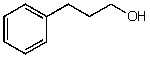
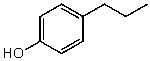
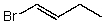
Deck 9: Nuclear Magnetic Resonance and Mass Spectrometry

Full screen (f)
exit full mode
Question
Which one of the following best represents the predicted approximate chemical shift and coupling for the hydrogen(s)indicated with the arrow in the compound nicotine? <strong>Which one of the following best represents the predicted approximate chemical shift and coupling for the hydrogen(s)indicated with the arrow in the compound nicotine?  </strong> A)1.00 ppm,singlet B)2.00 ppm,doublet C)3.00 ppm,broad multiplet D)5.00 ppm,broad multiplet E)None of these choices. <div style=padding-top: 35px>
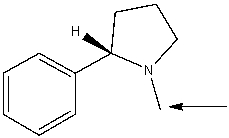
A)1.00 ppm,singlet
B)2.00 ppm,doublet
C)3.00 ppm,broad multiplet
D)5.00 ppm,broad multiplet
E)None of these choices.
Use Space or
up arrow
down arrow
to flip the card.
Question
Which one of the following best represents the predicted approximate chemical shift and coupling for the hydrogen(s)indicated with the arrow? <strong>Which one of the following best represents the predicted approximate chemical shift and coupling for the hydrogen(s)indicated with the arrow?  </strong> A)3.00 ppm,doublet B)3.00 ppm,triplet C)5.00 ppm,triplet D)1.00 ppm,doublet E)3.00 ppm,singlet <div style=padding-top: 35px>
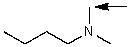
A)3.00 ppm,doublet
B)3.00 ppm,triplet
C)5.00 ppm,triplet
D)1.00 ppm,doublet
E)3.00 ppm,singlet
Question
Which one of the following best represents the predicted approximate chemical shift and coupling for the hydrogen(s)indicated with the arrow in the compound nicotine? <strong>Which one of the following best represents the predicted approximate chemical shift and coupling for the hydrogen(s)indicated with the arrow in the compound nicotine?  </strong> A)1.00 ppm,triplet B)2.00 ppm,doublet C)5.00 ppm,triplet D)7.00 ppm.mulitplet E)None of these choices. <div style=padding-top: 35px>
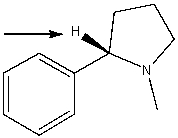
A)1.00 ppm,triplet
B)2.00 ppm,doublet
C)5.00 ppm,triplet
D)7.00 ppm.mulitplet
E)None of these choices.
Question
For the following compound how many different signals would you see in the proton NMR? (Assume that you can see them all.) <strong>For the following compound how many different signals would you see in the proton NMR? (Assume that you can see them all.)  </strong> A)4 B)5 C)6 D)7 E)8 <div style=padding-top: 35px>
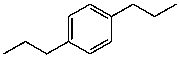
A)4
B)5
C)6
D)7
E)8
Question
For the compound adamantine,how many different signals would you see in the proton NMR? (Assume that you can see them all.) <strong>For the compound adamantine,how many different signals would you see in the proton NMR? (Assume that you can see them all.)  </strong> A)1 B)2 C)3 D)4 E)None of these choices. <div style=padding-top: 35px>
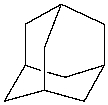
A)1
B)2
C)3
D)4
E)None of these choices.
Question
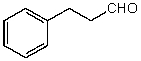
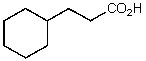
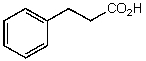
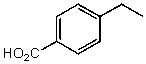
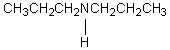
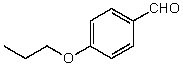
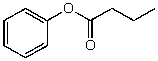
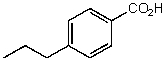
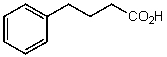
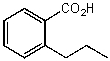
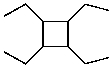
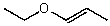
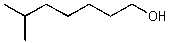
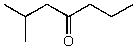
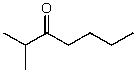
A downfield ( δ\delta 9-10)singlet is observed in the 1H NMR spectrum of:

A)  <strong>A downfield ( \delta  9-10)singlet is observed in the <sup>1</sup>H NMR spectrum of:</strong> A)   B)   C)   D)   E)   <div style=padding-top: 35px>
B)  <strong>A downfield ( \delta  9-10)singlet is observed in the <sup>1</sup>H NMR spectrum of:</strong> A)   B)   C)   D)   E)   <div style=padding-top: 35px>
C)  <strong>A downfield ( \delta  9-10)singlet is observed in the <sup>1</sup>H NMR spectrum of:</strong> A)   B)   C)   D)   E)   <div style=padding-top: 35px>
D)  <strong>A downfield ( \delta  9-10)singlet is observed in the <sup>1</sup>H NMR spectrum of:</strong> A)   B)   C)   D)   E)   <div style=padding-top: 35px>
E)  <strong>A downfield ( \delta  9-10)singlet is observed in the <sup>1</sup>H NMR spectrum of:</strong> A)   B)   C)   D)   E)   <div style=padding-top: 35px>
Question
For the following compound how many different signals would you see in the proton NMR? (Assume that you can see them all.) <strong>For the following compound how many different signals would you see in the proton NMR? (Assume that you can see them all.)  </strong> A)1 B)2 C)3 D)4 E)5 <div style=padding-top: 35px>

A)1
B)2
C)3
D)4
E)5
Question
For the following compound how many different signals would you see in the proton NMR? (Assume that you can see them all.) <strong>For the following compound how many different signals would you see in the proton NMR? (Assume that you can see them all.)  </strong> A)1 B)2 C)3 D)4 E)5 <div style=padding-top: 35px>

A)1
B)2
C)3
D)4
E)5
Question
Which one of the following best represents the predicted approximate chemical shift and coupling for the hydrogen(s)indicated with the arrow? <strong>Which one of the following best represents the predicted approximate chemical shift and coupling for the hydrogen(s)indicated with the arrow?  </strong> A)1.10 ppm,singlet B)2.10 ppm,doublet C)3.40 ppm,singlet D)4.5 ppm,singlet E)3.5 ppm,quartet <div style=padding-top: 35px>
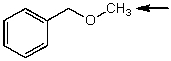
A)1.10 ppm,singlet
B)2.10 ppm,doublet
C)3.40 ppm,singlet
D)4.5 ppm,singlet
E)3.5 ppm,quartet
Question
Predict the splitting pattern you would observe for the proton at C1 of 2,3-dimethyl-2-phenylbutane. <strong>Predict the splitting pattern you would observe for the proton at C1 of 2,3-dimethyl-2-phenylbutane.  </strong> A)Doublet B)Singlet C)Quartet D)Septet E)Octet <div style=padding-top: 35px>

A)Doublet
B)Singlet
C)Quartet
D)Septet
E)Octet
Question
For the following compound how many different signals would you see in the proton NMR? (Assume that you can see them all.) <strong>For the following compound how many different signals would you see in the proton NMR? (Assume that you can see them all.)  </strong> A)4 B)5 C)6 D)7 E)8 <div style=padding-top: 35px>
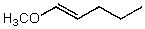
A)4
B)5
C)6
D)7
E)8
Question
For the compound dimedone,how many different signals would you see in the proton NMR? (Assume that you can see them all.) <strong>For the compound dimedone,how many different signals would you see in the proton NMR? (Assume that you can see them all.)  </strong> A)2 B)3 C)4 D)5 E)None of these choices. <div style=padding-top: 35px>
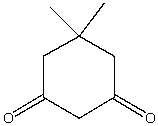
A)2
B)3
C)4
D)5
E)None of these choices.
Question
Which one of the following best represents the predicted approximate chemical shift and coupling for the hydrogen(s)indicated with the arrow? <strong>Which one of the following best represents the predicted approximate chemical shift and coupling for the hydrogen(s)indicated with the arrow?  </strong> A)3.00 ppm,doublet B)3.00 ppm,triplet C)5.00 ppm,triplet D)1.00 ppm,doublet E)5.40 ppm,multiplet <div style=padding-top: 35px>
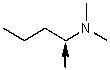
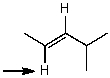
A)3.00 ppm,doublet
B)3.00 ppm,triplet
C)5.00 ppm,triplet
D)1.00 ppm,doublet
E)5.40 ppm,multiplet
Question
Which one of the following best represents the predicted approximate chemical shift and coupling for the hydrogen(s)indicated with the arrow? <strong>Which one of the following best represents the predicted approximate chemical shift and coupling for the hydrogen(s)indicated with the arrow?  </strong> A)5.40 ppm,multiplet B)2.00 ppm,multiplet C)2.00 ppm,doublet D)2.00 ppm,quartet E)5.40 ppm,doublet <div style=padding-top: 35px>
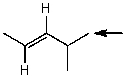
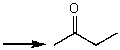
A)5.40 ppm,multiplet
B)2.00 ppm,multiplet
C)2.00 ppm,doublet
D)2.00 ppm,quartet
E)5.40 ppm,doublet
Question
Which one of the following best represents the predicted approximate chemical shift and coupling for the hydrogen(s)indicated with the arrow? <strong>Which one of the following best represents the predicted approximate chemical shift and coupling for the hydrogen(s)indicated with the arrow?  </strong> A)5.40 ppm,doublet B)1.00 ppm,multiplet C)2.00 ppm,doublet D)1.00 ppm,doublet E)5.40 ppm,multiplet <div style=padding-top: 35px>
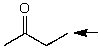
A)5.40 ppm,doublet
B)1.00 ppm,multiplet
C)2.00 ppm,doublet
D)1.00 ppm,doublet
E)5.40 ppm,multiplet
Question
How many signals would you expect to find in the 1H NMR spectrum of CH3OCH2CH2OCH3?

A)1
B)2
C)3
D)4
E)5
Question
Which one of the following best represents the predicted approximate chemical shift and coupling for the hydrogen(s)indicated with the arrow? <strong>Which one of the following best represents the predicted approximate chemical shift and coupling for the hydrogen(s)indicated with the arrow?  </strong> A)1.00 ppm,singlet B)2.10 ppm,singlet C)2.10 ppm,quartet D)3.00 ppm,singlet E)2.10 ppm,triplet <div style=padding-top: 35px>

A)1.00 ppm,singlet
B)2.10 ppm,singlet
C)2.10 ppm,quartet
D)3.00 ppm,singlet
E)2.10 ppm,triplet
Question
Which one of the following best represents the predicted approximate chemical shift and coupling for the hydrogen(s)indicated with the arrow? <strong>Which one of the following best represents the predicted approximate chemical shift and coupling for the hydrogen(s)indicated with the arrow?  </strong> A)1.00 ppm,quartet B)2.40 ppm,singlet C)2.40 ppm,quartet D)3.00 ppm,quartet E)1.00 ppm,triplet <div style=padding-top: 35px>

A)1.00 ppm,quartet
B)2.40 ppm,singlet
C)2.40 ppm,quartet
D)3.00 ppm,quartet
E)1.00 ppm,triplet
Question
Which one of the following best represents the predicted approximate chemical shift and coupling for the hydrogen(s)indicated with the arrow? <strong>Which one of the following best represents the predicted approximate chemical shift and coupling for the hydrogen(s)indicated with the arrow?  </strong> A)1.00 ppm,quartet B)2.40 ppm,singlet C)2.40 ppm,quartet D)3.00 ppm,quartet E)2.40 ppm,triplet <div style=padding-top: 35px>

A)1.00 ppm,quartet
B)2.40 ppm,singlet
C)2.40 ppm,quartet
D)3.00 ppm,quartet
E)2.40 ppm,triplet
Question
Which one of the following best represents the predicted approximate chemical shift and coupling for the hydrogen(s)indicated with the arrow in the compound nicotine? <strong>Which one of the following best represents the predicted approximate chemical shift and coupling for the hydrogen(s)indicated with the arrow in the compound nicotine?  </strong> A)6.00 ppm,singlet B)5.00 ppm.doublet C)7.00 ppm,multiplet D)9.00 ppm,triplet E)none of these choices <div style=padding-top: 35px>
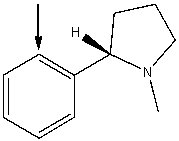
A)6.00 ppm,singlet
B)5.00 ppm.doublet
C)7.00 ppm,multiplet
D)9.00 ppm,triplet
E)none of these choices
Question
How many chemically distinct 1H NMR signals are there in the following compound? <strong>How many chemically distinct <sup>1</sup>H NMR signals are there in the following compound?  </strong> A)1 B)2 C)3 D)4 E)5 <div style=padding-top: 35px>
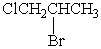
A)1
B)2
C)3
D)4
E)5
Question
For the following compound how many different signals would you see in the proton NMR? (Assume that you can see them all.) <strong>For the following compound how many different signals would you see in the proton NMR? (Assume that you can see them all.)  </strong> A)4 B)5 C)6 D)7 E)8 <div style=padding-top: 35px>
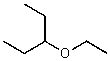
A)4
B)5
C)6
D)7
E)8
Question
A compound C5H11Cl which exhibits only two singlets in the 1H NMR spectrum must be:

A)1-Chloropentane
B)1-Chloro-2,2-dimethylpropane
C)1-Chloro-2-methylbutane
D)3-Chloropentane
E)1-Chloro-3-methylbutane
Question
Which proton(s)of the compound below would appear as a triplet in the 1H NMR spectrum? <strong>Which proton(s)of the compound below would appear as a triplet in the <sup>1</sup>H NMR spectrum?  </strong> A)The protons on carbon II. B)The protons on carbon I and V. C)The protons on carbon III and V. D)The protons on carbon III and IV. E)The protons on carbon V. <div style=padding-top: 35px>
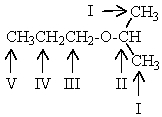
A)The protons on carbon II.
B)The protons on carbon I and V.
C)The protons on carbon III and V.
D)The protons on carbon III and IV.
E)The protons on carbon V.
Question
Which proton(s)of the compound below would appear as a doublet in the 1H NMR spectrum? <strong>Which proton(s)of the compound below would appear as a doublet in the <sup>1</sup>H NMR spectrum?  </strong> A)The protons on carbon I. B)The protons on carbon II. C)The protons on carbon III. D)The protons on carbon IV. E)The protons on carbon V. <div style=padding-top: 35px>
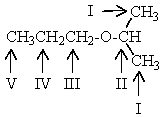
A)The protons on carbon I.
B)The protons on carbon II.
C)The protons on carbon III.
D)The protons on carbon IV.
E)The protons on carbon V.
Question
Consider the expected 1H NMR spectrum of 2,4-dimethyl-1,4-pentadiene.Which of the following is likely to be observed? <strong>Consider the expected <sup>1</sup>H NMR spectrum of 2,4-dimethyl-1,4-pentadiene.Which of the following is likely to be observed?  </strong> A)7 signals: all singlets B)4 signals: all singlets C)3 signals: all singlets D)3 signals: one singlet,2 doublets E)4 signals: two singlets,two doublets <div style=padding-top: 35px>
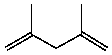
A)7 signals: all singlets
B)4 signals: all singlets
C)3 signals: all singlets
D)3 signals: one singlet,2 doublets
E)4 signals: two singlets,two doublets
Question
Which one of the following best represents the predicted approximate chemical shift and coupling for the hydrogen(s)indicated with the arrow? <strong>Which one of the following best represents the predicted approximate chemical shift and coupling for the hydrogen(s)indicated with the arrow?  </strong> A)1.00 ppm,doublet B)2.00 ppm,singlet C)2.00 ppm,triplet D)2.00 ppm,doublet E)1.00 ppm,triplet <div style=padding-top: 35px>
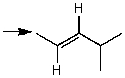
A)1.00 ppm,doublet
B)2.00 ppm,singlet
C)2.00 ppm,triplet
D)2.00 ppm,doublet
E)1.00 ppm,triplet
Question
How many 1H NMR signals would you expect from this compound? <strong>How many <sup>1</sup>H NMR signals would you expect from this compound?  </strong> A)1 B)2 C)3 D)4 E)5 <div style=padding-top: 35px>

A)1
B)2
C)3
D)4
E)5
Question
Consider the expected 1H NMR spectrum of 1,1,3,3-tetramethylcyclopentane.Which of the following is likely to be observed? <strong>Consider the expected <sup>1</sup>H NMR spectrum of 1,1,3,3-tetramethylcyclopentane.Which of the following is likely to be observed?  </strong> A)7 signals: all singlets B)7 signals: 4 singlets,3 doublets C)3 signals: all singlets D)3 signals: one singlet,2 doublets E)3 signals: two singlets,one doublet <div style=padding-top: 35px>

A)7 signals: all singlets
B)7 signals: 4 singlets,3 doublets
C)3 signals: all singlets
D)3 signals: one singlet,2 doublets
E)3 signals: two singlets,one doublet
Question
How many 1H NMR signals would trans-1,2-dichlorocyclopropane give?

A)1
B)2
C)3
D)4
E)5
Question
Which proton(s)of the compound below would appear as a septet in the 1H NMR spectrum? <strong>Which proton(s)of the compound below would appear as a septet in the <sup>1</sup>H NMR spectrum?  </strong> A)The protons on carbon I B)The protons on carbon II C)The protons on carbon III D)The protons on carbon IV E)The protons on carbon V <div style=padding-top: 35px>
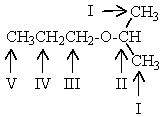
A)The protons on carbon I
B)The protons on carbon II
C)The protons on carbon III
D)The protons on carbon IV
E)The protons on carbon V
Question
If all the protons of 1-fluoropentane could be discerned,which would you expect to be at the lowest field in the 1H NMR spectrum of this compound? <strong>If all the protons of 1-fluoropentane could be discerned,which would you expect to be at the lowest field in the <sup>1</sup>H NMR spectrum of this compound?  </strong> A)Protons on carbon I B)Protons on carbon II C)Protons on carbon III D)Protons on carbon IV E)Protons on carbon V <div style=padding-top: 35px>
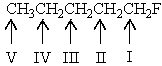
A)Protons on carbon I
B)Protons on carbon II
C)Protons on carbon III
D)Protons on carbon IV
E)Protons on carbon V
Question
The 1H NMR spectrum of which of these compounds would consist of a triplet,singlet and quartet only?

A)2-chloro-4-methylpentane
B)3-chloro-2-methylpentane
C)3-chloropentane
D)1-chloro-2,2-dimethylbutane
E)3-chloro-3-methylpentane
Question
A compound that would show two triplets and a septet in the 1H NMR spectrum could be:

A)3-ethylpentane
B)2-bromopropane
C)chlorocyclopropane
D)1-iodopropane
E)none of these choices
Question
Predict the splitting pattern you would observe for the proton at C4 of 2,3-dimethyl-2-phenylbutane. <strong>Predict the splitting pattern you would observe for the proton at C4 of 2,3-dimethyl-2-phenylbutane.  </strong> A)Doublet B)Singlet C)Quartet D)Septet E)Octet <div style=padding-top: 35px>

A)Doublet
B)Singlet
C)Quartet
D)Septet
E)Octet
Question
The 1H NMR signal for which of the indicated protons will occur at the lowest frequency (most upfield signal)? <strong>The <sup>1</sup>H NMR signal for which of the indicated protons will occur at the lowest frequency (most upfield signal)?  </strong> A)I B)II C)III D)IV E)V <div style=padding-top: 35px>
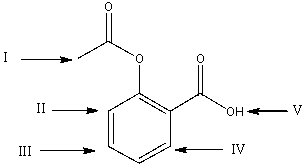
A)I
B)II
C)III
D)IV
E)V
Question
Which of the following compounds would not be represented by a lone singlet in the proton NMR?

A)cyclohexane
B)benzene
C)dimethyl ether (CH3-O-CH3)
D)1,2-ethanediol
E)none of these choices
Question
How many 1H NMR signals would cis-1,2-dichlorocyclopropane give?

A)1
B)2
C)3
D)4
E)5
Question
Predict the splitting pattern you would observe for the proton at C3 of 2,3-dimethyl-2-phenylbutane. <strong>Predict the splitting pattern you would observe for the proton at C3 of 2,3-dimethyl-2-phenylbutane.  </strong> A)Doublet B)Singlet C)Quartet D)Septet E)Octet <div style=padding-top: 35px>

A)Doublet
B)Singlet
C)Quartet
D)Septet
E)Octet
Question
Which one of the following best represents the predicted approximate chemical shift and coupling for the hydrogen(s)indicated with the arrow? <strong>Which one of the following best represents the predicted approximate chemical shift and coupling for the hydrogen(s)indicated with the arrow?  </strong> A)1.10 ppm,singlet B)2.10 ppm,triplet C)3.40 ppm,triplet D)4.5 ppm,singlet E)5.3 ppm,doublet <div style=padding-top: 35px>
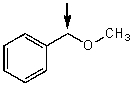
A)1.10 ppm,singlet
B)2.10 ppm,triplet
C)3.40 ppm,triplet
D)4.5 ppm,singlet
E)5.3 ppm,doublet
Question
A compound with the molecular formula C8H9ClO gave the following 1H NMR spectrum: triplet, δ\delta 3.7
Triplet, δ\delta 4.2
Multiplet, δ\delta 7.1
There was no evidence of an -OH band in the IR spectrum.The most likely structure for the compound is:  <strong>A compound with the molecular formula C<sub>8</sub>H<sub>9</sub>ClO gave the following <sup>1</sup>H NMR spectrum: triplet, \delta 3.7 Triplet, \delta  4.2 Multiplet, \delta  7.1 There was no evidence of an -OH band in the IR spectrum.The most likely structure for the compound is:  </strong> A)I B)II C)III D)IV E)V <div style=padding-top: 35px>
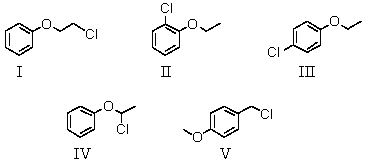
A)I
B)II
C)III
D)IV
E)V
Question
What is the structure of the compound in the following 1H-NMR spectrum with the molecular formula C8H14? Relative integration is shown. <strong>What is the structure of the compound in the following <sup>1</sup>H-NMR spectrum with the molecular formula C<sub>8</sub>H<sub>14</sub>? Relative integration is shown.  </strong> A)   B)   C)   D)   E)   <div style=padding-top: 35px>
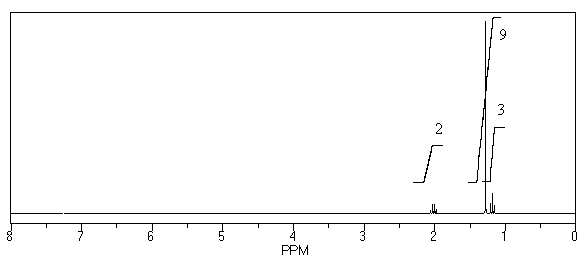
A) <strong>What is the structure of the compound in the following <sup>1</sup>H-NMR spectrum with the molecular formula C<sub>8</sub>H<sub>14</sub>? Relative integration is shown.  </strong> A)   B)   C)   D)   E)   <div style=padding-top: 35px>
B) <strong>What is the structure of the compound in the following <sup>1</sup>H-NMR spectrum with the molecular formula C<sub>8</sub>H<sub>14</sub>? Relative integration is shown.  </strong> A)   B)   C)   D)   E)   <div style=padding-top: 35px>
C) <strong>What is the structure of the compound in the following <sup>1</sup>H-NMR spectrum with the molecular formula C<sub>8</sub>H<sub>14</sub>? Relative integration is shown.  </strong> A)   B)   C)   D)   E)   <div style=padding-top: 35px>
D) <strong>What is the structure of the compound in the following <sup>1</sup>H-NMR spectrum with the molecular formula C<sub>8</sub>H<sub>14</sub>? Relative integration is shown.  </strong> A)   B)   C)   D)   E)   <div style=padding-top: 35px>
E) <strong>What is the structure of the compound in the following <sup>1</sup>H-NMR spectrum with the molecular formula C<sub>8</sub>H<sub>14</sub>? Relative integration is shown.  </strong> A)   B)   C)   D)   E)   <div style=padding-top: 35px>
Question
What is the structure of the compound in the following 1H-NMR spectrum with the molecular formula C6H11N? In the IR spectrum you notice a stretch at about 2250 cm-1.Relative integration is shown. <strong>What is the structure of the compound in the following <sup>1</sup>H-NMR spectrum with the molecular formula C<sub>6</sub>H<sub>11</sub>N? In the IR spectrum you notice a stretch at about 2250 cm<sup>-1</sup>.Relative integration is shown.  </strong> A)   B)   C)   D)   E)   <div style=padding-top: 35px>
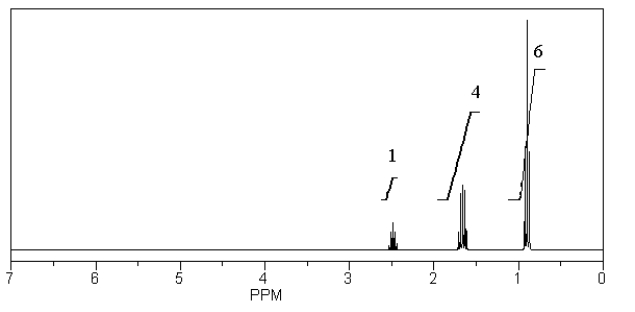
A) <strong>What is the structure of the compound in the following <sup>1</sup>H-NMR spectrum with the molecular formula C<sub>6</sub>H<sub>11</sub>N? In the IR spectrum you notice a stretch at about 2250 cm<sup>-1</sup>.Relative integration is shown.  </strong> A)   B)   C)   D)   E)   <div style=padding-top: 35px>
B) <strong>What is the structure of the compound in the following <sup>1</sup>H-NMR spectrum with the molecular formula C<sub>6</sub>H<sub>11</sub>N? In the IR spectrum you notice a stretch at about 2250 cm<sup>-1</sup>.Relative integration is shown.  </strong> A)   B)   C)   D)   E)   <div style=padding-top: 35px>
C) <strong>What is the structure of the compound in the following <sup>1</sup>H-NMR spectrum with the molecular formula C<sub>6</sub>H<sub>11</sub>N? In the IR spectrum you notice a stretch at about 2250 cm<sup>-1</sup>.Relative integration is shown.  </strong> A)   B)   C)   D)   E)   <div style=padding-top: 35px>
D) <strong>What is the structure of the compound in the following <sup>1</sup>H-NMR spectrum with the molecular formula C<sub>6</sub>H<sub>11</sub>N? In the IR spectrum you notice a stretch at about 2250 cm<sup>-1</sup>.Relative integration is shown.  </strong> A)   B)   C)   D)   E)   <div style=padding-top: 35px>
E) <strong>What is the structure of the compound in the following <sup>1</sup>H-NMR spectrum with the molecular formula C<sub>6</sub>H<sub>11</sub>N? In the IR spectrum you notice a stretch at about 2250 cm<sup>-1</sup>.Relative integration is shown.  </strong> A)   B)   C)   D)   E)   <div style=padding-top: 35px>
Question
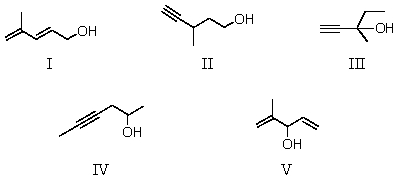
The 1H NMR spectrum of which of the compounds below,all of formula C7H12O2,would consist of two singlets only? <strong>The <sup>1</sup>H NMR spectrum of which of the compounds below,all of formula C<sub>7</sub>H<sub>12</sub>O<sub>2</sub>,would consist of two singlets only?  </strong> A)I B)II C)III D)IV E)V <div style=padding-top: 35px>
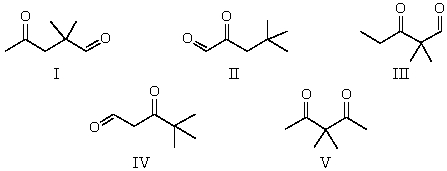
A)I
B)II
C)III
D)IV
E)V
Question
What is the structure of the compound in the following 1H-NMR spectrum with the molecular formula C9H10O2? Relative integration is shown. <strong>What is the structure of the compound in the following <sup>1</sup>H-NMR spectrum with the molecular formula C<sub>9</sub>H<sub>10</sub>O<sub>2</sub>? Relative integration is shown.  </strong> A)   B)   C)   D)   E)   <div style=padding-top: 35px>
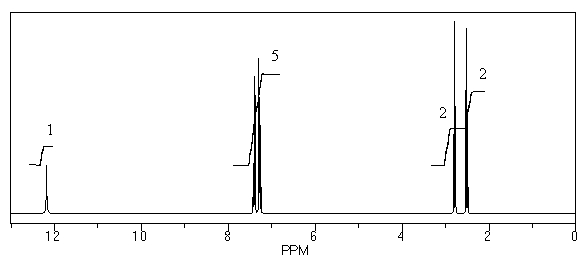
A) <strong>What is the structure of the compound in the following <sup>1</sup>H-NMR spectrum with the molecular formula C<sub>9</sub>H<sub>10</sub>O<sub>2</sub>? Relative integration is shown.  </strong> A)   B)   C)   D)   E)   <div style=padding-top: 35px>
B) <strong>What is the structure of the compound in the following <sup>1</sup>H-NMR spectrum with the molecular formula C<sub>9</sub>H<sub>10</sub>O<sub>2</sub>? Relative integration is shown.  </strong> A)   B)   C)   D)   E)   <div style=padding-top: 35px>
C) <strong>What is the structure of the compound in the following <sup>1</sup>H-NMR spectrum with the molecular formula C<sub>9</sub>H<sub>10</sub>O<sub>2</sub>? Relative integration is shown.  </strong> A)   B)   C)   D)   E)   <div style=padding-top: 35px>
D) <strong>What is the structure of the compound in the following <sup>1</sup>H-NMR spectrum with the molecular formula C<sub>9</sub>H<sub>10</sub>O<sub>2</sub>? Relative integration is shown.  </strong> A)   B)   C)   D)   E)   <div style=padding-top: 35px>
E) <strong>What is the structure of the compound in the following <sup>1</sup>H-NMR spectrum with the molecular formula C<sub>9</sub>H<sub>10</sub>O<sub>2</sub>? Relative integration is shown.  </strong> A)   B)   C)   D)   E)   <div style=padding-top: 35px>
Question
Consider the expected splitting of the C2 proton signal in the 1H NMR spectrum of 1,1-dibromopentane.Presuming that the coupling constants for neighboring protons are sufficiently different,and that the instrument has sufficient resolving power,what is the theoretical multiplicity of the C2 proton signal?

A)3
B)4
C)5
D)6
E)8
Question
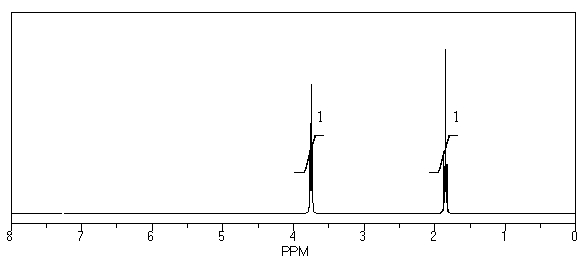
What is the structure of the compound in the following 1H-NMR spectrum with the molecular formula C4H8O? Relative integration is shown. <strong>What is the structure of the compound in the following <sup>1</sup>H-NMR spectrum with the molecular formula C<sub>4</sub>H<sub>8</sub>O? Relative integration is shown.  </strong> A)   B)   C)   D)   E)   <div style=padding-top: 35px>
A) <strong>What is the structure of the compound in the following <sup>1</sup>H-NMR spectrum with the molecular formula C<sub>4</sub>H<sub>8</sub>O? Relative integration is shown.  </strong> A)   B)   C)   D)   E)   <div style=padding-top: 35px>
B) <strong>What is the structure of the compound in the following <sup>1</sup>H-NMR spectrum with the molecular formula C<sub>4</sub>H<sub>8</sub>O? Relative integration is shown.  </strong> A)   B)   C)   D)   E)   <div style=padding-top: 35px>
C) <strong>What is the structure of the compound in the following <sup>1</sup>H-NMR spectrum with the molecular formula C<sub>4</sub>H<sub>8</sub>O? Relative integration is shown.  </strong> A)   B)   C)   D)   E)   <div style=padding-top: 35px>
D) <strong>What is the structure of the compound in the following <sup>1</sup>H-NMR spectrum with the molecular formula C<sub>4</sub>H<sub>8</sub>O? Relative integration is shown.  </strong> A)   B)   C)   D)   E)   <div style=padding-top: 35px>
E) <strong>What is the structure of the compound in the following <sup>1</sup>H-NMR spectrum with the molecular formula C<sub>4</sub>H<sub>8</sub>O? Relative integration is shown.  </strong> A)   B)   C)   D)   E)   <div style=padding-top: 35px>
Question
A compound with the molecular formula C4H10O gives a 1H NMR spectrum consisting only of a quartet centered at δ\delta 3.5 and a triplet at δ\delta 1.1.The most likely structure for the compound is:

A)  <strong>A compound with the molecular formula C<sub>4</sub>H<sub>10</sub>O gives a <sup>1</sup>H NMR spectrum consisting only of a quartet centered at  \delta 3.5 and a triplet at  \delta  1.1.The most likely structure for the compound is:</strong> A)   B)   C)CH<sub>3</sub>CH<sub>2</sub>CH<sub>2</sub>CH<sub>2</sub>OH D)CH<sub>3</sub>CH<sub>2</sub>OCH<sub>2</sub>CH<sub>3</sub> E)   <div style=padding-top: 35px>
B)  <strong>A compound with the molecular formula C<sub>4</sub>H<sub>10</sub>O gives a <sup>1</sup>H NMR spectrum consisting only of a quartet centered at  \delta 3.5 and a triplet at  \delta  1.1.The most likely structure for the compound is:</strong> A)   B)   C)CH<sub>3</sub>CH<sub>2</sub>CH<sub>2</sub>CH<sub>2</sub>OH D)CH<sub>3</sub>CH<sub>2</sub>OCH<sub>2</sub>CH<sub>3</sub> E)   <div style=padding-top: 35px>
C)CH3CH2CH2CH2OH
D)CH3CH2OCH2CH3
E)  <strong>A compound with the molecular formula C<sub>4</sub>H<sub>10</sub>O gives a <sup>1</sup>H NMR spectrum consisting only of a quartet centered at  \delta 3.5 and a triplet at  \delta  1.1.The most likely structure for the compound is:</strong> A)   B)   C)CH<sub>3</sub>CH<sub>2</sub>CH<sub>2</sub>CH<sub>2</sub>OH D)CH<sub>3</sub>CH<sub>2</sub>OCH<sub>2</sub>CH<sub>3</sub> E)   <div style=padding-top: 35px>
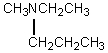
Question
A compound with the molecular formula C6H15N gave the following 1H NMR spectrum: triplet, δ\delta 0 0.90
Quartet, δ\delta 2.4
There were no other signals.The most likely structure for the compound is:

A)  <strong>A compound with the molecular formula C<sub>6</sub>H<sub>15</sub>N gave the following <sup>1</sup>H NMR spectrum: triplet, \delta 0 0.90 Quartet, \delta  2.4 There were no other signals.The most likely structure for the compound is:</strong> A)   B)   C)CH<sub>3</sub>CH<sub>2</sub>CH<sub>2</sub>CH<sub>2</sub>CH<sub>2</sub>CH<sub>2</sub>NH<sub>2</sub> D)   E)   <div style=padding-top: 35px>
B)  <strong>A compound with the molecular formula C<sub>6</sub>H<sub>15</sub>N gave the following <sup>1</sup>H NMR spectrum: triplet, \delta 0 0.90 Quartet, \delta  2.4 There were no other signals.The most likely structure for the compound is:</strong> A)   B)   C)CH<sub>3</sub>CH<sub>2</sub>CH<sub>2</sub>CH<sub>2</sub>CH<sub>2</sub>CH<sub>2</sub>NH<sub>2</sub> D)   E)   <div style=padding-top: 35px>
C)CH3CH2CH2CH2CH2CH2NH2
D)  <strong>A compound with the molecular formula C<sub>6</sub>H<sub>15</sub>N gave the following <sup>1</sup>H NMR spectrum: triplet, \delta 0 0.90 Quartet, \delta  2.4 There were no other signals.The most likely structure for the compound is:</strong> A)   B)   C)CH<sub>3</sub>CH<sub>2</sub>CH<sub>2</sub>CH<sub>2</sub>CH<sub>2</sub>CH<sub>2</sub>NH<sub>2</sub> D)   E)   <div style=padding-top: 35px>
E)  <strong>A compound with the molecular formula C<sub>6</sub>H<sub>15</sub>N gave the following <sup>1</sup>H NMR spectrum: triplet, \delta 0 0.90 Quartet, \delta  2.4 There were no other signals.The most likely structure for the compound is:</strong> A)   B)   C)CH<sub>3</sub>CH<sub>2</sub>CH<sub>2</sub>CH<sub>2</sub>CH<sub>2</sub>CH<sub>2</sub>NH<sub>2</sub> D)   E)   <div style=padding-top: 35px>
Question
Which of these compounds will not be represented by a singlet only in the 1H NMR spectrum?

A)Neopentane
B)Hexamethylbenzene
C)Isobutane
D)(Z)-1,2-Dichloroethene
E)(E)-1,2-Dichloroethene
Question
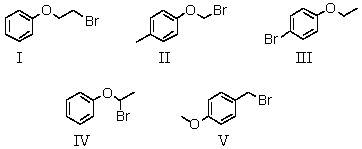
A compound with the molecular formula C8H9BrO gave the following 1H NMR spectrum: triplet, δ\delta 1.4
Quartet, δ\delta 3.9
Multiplet, δ\delta 7.0 (4H)
There was no evidence of an -OH band in the IR spectrum.A possible structure for the compound is:  <strong>A compound with the molecular formula C<sub>8</sub>H<sub>9</sub>BrO gave the following <sup>1</sup>H NMR spectrum: triplet, \delta  1.4 Quartet, \delta  3.9 Multiplet, \delta  7.0 (4H) There was no evidence of an -OH band in the IR spectrum.A possible structure for the compound is:  </strong> A)I B)II C)III D)IV E)V <div style=padding-top: 35px>
A)I
B)II
C)III
D)IV
E)V
Question
Determine the most likely structure of a compound,with the molecular formula C9H12,which gave a 1H NMR spectrum consisting of: a doublet at δ\delta 1.25
A septet at δ\delta 2.90 and
A multiplet at δ\delta 7.25  <strong>Determine the most likely structure of a compound,with the molecular formula C<sub>9</sub>H<sub>12</sub>,which gave a <sup>1</sup>H NMR spectrum consisting of: a doublet at  \delta  1.25 A septet at  \delta  2.90 and A multiplet at  \delta  7.25   ]</strong> A)I B)II C)III D)IV E)V <div style=padding-top: 35px>  ]

A)I
B)II
C)III
D)IV
E)V
Question
A compound with the molecular formula C3H6Cl2 gave a 1H NMR spectrum consisting only of a triplet centered at δ\delta 3.7 and a quintet centered at δ\delta 2.2.The most likely structure for the compound is:

A)CH3CH2CHCl2
B)CH3CHClCH2Cl
C)ClCH2CHClCH3
D)ClCH2CH2CH2Cl
E)CH3CCl2CH3
Question
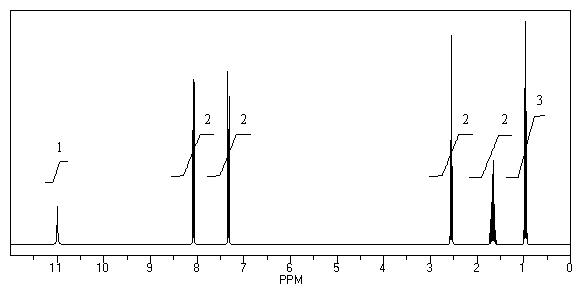
What is the structure of the compound in the following 1H-NMR spectrum with the molecular formula C10H12O2? Relative integration is shown. <strong>What is the structure of the compound in the following <sup>1</sup>H-NMR spectrum with the molecular formula C<sub>10</sub>H<sub>12</sub>O<sub>2</sub>? Relative integration is shown.  </strong> A)   B)   C)   D)   E)   <div style=padding-top: 35px>
A) <strong>What is the structure of the compound in the following <sup>1</sup>H-NMR spectrum with the molecular formula C<sub>10</sub>H<sub>12</sub>O<sub>2</sub>? Relative integration is shown.  </strong> A)   B)   C)   D)   E)   <div style=padding-top: 35px>
B) <strong>What is the structure of the compound in the following <sup>1</sup>H-NMR spectrum with the molecular formula C<sub>10</sub>H<sub>12</sub>O<sub>2</sub>? Relative integration is shown.  </strong> A)   B)   C)   D)   E)   <div style=padding-top: 35px>
C) <strong>What is the structure of the compound in the following <sup>1</sup>H-NMR spectrum with the molecular formula C<sub>10</sub>H<sub>12</sub>O<sub>2</sub>? Relative integration is shown.  </strong> A)   B)   C)   D)   E)   <div style=padding-top: 35px>
D) <strong>What is the structure of the compound in the following <sup>1</sup>H-NMR spectrum with the molecular formula C<sub>10</sub>H<sub>12</sub>O<sub>2</sub>? Relative integration is shown.  </strong> A)   B)   C)   D)   E)   <div style=padding-top: 35px>
E) <strong>What is the structure of the compound in the following <sup>1</sup>H-NMR spectrum with the molecular formula C<sub>10</sub>H<sub>12</sub>O<sub>2</sub>? Relative integration is shown.  </strong> A)   B)   C)   D)   E)   <div style=padding-top: 35px>
Question
Consider the expected splitting of the C2 proton signal in the 1H NMR spectrum of 2-ethyl-1,3-propanediol.Presuming that the coupling constants for neighboring protons are sufficiently different,and that the instrument has sufficient resolving power,what is the theoretical multiplicity of the C2 proton signal?

A)6
B)7
C)8
D)12
E)15
Question
What is the theoretical multiplicity of the C-2 proton signal in the 1H NMR spectrum of 2-hydroxymethyl-1,3-propanediol,shown below? <strong>What is the theoretical multiplicity of the C-2 proton signal in the <sup>1</sup>H NMR spectrum of 2-hydroxymethyl-1,3-propanediol,shown below?  </strong> A)1 B)6 C)7 D)8 E)9 <div style=padding-top: 35px>
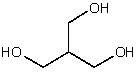
A)1
B)6
C)7
D)8
E)9
Question
The 1H NMR spectrum of which of the compounds below,all of formula C7H12O2,would consist of a singlet,a doublet and a triplet only? <strong>The <sup>1</sup>H NMR spectrum of which of the compounds below,all of formula C<sub>7</sub>H<sub>12</sub>O<sub>2</sub>,would consist of a singlet,a doublet and a triplet only?  </strong> A)I B)II C)III D)IV E)V <div style=padding-top: 35px>
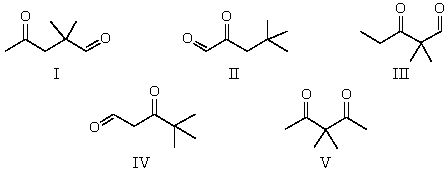
A)I
B)II
C)III
D)IV
E)V
Question
A compound with the molecular formula C10H13Cl gave the following 1H NMR spectrum: singlet, δ\delta 1.6
Singlet, δ\delta 3.1
Multiplet, δ\delta 7.2 (5H)
The most likely structure for the compound is:  <strong>A compound with the molecular formula C<sub>10</sub>H<sub>13</sub>Cl gave the following <sup>1</sup>H NMR spectrum: singlet, \delta  1.6 Singlet, \delta  3.1 Multiplet, \delta  7.2 (5H) The most likely structure for the compound is:  </strong> A)I B)II C)III D)IV E)V <div style=padding-top: 35px>
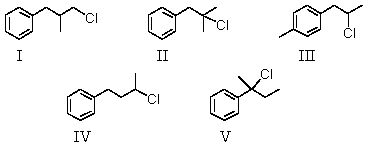
A)I
B)II
C)III
D)IV
E)V
Question
What is the structure of the compound in the following 1H-NMR spectrum with the molecular formula C10H20? Relative integration is shown. <strong>What is the structure of the compound in the following <sup>1</sup>H-NMR spectrum with the molecular formula C<sub>10</sub>H<sub>20</sub>? Relative integration is shown.  </strong> A)   B)   C)   D)   E)   <div style=padding-top: 35px>
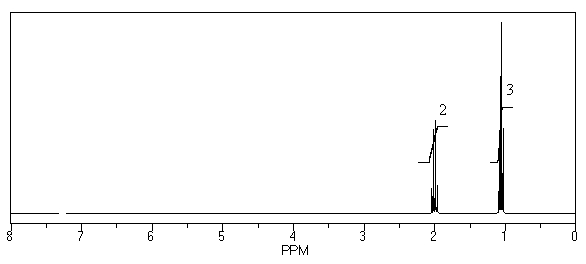
A) <strong>What is the structure of the compound in the following <sup>1</sup>H-NMR spectrum with the molecular formula C<sub>10</sub>H<sub>20</sub>? Relative integration is shown.  </strong> A)   B)   C)   D)   E)   <div style=padding-top: 35px>
B) <strong>What is the structure of the compound in the following <sup>1</sup>H-NMR spectrum with the molecular formula C<sub>10</sub>H<sub>20</sub>? Relative integration is shown.  </strong> A)   B)   C)   D)   E)   <div style=padding-top: 35px>
C) <strong>What is the structure of the compound in the following <sup>1</sup>H-NMR spectrum with the molecular formula C<sub>10</sub>H<sub>20</sub>? Relative integration is shown.  </strong> A)   B)   C)   D)   E)   <div style=padding-top: 35px>
D) <strong>What is the structure of the compound in the following <sup>1</sup>H-NMR spectrum with the molecular formula C<sub>10</sub>H<sub>20</sub>? Relative integration is shown.  </strong> A)   B)   C)   D)   E)   <div style=padding-top: 35px>
E) <strong>What is the structure of the compound in the following <sup>1</sup>H-NMR spectrum with the molecular formula C<sub>10</sub>H<sub>20</sub>? Relative integration is shown.  </strong> A)   B)   C)   D)   E)   <div style=padding-top: 35px>
Question
The 1H NMR spectrum of which of the compounds below,all of formula C7H12O2,would consist of three singlets only? <strong>The <sup>1</sup>H NMR spectrum of which of the compounds below,all of formula C<sub>7</sub>H<sub>12</sub>O<sub>2</sub>,would consist of three singlets only?  </strong> A)I B)II C)III D)IV E)V <div style=padding-top: 35px>
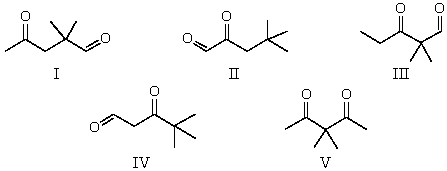
A)I
B)II
C)III
D)IV
E)V
Question
What is the structure of the compound in the following 1H-NMR spectrum with the molecular formula C5H10O? The IR spectrum does not show any characteristic stretches around 1700 cm-1.Relative integration is shown. <strong>What is the structure of the compound in the following <sup>1</sup>H-NMR spectrum with the molecular formula C<sub>5</sub>H<sub>10</sub>O? The IR spectrum does not show any characteristic stretches around 1700 cm<sup>-1</sup>.Relative integration is shown.  </strong> A)   B)   C)   D)   E)   <div style=padding-top: 35px>
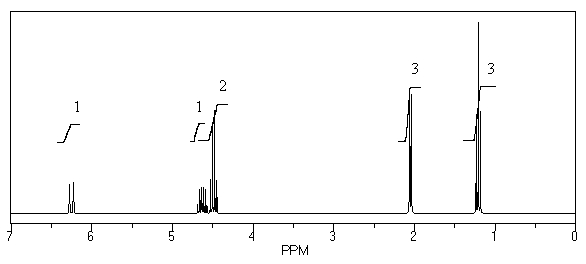
A) <strong>What is the structure of the compound in the following <sup>1</sup>H-NMR spectrum with the molecular formula C<sub>5</sub>H<sub>10</sub>O? The IR spectrum does not show any characteristic stretches around 1700 cm<sup>-1</sup>.Relative integration is shown.  </strong> A)   B)   C)   D)   E)   <div style=padding-top: 35px>
B) <strong>What is the structure of the compound in the following <sup>1</sup>H-NMR spectrum with the molecular formula C<sub>5</sub>H<sub>10</sub>O? The IR spectrum does not show any characteristic stretches around 1700 cm<sup>-1</sup>.Relative integration is shown.  </strong> A)   B)   C)   D)   E)   <div style=padding-top: 35px>
C) <strong>What is the structure of the compound in the following <sup>1</sup>H-NMR spectrum with the molecular formula C<sub>5</sub>H<sub>10</sub>O? The IR spectrum does not show any characteristic stretches around 1700 cm<sup>-1</sup>.Relative integration is shown.  </strong> A)   B)   C)   D)   E)   <div style=padding-top: 35px>
D) <strong>What is the structure of the compound in the following <sup>1</sup>H-NMR spectrum with the molecular formula C<sub>5</sub>H<sub>10</sub>O? The IR spectrum does not show any characteristic stretches around 1700 cm<sup>-1</sup>.Relative integration is shown.  </strong> A)   B)   C)   D)   E)   <div style=padding-top: 35px>
E) <strong>What is the structure of the compound in the following <sup>1</sup>H-NMR spectrum with the molecular formula C<sub>5</sub>H<sub>10</sub>O? The IR spectrum does not show any characteristic stretches around 1700 cm<sup>-1</sup>.Relative integration is shown.  </strong> A)   B)   C)   D)   E)   <div style=padding-top: 35px>
Question
In the structure shown,Ha and Hb are classified as: <strong>In the structure shown,H<sub>a</sub> and H<sub>b</sub> are classified as:  </strong> A)homotopic protons. B)vicinal protons. C)enantiotopic protons. D)diastereotopic protons. E)isomeric protons. <div style=padding-top: 35px>
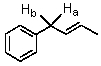
A)homotopic protons.
B)vicinal protons.
C)enantiotopic protons.
D)diastereotopic protons.
E)isomeric protons.
Question
What is the structure of the compound in the following 1H-NMR spectrum with the molecular formula C8H16O? Relative integration is shown. <strong>What is the structure of the compound in the following <sup>1</sup>H-NMR spectrum with the molecular formula C<sub>8</sub>H<sub>16</sub>O? Relative integration is shown.  </strong> A)   B)   C)   D)   E)   <div style=padding-top: 35px>
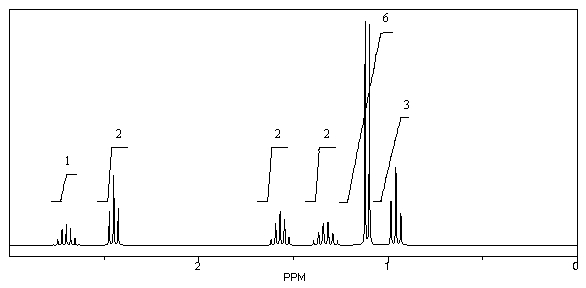
A) <strong>What is the structure of the compound in the following <sup>1</sup>H-NMR spectrum with the molecular formula C<sub>8</sub>H<sub>16</sub>O? Relative integration is shown.  </strong> A)   B)   C)   D)   E)   <div style=padding-top: 35px>
B) <strong>What is the structure of the compound in the following <sup>1</sup>H-NMR spectrum with the molecular formula C<sub>8</sub>H<sub>16</sub>O? Relative integration is shown.  </strong> A)   B)   C)   D)   E)   <div style=padding-top: 35px>
C) <strong>What is the structure of the compound in the following <sup>1</sup>H-NMR spectrum with the molecular formula C<sub>8</sub>H<sub>16</sub>O? Relative integration is shown.  </strong> A)   B)   C)   D)   E)   <div style=padding-top: 35px>
D) <strong>What is the structure of the compound in the following <sup>1</sup>H-NMR spectrum with the molecular formula C<sub>8</sub>H<sub>16</sub>O? Relative integration is shown.  </strong> A)   B)   C)   D)   E)   <div style=padding-top: 35px>
E) <strong>What is the structure of the compound in the following <sup>1</sup>H-NMR spectrum with the molecular formula C<sub>8</sub>H<sub>16</sub>O? Relative integration is shown.  </strong> A)   B)   C)   D)   E)   <div style=padding-top: 35px>
Question
In the structure shown,Hb and Hc are classified as: <strong>In the structure shown,H<sub>b</sub> and H<sub>c</sub> are classified as:  </strong> A)homotopic protons. B)geminal protons. C)enantiotopic protons. D)diastereotopic protons. E)isomeric protons. <div style=padding-top: 35px>

A)homotopic protons.
B)geminal protons.
C)enantiotopic protons.
D)diastereotopic protons.
E)isomeric protons.
Question
Determine the likely structure for a compound A (C6H10O),which is found to decolorize bromine in carbon tetrachloride.Its spectral data is as follows: 1H NMR IR
Triplet, δ\delta 1.0 singlet, δ\delta 2.4 2200 cm-1 (sharp)
Singlet, δ\delta 1.4 singlet, δ\delta 3.4 3300 cm-1 (sharp)
Quartet, δ\delta 1.6 3500 cm-1 (broad)  <strong>Determine the likely structure for a compound A (C<sub>6</sub>H<sub>10</sub>O),which is found to decolorize bromine in carbon tetrachloride.Its spectral data is as follows: <sup>1</sup>H NMR IR Triplet, \delta 1.0 singlet, \delta 2.4 2200 cm<sup>-1</sup> (sharp) Singlet, \delta  1.4 singlet, \delta 3.4 3300 cm<sup>-1 </sup>(sharp) Quartet, \delta  1.6 3500 cm<sup>-1 </sup>(broad)  </strong> A)I B)II C)III D)IV E)V <div style=padding-top: 35px>

A)I
B)II
C)III
D)IV
E)V
Question
What is the structure of the compound in the following 1H-NMR spectrum with the molecular formula C6H12O which shows no characteristic stretches in the IR between 3600-3300 cm-1,but does around 1600 cm-1? Relative integration is shown. <strong>What is the structure of the compound in the following <sup>1</sup>H-NMR spectrum with the molecular formula C<sub>6</sub>H<sub>12</sub>O which shows no characteristic stretches in the IR between 3600-3300 cm<sup>-1</sup>,but does around 1600 cm<sup>-1</sup>? Relative integration is shown.  </strong> A)   B)   C)   D)   E)   <div style=padding-top: 35px>
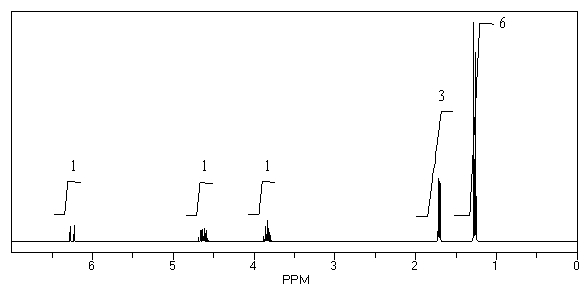
A) <strong>What is the structure of the compound in the following <sup>1</sup>H-NMR spectrum with the molecular formula C<sub>6</sub>H<sub>12</sub>O which shows no characteristic stretches in the IR between 3600-3300 cm<sup>-1</sup>,but does around 1600 cm<sup>-1</sup>? Relative integration is shown.  </strong> A)   B)   C)   D)   E)   <div style=padding-top: 35px>
B) <strong>What is the structure of the compound in the following <sup>1</sup>H-NMR spectrum with the molecular formula C<sub>6</sub>H<sub>12</sub>O which shows no characteristic stretches in the IR between 3600-3300 cm<sup>-1</sup>,but does around 1600 cm<sup>-1</sup>? Relative integration is shown.  </strong> A)   B)   C)   D)   E)   <div style=padding-top: 35px>
C) <strong>What is the structure of the compound in the following <sup>1</sup>H-NMR spectrum with the molecular formula C<sub>6</sub>H<sub>12</sub>O which shows no characteristic stretches in the IR between 3600-3300 cm<sup>-1</sup>,but does around 1600 cm<sup>-1</sup>? Relative integration is shown.  </strong> A)   B)   C)   D)   E)   <div style=padding-top: 35px>
D) <strong>What is the structure of the compound in the following <sup>1</sup>H-NMR spectrum with the molecular formula C<sub>6</sub>H<sub>12</sub>O which shows no characteristic stretches in the IR between 3600-3300 cm<sup>-1</sup>,but does around 1600 cm<sup>-1</sup>? Relative integration is shown.  </strong> A)   B)   C)   D)   E)   <div style=padding-top: 35px>
E) <strong>What is the structure of the compound in the following <sup>1</sup>H-NMR spectrum with the molecular formula C<sub>6</sub>H<sub>12</sub>O which shows no characteristic stretches in the IR between 3600-3300 cm<sup>-1</sup>,but does around 1600 cm<sup>-1</sup>? Relative integration is shown.  </strong> A)   B)   C)   D)   E)   <div style=padding-top: 35px>
Question
For the C2 methylene group in 1-bromopropane, the theoretical multiplicity in the 1H NMR spectrum,presuming that Jab is sufficiently different from Jbc and that the instrument has sufficient resolving power,is which of these? <strong>For the C2 methylene group in 1-bromopropane, the theoretical multiplicity in the <sup>1</sup>H NMR spectrum,presuming that J<sub>ab</sub> is sufficiently different from J<sub>bc</sub> and that the instrument has sufficient resolving power,is which of these?  </strong> A)2 B)5 C)6 D)8 E)12 <div style=padding-top: 35px>
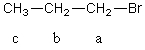
A)2
B)5
C)6
D)8
E)12
Question
What is the structure of the compound in the following 1H-NMR spectrum with the molecular formula C6H12O2? Relative integration is shown. <strong>What is the structure of the compound in the following <sup>1</sup>H-NMR spectrum with the molecular formula C<sub>6</sub>H<sub>12</sub>O<sub>2</sub>? Relative integration is shown.  </strong> A)   B)   C)   D)   E)   <div style=padding-top: 35px>
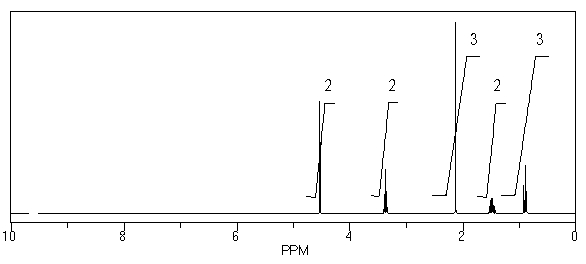
A) <strong>What is the structure of the compound in the following <sup>1</sup>H-NMR spectrum with the molecular formula C<sub>6</sub>H<sub>12</sub>O<sub>2</sub>? Relative integration is shown.  </strong> A)   B)   C)   D)   E)   <div style=padding-top: 35px>
B) <strong>What is the structure of the compound in the following <sup>1</sup>H-NMR spectrum with the molecular formula C<sub>6</sub>H<sub>12</sub>O<sub>2</sub>? Relative integration is shown.  </strong> A)   B)   C)   D)   E)   <div style=padding-top: 35px>
C) <strong>What is the structure of the compound in the following <sup>1</sup>H-NMR spectrum with the molecular formula C<sub>6</sub>H<sub>12</sub>O<sub>2</sub>? Relative integration is shown.  </strong> A)   B)   C)   D)   E)   <div style=padding-top: 35px>
D) <strong>What is the structure of the compound in the following <sup>1</sup>H-NMR spectrum with the molecular formula C<sub>6</sub>H<sub>12</sub>O<sub>2</sub>? Relative integration is shown.  </strong> A)   B)   C)   D)   E)   <div style=padding-top: 35px>
E) <strong>What is the structure of the compound in the following <sup>1</sup>H-NMR spectrum with the molecular formula C<sub>6</sub>H<sub>12</sub>O<sub>2</sub>? Relative integration is shown.  </strong> A)   B)   C)   D)   E)   <div style=padding-top: 35px>
Question
A compound with the molecular formula C10H14 gave the following 1H NMR spectrum: doublet, δ\delta 1.2
Singlet, δ\delta 2.3
Septet, δ\delta 2.8
Multiplet, δ\delta 7.1
A possible structure for the compound is:  <strong>A compound with the molecular formula C<sub>10</sub>H<sub>14 </sub>gave the following <sup>1</sup>H NMR spectrum: doublet, \delta 1.2 Singlet, \delta  2.3 Septet, \delta  2.8 Multiplet, \delta  7.1 A possible structure for the compound is:  </strong> A)I B)II C)III D)IV E)V <div style=padding-top: 35px>
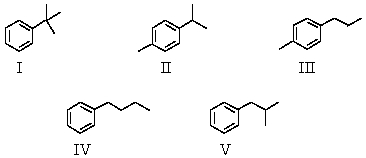
A)I
B)II
C)III
D)IV
E)V
Question
In NMR terminology,protons Ha and Hb are said to be: <strong>In NMR terminology,protons H<sub>a</sub> and H<sub>b</sub> are said to be:  </strong> A)Identical B)Enantiotopic C)Diastereotopic D)Homotopic E)Mesotopic <div style=padding-top: 35px>

A)Identical
B)Enantiotopic
C)Diastereotopic
D)Homotopic
E)Mesotopic
Question
A compound C5H10O gave the following spectral data: 1H NMR spectrum IR spectrum
Doublet, δ\delta 1.10 strong peak
Singlet, δ\delta 2.10 near 1720 cm-1
Septet, δ\delta 2.50
Which is a reasonable structure for the compound?  <strong>A compound C<sub>5</sub>H<sub>10</sub>O gave the following spectral data: <sup>1</sup>H NMR spectrum IR spectrum Doublet, \delta  1.10 strong peak Singlet, \delta  2.10 near 1720 cm<sup>-1</sup> Septet, \delta  2.50 Which is a reasonable structure for the compound?  </strong> A)I B)II C)III D)IV E)V <div style=padding-top: 35px>
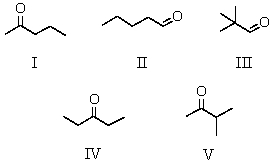
A)I
B)II
C)III
D)IV
E)V
Question
What is the structure of the compound in the following 1H-NMR spectrum with the molecular formula C6H12? Relative integration is shown. <strong>What is the structure of the compound in the following <sup>1</sup>H-NMR spectrum with the molecular formula C<sub>6</sub>H<sub>12</sub>? Relative integration is shown.  </strong> A)   B)   C)   D)   E)   <div style=padding-top: 35px>
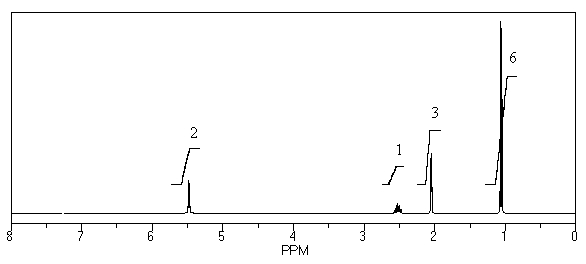
A) <strong>What is the structure of the compound in the following <sup>1</sup>H-NMR spectrum with the molecular formula C<sub>6</sub>H<sub>12</sub>? Relative integration is shown.  </strong> A)   B)   C)   D)   E)   <div style=padding-top: 35px>
B) <strong>What is the structure of the compound in the following <sup>1</sup>H-NMR spectrum with the molecular formula C<sub>6</sub>H<sub>12</sub>? Relative integration is shown.  </strong> A)   B)   C)   D)   E)   <div style=padding-top: 35px>
C) <strong>What is the structure of the compound in the following <sup>1</sup>H-NMR spectrum with the molecular formula C<sub>6</sub>H<sub>12</sub>? Relative integration is shown.  </strong> A)   B)   C)   D)   E)   <div style=padding-top: 35px>
D) <strong>What is the structure of the compound in the following <sup>1</sup>H-NMR spectrum with the molecular formula C<sub>6</sub>H<sub>12</sub>? Relative integration is shown.  </strong> A)   B)   C)   D)   E)   <div style=padding-top: 35px>
E) <strong>What is the structure of the compound in the following <sup>1</sup>H-NMR spectrum with the molecular formula C<sub>6</sub>H<sub>12</sub>? Relative integration is shown.  </strong> A)   B)   C)   D)   E)   <div style=padding-top: 35px>
Question
What is the structure of the compound in the following 1H-NMR spectrum with the molecular formula C6H10O2? Relative integration is shown. <strong>What is the structure of the compound in the following <sup>1</sup>H-NMR spectrum with the molecular formula C<sub>6</sub>H<sub>10</sub>O<sub>2</sub>? Relative integration is shown.  </strong> A)   B)   C)   D)   E)   <div style=padding-top: 35px>
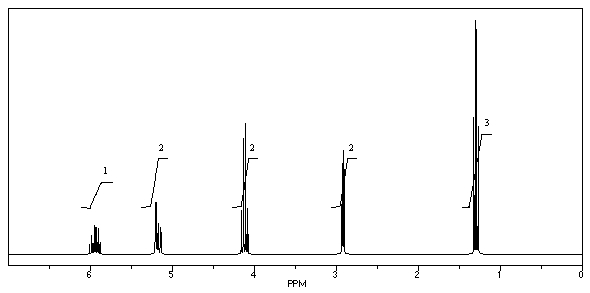
A) <strong>What is the structure of the compound in the following <sup>1</sup>H-NMR spectrum with the molecular formula C<sub>6</sub>H<sub>10</sub>O<sub>2</sub>? Relative integration is shown.  </strong> A)   B)   C)   D)   E)   <div style=padding-top: 35px>
B) <strong>What is the structure of the compound in the following <sup>1</sup>H-NMR spectrum with the molecular formula C<sub>6</sub>H<sub>10</sub>O<sub>2</sub>? Relative integration is shown.  </strong> A)   B)   C)   D)   E)   <div style=padding-top: 35px>
C) <strong>What is the structure of the compound in the following <sup>1</sup>H-NMR spectrum with the molecular formula C<sub>6</sub>H<sub>10</sub>O<sub>2</sub>? Relative integration is shown.  </strong> A)   B)   C)   D)   E)   <div style=padding-top: 35px>
D) <strong>What is the structure of the compound in the following <sup>1</sup>H-NMR spectrum with the molecular formula C<sub>6</sub>H<sub>10</sub>O<sub>2</sub>? Relative integration is shown.  </strong> A)   B)   C)   D)   E)   <div style=padding-top: 35px>
E) <strong>What is the structure of the compound in the following <sup>1</sup>H-NMR spectrum with the molecular formula C<sub>6</sub>H<sub>10</sub>O<sub>2</sub>? Relative integration is shown.  </strong> A)   B)   C)   D)   E)   <div style=padding-top: 35px>
Question
In the structure shown,Ha and Hb are classified as: <strong>In the structure shown,H<sub>a</sub> and H<sub>b</sub> are classified as:  </strong> A)homotopic protons. B)vicinal protons. C)enantiotopic protons. D)diastereotopic protons. E)isomeric protons. <div style=padding-top: 35px>
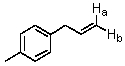
A)homotopic protons.
B)vicinal protons.
C)enantiotopic protons.
D)diastereotopic protons.
E)isomeric protons.
Question
What is the structure of the compound in the following 1H-NMR spectrum with the molecular formula C9H12O? Relative integration is shown. <strong>What is the structure of the compound in the following <sup>1</sup>H-NMR spectrum with the molecular formula C<sub>9</sub>H<sub>12</sub>O? Relative integration is shown.  </strong> A)   B)   C)   D)   E)   <div style=padding-top: 35px>

A) <strong>What is the structure of the compound in the following <sup>1</sup>H-NMR spectrum with the molecular formula C<sub>9</sub>H<sub>12</sub>O? Relative integration is shown.  </strong> A)   B)   C)   D)   E)   <div style=padding-top: 35px>
B) <strong>What is the structure of the compound in the following <sup>1</sup>H-NMR spectrum with the molecular formula C<sub>9</sub>H<sub>12</sub>O? Relative integration is shown.  </strong> A)   B)   C)   D)   E)   <div style=padding-top: 35px>
C) <strong>What is the structure of the compound in the following <sup>1</sup>H-NMR spectrum with the molecular formula C<sub>9</sub>H<sub>12</sub>O? Relative integration is shown.  </strong> A)   B)   C)   D)   E)   <div style=padding-top: 35px>
D) <strong>What is the structure of the compound in the following <sup>1</sup>H-NMR spectrum with the molecular formula C<sub>9</sub>H<sub>12</sub>O? Relative integration is shown.  </strong> A)   B)   C)   D)   E)   <div style=padding-top: 35px>
E) <strong>What is the structure of the compound in the following <sup>1</sup>H-NMR spectrum with the molecular formula C<sub>9</sub>H<sub>12</sub>O? Relative integration is shown.  </strong> A)   B)   C)   D)   E)   <div style=padding-top: 35px>
Question
A compound C4H9Br gave the following 1H NMR spectrum: triplet, δ\delta 1.0 (3H); doublet, δ\delta 1.7; multiplet δ\delta 1.8; multiplet, δ\delta 4.1 (1H)
Which is a reasonable structure for the compound?

A)CH3CH2CHBrCH3
B)CH3CH2CH2CH2Br
C)(CH3)2CHCH2Br
D)(CH3)3CBr
Question
What is the structure of the compound in the following 1H-NMR spectrum with the molecular formula C5H8O? The IR spectrum does show a characteristic stretch around 1700 cm-1.Relative integration is shown. <strong>What is the structure of the compound in the following <sup>1</sup>H-NMR spectrum with the molecular formula C<sub>5</sub>H<sub>8</sub>O? The IR spectrum does show a characteristic stretch around 1700 cm<sup>-1</sup>.Relative integration is shown.  </strong> A)   B)   C)   D)   E)   <div style=padding-top: 35px>
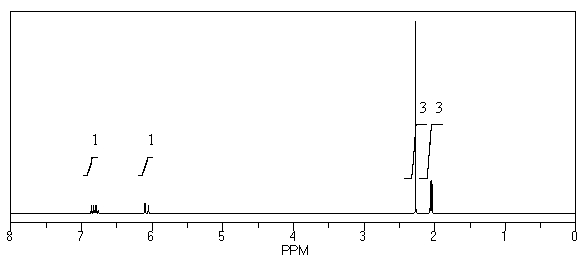
A) <strong>What is the structure of the compound in the following <sup>1</sup>H-NMR spectrum with the molecular formula C<sub>5</sub>H<sub>8</sub>O? The IR spectrum does show a characteristic stretch around 1700 cm<sup>-1</sup>.Relative integration is shown.  </strong> A)   B)   C)   D)   E)   <div style=padding-top: 35px>
B) <strong>What is the structure of the compound in the following <sup>1</sup>H-NMR spectrum with the molecular formula C<sub>5</sub>H<sub>8</sub>O? The IR spectrum does show a characteristic stretch around 1700 cm<sup>-1</sup>.Relative integration is shown.  </strong> A)   B)   C)   D)   E)   <div style=padding-top: 35px>
C) <strong>What is the structure of the compound in the following <sup>1</sup>H-NMR spectrum with the molecular formula C<sub>5</sub>H<sub>8</sub>O? The IR spectrum does show a characteristic stretch around 1700 cm<sup>-1</sup>.Relative integration is shown.  </strong> A)   B)   C)   D)   E)   <div style=padding-top: 35px>
D) <strong>What is the structure of the compound in the following <sup>1</sup>H-NMR spectrum with the molecular formula C<sub>5</sub>H<sub>8</sub>O? The IR spectrum does show a characteristic stretch around 1700 cm<sup>-1</sup>.Relative integration is shown.  </strong> A)   B)   C)   D)   E)   <div style=padding-top: 35px>
E) <strong>What is the structure of the compound in the following <sup>1</sup>H-NMR spectrum with the molecular formula C<sub>5</sub>H<sub>8</sub>O? The IR spectrum does show a characteristic stretch around 1700 cm<sup>-1</sup>.Relative integration is shown.  </strong> A)   B)   C)   D)   E)   <div style=padding-top: 35px>
Question
What is the structure of the compound in the following 1H-NMR spectrum with the molecular formula C4H7Br? Relative integration is shown. <strong>What is the structure of the compound in the following <sup>1</sup>H-NMR spectrum with the molecular formula C<sub>4</sub>H<sub>7</sub>Br? Relative integration is shown.  </strong> A)   B)   C)   D)   E)   <div style=padding-top: 35px>
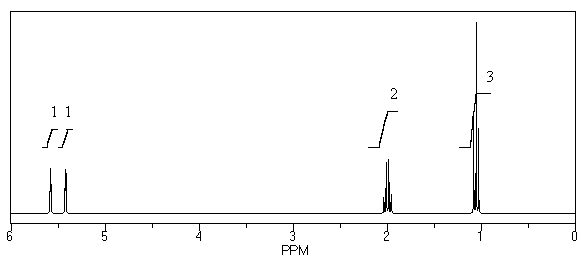
A) <strong>What is the structure of the compound in the following <sup>1</sup>H-NMR spectrum with the molecular formula C<sub>4</sub>H<sub>7</sub>Br? Relative integration is shown.  </strong> A)   B)   C)   D)   E)   <div style=padding-top: 35px>
B) <strong>What is the structure of the compound in the following <sup>1</sup>H-NMR spectrum with the molecular formula C<sub>4</sub>H<sub>7</sub>Br? Relative integration is shown.  </strong> A)   B)   C)   D)   E)   <div style=padding-top: 35px>
C) <strong>What is the structure of the compound in the following <sup>1</sup>H-NMR spectrum with the molecular formula C<sub>4</sub>H<sub>7</sub>Br? Relative integration is shown.  </strong> A)   B)   C)   D)   E)   <div style=padding-top: 35px>
D) <strong>What is the structure of the compound in the following <sup>1</sup>H-NMR spectrum with the molecular formula C<sub>4</sub>H<sub>7</sub>Br? Relative integration is shown.  </strong> A)   B)   C)   D)   E)   <div style=padding-top: 35px>
E) <strong>What is the structure of the compound in the following <sup>1</sup>H-NMR spectrum with the molecular formula C<sub>4</sub>H<sub>7</sub>Br? Relative integration is shown.  </strong> A)   B)   C)   D)   E)   <div style=padding-top: 35px>
Question
In the structure shown,Ha and Hb are classified as: <strong>In the structure shown,H<sub>a</sub> and H<sub>b</sub> are classified as:  </strong> A)homotopic protons. B)vicinal protons. C)enantiotopic protons. D)diastereotopic protons. E)isomeric protons. <div style=padding-top: 35px>

A)homotopic protons.
B)vicinal protons.
C)enantiotopic protons.
D)diastereotopic protons.
E)isomeric protons.
Question
Consider the expected splitting of signal "b" in the 1H NMR spectrum of 1-methoxy-2-methylpropane,shown below.Presuming that Jab is sufficiently different from Jbc and that the instrument has sufficient resolving power,what is the theoretical multiplicity of signal "b"? <strong>Consider the expected splitting of signal b in the <sup>1</sup>H NMR spectrum of 1-methoxy-2-methylpropane,shown below.Presuming that J<sub>ab</sub> is sufficiently different from J<sub>bc</sub> and that the instrument has sufficient resolving power,what is the theoretical multiplicity of signal b?  </strong> A)8 B)9 C)12 D)21 E)24 <div style=padding-top: 35px>
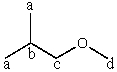
A)8
B)9
C)12
D)21
E)24
Unlock Deck
Sign up to unlock the cards in this deck!
Unlock Deck
Unlock Deck
1/158
auto play flashcards
Play
simple tutorial
Full screen (f)
exit full mode
Deck 9: Nuclear Magnetic Resonance and Mass Spectrometry
1
Which one of the following best represents the predicted approximate chemical shift and coupling for the hydrogen(s)indicated with the arrow in the compound nicotine? <strong>Which one of the following best represents the predicted approximate chemical shift and coupling for the hydrogen(s)indicated with the arrow in the compound nicotine?  </strong> A)1.00 ppm,singlet B)2.00 ppm,doublet C)3.00 ppm,broad multiplet D)5.00 ppm,broad multiplet E)None of these choices.

A)1.00 ppm,singlet
B)2.00 ppm,doublet
C)3.00 ppm,broad multiplet
D)5.00 ppm,broad multiplet
E)None of these choices.
None of these choices.
2
Which one of the following best represents the predicted approximate chemical shift and coupling for the hydrogen(s)indicated with the arrow? <strong>Which one of the following best represents the predicted approximate chemical shift and coupling for the hydrogen(s)indicated with the arrow?  </strong> A)3.00 ppm,doublet B)3.00 ppm,triplet C)5.00 ppm,triplet D)1.00 ppm,doublet E)3.00 ppm,singlet

A)3.00 ppm,doublet
B)3.00 ppm,triplet
C)5.00 ppm,triplet
D)1.00 ppm,doublet
E)3.00 ppm,singlet
3.00 ppm,singlet
3
Which one of the following best represents the predicted approximate chemical shift and coupling for the hydrogen(s)indicated with the arrow in the compound nicotine? <strong>Which one of the following best represents the predicted approximate chemical shift and coupling for the hydrogen(s)indicated with the arrow in the compound nicotine?  </strong> A)1.00 ppm,triplet B)2.00 ppm,doublet C)5.00 ppm,triplet D)7.00 ppm.mulitplet E)None of these choices.

A)1.00 ppm,triplet
B)2.00 ppm,doublet
C)5.00 ppm,triplet
D)7.00 ppm.mulitplet
E)None of these choices.
5.00 ppm,triplet
4
For the following compound how many different signals would you see in the proton NMR? (Assume that you can see them all.) <strong>For the following compound how many different signals would you see in the proton NMR? (Assume that you can see them all.)  </strong> A)4 B)5 C)6 D)7 E)8

A)4
B)5
C)6
D)7
E)8
Unlock Deck
Unlock for access to all 158 flashcards in this deck.
Unlock Deck
k this deck
5
For the compound adamantine,how many different signals would you see in the proton NMR? (Assume that you can see them all.) <strong>For the compound adamantine,how many different signals would you see in the proton NMR? (Assume that you can see them all.)  </strong> A)1 B)2 C)3 D)4 E)None of these choices.

A)1
B)2
C)3
D)4
E)None of these choices.
Unlock Deck
Unlock for access to all 158 flashcards in this deck.
Unlock Deck
k this deck
6
A downfield ( δ\delta 9-10)singlet is observed in the 1H NMR spectrum of:

A)  <strong>A downfield ( \delta  9-10)singlet is observed in the <sup>1</sup>H NMR spectrum of:</strong> A)   B)   C)   D)   E)
B)  <strong>A downfield ( \delta  9-10)singlet is observed in the <sup>1</sup>H NMR spectrum of:</strong> A)   B)   C)   D)   E)
C)  <strong>A downfield ( \delta  9-10)singlet is observed in the <sup>1</sup>H NMR spectrum of:</strong> A)   B)   C)   D)   E)
D)  <strong>A downfield ( \delta  9-10)singlet is observed in the <sup>1</sup>H NMR spectrum of:</strong> A)   B)   C)   D)   E)
E)  <strong>A downfield ( \delta  9-10)singlet is observed in the <sup>1</sup>H NMR spectrum of:</strong> A)   B)   C)   D)   E)
Unlock Deck
Unlock for access to all 158 flashcards in this deck.
Unlock Deck
k this deck
7
For the following compound how many different signals would you see in the proton NMR? (Assume that you can see them all.) <strong>For the following compound how many different signals would you see in the proton NMR? (Assume that you can see them all.)  </strong> A)1 B)2 C)3 D)4 E)5

A)1
B)2
C)3
D)4
E)5
Unlock Deck
Unlock for access to all 158 flashcards in this deck.
Unlock Deck
k this deck
8
For the following compound how many different signals would you see in the proton NMR? (Assume that you can see them all.) <strong>For the following compound how many different signals would you see in the proton NMR? (Assume that you can see them all.)  </strong> A)1 B)2 C)3 D)4 E)5

A)1
B)2
C)3
D)4
E)5
Unlock Deck
Unlock for access to all 158 flashcards in this deck.
Unlock Deck
k this deck
9
Which one of the following best represents the predicted approximate chemical shift and coupling for the hydrogen(s)indicated with the arrow? <strong>Which one of the following best represents the predicted approximate chemical shift and coupling for the hydrogen(s)indicated with the arrow?  </strong> A)1.10 ppm,singlet B)2.10 ppm,doublet C)3.40 ppm,singlet D)4.5 ppm,singlet E)3.5 ppm,quartet

A)1.10 ppm,singlet
B)2.10 ppm,doublet
C)3.40 ppm,singlet
D)4.5 ppm,singlet
E)3.5 ppm,quartet
Unlock Deck
Unlock for access to all 158 flashcards in this deck.
Unlock Deck
k this deck
10
Predict the splitting pattern you would observe for the proton at C1 of 2,3-dimethyl-2-phenylbutane. <strong>Predict the splitting pattern you would observe for the proton at C1 of 2,3-dimethyl-2-phenylbutane.  </strong> A)Doublet B)Singlet C)Quartet D)Septet E)Octet

A)Doublet
B)Singlet
C)Quartet
D)Septet
E)Octet
Unlock Deck
Unlock for access to all 158 flashcards in this deck.
Unlock Deck
k this deck
11
For the following compound how many different signals would you see in the proton NMR? (Assume that you can see them all.) <strong>For the following compound how many different signals would you see in the proton NMR? (Assume that you can see them all.)  </strong> A)4 B)5 C)6 D)7 E)8

A)4
B)5
C)6
D)7
E)8
Unlock Deck
Unlock for access to all 158 flashcards in this deck.
Unlock Deck
k this deck
12
For the compound dimedone,how many different signals would you see in the proton NMR? (Assume that you can see them all.) <strong>For the compound dimedone,how many different signals would you see in the proton NMR? (Assume that you can see them all.)  </strong> A)2 B)3 C)4 D)5 E)None of these choices.

A)2
B)3
C)4
D)5
E)None of these choices.
Unlock Deck
Unlock for access to all 158 flashcards in this deck.
Unlock Deck
k this deck
13
Which one of the following best represents the predicted approximate chemical shift and coupling for the hydrogen(s)indicated with the arrow? <strong>Which one of the following best represents the predicted approximate chemical shift and coupling for the hydrogen(s)indicated with the arrow?  </strong> A)3.00 ppm,doublet B)3.00 ppm,triplet C)5.00 ppm,triplet D)1.00 ppm,doublet E)5.40 ppm,multiplet

A)3.00 ppm,doublet
B)3.00 ppm,triplet
C)5.00 ppm,triplet
D)1.00 ppm,doublet
E)5.40 ppm,multiplet
Unlock Deck
Unlock for access to all 158 flashcards in this deck.
Unlock Deck
k this deck
14
Which one of the following best represents the predicted approximate chemical shift and coupling for the hydrogen(s)indicated with the arrow? <strong>Which one of the following best represents the predicted approximate chemical shift and coupling for the hydrogen(s)indicated with the arrow?  </strong> A)5.40 ppm,multiplet B)2.00 ppm,multiplet C)2.00 ppm,doublet D)2.00 ppm,quartet E)5.40 ppm,doublet

A)5.40 ppm,multiplet
B)2.00 ppm,multiplet
C)2.00 ppm,doublet
D)2.00 ppm,quartet
E)5.40 ppm,doublet
Unlock Deck
Unlock for access to all 158 flashcards in this deck.
Unlock Deck
k this deck
15
Which one of the following best represents the predicted approximate chemical shift and coupling for the hydrogen(s)indicated with the arrow? <strong>Which one of the following best represents the predicted approximate chemical shift and coupling for the hydrogen(s)indicated with the arrow?  </strong> A)5.40 ppm,doublet B)1.00 ppm,multiplet C)2.00 ppm,doublet D)1.00 ppm,doublet E)5.40 ppm,multiplet

A)5.40 ppm,doublet
B)1.00 ppm,multiplet
C)2.00 ppm,doublet
D)1.00 ppm,doublet
E)5.40 ppm,multiplet
Unlock Deck
Unlock for access to all 158 flashcards in this deck.
Unlock Deck
k this deck
16
How many signals would you expect to find in the 1H NMR spectrum of CH3OCH2CH2OCH3?

A)1
B)2
C)3
D)4
E)5
Unlock Deck
Unlock for access to all 158 flashcards in this deck.
Unlock Deck
k this deck
17
Which one of the following best represents the predicted approximate chemical shift and coupling for the hydrogen(s)indicated with the arrow? <strong>Which one of the following best represents the predicted approximate chemical shift and coupling for the hydrogen(s)indicated with the arrow?  </strong> A)1.00 ppm,singlet B)2.10 ppm,singlet C)2.10 ppm,quartet D)3.00 ppm,singlet E)2.10 ppm,triplet

A)1.00 ppm,singlet
B)2.10 ppm,singlet
C)2.10 ppm,quartet
D)3.00 ppm,singlet
E)2.10 ppm,triplet
Unlock Deck
Unlock for access to all 158 flashcards in this deck.
Unlock Deck
k this deck
18
Which one of the following best represents the predicted approximate chemical shift and coupling for the hydrogen(s)indicated with the arrow? <strong>Which one of the following best represents the predicted approximate chemical shift and coupling for the hydrogen(s)indicated with the arrow?  </strong> A)1.00 ppm,quartet B)2.40 ppm,singlet C)2.40 ppm,quartet D)3.00 ppm,quartet E)1.00 ppm,triplet

A)1.00 ppm,quartet
B)2.40 ppm,singlet
C)2.40 ppm,quartet
D)3.00 ppm,quartet
E)1.00 ppm,triplet
Unlock Deck
Unlock for access to all 158 flashcards in this deck.
Unlock Deck
k this deck
19
Which one of the following best represents the predicted approximate chemical shift and coupling for the hydrogen(s)indicated with the arrow? <strong>Which one of the following best represents the predicted approximate chemical shift and coupling for the hydrogen(s)indicated with the arrow?  </strong> A)1.00 ppm,quartet B)2.40 ppm,singlet C)2.40 ppm,quartet D)3.00 ppm,quartet E)2.40 ppm,triplet

A)1.00 ppm,quartet
B)2.40 ppm,singlet
C)2.40 ppm,quartet
D)3.00 ppm,quartet
E)2.40 ppm,triplet
Unlock Deck
Unlock for access to all 158 flashcards in this deck.
Unlock Deck
k this deck
20
Which one of the following best represents the predicted approximate chemical shift and coupling for the hydrogen(s)indicated with the arrow in the compound nicotine? <strong>Which one of the following best represents the predicted approximate chemical shift and coupling for the hydrogen(s)indicated with the arrow in the compound nicotine?  </strong> A)6.00 ppm,singlet B)5.00 ppm.doublet C)7.00 ppm,multiplet D)9.00 ppm,triplet E)none of these choices

A)6.00 ppm,singlet
B)5.00 ppm.doublet
C)7.00 ppm,multiplet
D)9.00 ppm,triplet
E)none of these choices
Unlock Deck
Unlock for access to all 158 flashcards in this deck.
Unlock Deck
k this deck
21
How many chemically distinct 1H NMR signals are there in the following compound? <strong>How many chemically distinct <sup>1</sup>H NMR signals are there in the following compound?  </strong> A)1 B)2 C)3 D)4 E)5

A)1
B)2
C)3
D)4
E)5
Unlock Deck
Unlock for access to all 158 flashcards in this deck.
Unlock Deck
k this deck
22
For the following compound how many different signals would you see in the proton NMR? (Assume that you can see them all.) <strong>For the following compound how many different signals would you see in the proton NMR? (Assume that you can see them all.)  </strong> A)4 B)5 C)6 D)7 E)8

A)4
B)5
C)6
D)7
E)8
Unlock Deck
Unlock for access to all 158 flashcards in this deck.
Unlock Deck
k this deck
23
A compound C5H11Cl which exhibits only two singlets in the 1H NMR spectrum must be:

A)1-Chloropentane
B)1-Chloro-2,2-dimethylpropane
C)1-Chloro-2-methylbutane
D)3-Chloropentane
E)1-Chloro-3-methylbutane
Unlock Deck
Unlock for access to all 158 flashcards in this deck.
Unlock Deck
k this deck
24
Which proton(s)of the compound below would appear as a triplet in the 1H NMR spectrum? <strong>Which proton(s)of the compound below would appear as a triplet in the <sup>1</sup>H NMR spectrum?  </strong> A)The protons on carbon II. B)The protons on carbon I and V. C)The protons on carbon III and V. D)The protons on carbon III and IV. E)The protons on carbon V.

A)The protons on carbon II.
B)The protons on carbon I and V.
C)The protons on carbon III and V.
D)The protons on carbon III and IV.
E)The protons on carbon V.
Unlock Deck
Unlock for access to all 158 flashcards in this deck.
Unlock Deck
k this deck
25
Which proton(s)of the compound below would appear as a doublet in the 1H NMR spectrum? <strong>Which proton(s)of the compound below would appear as a doublet in the <sup>1</sup>H NMR spectrum?  </strong> A)The protons on carbon I. B)The protons on carbon II. C)The protons on carbon III. D)The protons on carbon IV. E)The protons on carbon V.

A)The protons on carbon I.
B)The protons on carbon II.
C)The protons on carbon III.
D)The protons on carbon IV.
E)The protons on carbon V.
Unlock Deck
Unlock for access to all 158 flashcards in this deck.
Unlock Deck
k this deck
26
Consider the expected 1H NMR spectrum of 2,4-dimethyl-1,4-pentadiene.Which of the following is likely to be observed? <strong>Consider the expected <sup>1</sup>H NMR spectrum of 2,4-dimethyl-1,4-pentadiene.Which of the following is likely to be observed?  </strong> A)7 signals: all singlets B)4 signals: all singlets C)3 signals: all singlets D)3 signals: one singlet,2 doublets E)4 signals: two singlets,two doublets

A)7 signals: all singlets
B)4 signals: all singlets
C)3 signals: all singlets
D)3 signals: one singlet,2 doublets
E)4 signals: two singlets,two doublets
Unlock Deck
Unlock for access to all 158 flashcards in this deck.
Unlock Deck
k this deck
27
Which one of the following best represents the predicted approximate chemical shift and coupling for the hydrogen(s)indicated with the arrow? <strong>Which one of the following best represents the predicted approximate chemical shift and coupling for the hydrogen(s)indicated with the arrow?  </strong> A)1.00 ppm,doublet B)2.00 ppm,singlet C)2.00 ppm,triplet D)2.00 ppm,doublet E)1.00 ppm,triplet

A)1.00 ppm,doublet
B)2.00 ppm,singlet
C)2.00 ppm,triplet
D)2.00 ppm,doublet
E)1.00 ppm,triplet
Unlock Deck
Unlock for access to all 158 flashcards in this deck.
Unlock Deck
k this deck
28
How many 1H NMR signals would you expect from this compound? <strong>How many <sup>1</sup>H NMR signals would you expect from this compound?  </strong> A)1 B)2 C)3 D)4 E)5

A)1
B)2
C)3
D)4
E)5
Unlock Deck
Unlock for access to all 158 flashcards in this deck.
Unlock Deck
k this deck
29
Consider the expected 1H NMR spectrum of 1,1,3,3-tetramethylcyclopentane.Which of the following is likely to be observed? <strong>Consider the expected <sup>1</sup>H NMR spectrum of 1,1,3,3-tetramethylcyclopentane.Which of the following is likely to be observed?  </strong> A)7 signals: all singlets B)7 signals: 4 singlets,3 doublets C)3 signals: all singlets D)3 signals: one singlet,2 doublets E)3 signals: two singlets,one doublet

A)7 signals: all singlets
B)7 signals: 4 singlets,3 doublets
C)3 signals: all singlets
D)3 signals: one singlet,2 doublets
E)3 signals: two singlets,one doublet
Unlock Deck
Unlock for access to all 158 flashcards in this deck.
Unlock Deck
k this deck
30
How many 1H NMR signals would trans-1,2-dichlorocyclopropane give?

A)1
B)2
C)3
D)4
E)5
Unlock Deck
Unlock for access to all 158 flashcards in this deck.
Unlock Deck
k this deck
31
Which proton(s)of the compound below would appear as a septet in the 1H NMR spectrum? <strong>Which proton(s)of the compound below would appear as a septet in the <sup>1</sup>H NMR spectrum?  </strong> A)The protons on carbon I B)The protons on carbon II C)The protons on carbon III D)The protons on carbon IV E)The protons on carbon V

A)The protons on carbon I
B)The protons on carbon II
C)The protons on carbon III
D)The protons on carbon IV
E)The protons on carbon V
Unlock Deck
Unlock for access to all 158 flashcards in this deck.
Unlock Deck
k this deck
32
If all the protons of 1-fluoropentane could be discerned,which would you expect to be at the lowest field in the 1H NMR spectrum of this compound? <strong>If all the protons of 1-fluoropentane could be discerned,which would you expect to be at the lowest field in the <sup>1</sup>H NMR spectrum of this compound?  </strong> A)Protons on carbon I B)Protons on carbon II C)Protons on carbon III D)Protons on carbon IV E)Protons on carbon V

A)Protons on carbon I
B)Protons on carbon II
C)Protons on carbon III
D)Protons on carbon IV
E)Protons on carbon V
Unlock Deck
Unlock for access to all 158 flashcards in this deck.
Unlock Deck
k this deck
33
The 1H NMR spectrum of which of these compounds would consist of a triplet,singlet and quartet only?

A)2-chloro-4-methylpentane
B)3-chloro-2-methylpentane
C)3-chloropentane
D)1-chloro-2,2-dimethylbutane
E)3-chloro-3-methylpentane
Unlock Deck
Unlock for access to all 158 flashcards in this deck.
Unlock Deck
k this deck
34
A compound that would show two triplets and a septet in the 1H NMR spectrum could be:

A)3-ethylpentane
B)2-bromopropane
C)chlorocyclopropane
D)1-iodopropane
E)none of these choices
Unlock Deck
Unlock for access to all 158 flashcards in this deck.
Unlock Deck
k this deck
35
Predict the splitting pattern you would observe for the proton at C4 of 2,3-dimethyl-2-phenylbutane. <strong>Predict the splitting pattern you would observe for the proton at C4 of 2,3-dimethyl-2-phenylbutane.  </strong> A)Doublet B)Singlet C)Quartet D)Septet E)Octet

A)Doublet
B)Singlet
C)Quartet
D)Septet
E)Octet
Unlock Deck
Unlock for access to all 158 flashcards in this deck.
Unlock Deck
k this deck
36
The 1H NMR signal for which of the indicated protons will occur at the lowest frequency (most upfield signal)? <strong>The <sup>1</sup>H NMR signal for which of the indicated protons will occur at the lowest frequency (most upfield signal)?  </strong> A)I B)II C)III D)IV E)V

A)I
B)II
C)III
D)IV
E)V
Unlock Deck
Unlock for access to all 158 flashcards in this deck.
Unlock Deck
k this deck
37
Which of the following compounds would not be represented by a lone singlet in the proton NMR?

A)cyclohexane
B)benzene
C)dimethyl ether (CH3-O-CH3)
D)1,2-ethanediol
E)none of these choices
Unlock Deck
Unlock for access to all 158 flashcards in this deck.
Unlock Deck
k this deck
38
How many 1H NMR signals would cis-1,2-dichlorocyclopropane give?

A)1
B)2
C)3
D)4
E)5
Unlock Deck
Unlock for access to all 158 flashcards in this deck.
Unlock Deck
k this deck
39
Predict the splitting pattern you would observe for the proton at C3 of 2,3-dimethyl-2-phenylbutane. <strong>Predict the splitting pattern you would observe for the proton at C3 of 2,3-dimethyl-2-phenylbutane.  </strong> A)Doublet B)Singlet C)Quartet D)Septet E)Octet

A)Doublet
B)Singlet
C)Quartet
D)Septet
E)Octet
Unlock Deck
Unlock for access to all 158 flashcards in this deck.
Unlock Deck
k this deck
40
Which one of the following best represents the predicted approximate chemical shift and coupling for the hydrogen(s)indicated with the arrow? <strong>Which one of the following best represents the predicted approximate chemical shift and coupling for the hydrogen(s)indicated with the arrow?  </strong> A)1.10 ppm,singlet B)2.10 ppm,triplet C)3.40 ppm,triplet D)4.5 ppm,singlet E)5.3 ppm,doublet

A)1.10 ppm,singlet
B)2.10 ppm,triplet
C)3.40 ppm,triplet
D)4.5 ppm,singlet
E)5.3 ppm,doublet
Unlock Deck
Unlock for access to all 158 flashcards in this deck.
Unlock Deck
k this deck
41
A compound with the molecular formula C8H9ClO gave the following 1H NMR spectrum: triplet, δ\delta 3.7
Triplet, δ\delta 4.2
Multiplet, δ\delta 7.1
There was no evidence of an -OH band in the IR spectrum.The most likely structure for the compound is:  <strong>A compound with the molecular formula C<sub>8</sub>H<sub>9</sub>ClO gave the following <sup>1</sup>H NMR spectrum: triplet, \delta 3.7 Triplet, \delta  4.2 Multiplet, \delta  7.1 There was no evidence of an -OH band in the IR spectrum.The most likely structure for the compound is:  </strong> A)I B)II C)III D)IV E)V

A)I
B)II
C)III
D)IV
E)V
Unlock Deck
Unlock for access to all 158 flashcards in this deck.
Unlock Deck
k this deck
42
What is the structure of the compound in the following 1H-NMR spectrum with the molecular formula C8H14? Relative integration is shown. <strong>What is the structure of the compound in the following <sup>1</sup>H-NMR spectrum with the molecular formula C<sub>8</sub>H<sub>14</sub>? Relative integration is shown.  </strong> A)   B)   C)   D)   E)

A) <strong>What is the structure of the compound in the following <sup>1</sup>H-NMR spectrum with the molecular formula C<sub>8</sub>H<sub>14</sub>? Relative integration is shown.  </strong> A)   B)   C)   D)   E)
B) <strong>What is the structure of the compound in the following <sup>1</sup>H-NMR spectrum with the molecular formula C<sub>8</sub>H<sub>14</sub>? Relative integration is shown.  </strong> A)   B)   C)   D)   E)
C) <strong>What is the structure of the compound in the following <sup>1</sup>H-NMR spectrum with the molecular formula C<sub>8</sub>H<sub>14</sub>? Relative integration is shown.  </strong> A)   B)   C)   D)   E)
D) <strong>What is the structure of the compound in the following <sup>1</sup>H-NMR spectrum with the molecular formula C<sub>8</sub>H<sub>14</sub>? Relative integration is shown.  </strong> A)   B)   C)   D)   E)
E) <strong>What is the structure of the compound in the following <sup>1</sup>H-NMR spectrum with the molecular formula C<sub>8</sub>H<sub>14</sub>? Relative integration is shown.  </strong> A)   B)   C)   D)   E)
Unlock Deck
Unlock for access to all 158 flashcards in this deck.
Unlock Deck
k this deck
43
What is the structure of the compound in the following 1H-NMR spectrum with the molecular formula C6H11N? In the IR spectrum you notice a stretch at about 2250 cm-1.Relative integration is shown. <strong>What is the structure of the compound in the following <sup>1</sup>H-NMR spectrum with the molecular formula C<sub>6</sub>H<sub>11</sub>N? In the IR spectrum you notice a stretch at about 2250 cm<sup>-1</sup>.Relative integration is shown.  </strong> A)   B)   C)   D)   E)

A) <strong>What is the structure of the compound in the following <sup>1</sup>H-NMR spectrum with the molecular formula C<sub>6</sub>H<sub>11</sub>N? In the IR spectrum you notice a stretch at about 2250 cm<sup>-1</sup>.Relative integration is shown.  </strong> A)   B)   C)   D)   E)
B) <strong>What is the structure of the compound in the following <sup>1</sup>H-NMR spectrum with the molecular formula C<sub>6</sub>H<sub>11</sub>N? In the IR spectrum you notice a stretch at about 2250 cm<sup>-1</sup>.Relative integration is shown.  </strong> A)   B)   C)   D)   E)
C) <strong>What is the structure of the compound in the following <sup>1</sup>H-NMR spectrum with the molecular formula C<sub>6</sub>H<sub>11</sub>N? In the IR spectrum you notice a stretch at about 2250 cm<sup>-1</sup>.Relative integration is shown.  </strong> A)   B)   C)   D)   E)
D) <strong>What is the structure of the compound in the following <sup>1</sup>H-NMR spectrum with the molecular formula C<sub>6</sub>H<sub>11</sub>N? In the IR spectrum you notice a stretch at about 2250 cm<sup>-1</sup>.Relative integration is shown.  </strong> A)   B)   C)   D)   E)
E) <strong>What is the structure of the compound in the following <sup>1</sup>H-NMR spectrum with the molecular formula C<sub>6</sub>H<sub>11</sub>N? In the IR spectrum you notice a stretch at about 2250 cm<sup>-1</sup>.Relative integration is shown.  </strong> A)   B)   C)   D)   E)
Unlock Deck
Unlock for access to all 158 flashcards in this deck.
Unlock Deck
k this deck
44
The 1H NMR spectrum of which of the compounds below,all of formula C7H12O2,would consist of two singlets only? <strong>The <sup>1</sup>H NMR spectrum of which of the compounds below,all of formula C<sub>7</sub>H<sub>12</sub>O<sub>2</sub>,would consist of two singlets only?  </strong> A)I B)II C)III D)IV E)V

A)I
B)II
C)III
D)IV
E)V
Unlock Deck
Unlock for access to all 158 flashcards in this deck.
Unlock Deck
k this deck
45
What is the structure of the compound in the following 1H-NMR spectrum with the molecular formula C9H10O2? Relative integration is shown. <strong>What is the structure of the compound in the following <sup>1</sup>H-NMR spectrum with the molecular formula C<sub>9</sub>H<sub>10</sub>O<sub>2</sub>? Relative integration is shown.  </strong> A)   B)   C)   D)   E)

A) <strong>What is the structure of the compound in the following <sup>1</sup>H-NMR spectrum with the molecular formula C<sub>9</sub>H<sub>10</sub>O<sub>2</sub>? Relative integration is shown.  </strong> A)   B)   C)   D)   E)
B) <strong>What is the structure of the compound in the following <sup>1</sup>H-NMR spectrum with the molecular formula C<sub>9</sub>H<sub>10</sub>O<sub>2</sub>? Relative integration is shown.  </strong> A)   B)   C)   D)   E)
C) <strong>What is the structure of the compound in the following <sup>1</sup>H-NMR spectrum with the molecular formula C<sub>9</sub>H<sub>10</sub>O<sub>2</sub>? Relative integration is shown.  </strong> A)   B)   C)   D)   E)
D) <strong>What is the structure of the compound in the following <sup>1</sup>H-NMR spectrum with the molecular formula C<sub>9</sub>H<sub>10</sub>O<sub>2</sub>? Relative integration is shown.  </strong> A)   B)   C)   D)   E)
E) <strong>What is the structure of the compound in the following <sup>1</sup>H-NMR spectrum with the molecular formula C<sub>9</sub>H<sub>10</sub>O<sub>2</sub>? Relative integration is shown.  </strong> A)   B)   C)   D)   E)
Unlock Deck
Unlock for access to all 158 flashcards in this deck.
Unlock Deck
k this deck
46
Consider the expected splitting of the C2 proton signal in the 1H NMR spectrum of 1,1-dibromopentane.Presuming that the coupling constants for neighboring protons are sufficiently different,and that the instrument has sufficient resolving power,what is the theoretical multiplicity of the C2 proton signal?

A)3
B)4
C)5
D)6
E)8
Unlock Deck
Unlock for access to all 158 flashcards in this deck.
Unlock Deck
k this deck
47
What is the structure of the compound in the following 1H-NMR spectrum with the molecular formula C4H8O? Relative integration is shown. <strong>What is the structure of the compound in the following <sup>1</sup>H-NMR spectrum with the molecular formula C<sub>4</sub>H<sub>8</sub>O? Relative integration is shown.  </strong> A)   B)   C)   D)   E)

A) <strong>What is the structure of the compound in the following <sup>1</sup>H-NMR spectrum with the molecular formula C<sub>4</sub>H<sub>8</sub>O? Relative integration is shown.  </strong> A)   B)   C)   D)   E)
B) <strong>What is the structure of the compound in the following <sup>1</sup>H-NMR spectrum with the molecular formula C<sub>4</sub>H<sub>8</sub>O? Relative integration is shown.  </strong> A)   B)   C)   D)   E)
C) <strong>What is the structure of the compound in the following <sup>1</sup>H-NMR spectrum with the molecular formula C<sub>4</sub>H<sub>8</sub>O? Relative integration is shown.  </strong> A)   B)   C)   D)   E)
D) <strong>What is the structure of the compound in the following <sup>1</sup>H-NMR spectrum with the molecular formula C<sub>4</sub>H<sub>8</sub>O? Relative integration is shown.  </strong> A)   B)   C)   D)   E)
E) <strong>What is the structure of the compound in the following <sup>1</sup>H-NMR spectrum with the molecular formula C<sub>4</sub>H<sub>8</sub>O? Relative integration is shown.  </strong> A)   B)   C)   D)   E)
Unlock Deck
Unlock for access to all 158 flashcards in this deck.
Unlock Deck
k this deck
48
A compound with the molecular formula C4H10O gives a 1H NMR spectrum consisting only of a quartet centered at δ\delta 3.5 and a triplet at δ\delta 1.1.The most likely structure for the compound is:

A)  <strong>A compound with the molecular formula C<sub>4</sub>H<sub>10</sub>O gives a <sup>1</sup>H NMR spectrum consisting only of a quartet centered at  \delta 3.5 and a triplet at  \delta  1.1.The most likely structure for the compound is:</strong> A)   B)   C)CH<sub>3</sub>CH<sub>2</sub>CH<sub>2</sub>CH<sub>2</sub>OH D)CH<sub>3</sub>CH<sub>2</sub>OCH<sub>2</sub>CH<sub>3</sub> E)
B)  <strong>A compound with the molecular formula C<sub>4</sub>H<sub>10</sub>O gives a <sup>1</sup>H NMR spectrum consisting only of a quartet centered at  \delta 3.5 and a triplet at  \delta  1.1.The most likely structure for the compound is:</strong> A)   B)   C)CH<sub>3</sub>CH<sub>2</sub>CH<sub>2</sub>CH<sub>2</sub>OH D)CH<sub>3</sub>CH<sub>2</sub>OCH<sub>2</sub>CH<sub>3</sub> E)
C)CH3CH2CH2CH2OH
D)CH3CH2OCH2CH3
E)  <strong>A compound with the molecular formula C<sub>4</sub>H<sub>10</sub>O gives a <sup>1</sup>H NMR spectrum consisting only of a quartet centered at  \delta 3.5 and a triplet at  \delta  1.1.The most likely structure for the compound is:</strong> A)   B)   C)CH<sub>3</sub>CH<sub>2</sub>CH<sub>2</sub>CH<sub>2</sub>OH D)CH<sub>3</sub>CH<sub>2</sub>OCH<sub>2</sub>CH<sub>3</sub> E)
Unlock Deck
Unlock for access to all 158 flashcards in this deck.
Unlock Deck
k this deck
49
A compound with the molecular formula C6H15N gave the following 1H NMR spectrum: triplet, δ\delta 0 0.90
Quartet, δ\delta 2.4
There were no other signals.The most likely structure for the compound is:

A)  <strong>A compound with the molecular formula C<sub>6</sub>H<sub>15</sub>N gave the following <sup>1</sup>H NMR spectrum: triplet, \delta 0 0.90 Quartet, \delta  2.4 There were no other signals.The most likely structure for the compound is:</strong> A)   B)   C)CH<sub>3</sub>CH<sub>2</sub>CH<sub>2</sub>CH<sub>2</sub>CH<sub>2</sub>CH<sub>2</sub>NH<sub>2</sub> D)   E)
B)  <strong>A compound with the molecular formula C<sub>6</sub>H<sub>15</sub>N gave the following <sup>1</sup>H NMR spectrum: triplet, \delta 0 0.90 Quartet, \delta  2.4 There were no other signals.The most likely structure for the compound is:</strong> A)   B)   C)CH<sub>3</sub>CH<sub>2</sub>CH<sub>2</sub>CH<sub>2</sub>CH<sub>2</sub>CH<sub>2</sub>NH<sub>2</sub> D)   E)
C)CH3CH2CH2CH2CH2CH2NH2
D)  <strong>A compound with the molecular formula C<sub>6</sub>H<sub>15</sub>N gave the following <sup>1</sup>H NMR spectrum: triplet, \delta 0 0.90 Quartet, \delta  2.4 There were no other signals.The most likely structure for the compound is:</strong> A)   B)   C)CH<sub>3</sub>CH<sub>2</sub>CH<sub>2</sub>CH<sub>2</sub>CH<sub>2</sub>CH<sub>2</sub>NH<sub>2</sub> D)   E)
E)  <strong>A compound with the molecular formula C<sub>6</sub>H<sub>15</sub>N gave the following <sup>1</sup>H NMR spectrum: triplet, \delta 0 0.90 Quartet, \delta  2.4 There were no other signals.The most likely structure for the compound is:</strong> A)   B)   C)CH<sub>3</sub>CH<sub>2</sub>CH<sub>2</sub>CH<sub>2</sub>CH<sub>2</sub>CH<sub>2</sub>NH<sub>2</sub> D)   E)
Unlock Deck
Unlock for access to all 158 flashcards in this deck.
Unlock Deck
k this deck
50
Which of these compounds will not be represented by a singlet only in the 1H NMR spectrum?

A)Neopentane
B)Hexamethylbenzene
C)Isobutane
D)(Z)-1,2-Dichloroethene
E)(E)-1,2-Dichloroethene
Unlock Deck
Unlock for access to all 158 flashcards in this deck.
Unlock Deck
k this deck
51
A compound with the molecular formula C8H9BrO gave the following 1H NMR spectrum: triplet, δ\delta 1.4
Quartet, δ\delta 3.9
Multiplet, δ\delta 7.0 (4H)
There was no evidence of an -OH band in the IR spectrum.A possible structure for the compound is:  <strong>A compound with the molecular formula C<sub>8</sub>H<sub>9</sub>BrO gave the following <sup>1</sup>H NMR spectrum: triplet, \delta  1.4 Quartet, \delta  3.9 Multiplet, \delta  7.0 (4H) There was no evidence of an -OH band in the IR spectrum.A possible structure for the compound is:  </strong> A)I B)II C)III D)IV E)V

A)I
B)II
C)III
D)IV
E)V
Unlock Deck
Unlock for access to all 158 flashcards in this deck.
Unlock Deck
k this deck
52
Determine the most likely structure of a compound,with the molecular formula C9H12,which gave a 1H NMR spectrum consisting of: a doublet at δ\delta 1.25
A septet at δ\delta 2.90 and
A multiplet at δ\delta 7.25  <strong>Determine the most likely structure of a compound,with the molecular formula C<sub>9</sub>H<sub>12</sub>,which gave a <sup>1</sup>H NMR spectrum consisting of: a doublet at  \delta  1.25 A septet at  \delta  2.90 and A multiplet at  \delta  7.25   ]</strong> A)I B)II C)III D)IV E)V  ]

A)I
B)II
C)III
D)IV
E)V
Unlock Deck
Unlock for access to all 158 flashcards in this deck.
Unlock Deck
k this deck
53
A compound with the molecular formula C3H6Cl2 gave a 1H NMR spectrum consisting only of a triplet centered at δ\delta 3.7 and a quintet centered at δ\delta 2.2.The most likely structure for the compound is:

A)CH3CH2CHCl2
B)CH3CHClCH2Cl
C)ClCH2CHClCH3
D)ClCH2CH2CH2Cl
E)CH3CCl2CH3
Unlock Deck
Unlock for access to all 158 flashcards in this deck.
Unlock Deck
k this deck
54
What is the structure of the compound in the following 1H-NMR spectrum with the molecular formula C10H12O2? Relative integration is shown. <strong>What is the structure of the compound in the following <sup>1</sup>H-NMR spectrum with the molecular formula C<sub>10</sub>H<sub>12</sub>O<sub>2</sub>? Relative integration is shown.  </strong> A)   B)   C)   D)   E)

A) <strong>What is the structure of the compound in the following <sup>1</sup>H-NMR spectrum with the molecular formula C<sub>10</sub>H<sub>12</sub>O<sub>2</sub>? Relative integration is shown.  </strong> A)   B)   C)   D)   E)
B) <strong>What is the structure of the compound in the following <sup>1</sup>H-NMR spectrum with the molecular formula C<sub>10</sub>H<sub>12</sub>O<sub>2</sub>? Relative integration is shown.  </strong> A)   B)   C)   D)   E)
C) <strong>What is the structure of the compound in the following <sup>1</sup>H-NMR spectrum with the molecular formula C<sub>10</sub>H<sub>12</sub>O<sub>2</sub>? Relative integration is shown.  </strong> A)   B)   C)   D)   E)
D) <strong>What is the structure of the compound in the following <sup>1</sup>H-NMR spectrum with the molecular formula C<sub>10</sub>H<sub>12</sub>O<sub>2</sub>? Relative integration is shown.  </strong> A)   B)   C)   D)   E)
E) <strong>What is the structure of the compound in the following <sup>1</sup>H-NMR spectrum with the molecular formula C<sub>10</sub>H<sub>12</sub>O<sub>2</sub>? Relative integration is shown.  </strong> A)   B)   C)   D)   E)
Unlock Deck
Unlock for access to all 158 flashcards in this deck.
Unlock Deck
k this deck
55
Consider the expected splitting of the C2 proton signal in the 1H NMR spectrum of 2-ethyl-1,3-propanediol.Presuming that the coupling constants for neighboring protons are sufficiently different,and that the instrument has sufficient resolving power,what is the theoretical multiplicity of the C2 proton signal?

A)6
B)7
C)8
D)12
E)15
Unlock Deck
Unlock for access to all 158 flashcards in this deck.
Unlock Deck
k this deck
56
What is the theoretical multiplicity of the C-2 proton signal in the 1H NMR spectrum of 2-hydroxymethyl-1,3-propanediol,shown below? <strong>What is the theoretical multiplicity of the C-2 proton signal in the <sup>1</sup>H NMR spectrum of 2-hydroxymethyl-1,3-propanediol,shown below?  </strong> A)1 B)6 C)7 D)8 E)9

A)1
B)6
C)7
D)8
E)9
Unlock Deck
Unlock for access to all 158 flashcards in this deck.
Unlock Deck
k this deck
57
The 1H NMR spectrum of which of the compounds below,all of formula C7H12O2,would consist of a singlet,a doublet and a triplet only? <strong>The <sup>1</sup>H NMR spectrum of which of the compounds below,all of formula C<sub>7</sub>H<sub>12</sub>O<sub>2</sub>,would consist of a singlet,a doublet and a triplet only?  </strong> A)I B)II C)III D)IV E)V

A)I
B)II
C)III
D)IV
E)V
Unlock Deck
Unlock for access to all 158 flashcards in this deck.
Unlock Deck
k this deck
58
A compound with the molecular formula C10H13Cl gave the following 1H NMR spectrum: singlet, δ\delta 1.6
Singlet, δ\delta 3.1
Multiplet, δ\delta 7.2 (5H)
The most likely structure for the compound is:  <strong>A compound with the molecular formula C<sub>10</sub>H<sub>13</sub>Cl gave the following <sup>1</sup>H NMR spectrum: singlet, \delta  1.6 Singlet, \delta  3.1 Multiplet, \delta  7.2 (5H) The most likely structure for the compound is:  </strong> A)I B)II C)III D)IV E)V

A)I
B)II
C)III
D)IV
E)V
Unlock Deck
Unlock for access to all 158 flashcards in this deck.
Unlock Deck
k this deck
59
What is the structure of the compound in the following 1H-NMR spectrum with the molecular formula C10H20? Relative integration is shown. <strong>What is the structure of the compound in the following <sup>1</sup>H-NMR spectrum with the molecular formula C<sub>10</sub>H<sub>20</sub>? Relative integration is shown.  </strong> A)   B)   C)   D)   E)

A) <strong>What is the structure of the compound in the following <sup>1</sup>H-NMR spectrum with the molecular formula C<sub>10</sub>H<sub>20</sub>? Relative integration is shown.  </strong> A)   B)   C)   D)   E)
B) <strong>What is the structure of the compound in the following <sup>1</sup>H-NMR spectrum with the molecular formula C<sub>10</sub>H<sub>20</sub>? Relative integration is shown.  </strong> A)   B)   C)   D)   E)
C) <strong>What is the structure of the compound in the following <sup>1</sup>H-NMR spectrum with the molecular formula C<sub>10</sub>H<sub>20</sub>? Relative integration is shown.  </strong> A)   B)   C)   D)   E)
D) <strong>What is the structure of the compound in the following <sup>1</sup>H-NMR spectrum with the molecular formula C<sub>10</sub>H<sub>20</sub>? Relative integration is shown.  </strong> A)   B)   C)   D)   E)
E) <strong>What is the structure of the compound in the following <sup>1</sup>H-NMR spectrum with the molecular formula C<sub>10</sub>H<sub>20</sub>? Relative integration is shown.  </strong> A)   B)   C)   D)   E)
Unlock Deck
Unlock for access to all 158 flashcards in this deck.
Unlock Deck
k this deck
60
The 1H NMR spectrum of which of the compounds below,all of formula C7H12O2,would consist of three singlets only? <strong>The <sup>1</sup>H NMR spectrum of which of the compounds below,all of formula C<sub>7</sub>H<sub>12</sub>O<sub>2</sub>,would consist of three singlets only?  </strong> A)I B)II C)III D)IV E)V

A)I
B)II
C)III
D)IV
E)V
Unlock Deck
Unlock for access to all 158 flashcards in this deck.
Unlock Deck
k this deck
61
What is the structure of the compound in the following 1H-NMR spectrum with the molecular formula C5H10O? The IR spectrum does not show any characteristic stretches around 1700 cm-1.Relative integration is shown. <strong>What is the structure of the compound in the following <sup>1</sup>H-NMR spectrum with the molecular formula C<sub>5</sub>H<sub>10</sub>O? The IR spectrum does not show any characteristic stretches around 1700 cm<sup>-1</sup>.Relative integration is shown.  </strong> A)   B)   C)   D)   E)

A) <strong>What is the structure of the compound in the following <sup>1</sup>H-NMR spectrum with the molecular formula C<sub>5</sub>H<sub>10</sub>O? The IR spectrum does not show any characteristic stretches around 1700 cm<sup>-1</sup>.Relative integration is shown.  </strong> A)   B)   C)   D)   E)
B) <strong>What is the structure of the compound in the following <sup>1</sup>H-NMR spectrum with the molecular formula C<sub>5</sub>H<sub>10</sub>O? The IR spectrum does not show any characteristic stretches around 1700 cm<sup>-1</sup>.Relative integration is shown.  </strong> A)   B)   C)   D)   E)
C) <strong>What is the structure of the compound in the following <sup>1</sup>H-NMR spectrum with the molecular formula C<sub>5</sub>H<sub>10</sub>O? The IR spectrum does not show any characteristic stretches around 1700 cm<sup>-1</sup>.Relative integration is shown.  </strong> A)   B)   C)   D)   E)
D) <strong>What is the structure of the compound in the following <sup>1</sup>H-NMR spectrum with the molecular formula C<sub>5</sub>H<sub>10</sub>O? The IR spectrum does not show any characteristic stretches around 1700 cm<sup>-1</sup>.Relative integration is shown.  </strong> A)   B)   C)   D)   E)
E) <strong>What is the structure of the compound in the following <sup>1</sup>H-NMR spectrum with the molecular formula C<sub>5</sub>H<sub>10</sub>O? The IR spectrum does not show any characteristic stretches around 1700 cm<sup>-1</sup>.Relative integration is shown.  </strong> A)   B)   C)   D)   E)
Unlock Deck
Unlock for access to all 158 flashcards in this deck.
Unlock Deck
k this deck
62
In the structure shown,Ha and Hb are classified as: <strong>In the structure shown,H<sub>a</sub> and H<sub>b</sub> are classified as:  </strong> A)homotopic protons. B)vicinal protons. C)enantiotopic protons. D)diastereotopic protons. E)isomeric protons.

A)homotopic protons.
B)vicinal protons.
C)enantiotopic protons.
D)diastereotopic protons.
E)isomeric protons.
Unlock Deck
Unlock for access to all 158 flashcards in this deck.
Unlock Deck
k this deck
63
What is the structure of the compound in the following 1H-NMR spectrum with the molecular formula C8H16O? Relative integration is shown. <strong>What is the structure of the compound in the following <sup>1</sup>H-NMR spectrum with the molecular formula C<sub>8</sub>H<sub>16</sub>O? Relative integration is shown.  </strong> A)   B)   C)   D)   E)

A) <strong>What is the structure of the compound in the following <sup>1</sup>H-NMR spectrum with the molecular formula C<sub>8</sub>H<sub>16</sub>O? Relative integration is shown.  </strong> A)   B)   C)   D)   E)
B) <strong>What is the structure of the compound in the following <sup>1</sup>H-NMR spectrum with the molecular formula C<sub>8</sub>H<sub>16</sub>O? Relative integration is shown.  </strong> A)   B)   C)   D)   E)
C) <strong>What is the structure of the compound in the following <sup>1</sup>H-NMR spectrum with the molecular formula C<sub>8</sub>H<sub>16</sub>O? Relative integration is shown.  </strong> A)   B)   C)   D)   E)
D) <strong>What is the structure of the compound in the following <sup>1</sup>H-NMR spectrum with the molecular formula C<sub>8</sub>H<sub>16</sub>O? Relative integration is shown.  </strong> A)   B)   C)   D)   E)
E) <strong>What is the structure of the compound in the following <sup>1</sup>H-NMR spectrum with the molecular formula C<sub>8</sub>H<sub>16</sub>O? Relative integration is shown.  </strong> A)   B)   C)   D)   E)
Unlock Deck
Unlock for access to all 158 flashcards in this deck.
Unlock Deck
k this deck
64
In the structure shown,Hb and Hc are classified as: <strong>In the structure shown,H<sub>b</sub> and H<sub>c</sub> are classified as:  </strong> A)homotopic protons. B)geminal protons. C)enantiotopic protons. D)diastereotopic protons. E)isomeric protons.

A)homotopic protons.
B)geminal protons.
C)enantiotopic protons.
D)diastereotopic protons.
E)isomeric protons.
Unlock Deck
Unlock for access to all 158 flashcards in this deck.
Unlock Deck
k this deck
65
Determine the likely structure for a compound A (C6H10O),which is found to decolorize bromine in carbon tetrachloride.Its spectral data is as follows: 1H NMR IR
Triplet, δ\delta 1.0 singlet, δ\delta 2.4 2200 cm-1 (sharp)
Singlet, δ\delta 1.4 singlet, δ\delta 3.4 3300 cm-1 (sharp)
Quartet, δ\delta 1.6 3500 cm-1 (broad)  <strong>Determine the likely structure for a compound A (C<sub>6</sub>H<sub>10</sub>O),which is found to decolorize bromine in carbon tetrachloride.Its spectral data is as follows: <sup>1</sup>H NMR IR Triplet, \delta 1.0 singlet, \delta 2.4 2200 cm<sup>-1</sup> (sharp) Singlet, \delta  1.4 singlet, \delta 3.4 3300 cm<sup>-1 </sup>(sharp) Quartet, \delta  1.6 3500 cm<sup>-1 </sup>(broad)  </strong> A)I B)II C)III D)IV E)V

A)I
B)II
C)III
D)IV
E)V
Unlock Deck
Unlock for access to all 158 flashcards in this deck.
Unlock Deck
k this deck
66
What is the structure of the compound in the following 1H-NMR spectrum with the molecular formula C6H12O which shows no characteristic stretches in the IR between 3600-3300 cm-1,but does around 1600 cm-1? Relative integration is shown. <strong>What is the structure of the compound in the following <sup>1</sup>H-NMR spectrum with the molecular formula C<sub>6</sub>H<sub>12</sub>O which shows no characteristic stretches in the IR between 3600-3300 cm<sup>-1</sup>,but does around 1600 cm<sup>-1</sup>? Relative integration is shown.  </strong> A)   B)   C)   D)   E)

A) <strong>What is the structure of the compound in the following <sup>1</sup>H-NMR spectrum with the molecular formula C<sub>6</sub>H<sub>12</sub>O which shows no characteristic stretches in the IR between 3600-3300 cm<sup>-1</sup>,but does around 1600 cm<sup>-1</sup>? Relative integration is shown.  </strong> A)   B)   C)   D)   E)
B) <strong>What is the structure of the compound in the following <sup>1</sup>H-NMR spectrum with the molecular formula C<sub>6</sub>H<sub>12</sub>O which shows no characteristic stretches in the IR between 3600-3300 cm<sup>-1</sup>,but does around 1600 cm<sup>-1</sup>? Relative integration is shown.  </strong> A)   B)   C)   D)   E)
C) <strong>What is the structure of the compound in the following <sup>1</sup>H-NMR spectrum with the molecular formula C<sub>6</sub>H<sub>12</sub>O which shows no characteristic stretches in the IR between 3600-3300 cm<sup>-1</sup>,but does around 1600 cm<sup>-1</sup>? Relative integration is shown.  </strong> A)   B)   C)   D)   E)
D) <strong>What is the structure of the compound in the following <sup>1</sup>H-NMR spectrum with the molecular formula C<sub>6</sub>H<sub>12</sub>O which shows no characteristic stretches in the IR between 3600-3300 cm<sup>-1</sup>,but does around 1600 cm<sup>-1</sup>? Relative integration is shown.  </strong> A)   B)   C)   D)   E)
E) <strong>What is the structure of the compound in the following <sup>1</sup>H-NMR spectrum with the molecular formula C<sub>6</sub>H<sub>12</sub>O which shows no characteristic stretches in the IR between 3600-3300 cm<sup>-1</sup>,but does around 1600 cm<sup>-1</sup>? Relative integration is shown.  </strong> A)   B)   C)   D)   E)
Unlock Deck
Unlock for access to all 158 flashcards in this deck.
Unlock Deck
k this deck
67
For the C2 methylene group in 1-bromopropane, the theoretical multiplicity in the 1H NMR spectrum,presuming that Jab is sufficiently different from Jbc and that the instrument has sufficient resolving power,is which of these? <strong>For the C2 methylene group in 1-bromopropane, the theoretical multiplicity in the <sup>1</sup>H NMR spectrum,presuming that J<sub>ab</sub> is sufficiently different from J<sub>bc</sub> and that the instrument has sufficient resolving power,is which of these?  </strong> A)2 B)5 C)6 D)8 E)12

A)2
B)5
C)6
D)8
E)12
Unlock Deck
Unlock for access to all 158 flashcards in this deck.
Unlock Deck
k this deck
68
What is the structure of the compound in the following 1H-NMR spectrum with the molecular formula C6H12O2? Relative integration is shown. <strong>What is the structure of the compound in the following <sup>1</sup>H-NMR spectrum with the molecular formula C<sub>6</sub>H<sub>12</sub>O<sub>2</sub>? Relative integration is shown.  </strong> A)   B)   C)   D)   E)

A) <strong>What is the structure of the compound in the following <sup>1</sup>H-NMR spectrum with the molecular formula C<sub>6</sub>H<sub>12</sub>O<sub>2</sub>? Relative integration is shown.  </strong> A)   B)   C)   D)   E)
B) <strong>What is the structure of the compound in the following <sup>1</sup>H-NMR spectrum with the molecular formula C<sub>6</sub>H<sub>12</sub>O<sub>2</sub>? Relative integration is shown.  </strong> A)   B)   C)   D)   E)
C) <strong>What is the structure of the compound in the following <sup>1</sup>H-NMR spectrum with the molecular formula C<sub>6</sub>H<sub>12</sub>O<sub>2</sub>? Relative integration is shown.  </strong> A)   B)   C)   D)   E)
D) <strong>What is the structure of the compound in the following <sup>1</sup>H-NMR spectrum with the molecular formula C<sub>6</sub>H<sub>12</sub>O<sub>2</sub>? Relative integration is shown.  </strong> A)   B)   C)   D)   E)
E) <strong>What is the structure of the compound in the following <sup>1</sup>H-NMR spectrum with the molecular formula C<sub>6</sub>H<sub>12</sub>O<sub>2</sub>? Relative integration is shown.  </strong> A)   B)   C)   D)   E)
Unlock Deck
Unlock for access to all 158 flashcards in this deck.
Unlock Deck
k this deck
69
A compound with the molecular formula C10H14 gave the following 1H NMR spectrum: doublet, δ\delta 1.2
Singlet, δ\delta 2.3
Septet, δ\delta 2.8
Multiplet, δ\delta 7.1
A possible structure for the compound is:  <strong>A compound with the molecular formula C<sub>10</sub>H<sub>14 </sub>gave the following <sup>1</sup>H NMR spectrum: doublet, \delta 1.2 Singlet, \delta  2.3 Septet, \delta  2.8 Multiplet, \delta  7.1 A possible structure for the compound is:  </strong> A)I B)II C)III D)IV E)V

A)I
B)II
C)III
D)IV
E)V
Unlock Deck
Unlock for access to all 158 flashcards in this deck.
Unlock Deck
k this deck
70
In NMR terminology,protons Ha and Hb are said to be: <strong>In NMR terminology,protons H<sub>a</sub> and H<sub>b</sub> are said to be:  </strong> A)Identical B)Enantiotopic C)Diastereotopic D)Homotopic E)Mesotopic

A)Identical
B)Enantiotopic
C)Diastereotopic
D)Homotopic
E)Mesotopic
Unlock Deck
Unlock for access to all 158 flashcards in this deck.
Unlock Deck
k this deck
71
A compound C5H10O gave the following spectral data: 1H NMR spectrum IR spectrum
Doublet, δ\delta 1.10 strong peak
Singlet, δ\delta 2.10 near 1720 cm-1
Septet, δ\delta 2.50
Which is a reasonable structure for the compound?  <strong>A compound C<sub>5</sub>H<sub>10</sub>O gave the following spectral data: <sup>1</sup>H NMR spectrum IR spectrum Doublet, \delta  1.10 strong peak Singlet, \delta  2.10 near 1720 cm<sup>-1</sup> Septet, \delta  2.50 Which is a reasonable structure for the compound?  </strong> A)I B)II C)III D)IV E)V

A)I
B)II
C)III
D)IV
E)V
Unlock Deck
Unlock for access to all 158 flashcards in this deck.
Unlock Deck
k this deck
72
What is the structure of the compound in the following 1H-NMR spectrum with the molecular formula C6H12? Relative integration is shown. <strong>What is the structure of the compound in the following <sup>1</sup>H-NMR spectrum with the molecular formula C<sub>6</sub>H<sub>12</sub>? Relative integration is shown.  </strong> A)   B)   C)   D)   E)

A) <strong>What is the structure of the compound in the following <sup>1</sup>H-NMR spectrum with the molecular formula C<sub>6</sub>H<sub>12</sub>? Relative integration is shown.  </strong> A)   B)   C)   D)   E)
B) <strong>What is the structure of the compound in the following <sup>1</sup>H-NMR spectrum with the molecular formula C<sub>6</sub>H<sub>12</sub>? Relative integration is shown.  </strong> A)   B)   C)   D)   E)
C) <strong>What is the structure of the compound in the following <sup>1</sup>H-NMR spectrum with the molecular formula C<sub>6</sub>H<sub>12</sub>? Relative integration is shown.  </strong> A)   B)   C)   D)   E)
D) <strong>What is the structure of the compound in the following <sup>1</sup>H-NMR spectrum with the molecular formula C<sub>6</sub>H<sub>12</sub>? Relative integration is shown.  </strong> A)   B)   C)   D)   E)
E) <strong>What is the structure of the compound in the following <sup>1</sup>H-NMR spectrum with the molecular formula C<sub>6</sub>H<sub>12</sub>? Relative integration is shown.  </strong> A)   B)   C)   D)   E)
Unlock Deck
Unlock for access to all 158 flashcards in this deck.
Unlock Deck
k this deck
73
What is the structure of the compound in the following 1H-NMR spectrum with the molecular formula C6H10O2? Relative integration is shown. <strong>What is the structure of the compound in the following <sup>1</sup>H-NMR spectrum with the molecular formula C<sub>6</sub>H<sub>10</sub>O<sub>2</sub>? Relative integration is shown.  </strong> A)   B)   C)   D)   E)

A) <strong>What is the structure of the compound in the following <sup>1</sup>H-NMR spectrum with the molecular formula C<sub>6</sub>H<sub>10</sub>O<sub>2</sub>? Relative integration is shown.  </strong> A)   B)   C)   D)   E)
B) <strong>What is the structure of the compound in the following <sup>1</sup>H-NMR spectrum with the molecular formula C<sub>6</sub>H<sub>10</sub>O<sub>2</sub>? Relative integration is shown.  </strong> A)   B)   C)   D)   E)
C) <strong>What is the structure of the compound in the following <sup>1</sup>H-NMR spectrum with the molecular formula C<sub>6</sub>H<sub>10</sub>O<sub>2</sub>? Relative integration is shown.  </strong> A)   B)   C)   D)   E)
D) <strong>What is the structure of the compound in the following <sup>1</sup>H-NMR spectrum with the molecular formula C<sub>6</sub>H<sub>10</sub>O<sub>2</sub>? Relative integration is shown.  </strong> A)   B)   C)   D)   E)
E) <strong>What is the structure of the compound in the following <sup>1</sup>H-NMR spectrum with the molecular formula C<sub>6</sub>H<sub>10</sub>O<sub>2</sub>? Relative integration is shown.  </strong> A)   B)   C)   D)   E)
Unlock Deck
Unlock for access to all 158 flashcards in this deck.
Unlock Deck
k this deck
74
In the structure shown,Ha and Hb are classified as: <strong>In the structure shown,H<sub>a</sub> and H<sub>b</sub> are classified as:  </strong> A)homotopic protons. B)vicinal protons. C)enantiotopic protons. D)diastereotopic protons. E)isomeric protons.

A)homotopic protons.
B)vicinal protons.
C)enantiotopic protons.
D)diastereotopic protons.
E)isomeric protons.
Unlock Deck
Unlock for access to all 158 flashcards in this deck.
Unlock Deck
k this deck
75
What is the structure of the compound in the following 1H-NMR spectrum with the molecular formula C9H12O? Relative integration is shown. <strong>What is the structure of the compound in the following <sup>1</sup>H-NMR spectrum with the molecular formula C<sub>9</sub>H<sub>12</sub>O? Relative integration is shown.  </strong> A)   B)   C)   D)   E)

A) <strong>What is the structure of the compound in the following <sup>1</sup>H-NMR spectrum with the molecular formula C<sub>9</sub>H<sub>12</sub>O? Relative integration is shown.  </strong> A)   B)   C)   D)   E)
B) <strong>What is the structure of the compound in the following <sup>1</sup>H-NMR spectrum with the molecular formula C<sub>9</sub>H<sub>12</sub>O? Relative integration is shown.  </strong> A)   B)   C)   D)   E)
C) <strong>What is the structure of the compound in the following <sup>1</sup>H-NMR spectrum with the molecular formula C<sub>9</sub>H<sub>12</sub>O? Relative integration is shown.  </strong> A)   B)   C)   D)   E)
D) <strong>What is the structure of the compound in the following <sup>1</sup>H-NMR spectrum with the molecular formula C<sub>9</sub>H<sub>12</sub>O? Relative integration is shown.  </strong> A)   B)   C)   D)   E)
E) <strong>What is the structure of the compound in the following <sup>1</sup>H-NMR spectrum with the molecular formula C<sub>9</sub>H<sub>12</sub>O? Relative integration is shown.  </strong> A)   B)   C)   D)   E)
Unlock Deck
Unlock for access to all 158 flashcards in this deck.
Unlock Deck
k this deck
76
A compound C4H9Br gave the following 1H NMR spectrum: triplet, δ\delta 1.0 (3H); doublet, δ\delta 1.7; multiplet δ\delta 1.8; multiplet, δ\delta 4.1 (1H)
Which is a reasonable structure for the compound?

A)CH3CH2CHBrCH3
B)CH3CH2CH2CH2Br
C)(CH3)2CHCH2Br
D)(CH3)3CBr
Unlock Deck
Unlock for access to all 158 flashcards in this deck.
Unlock Deck
k this deck
77
What is the structure of the compound in the following 1H-NMR spectrum with the molecular formula C5H8O? The IR spectrum does show a characteristic stretch around 1700 cm-1.Relative integration is shown. <strong>What is the structure of the compound in the following <sup>1</sup>H-NMR spectrum with the molecular formula C<sub>5</sub>H<sub>8</sub>O? The IR spectrum does show a characteristic stretch around 1700 cm<sup>-1</sup>.Relative integration is shown.  </strong> A)   B)   C)   D)   E)

A) <strong>What is the structure of the compound in the following <sup>1</sup>H-NMR spectrum with the molecular formula C<sub>5</sub>H<sub>8</sub>O? The IR spectrum does show a characteristic stretch around 1700 cm<sup>-1</sup>.Relative integration is shown.  </strong> A)   B)   C)   D)   E)
B) <strong>What is the structure of the compound in the following <sup>1</sup>H-NMR spectrum with the molecular formula C<sub>5</sub>H<sub>8</sub>O? The IR spectrum does show a characteristic stretch around 1700 cm<sup>-1</sup>.Relative integration is shown.  </strong> A)   B)   C)   D)   E)
C) <strong>What is the structure of the compound in the following <sup>1</sup>H-NMR spectrum with the molecular formula C<sub>5</sub>H<sub>8</sub>O? The IR spectrum does show a characteristic stretch around 1700 cm<sup>-1</sup>.Relative integration is shown.  </strong> A)   B)   C)   D)   E)
D) <strong>What is the structure of the compound in the following <sup>1</sup>H-NMR spectrum with the molecular formula C<sub>5</sub>H<sub>8</sub>O? The IR spectrum does show a characteristic stretch around 1700 cm<sup>-1</sup>.Relative integration is shown.  </strong> A)   B)   C)   D)   E)
E) <strong>What is the structure of the compound in the following <sup>1</sup>H-NMR spectrum with the molecular formula C<sub>5</sub>H<sub>8</sub>O? The IR spectrum does show a characteristic stretch around 1700 cm<sup>-1</sup>.Relative integration is shown.  </strong> A)   B)   C)   D)   E)
Unlock Deck
Unlock for access to all 158 flashcards in this deck.
Unlock Deck
k this deck
78
What is the structure of the compound in the following 1H-NMR spectrum with the molecular formula C4H7Br? Relative integration is shown. <strong>What is the structure of the compound in the following <sup>1</sup>H-NMR spectrum with the molecular formula C<sub>4</sub>H<sub>7</sub>Br? Relative integration is shown.  </strong> A)   B)   C)   D)   E)

A) <strong>What is the structure of the compound in the following <sup>1</sup>H-NMR spectrum with the molecular formula C<sub>4</sub>H<sub>7</sub>Br? Relative integration is shown.  </strong> A)   B)   C)   D)   E)
B) <strong>What is the structure of the compound in the following <sup>1</sup>H-NMR spectrum with the molecular formula C<sub>4</sub>H<sub>7</sub>Br? Relative integration is shown.  </strong> A)   B)   C)   D)   E)
C) <strong>What is the structure of the compound in the following <sup>1</sup>H-NMR spectrum with the molecular formula C<sub>4</sub>H<sub>7</sub>Br? Relative integration is shown.  </strong> A)   B)   C)   D)   E)
D) <strong>What is the structure of the compound in the following <sup>1</sup>H-NMR spectrum with the molecular formula C<sub>4</sub>H<sub>7</sub>Br? Relative integration is shown.  </strong> A)   B)   C)   D)   E)
E) <strong>What is the structure of the compound in the following <sup>1</sup>H-NMR spectrum with the molecular formula C<sub>4</sub>H<sub>7</sub>Br? Relative integration is shown.  </strong> A)   B)   C)   D)   E)
Unlock Deck
Unlock for access to all 158 flashcards in this deck.
Unlock Deck
k this deck
79
In the structure shown,Ha and Hb are classified as: <strong>In the structure shown,H<sub>a</sub> and H<sub>b</sub> are classified as:  </strong> A)homotopic protons. B)vicinal protons. C)enantiotopic protons. D)diastereotopic protons. E)isomeric protons.

A)homotopic protons.
B)vicinal protons.
C)enantiotopic protons.
D)diastereotopic protons.
E)isomeric protons.
Unlock Deck
Unlock for access to all 158 flashcards in this deck.
Unlock Deck
k this deck
80
Consider the expected splitting of signal "b" in the 1H NMR spectrum of 1-methoxy-2-methylpropane,shown below.Presuming that Jab is sufficiently different from Jbc and that the instrument has sufficient resolving power,what is the theoretical multiplicity of signal "b"? <strong>Consider the expected splitting of signal b in the <sup>1</sup>H NMR spectrum of 1-methoxy-2-methylpropane,shown below.Presuming that J<sub>ab</sub> is sufficiently different from J<sub>bc</sub> and that the instrument has sufficient resolving power,what is the theoretical multiplicity of signal b?  </strong> A)8 B)9 C)12 D)21 E)24

A)8
B)9
C)12
D)21
E)24
Unlock Deck
Unlock for access to all 158 flashcards in this deck.
Unlock Deck
k this deck
locked card icon
Unlock Deck
Unlock for access to all 158 flashcards in this deck.