







 Chat with AI

Deck 12: Molecular Biology of the Gene
Full screen (f)

Question

Question
Question
Question
Question
Question
Question
Question
Question
Question
Question
Question
Question
Question
Question
Question
Question
Question
Question
Question
Question
Question
Question
Question
Question
Question
Question
A sample of Chargaff's data on the DNA base composition in various species is provided. Discuss several conclusions that may be drawn from this data? 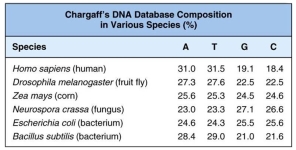
Question
Question
Question
Question
Question
Question
Question
Question
Question
Question
Question
Question
Question
Question
Question
Question
Question
Question
Question
Question
Question
Question

Unlock Deck
Sign up to unlock the cards in this deck!
Unlock Deck
Unlock Deck
1/49

Play

Full screen (f)
Deck 12: Molecular Biology of the Gene
1
Which statement is NOT true about DNA replication in prokaryotes?
A) Replication begins at a single origin of replication.
B) Replication is bidirectional from the origin(s).
C) Replication occurs at about 1 million base pairs per minute.
D) Since bacterial cells replicate so rapidly, a second round of replication may begin before the first has been completed.
E) There are many bacterial chromosomes, with replication occurring in each at the same time.
A) Replication begins at a single origin of replication.
B) Replication is bidirectional from the origin(s).
C) Replication occurs at about 1 million base pairs per minute.
D) Since bacterial cells replicate so rapidly, a second round of replication may begin before the first has been completed.
E) There are many bacterial chromosomes, with replication occurring in each at the same time.
E
2
Which of the following statements is NOT true about the debate over the nature of genetic material?
A) Many scientists believed that DNA was not the genetic material because, with only four types of nucleotides, DNA did not have enough variability to store information.
B) Scientists focused on carbohydrate and protein in their studies of possible genetic material since they knew that genes were on chromosomes and that chromosomes were made of carbohydrate and protein.
C) Many scientists thought that proteins had a greater capacity for storing information because proteins contain 20 amino acids that could be sequenced differently.
D) Some scientists thought that RNA was likely to be the genetic material.
A) Many scientists believed that DNA was not the genetic material because, with only four types of nucleotides, DNA did not have enough variability to store information.
B) Scientists focused on carbohydrate and protein in their studies of possible genetic material since they knew that genes were on chromosomes and that chromosomes were made of carbohydrate and protein.
C) Many scientists thought that proteins had a greater capacity for storing information because proteins contain 20 amino acids that could be sequenced differently.
D) Some scientists thought that RNA was likely to be the genetic material.
B
3
Before Watson and Crick described DNA structure, Linus Pauling proposed a possible model with three strands of support running down the middle and the bases extending out the sides. How did Pauling's model differ from Watson and Crick's?
A) He missed the number of support strands which was two rather than three.
B) The support strands ran along the outside rather than down the center.
C) The bases were paired in the middle rather than sticking out the sides.
D) All of the choices describe how Pauling's model was different than Watson and Crick's model.
A) He missed the number of support strands which was two rather than three.
B) The support strands ran along the outside rather than down the center.
C) The bases were paired in the middle rather than sticking out the sides.
D) All of the choices describe how Pauling's model was different than Watson and Crick's model.
D
4
During DNA replication, the enzyme ___________, catalyzes the elongation of new DNA by adding, to the 3' end of the previous nucleotide, new nucleotides that are complementary to a DNA template.
A) helicase
B) DNA polymerase
C) DNA ligase
D) ATP synthase
A) helicase
B) DNA polymerase
C) DNA ligase
D) ATP synthase
Unlock Deck
Unlock for access to all 49 flashcards in this deck.
Unlock Deck
k this deck
5
An experiment was performed in which DNAase enzyme digestion prevented transformation. This finding
Unlock Deck
Unlock for access to all 49 flashcards in this deck.
Unlock Deck
k this deck
6
Which of the following statements about DNA replication is NOT correct?
A) Unwinding of the DNA molecule occurs as hydrogen bonds break.
B) Replication occurs as each base is paired with another exactly like it.
C) The process is known as semiconservative replication because one old strand is conserved in the new molecule.
D) The enzyme that catalyzes DNA replication is DNA polymerase.
E) Complementary base pairs are held together with hydrogen bonds.
A) Unwinding of the DNA molecule occurs as hydrogen bonds break.
B) Replication occurs as each base is paired with another exactly like it.
C) The process is known as semiconservative replication because one old strand is conserved in the new molecule.
D) The enzyme that catalyzes DNA replication is DNA polymerase.
E) Complementary base pairs are held together with hydrogen bonds.
Unlock Deck
Unlock for access to all 49 flashcards in this deck.
Unlock Deck
k this deck
7
According to Watson and Crick's model, DNA consists of two strands of nucleotides that are antiparallel. What does this mean? What evidence supports the antiparallel nature of the strands?
Unlock Deck
Unlock for access to all 49 flashcards in this deck.
Unlock Deck
k this deck
8
Which statement is NOT true about DNA replication?
A) It proceeds in a 5'-to-3' direction only.
B) One strand of new DNA is replicated faster than the other strand at the replication fork.
C) DNA can only replicate at one point on a chromosome at one time.
D) It occurs more rapidly in bacteria than in eukaryotes.
E) Replication can only begin at a special origin of replication.
A) It proceeds in a 5'-to-3' direction only.
B) One strand of new DNA is replicated faster than the other strand at the replication fork.
C) DNA can only replicate at one point on a chromosome at one time.
D) It occurs more rapidly in bacteria than in eukaryotes.
E) Replication can only begin at a special origin of replication.
Unlock Deck
Unlock for access to all 49 flashcards in this deck.
Unlock Deck
k this deck
9
DNA was shown to be the transforming substance when only the ______ enzymes could inhibit transformation.
A) proteinase
B) RNAase
C) DNAase
D) lipase
A) proteinase
B) RNAase
C) DNAase
D) lipase
Unlock Deck
Unlock for access to all 49 flashcards in this deck.
Unlock Deck
k this deck
10
An experiment was performed that demonstrated that RNAase fails to prevent transformation of the R strain to S strain. This finding
Unlock Deck
Unlock for access to all 49 flashcards in this deck.
Unlock Deck
k this deck
11
Transformation of bacteria was shown to occur when _______ bacteria were injected into mice and the mice _______.
A) live S strain; died
B) live R strain; didn't die
C) live S and R strain; died
D) live R strain and dead S strain; died
E) live S strain and dead R strain; didn't die
A) live S strain; died
B) live R strain; didn't die
C) live S and R strain; died
D) live R strain and dead S strain; died
E) live S strain and dead R strain; didn't die
Unlock Deck
Unlock for access to all 49 flashcards in this deck.
Unlock Deck
k this deck
12
Scientists have created genetically modified organisms (GMOs) by isolating and then transferring the jellyfish gene for green fluorescent protein into pigs, bacteria, plants and mice. The result was bioluminescent organisms! These experiments demonstrate that
A) jellyfish genes may be transferred into other aquatic ectotherms, but not mammals.
B) genes have no difficulty crossing the species barrier.
C) animal genes will not function if transferred into animals.
D) genes can only be transferred to other organisms within the same species.
A) jellyfish genes may be transferred into other aquatic ectotherms, but not mammals.
B) genes have no difficulty crossing the species barrier.
C) animal genes will not function if transferred into animals.
D) genes can only be transferred to other organisms within the same species.
Unlock Deck
Unlock for access to all 49 flashcards in this deck.
Unlock Deck
k this deck
13
The X-ray diffraction photography of Rosalind Franklin and Maurice Wilkins was critical evidence in the study of DNA,
A) indicating that DNA has a double helix structure.
B) showing equal numbers of purines and pyrimidines.
C) showing the bases of DNA were held together by hydrogen bonds.
D) revealing the structure of the deoxyribose sugar.
E) of the location of each adenine, guanine, cytosine, and thymine.
A) indicating that DNA has a double helix structure.
B) showing equal numbers of purines and pyrimidines.
C) showing the bases of DNA were held together by hydrogen bonds.
D) revealing the structure of the deoxyribose sugar.
E) of the location of each adenine, guanine, cytosine, and thymine.
Unlock Deck
Unlock for access to all 49 flashcards in this deck.
Unlock Deck
k this deck
14
If a DNA sample contains 13% adenine, what percentage of the sample contains cytosine?
A) 13%
B) 37%
C) 26%
D) 74%
A) 13%
B) 37%
C) 26%
D) 74%
Unlock Deck
Unlock for access to all 49 flashcards in this deck.
Unlock Deck
k this deck
15
An experiment was performed that demonstrated that the addition of protein-degrading enzyme did not prevent transformation. This finding
Unlock Deck
Unlock for access to all 49 flashcards in this deck.
Unlock Deck
k this deck
16
One of Chargaff's rules states that
A) A + G = T + C.
B) A = C, T = G.
C) A = G, T = C.
D) A + T = G + C.
A) A + G = T + C.
B) A = C, T = G.
C) A = G, T = C.
D) A + T = G + C.
Unlock Deck
Unlock for access to all 49 flashcards in this deck.
Unlock Deck
k this deck
17
Nucleotides contain all of the following except
A) a phosphate group.
B) a 5 - carbon sugar.
C) a nitrogen base.
D) histones.
E) a phosphate and a nitrogen base.
A) a phosphate group.
B) a 5 - carbon sugar.
C) a nitrogen base.
D) histones.
E) a phosphate and a nitrogen base.
Unlock Deck
Unlock for access to all 49 flashcards in this deck.
Unlock Deck
k this deck
18
An experiment was performed that demonstrated that DNA extracted from the S strain bacteria transformed R strain bacteria. This finding
Unlock Deck
Unlock for access to all 49 flashcards in this deck.
Unlock Deck
k this deck
19
In the Watson and Crick model of DNA, the "steps" of the ladder are composed of
A) sugars.
B) a purine and a pyrimidine.
C) two purines.
D) two pyrimidines.
E) a sugar and a phosphate molecule.
A) sugars.
B) a purine and a pyrimidine.
C) two purines.
D) two pyrimidines.
E) a sugar and a phosphate molecule.
Unlock Deck
Unlock for access to all 49 flashcards in this deck.
Unlock Deck
k this deck
20
In an experiment, neither heat-killed R strain nor heat-killed S strain can kill the mice. This finding
Unlock Deck
Unlock for access to all 49 flashcards in this deck.
Unlock Deck
k this deck
21
During the elongation of a polypeptide chain, _________ occurs when the mRNA moves to the next site on the ribosome to read the next codon.
A) translocation
B) transcription
C) translation
D) transference
A) translocation
B) transcription
C) translation
D) transference
Unlock Deck
Unlock for access to all 49 flashcards in this deck.
Unlock Deck
k this deck
22
An unknown chemical is analyzed and found to contain the bases thymine and guanine. This chemical is most likely
A) tRNA.
B) mRNA.
C) DNA.
D) rRNA.
A) tRNA.
B) mRNA.
C) DNA.
D) rRNA.
Unlock Deck
Unlock for access to all 49 flashcards in this deck.
Unlock Deck
k this deck
23
Which is NOT true about the genetic code?
A) Most amino acids have only one codon.
B) It is composed of a triplet code of three bases per codon.
C) It produces 64 different possibilities of base sequences.
D) It was cracked through the use of a cell-free system of enzymes.
E) It contains start and stop codons as instructions.
A) Most amino acids have only one codon.
B) It is composed of a triplet code of three bases per codon.
C) It produces 64 different possibilities of base sequences.
D) It was cracked through the use of a cell-free system of enzymes.
E) It contains start and stop codons as instructions.
Unlock Deck
Unlock for access to all 49 flashcards in this deck.
Unlock Deck
k this deck
24
DNA replication is considered semiconservative because
A) it will create three new, identical strands when finished.
B) it uses the original strand as a template for replication.
C) it always replicates in the 3 to 5 prime direction.
D) it never replicates in the 5 to 3 prime direction.
A) it will create three new, identical strands when finished.
B) it uses the original strand as a template for replication.
C) it always replicates in the 3 to 5 prime direction.
D) it never replicates in the 5 to 3 prime direction.
Unlock Deck
Unlock for access to all 49 flashcards in this deck.
Unlock Deck
k this deck
25
A (an) _______ is a group of three bases on tRNA that is complementary to a specific mRNA codon.
A) codon
B) anticodon
C) poly-A tail
D) cap
A) codon
B) anticodon
C) poly-A tail
D) cap
Unlock Deck
Unlock for access to all 49 flashcards in this deck.
Unlock Deck
k this deck
26
Before the DNA repair enzyme complex has completed its function, approximately how many base-pairs are still improperly matched?
A) 1 in 10,000
B) 1 in 100,000
C) 1 in 1,000,000
D) 1 in 10,000,000
E) 1 in a billion
A) 1 in 10,000
B) 1 in 100,000
C) 1 in 1,000,000
D) 1 in 10,000,000
E) 1 in a billion
Unlock Deck
Unlock for access to all 49 flashcards in this deck.
Unlock Deck
k this deck
27
A sample of Chargaff's data on the DNA base composition in various species is provided. Discuss several conclusions that may be drawn from this data?
Unlock Deck
Unlock for access to all 49 flashcards in this deck.
Unlock Deck
k this deck
28
Ribozymes are RNA molecules that function as enzymes, catalyzing reactions during RNA splicing.
Unlock Deck
Unlock for access to all 49 flashcards in this deck.
Unlock Deck
k this deck
29
After the DNA repair enzymes complex has completed its function, approximately how many base-pairs are still improperly matched in the bacterial genome?
A) 1 in 10,000
B) 1 in 100,000
C) 1 in 1,000,000
D) 1 in 100,000,000
E) 1 in a billion
A) 1 in 10,000
B) 1 in 100,000
C) 1 in 1,000,000
D) 1 in 100,000,000
E) 1 in a billion
Unlock Deck
Unlock for access to all 49 flashcards in this deck.
Unlock Deck
k this deck
30
The correct sequence of events in translation is
A) initiation, termination, elongation.
B) elongation, termination, initiation.
C) termination, elongation, initiation.
D) elongation, initiation, termination.
E) initiation, elongation, termination.
A) initiation, termination, elongation.
B) elongation, termination, initiation.
C) termination, elongation, initiation.
D) elongation, initiation, termination.
E) initiation, elongation, termination.
Unlock Deck
Unlock for access to all 49 flashcards in this deck.
Unlock Deck
k this deck
31
While many body cells only replicate 40 to 60 times, cells that produce certain white blood cells may replicate many more times. It is, therefore, crucial that proofreading and repair occur so that the transfer of biological information is accurate. On the other hand, absolute accuracy in replication of biological information would cancel out mutations that are the raw material of evolution. Why is accuracy in transcription and translation less critical than accuracy in gene replication?
Unlock Deck
Unlock for access to all 49 flashcards in this deck.
Unlock Deck
k this deck
32
Which of the following processes does NOT take place during translation?
A) Growth of a polypeptide chain.
B) Attachment of a ribosome to mRNA.
C) Binding of two tRNA molecules per ribosome.
D) Liberation of polypeptide from the ribosome.
E) Production of mRNA.
A) Growth of a polypeptide chain.
B) Attachment of a ribosome to mRNA.
C) Binding of two tRNA molecules per ribosome.
D) Liberation of polypeptide from the ribosome.
E) Production of mRNA.
Unlock Deck
Unlock for access to all 49 flashcards in this deck.
Unlock Deck
k this deck
33
Transcription is initiated when
A) initiation factors assemble ribosomal subunits, mRNA, and initiator tRNA.
B) RNA polymerase comes to a stop sequence.
C) RNA polymerase binds to a region of DNA called the promoter.
D) new nucleotides are added to an existing strand of nucleotides.
A) initiation factors assemble ribosomal subunits, mRNA, and initiator tRNA.
B) RNA polymerase comes to a stop sequence.
C) RNA polymerase binds to a region of DNA called the promoter.
D) new nucleotides are added to an existing strand of nucleotides.
Unlock Deck
Unlock for access to all 49 flashcards in this deck.
Unlock Deck
k this deck
34
Which statement is NOT true about DNA replication in eukaryotes?
A) Replication of the entire genome takes about ten minutes.
B) A replication fork occurs at each growing point of the replicating chromosome(s).
C) Eukaryotes have many different chromosomes, with replication occurring in each at the same time.
D) Replication occurs at the rate of about 500-5000 base pairs per minute.
E) Multiple sites of replication are present on each chromosome.
A) Replication of the entire genome takes about ten minutes.
B) A replication fork occurs at each growing point of the replicating chromosome(s).
C) Eukaryotes have many different chromosomes, with replication occurring in each at the same time.
D) Replication occurs at the rate of about 500-5000 base pairs per minute.
E) Multiple sites of replication are present on each chromosome.
Unlock Deck
Unlock for access to all 49 flashcards in this deck.
Unlock Deck
k this deck
35
For translation to take place, which of the following would NOT be required to be present?
A) DNA
B) mRNA
C) tRNA-amino acid complex
D) rRNA
E) ribosome
A) DNA
B) mRNA
C) tRNA-amino acid complex
D) rRNA
E) ribosome
Unlock Deck
Unlock for access to all 49 flashcards in this deck.
Unlock Deck
k this deck
36
The first codon to be deciphered was ______, which codes for ________.
A) AAA, proline
B) GGG, alanine
C) UUU, phenylalanine
D) TTT, arginine
E) CCC, glycine
A) AAA, proline
B) GGG, alanine
C) UUU, phenylalanine
D) TTT, arginine
E) CCC, glycine
Unlock Deck
Unlock for access to all 49 flashcards in this deck.
Unlock Deck
k this deck
37
Codons
A) are triplets coding for a single amino acid.
B) are the alphabet of the genetic language.
C) each have only one meaning.
D) All of the choices are correct.
E) Only two of the choices are true.
A) are triplets coding for a single amino acid.
B) are the alphabet of the genetic language.
C) each have only one meaning.
D) All of the choices are correct.
E) Only two of the choices are true.
Unlock Deck
Unlock for access to all 49 flashcards in this deck.
Unlock Deck
k this deck
38
Which of the following would be transcribed into mRNA?
A) a noncoding gene
B) a protein-coding gene
C) a promoter
D) a ribozyme
A) a noncoding gene
B) a protein-coding gene
C) a promoter
D) a ribozyme
Unlock Deck
Unlock for access to all 49 flashcards in this deck.
Unlock Deck
k this deck
39
Which of the following statements concerning ribosomes are true?
A) Several ribosomes are often attached to and translating the same mRNA.
B) Ribosomes join amino acids to form a polypeptide.
C) Ribosomes have a binding site for mRNA and three binding sites for tRNA molecules.
D) No protein synthesis within a cell would occur without ribosomes.
E) All of the above statements are true.
A) Several ribosomes are often attached to and translating the same mRNA.
B) Ribosomes join amino acids to form a polypeptide.
C) Ribosomes have a binding site for mRNA and three binding sites for tRNA molecules.
D) No protein synthesis within a cell would occur without ribosomes.
E) All of the above statements are true.
Unlock Deck
Unlock for access to all 49 flashcards in this deck.
Unlock Deck
k this deck
40
If one strand of DNA has the base sequence AAGCAA, the complementary strand has which of the following sequences?
A) UUCGUU
B) TTCGTT
C) AAGCAA
D) UTCGTU
E) TTCGTG
A) UUCGUU
B) TTCGTT
C) AAGCAA
D) UTCGTU
E) TTCGTG
Unlock Deck
Unlock for access to all 49 flashcards in this deck.
Unlock Deck
k this deck
41
Determine the number of codon sequences it would require to produce the following amino acid sequence: alanine - proline - serine - isoleucine - stop.
A) It would take 5 codon sequences.
B) It would take 3 codon sequences.
C) It would take 6 codon sequences.
D) It would take 4 codon sequences.
A) It would take 5 codon sequences.
B) It would take 3 codon sequences.
C) It would take 6 codon sequences.
D) It would take 4 codon sequences.
Unlock Deck
Unlock for access to all 49 flashcards in this deck.
Unlock Deck
k this deck
42
Growth at two replication forks arising from a single origin of replication produce a "bubble" as daughter DNA molecules form.
Unlock Deck
Unlock for access to all 49 flashcards in this deck.
Unlock Deck
k this deck
43
Telomerase is an enzyme that unwinds DNA during DNA replication.
Unlock Deck
Unlock for access to all 49 flashcards in this deck.
Unlock Deck
k this deck
44
During the replication of DNA, DNA polymerase has to synthesize the daughter strand in the 5' to 3' direction because DNA polymerase can only join nucleotides to the 3' end of the growing new strand.
Unlock Deck
Unlock for access to all 49 flashcards in this deck.
Unlock Deck
k this deck
45
Which of the following amino acid chains would be produced from the mRNA sequence AUACUUCCUAGUUGA?
A) Isoleucine - leucine- proline- serine- stop
B) Isoleucine - leucine- stop - proline- serine
C) Glycine - glutamate - lysine - lysine - stop
D) Isoleucine - alanine- proline- serine- stop
A) Isoleucine - leucine- proline- serine- stop
B) Isoleucine - leucine- stop - proline- serine
C) Glycine - glutamate - lysine - lysine - stop
D) Isoleucine - alanine- proline- serine- stop
Unlock Deck
Unlock for access to all 49 flashcards in this deck.
Unlock Deck
k this deck
46
Which of the following statements applies to the semiconservative nature of DNA replication?
A) The old strands serve as a template for the new strand.
B) The old strand is pulled apart and reformed into the new strand.
C) The new strand serves as a template for the old strand.
D) None of these statements apply to the semiconservative nature of DNA replication.
A) The old strands serve as a template for the new strand.
B) The old strand is pulled apart and reformed into the new strand.
C) The new strand serves as a template for the old strand.
D) None of these statements apply to the semiconservative nature of DNA replication.
Unlock Deck
Unlock for access to all 49 flashcards in this deck.
Unlock Deck
k this deck
47
Write an essay describing the 3 main steps of DNA replication in the correct order. Be sure to include the key structures involved in the process.
Unlock Deck
Unlock for access to all 49 flashcards in this deck.
Unlock Deck
k this deck
48
Which section of the pre-mRNA contains the protein coding regions?
A) exons
B) introns
C) The entire pre-mRNA contains protein coding regions.
D) The pre-mRNA does not code for proteins at all.
A) exons
B) introns
C) The entire pre-mRNA contains protein coding regions.
D) The pre-mRNA does not code for proteins at all.
Unlock Deck
Unlock for access to all 49 flashcards in this deck.
Unlock Deck
k this deck
49
Which of the following polypeptide chain would be sequenced from the mRNA code AGGGAGCCC?
A) arginine - glutamate - proline
B) serine - leucine - proline
C) arginine - glutamate - alanine
D) serine - asparatate - proline
A) arginine - glutamate - proline
B) serine - leucine - proline
C) arginine - glutamate - alanine
D) serine - asparatate - proline
Unlock Deck
Unlock for access to all 49 flashcards in this deck.
Unlock Deck
k this deck
Unlock Deck
Unlock for access to all 49 flashcards in this deck.






