







 Chat with AI

Deck 13: Chemical Equilibrium
Full screen (f)

Question

Question
Determine the equilibrium constant for the system N2O4 ![<strong>Determine the equilibrium constant for the system N<sub>2</sub>O<sub>4</sub> 2NO<sub>2</sub> at 25°C.The concentrations are shown here: [N<sub>2</sub>O<sub>4</sub>] = 2.32 \times 10<sup>-</sup><sup>2</sup> M,[NO<sub>2</sub>] = 1.41 \times 10<sup>-</sup><sup>2</sup> M.</strong> A)0.608 B)1.65 C)1.17 \times 10<sup>2</sup> D)0.369 E)8.57 \times 10<sup>-</sup><sup>3</sup> <div style=padding-top: 35px>](https://d2lvgg3v3hfg70.cloudfront.net/TB6423/11eaa8f0_66f1_c729_93a6_c1001756c14c_TB6423_11.jpg) 2NO2 at 25°C.The concentrations are shown here: [N2O4] = 2.32 10-2 M,[NO2] = 1.41 10-2 M.
2NO2 at 25°C.The concentrations are shown here: [N2O4] = 2.32 10-2 M,[NO2] = 1.41 10-2 M.
A)0.608
B)1.65
C)1.17 102
D)0.369
E)8.57 10-3
2NO2 at 25°C.The concentrations are shown here: [N2O4] = 2.32 10-2 M,[NO2] = 1.41 10-2 M.A)0.608
B)1.65
C)1.17 102
D)0.369
E)8.57 10-3
Question
Apply the law of mass action to determine the equilibrium expression for 2NO2Cl(aq) ![<strong>Apply the law of mass action to determine the equilibrium expression for 2NO<sub>2</sub>Cl(aq) 2NO<sub>2</sub>(aq)+ Cl<sub>2</sub>(aq).</strong> A)K = 2[NO<sub>2</sub>][Cl<sub>2</sub>]/2[NO<sub>2</sub>Cl] B)K = 2[NO<sub>2</sub>Cl]/2[NO<sub>2</sub>][Cl<sub>2</sub>] C)K = [NO<sub>2</sub>Cl]<sup>2</sup>/[NO<sub>2</sub>]<sup>2</sup>[Cl<sub>2</sub>] D)K = [NO<sub>2</sub>]<sup>2</sup>[Cl<sub>2</sub>]/[NO<sub>2</sub>Cl]<sup>2</sup> E)K = [NO<sub>2</sub>Cl]<sup>2</sup>[NO<sub>2</sub>]<sup>2</sup>[Cl<sub>2</sub>] <div style=padding-top: 35px>](https://d2lvgg3v3hfg70.cloudfront.net/TB6423/11eaa8f0_66f1_2adc_93a6_09a41eb8d737_TB6423_11.jpg) 2NO2(aq)+ Cl2(aq).
2NO2(aq)+ Cl2(aq).
A)K = 2[NO2][Cl2]/2[NO2Cl]
B)K = 2[NO2Cl]/2[NO2][Cl2]
C)K = [NO2Cl]2/[NO2]2[Cl2]
D)K = [NO2]2[Cl2]/[NO2Cl]2
E)K = [NO2Cl]2[NO2]2[Cl2]
2NO2(aq)+ Cl2(aq).A)K = 2[NO2][Cl2]/2[NO2Cl]
B)K = 2[NO2Cl]/2[NO2][Cl2]
C)K = [NO2Cl]2/[NO2]2[Cl2]
D)K = [NO2]2[Cl2]/[NO2Cl]2
E)K = [NO2Cl]2[NO2]2[Cl2]
Question
For the reaction N2O4(g)  2NO2(g),Kp = 0.148 at a temperature of 298 K.What is Kp for the following reaction? 10NO2(g)
  5N2O4(g)
A)6.76
B)0.74
C)1.35
D)1.41 104
E)7.10 10-5
2NO2(g),Kp = 0.148 at a temperature of 298 K.What is Kp for the following reaction? 10NO2(g) 5N2O4(g)A)6.76
B)0.74
C)1.35
D)1.41 104
E)7.10 10-5
Question
If,at a given temperature,the equilibrium constant for the reaction H2(g)+ Cl2(g)  2HCl(g)is Kp,then the equilibrium constant for the reaction HCl(g)
  H2(g)+
  Cl2 (g)can be represented as:
A)
B)Kp2
C)
D)
E)none of these
2HCl(g)is Kp,then the equilibrium constant for the reaction HCl(g) H2(g)+ Cl2 (g)can be represented as:A)
B)Kp2
C)
D)
E)none of these
Question
Question
Question
Given the equilibrium constants for the following reactions: 4Cu(s)+ O2(g)  2Cu2O(s),K1
2CuO(s) Cu2O(s)+
  O2(g),K2
What is K for the system
2Cu(s)+ O2(g) 2CuO(s)
Equivalent to?
A)(K1)(K2)
B)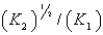
C)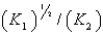
D)
E)
2Cu2O(s),K12CuO(s)
Cu2O(s)+ O2(g),K2What is K for the system
2Cu(s)+ O2(g)
2CuO(s)Equivalent to?
A)(K1)(K2)
B)
C)
D)
E)
Question
Consider the chemical system CO + Cl2  COCl2;K = 4.6 109 L/mol.
-If the concentration of the product were to double,what would happen to the equilibrium constant?
A)It would double its value.
B)It would become half its current value.
C)It would quadruple its value.
D)It would not change its value.
E)It would depend on the initial conditions of the product.
COCl2;K = 4.6 109 L/mol.-If the concentration of the product were to double,what would happen to the equilibrium constant?
A)It would double its value.
B)It would become half its current value.
C)It would quadruple its value.
D)It would not change its value.
E)It would depend on the initial conditions of the product.
Question
For the reaction H2(g)+ Cl2(g)  2HCl(g),Kc = 1.22 1033 at a temperature of 301 K.What is Kp at this temperature?
A)1.22 1033
B)3.01 1034
C)4.93 1031
D)7.43 1035
E)2.00 1030
2HCl(g),Kc = 1.22 1033 at a temperature of 301 K.What is Kp at this temperature?A)1.22 1033
B)3.01 1034
C)4.93 1031
D)7.43 1035
E)2.00 1030
Question
Consider the gaseous reaction CO(g)+ Cl2(g)  COCl2(g).What is the expression for Kp in terms of K?
A)K(RT)
B)K/(RT)
C)K(RT)2
D)K/(RT)2
E)1/K(RT)
COCl2(g).What is the expression for Kp in terms of K?A)K(RT)
B)K/(RT)
C)K(RT)2
D)K/(RT)2
E)1/K(RT)
Question
Question
At a given temperature,K = 0.017 for the equilibrium: PCl5(g)  PCl3(g)+ Cl2(g)
What is K for:
Cl2(g)+ PCl3(g) PCl5(g)?
A)0.017
B)59
C)0.00029
D)17
E)3500
PCl3(g)+ Cl2(g)What is K for:
Cl2(g)+ PCl3(g)
PCl5(g)?A)0.017
B)59
C)0.00029
D)17
E)3500
Question
For the reaction given below,2.00 moles of A and 3.00 moles of B are placed in a 6.00-L container. 

 At equilibrium,the concentration of A is 0.246 mol/L.What is the concentration of B at equilibrium?
A)0.246 mol/L
B)0.325 mol/L
C)0.500 mol/L
D)0.492 mol/L
E)none of these
At equilibrium,the concentration of A is 0.246 mol/L.What is the concentration of B at equilibrium?A)0.246 mol/L
B)0.325 mol/L
C)0.500 mol/L
D)0.492 mol/L
E)none of these
Question
Indicate the mass action expression for the following reaction: 2X(g)+ Y(g) ![<strong>Indicate the mass action expression for the following reaction: 2X(g)+ Y(g) 3W(g)+ V(g)</strong> A)[X]<sup>2</sup>[Y][W]<sup>3</sup>[V] B) C) D) E)none of these <div style=padding-top: 35px>](https://d2lvgg3v3hfg70.cloudfront.net/TB6423/11eaa8f0_66f0_b5a2_93a6_99b5e2c00451_TB6423_11.jpg) 3W(g)+ V(g)
3W(g)+ V(g)
A)[X]2[Y][W]3[V]
B)![<strong>Indicate the mass action expression for the following reaction: 2X(g)+ Y(g) 3W(g)+ V(g)</strong> A)[X]<sup>2</sup>[Y][W]<sup>3</sup>[V] B) C) D) E)none of these <div style=padding-top: 35px>](https://d2lvgg3v3hfg70.cloudfront.net/TB6423/11eaa8f0_66f0_dcb3_93a6_8588873b9cdc_TB6423_11.jpg)
C)![<strong>Indicate the mass action expression for the following reaction: 2X(g)+ Y(g) 3W(g)+ V(g)</strong> A)[X]<sup>2</sup>[Y][W]<sup>3</sup>[V] B) C) D) E)none of these <div style=padding-top: 35px>](https://d2lvgg3v3hfg70.cloudfront.net/TB6423/11eaa8f0_66f0_dcb4_93a6_611a522f6d33_TB6423_11.jpg)
D)![<strong>Indicate the mass action expression for the following reaction: 2X(g)+ Y(g) 3W(g)+ V(g)</strong> A)[X]<sup>2</sup>[Y][W]<sup>3</sup>[V] B) C) D) E)none of these <div style=padding-top: 35px>](https://d2lvgg3v3hfg70.cloudfront.net/TB6423/11eaa8f0_66f0_dcb5_93a6_5b1a1a767800_TB6423_11.jpg)
E)none of these
3W(g)+ V(g)A)[X]2[Y][W]3[V]
B)
C)
D)
E)none of these
Question
Which expression correctly describes the equilibrium constant for the following reaction? 4NH3(g)+ 5O2(g) ![<strong>Which expression correctly describes the equilibrium constant for the following reaction? 4NH<sub>3</sub>(g)+ 5O<sub>2</sub>(g) 4NO(g)+ 6H<sub>2</sub>O(g)</strong> A)K = ( 4NH<sub>3</sub>] + 5[O<sub>2</sub>] )/<sup> </sup>( 4[NO] + 6[H<sub>2</sub>O] ) B)K = ( 4[NO] + 6[H<sub>2</sub>O] )/ (4NH<sub>3</sub>] + 5[O<sub>2</sub>] ) C)K = ( [NO][H<sub>2</sub>O] )/ ( [NH<sub>3</sub>][O<sub>2</sub>] ) D)K = ( [NO]<sup>4</sup>[H<sub>2</sub>O]<sup>6</sup> )/ (<sup> </sup>[[NH<sub>3</sub>]<sup>4</sup>[O<sub>2</sub>]<sup>5 </sup>) E)K = ( [NH<sub>3</sub>]<sup>4</sup>[O<sub>2</sub>]<sup>5</sup> )/ ( [NO]<sup>4</sup>[H<sub>2</sub>O]<sup>6</sup> ) <div style=padding-top: 35px>](https://d2lvgg3v3hfg70.cloudfront.net/TB6423/11eaa8f0_66f1_7907_93a6_d7bb7c62809b_TB6423_11.jpg) 4NO(g)+ 6H2O(g)
4NO(g)+ 6H2O(g)
A)K = ( 4NH3] + 5[O2] )/ ( 4[NO] + 6[H2O] )
B)K = ( 4[NO] + 6[H2O] )/ (4NH3] + 5[O2] )
C)K = ( [NO][H2O] )/ ( [NH3][O2] )
D)K = ( [NO]4[H2O]6 )/ ( [[NH3]4[O2]5 )
E)K = ( [NH3]4[O2]5 )/ ( [NO]4[H2O]6 )
4NO(g)+ 6H2O(g)A)K = ( 4NH3] + 5[O2] )/ ( 4[NO] + 6[H2O] )
B)K = ( 4[NO] + 6[H2O] )/ (4NH3] + 5[O2] )
C)K = ( [NO][H2O] )/ ( [NH3][O2] )
D)K = ( [NO]4[H2O]6 )/ ( [[NH3]4[O2]5 )
E)K = ( [NH3]4[O2]5 )/ ( [NO]4[H2O]6 )
Question
Question
If the equilibrium constant for A + B  C is 0.208,then the equilibrium constant for 2C
  2A + 2B is
A)0.584
B)4.81
C)0.416
D)23.1
E)0.208
C is 0.208,then the equilibrium constant for 2C 2A + 2B isA)0.584
B)4.81
C)0.416
D)23.1
E)0.208
Question
Consider the chemical system CO + Cl2 COCl2;K = 4.6 109 L/mol.
-How do the equilibrium concentrations of the reactants compare to the equilibrium concentration of the product?
A)They are much smaller.
B)They are much bigger.
C)They are about the same.
D)They have to be exactly equal.
E)You can't tell from the information given.
COCl2;K = 4.6 109 L/mol.-How do the equilibrium concentrations of the reactants compare to the equilibrium concentration of the product?
A)They are much smaller.
B)They are much bigger.
C)They are about the same.
D)They have to be exactly equal.
E)You can't tell from the information given.
Question
If K = 0.144 for A2 + 2B  2AB,then for 4AB
  2A2 + 4B,K would equal:
A)0.288
B)0.144
C)-0.144
D)3.47
E)48.2
2AB,then for 4AB 2A2 + 4B,K would equal:A)0.288
B)0.144
C)-0.144
D)3.47
E)48.2
Question
Nitric oxide,an important pollutant in air,is formed from the elements nitrogen and oxygen at high temperatures,such as those obtained when gasoline burns in an automobile engine.At 2000°C,K for the reaction N2(g)+ O2(g)  2NO(g)is 0.01.
Predict the direction in which the system will move to reach equilibrium at 2000°C if 0.4 moles of N2,0.1 moles of O2,and 0.08 moles of NO are placed in a 1.0-liter container.
A)The system remains unchanged.
B)The concentration of NO will decrease;the concentrations of N2 and O2 will increase.
C)The concentration of NO will increase;the concentrations of N2 and O2 will decrease.
D)The concentration of NO will decrease;the concentrations of N2 and O2 will remain unchanged.
E)More information is necessary.
2NO(g)is 0.01.Predict the direction in which the system will move to reach equilibrium at 2000°C if 0.4 moles of N2,0.1 moles of O2,and 0.08 moles of NO are placed in a 1.0-liter container.
A)The system remains unchanged.
B)The concentration of NO will decrease;the concentrations of N2 and O2 will increase.
C)The concentration of NO will increase;the concentrations of N2 and O2 will decrease.
D)The concentration of NO will decrease;the concentrations of N2 and O2 will remain unchanged.
E)More information is necessary.
Question
Question
Consider the reaction: CaCl2(s)+ 2H2O(g) ![<strong>Consider the reaction: CaCl<sub>2</sub>(s)+ 2H<sub>2</sub>O(g) CaCl<sub>2</sub>·2H<sub>2</sub>O(s) The equilibrium constant for the reaction as written is:</strong> A)K = B) C) D)K = [H<sub>2</sub>O]<sup>2</sup> E)K = <div style=padding-top: 35px>](https://d2lvgg3v3hfg70.cloudfront.net/TB6423/11eaa8f0_66f2_ffc2_93a6_4d461e683231_TB6423_11.jpg) CaCl2·2H2O(s)
CaCl2·2H2O(s)
The equilibrium constant for the reaction as written is:
A)K =![<strong>Consider the reaction: CaCl<sub>2</sub>(s)+ 2H<sub>2</sub>O(g) CaCl<sub>2</sub>·2H<sub>2</sub>O(s) The equilibrium constant for the reaction as written is:</strong> A)K = B) C) D)K = [H<sub>2</sub>O]<sup>2</sup> E)K = <div style=padding-top: 35px>](https://d2lvgg3v3hfg70.cloudfront.net/TB6423/11eaa8f0_66f2_ffc3_93a6_17d30fe33073_TB6423_11.jpg)
B)![<strong>Consider the reaction: CaCl<sub>2</sub>(s)+ 2H<sub>2</sub>O(g) CaCl<sub>2</sub>·2H<sub>2</sub>O(s) The equilibrium constant for the reaction as written is:</strong> A)K = B) C) D)K = [H<sub>2</sub>O]<sup>2</sup> E)K = <div style=padding-top: 35px>](https://d2lvgg3v3hfg70.cloudfront.net/TB6423/11eaa8f0_66f2_ffc4_93a6_1f19ec3d6f21_TB6423_11.jpg)
C)![<strong>Consider the reaction: CaCl<sub>2</sub>(s)+ 2H<sub>2</sub>O(g) CaCl<sub>2</sub>·2H<sub>2</sub>O(s) The equilibrium constant for the reaction as written is:</strong> A)K = B) C) D)K = [H<sub>2</sub>O]<sup>2</sup> E)K = <div style=padding-top: 35px>](https://d2lvgg3v3hfg70.cloudfront.net/TB6423/11eaa8f0_66f2_ffc5_93a6_fb2c2b7bda8a_TB6423_11.jpg)
D)K = [H2O]2
E)K =![<strong>Consider the reaction: CaCl<sub>2</sub>(s)+ 2H<sub>2</sub>O(g) CaCl<sub>2</sub>·2H<sub>2</sub>O(s) The equilibrium constant for the reaction as written is:</strong> A)K = B) C) D)K = [H<sub>2</sub>O]<sup>2</sup> E)K = <div style=padding-top: 35px>](https://d2lvgg3v3hfg70.cloudfront.net/TB6423/11eaa8f0_66f2_ffc6_93a6_3b90a050b0ce_TB6423_11.jpg)
CaCl2·2H2O(s)The equilibrium constant for the reaction as written is:
A)K =
B)
C)
D)K = [H2O]2
E)K =
Question
Consider the following reaction: CS2(g)+ 4H2(g)  CH4(g)+ 2H2S(g).The equilibrium constant K is about 0.31 at 900.°C.What is Kp at this temperature?
A)2.9 103
B)3.2 10-3
C)3.3 10-5
D)3.0 101
E)1.1 10-3
CH4(g)+ 2H2S(g).The equilibrium constant K is about 0.31 at 900.°C.What is Kp at this temperature?A)2.9 103
B)3.2 10-3
C)3.3 10-5
D)3.0 101
E)1.1 10-3
Question
For the reaction given below,2.00 moles of A and 3.00 moles of B are placed in a 6.00-L container. A(g)+ 2B(g)  C(g)
C(g)
At equilibrium,the concentration of A is 0.213 mol/L.What is the value of K?
A)2.18
B)1.79
C)0.213
D)8.40
E)0.565
C(g)At equilibrium,the concentration of A is 0.213 mol/L.What is the value of K?
A)2.18
B)1.79
C)0.213
D)8.40
E)0.565
Question
Given the equation 2NOCl2(g)  2NO(g)+ Cl2(g),the equilibrium constant is about 0.0196 at 115°C.Calculate Kp.
A)0.0196
B)0.624
C)0.185
D)19.9
E)none of these
2NO(g)+ Cl2(g),the equilibrium constant is about 0.0196 at 115°C.Calculate Kp.A)0.0196
B)0.624
C)0.185
D)19.9
E)none of these
Question
Find the value of the equilibrium constant (K)(at 500 K)for N2(g)+ 3H2(g)  2NH3(g).The value for Kp at 500 K is 1.5 10-5/atm2.
A)7.5 10-2
B)1.3 10-2
C)9.6 10-2
D)2.5 10-2
E)6.0 10-2
2NH3(g).The value for Kp at 500 K is 1.5 10-5/atm2.A)7.5 10-2
B)1.3 10-2
C)9.6 10-2
D)2.5 10-2
E)6.0 10-2
Question
Consider the reaction: 2SO2(g)+ O2(g)  2SO3(g)at constant temperature.Initially a container is filled with pure SO3(g)at a pressure of 2 atm,after which equilibrium is reached.If y is the partial pressure of O2 at equilibrium,the value of Kp is:
A)
B)
C)
D)
E)none of these
2SO3(g)at constant temperature.Initially a container is filled with pure SO3(g)at a pressure of 2 atm,after which equilibrium is reached.If y is the partial pressure of O2 at equilibrium,the value of Kp is:A)
B)
C)
D)
E)none of these
Question
Calculate Kp for 

 using the following data: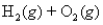

 Kp = 2.3 106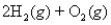

 Kp = 1.8 1037
A)4.1 1043
B)2.1 1043
C)2.9 10-25
D)5.4 10-13
E)9.8 10-13
using the following data: Kp = 2.3 106 Kp = 1.8 1037A)4.1 1043
B)2.1 1043
C)2.9 10-25
D)5.4 10-13
E)9.8 10-13
Question
Consider the reaction 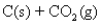

 At 1273 K,the Kp value is 167.5.What is the
  at equilibrium if the
  is 0.17 atm at this temperature?
A)2.7 atm
B)0.085 atm
C)11 atm
D)5.3 atm
E)7.5 atm
At 1273 K,the Kp value is 167.5.What is the at equilibrium if the is 0.17 atm at this temperature?A)2.7 atm
B)0.085 atm
C)11 atm
D)5.3 atm
E)7.5 atm
Question
Consider the following equilibrated system: 2NO2(g)  2NO(g)+ O2(g).If the Kp value is 0.604,find the equilibrium pressure of the O2 gas if the NO2 gas pressure is 0.520 atm and the PNO is 0.300 atm at equilibrium.
A)1.05 atm
B)24.8 atm
C)0.348 atm
D)0.201 atm
E)1.81 atm
2NO(g)+ O2(g).If the Kp value is 0.604,find the equilibrium pressure of the O2 gas if the NO2 gas pressure is 0.520 atm and the PNO is 0.300 atm at equilibrium.A)1.05 atm
B)24.8 atm
C)0.348 atm
D)0.201 atm
E)1.81 atm
Question
Consider the reaction H2 + I2  2HI for which K = 44.8 at a high temperature.If an equimolar mixture of reactants gives the concentration of the product to be 0.50 M at equilibrium,determine the equilibrium concentration of the hydrogen.
A)1.1 10-1 M
B)7.5 10-2 M
C)3.7 10-2 M
D)1.3 101 M
E)5.6 10-3 M
2HI for which K = 44.8 at a high temperature.If an equimolar mixture of reactants gives the concentration of the product to be 0.50 M at equilibrium,determine the equilibrium concentration of the hydrogen.A)1.1 10-1 M
B)7.5 10-2 M
C)3.7 10-2 M
D)1.3 101 M
E)5.6 10-3 M
Question
Consider the following equilibrium: H2(g)+ I2(s)  2HI(g)
The proper Keq expression is:
A)
B)
C)
D)
E)
2HI(g)The proper Keq expression is:
A)
B)
C)
D)
E)
Question
Question
For the reaction NO(g)+  O2(g)
O2(g)  NO2(g)at 750°C,the equilibrium constant Kc equals:
A)1.0
B)Kp
C)
D)
E)
O2(g) NO2(g)at 750°C,the equilibrium constant Kc equals:A)1.0
B)Kp
C)
D)
E)
Question
Question
A 10.0-g sample of solid NH4Cl is heated in a 5.00-L container to 900.°C.At equilibrium the pressure of NH3(g)is 1.51 atm. NH4Cl(s)  NH3(g)+ HCl(g)
The equilibrium constant,Kp,for the reaction is:
A)1.51
B)2.28
C)3.02
D)8.21
E)none of these
NH3(g)+ HCl(g)The equilibrium constant,Kp,for the reaction is:
A)1.51
B)2.28
C)3.02
D)8.21
E)none of these
Question
An equilibrium reaction,A2(g)+ 3B2(g)  2C(g),has a Kp at 225°C of 2.6 10-3 /atm2.What is K for this reaction at that temperature?
A)1.6 10-6
B)7.6 10-6
C)4.3
D)6.4 10-5
E)0.89
2C(g),has a Kp at 225°C of 2.6 10-3 /atm2.What is K for this reaction at that temperature?A)1.6 10-6
B)7.6 10-6
C)4.3
D)6.4 10-5
E)0.89
Question
Consider the following reaction: 2HF(g)  H2(g)+ F2(g)(K = 1.00
  10-2)
10-2)
Given 1.00 mole of HF(g),0.362 mole of H2(g),and 0.750 mole of F2(g)are mixed in a 5.00 L flask,determine the reaction quotient,Q.
A)Q = 0.0543
B)Q = 0.272
C)Q = 0.0679
D)Q = 2.11
E)none of these
H2(g)+ F2(g)(K = 1.00 10-2)Given 1.00 mole of HF(g),0.362 mole of H2(g),and 0.750 mole of F2(g)are mixed in a 5.00 L flask,determine the reaction quotient,Q.
A)Q = 0.0543
B)Q = 0.272
C)Q = 0.0679
D)Q = 2.11
E)none of these
Question
Question
Consider the following reaction (assume an ideal gas mixture): 2NOBr(g)  2NO(g)+ Br2(g)A 1.0-liter vessel was initially filled with pure NOBr,at a pressure of 4.0 atm,at 300 K.
After equilibrium was established,the partial pressure of NOBr was 3.1 atm.What is Kp for the reaction?
A)0.26
B)0.038
C)0.13
D)0.45
E)none of these
2NO(g)+ Br2(g)A 1.0-liter vessel was initially filled with pure NOBr,at a pressure of 4.0 atm,at 300 K.After equilibrium was established,the partial pressure of NOBr was 3.1 atm.What is Kp for the reaction?
A)0.26
B)0.038
C)0.13
D)0.45
E)none of these
Question
Question
Carbon disulfide and chlorine react according to the following equation: CS2(g)+ 3Cl2(g)  S2Cl2(g)+ CCl4(g)
When 2.14 mol of CS2 and 5.85 mol of Cl2 are placed in a 2.00-L container and allowed to come to equilibrium,the mixture is found to contain 0.620 mol of CCl4.How many moles of Cl2 are present at equilibrium?
A)1.520 mol
B)0.620 mol
C)3.99 mol
D)4.61 mol
E)2.00 mol
S2Cl2(g)+ CCl4(g)When 2.14 mol of CS2 and 5.85 mol of Cl2 are placed in a 2.00-L container and allowed to come to equilibrium,the mixture is found to contain 0.620 mol of CCl4.How many moles of Cl2 are present at equilibrium?
A)1.520 mol
B)0.620 mol
C)3.99 mol
D)4.61 mol
E)2.00 mol
Question
The reaction: H2(g)+ I2(g)  2HI(g)
Has Kp = 45.9 at 763 K.A particular equilibrium mixture at that temperature contains gaseous HI at a partial pressure of 4.00 atm and hydrogen gas at a partial pressure of 0.213 atm.What is the partial pressure of I2?
A)0.213 atm
B)0.409 atm
C)1.64 atm
D)10.9 atm
E)75.1 atm
2HI(g)Has Kp = 45.9 at 763 K.A particular equilibrium mixture at that temperature contains gaseous HI at a partial pressure of 4.00 atm and hydrogen gas at a partial pressure of 0.213 atm.What is the partial pressure of I2?
A)0.213 atm
B)0.409 atm
C)1.64 atm
D)10.9 atm
E)75.1 atm
Question
Question
A sample of solid NH4NO3 was placed in an evacuated container and then heated so that it decomposed explosively according to the following equation: NH4NO3(s)  N2O(g)+ 2H2O(g)
At equilibrium the total pressure in the container was found to be 2.63 atm at a temperature of 500.°C.Calculate Kp.
A)0.769
B)1.54
C)0.674
D)2.70
E)72.8
N2O(g)+ 2H2O(g)At equilibrium the total pressure in the container was found to be 2.63 atm at a temperature of 500.°C.Calculate Kp.
A)0.769
B)1.54
C)0.674
D)2.70
E)72.8
Question
Consider the equation A(aq)+ 2B(aq)  3C(aq)+ 2D(aq).In one experiment,45.0 mL of 0.050 M A is mixed with 25.0 mL 0.100 M B.At equilibrium the concentration of C is 0.0410 M.Calculate K.
A)7.3
B)0.34
C)0.040
D)0.14
E)none of these
3C(aq)+ 2D(aq).In one experiment,45.0 mL of 0.050 M A is mixed with 25.0 mL 0.100 M B.At equilibrium the concentration of C is 0.0410 M.Calculate K.A)7.3
B)0.34
C)0.040
D)0.14
E)none of these
Question
A 3.00-liter flask initially contains 3.00 mol of gas A and 1.50 mol of gas B.Gas A decomposes according to the following reaction: 3A  2B + C
The equilibrium concentration of gas C is 0.119 mol/L.Determine the equilibrium concentration of gas B.
A)0.119 M
B)0.619 M
C)0.738 M
D)0.262 M
E)0.238 M
2B + CThe equilibrium concentration of gas C is 0.119 mol/L.Determine the equilibrium concentration of gas B.
A)0.119 M
B)0.619 M
C)0.738 M
D)0.262 M
E)0.238 M
Question
Consider the following reaction (assume an ideal gas mixture): 2NOBr(g) 2NO(g)+ Br2(g)A 1.0-liter vessel was initially filled with pure NOBr,at a pressure of 4.0 atm,at 300 K.
After equilibrium was reached,the volume was increased to 2.0 liters,while the temperature was kept at 300 K.The result of this change was
A)an increase in Kp
B)a decrease in Kp
C)a shift in the equilibrium position to the right
D)a shift in the equilibrium position to the left
E)none of these
2NO(g)+ Br2(g)A 1.0-liter vessel was initially filled with pure NOBr,at a pressure of 4.0 atm,at 300 K.After equilibrium was reached,the volume was increased to 2.0 liters,while the temperature was kept at 300 K.The result of this change was
A)an increase in Kp
B)a decrease in Kp
C)a shift in the equilibrium position to the right
D)a shift in the equilibrium position to the left
E)none of these
Question
Consider the following equilibrium: 2NOCl(g)  2NO(g)+ Cl2(g)with K = 1.6 10-5.In an experiment,1.00 mole of pure NOCl and 1.00 mole of pure Cl2 are placed in a 1.00-L container.
-If x moles of NOCl react,what is the equilibrium concentration of NO?
A)x
B)2x
C)-x
D)-2x
E)x2
2NO(g)+ Cl2(g)with K = 1.6 10-5.In an experiment,1.00 mole of pure NOCl and 1.00 mole of pure Cl2 are placed in a 1.00-L container.-If x moles of NOCl react,what is the equilibrium concentration of NO?
A)x
B)2x
C)-x
D)-2x
E)x2
Question
Question
Question
Initially 2.0 moles of N2(g)and 4.0 moles of H2(g)were added to a 1.0-liter container and the following reaction then occurred: 3H2(g)+ N2(g)  2NH3(g)
The equilibrium concentration of NH3(g)= 0.55 moles/liter at 700.°C.The value for K at 700.°C for the formation of ammonia is:
A)1.0 10-1
B)5.5 10-2
C)5.5 10-3
D)3.0 10-1
E)none of these
2NH3(g)The equilibrium concentration of NH3(g)= 0.55 moles/liter at 700.°C.The value for K at 700.°C for the formation of ammonia is:
A)1.0 10-1
B)5.5 10-2
C)5.5 10-3
D)3.0 10-1
E)none of these
Question
A mixture of nitrogen and hydrogen was allowed to come to equilibrium at a given temperature. 3H2 + N2  2NH3
2NH3
An analysis of the mixture at equilibrium revealed 2.1 mol N2,3.2 mol H2,and 1.8 mol NH3.How many moles of H2 were present at the beginning of the reaction?
A)3.2
B)4.8
C)5.0
D)5.9
E)4.4
2NH3An analysis of the mixture at equilibrium revealed 2.1 mol N2,3.2 mol H2,and 1.8 mol NH3.How many moles of H2 were present at the beginning of the reaction?
A)3.2
B)4.8
C)5.0
D)5.9
E)4.4
Question
Given the equation 2A(g)  2B(g)+ C(g).At a particular temperature,K = 1.6 104.
-If you mixed 5.0 mol B,0.10 mol C,and 0.0010 mol A in a one-liter container,which direction would the reaction initially proceed?
A)To the left.
B)To the right.
C)The above mixture is the equilibrium mixture.
D)Cannot tell from the information given.
E)None of these (A-D).
2B(g)+ C(g).At a particular temperature,K = 1.6 104.-If you mixed 5.0 mol B,0.10 mol C,and 0.0010 mol A in a one-liter container,which direction would the reaction initially proceed?
A)To the left.
B)To the right.
C)The above mixture is the equilibrium mixture.
D)Cannot tell from the information given.
E)None of these (A-D).
Question
A 3.00-liter flask initially contains 3.00 mol of gas A and 1.50 mol of gas B.Gas A decomposes according to the following reaction: 3A  2B + C
The equilibrium concentration of gas C is 0.115 mol/L.Determine the equilibrium concentration of gas A.
A)0.115 M
B)0.655 M
C)0.730 M
D)0.885 M
E)0.345 M
2B + CThe equilibrium concentration of gas C is 0.115 mol/L.Determine the equilibrium concentration of gas A.
A)0.115 M
B)0.655 M
C)0.730 M
D)0.885 M
E)0.345 M
Question
A 3.00-liter flask initially contains 3.00 mol of gas A and 1.50 mol of gas B.Gas A decomposes according to the following reaction: 3A  2B + C
The equilibrium concentration of gas C is 0.146 mol/L.Determine the value of the equilibrium constant,K.
A)0.206
B)0.163
C)3.84 10-3
D)0.516
E)none of these
2B + CThe equilibrium concentration of gas C is 0.146 mol/L.Determine the value of the equilibrium constant,K.
A)0.206
B)0.163
C)3.84 10-3
D)0.516
E)none of these
Question
For the equilibrium system: CO2(g)+ H2(g)  CO(g)+ H2O(g)
  H = +42 kJ/mol
K equals 1.6 at 1260 K.If 0.15 mol each of CO2,H2,CO,and H2O (all at 1260 K)were placed in a 1.0-L thermally insulated vessel that was also at 1260 K,then as the system came to equilibrium:
A)The temperature would decrease and the mass of CO2 would increase.
B)The temperature would decrease and the mass of CO2 would decrease.
C)The temperature would remain constant and the mass of CO2 would increase.
D)The temperature would increase and the mass of CO2 would increase.
E)The temperature would increase and the mass of CO2 would decrease.
CO(g)+ H2O(g) H = +42 kJ/molK equals 1.6 at 1260 K.If 0.15 mol each of CO2,H2,CO,and H2O (all at 1260 K)were placed in a 1.0-L thermally insulated vessel that was also at 1260 K,then as the system came to equilibrium:
A)The temperature would decrease and the mass of CO2 would increase.
B)The temperature would decrease and the mass of CO2 would decrease.
C)The temperature would remain constant and the mass of CO2 would increase.
D)The temperature would increase and the mass of CO2 would increase.
E)The temperature would increase and the mass of CO2 would decrease.
Question
CS2(g)+ 3Cl2(g) ![<strong>CS<sub>2</sub>(g)+ 3Cl<sub>2</sub>(g) CCl<sub>4</sub>(g)+ S<sub>2</sub>Cl<sub>2</sub>(g) At a given temperature,the reaction above is at equilibrium when [CS<sub>2</sub>] = 0.050 M,[Cl<sub>2</sub>] = 0.25 M,[CCl<sub>4</sub>] = 0.15 M,and [S<sub>2</sub>Cl<sub>2</sub>] = 0.35 M.What would be the direction of the reaction when the reactants and products have the following concentrations: CS<sub>2</sub> = 0.15 M,Cl<sub>2</sub> = 0.18 M,CCl<sub>4</sub> = 0.29 M,and S<sub>2</sub>Cl<sub>2</sub> = 0.21 M?</strong> A)to the right B)to the left C)no change D)cannot predict unless we know the temperature E)cannot predict unless we know whether the reaction is endothermic or exothermic <div style=padding-top: 35px>](https://d2lvgg3v3hfg70.cloudfront.net/TB6423/11eaa8f0_66f4_8682_93a6_59b9b0b8dc7e_TB6423_11.jpg) CCl4(g)+ S2Cl2(g) At a given temperature,the reaction above is at equilibrium when [CS2] = 0.050 M,[Cl2] = 0.25 M,[CCl4] = 0.15 M,and [S2Cl2] = 0.35 M.What would be the direction of the reaction when the reactants and products have the following concentrations: CS2 = 0.15 M,Cl2 = 0.18 M,CCl4 = 0.29 M,and S2Cl2 = 0.21 M?
CCl4(g)+ S2Cl2(g) At a given temperature,the reaction above is at equilibrium when [CS2] = 0.050 M,[Cl2] = 0.25 M,[CCl4] = 0.15 M,and [S2Cl2] = 0.35 M.What would be the direction of the reaction when the reactants and products have the following concentrations: CS2 = 0.15 M,Cl2 = 0.18 M,CCl4 = 0.29 M,and S2Cl2 = 0.21 M?
A)to the right
B)to the left
C)no change
D)cannot predict unless we know the temperature
E)cannot predict unless we know whether the reaction is endothermic or exothermic
CCl4(g)+ S2Cl2(g) At a given temperature,the reaction above is at equilibrium when [CS2] = 0.050 M,[Cl2] = 0.25 M,[CCl4] = 0.15 M,and [S2Cl2] = 0.35 M.What would be the direction of the reaction when the reactants and products have the following concentrations: CS2 = 0.15 M,Cl2 = 0.18 M,CCl4 = 0.29 M,and S2Cl2 = 0.21 M?A)to the right
B)to the left
C)no change
D)cannot predict unless we know the temperature
E)cannot predict unless we know whether the reaction is endothermic or exothermic
Question
The following reaction is investigated (assume an ideal gas mixture): 2N2O(g)+ N2H4(g)  3N2(g)+ 2H2O(g)
Initially there are 0.10 moles of N2O and 0.25 moles of N2H4,in a 10.0-L container.If there are 0.048 moles of N2O at equilibrium,how many moles of N2 are present at equilibrium?
A)2.6 10-2
B)5.2 10-2
C)7.8 10-2
D)1.6 10-1
E)none of these
3N2(g)+ 2H2O(g)Initially there are 0.10 moles of N2O and 0.25 moles of N2H4,in a 10.0-L container.If there are 0.048 moles of N2O at equilibrium,how many moles of N2 are present at equilibrium?
A)2.6 10-2
B)5.2 10-2
C)7.8 10-2
D)1.6 10-1
E)none of these
Question
The following questions refer to the equilibrium shown here: 4NH3(g)+ 5O2(g)  4NO(g)+ 6H2O(g)
What would happen to the system if oxygen were added?
A)More ammonia would be produced.
B)More oxygen would be produced.
C)The equilibrium would shift to the right.
D)The equilibrium would shift to the left.
E)Nothing would happen.
4NO(g)+ 6H2O(g)What would happen to the system if oxygen were added?
A)More ammonia would be produced.
B)More oxygen would be produced.
C)The equilibrium would shift to the right.
D)The equilibrium would shift to the left.
E)Nothing would happen.
Question
The equilibrium system 2A  2B + C has a very small equilibrium constant: K = 2.6 10-6. Initially 3.0 moles of A are placed in a 1.5-L flask.Determine the concentration of C at equilibrium.
A)0.011 M
B)0.024 M
C)0.032 M
D)0.048 M
E)2.0 M
2B + C has a very small equilibrium constant: K = 2.6 10-6. Initially 3.0 moles of A are placed in a 1.5-L flask.Determine the concentration of C at equilibrium.A)0.011 M
B)0.024 M
C)0.032 M
D)0.048 M
E)2.0 M
Question
The questions below refer to the following system:
Co(H2O)62+ + 4 Cl- CoCl42- + 6H2O
(pink)
(blue)
When cobalt(II)chloride is added to pure water,the Co2+ ions hydrate.The hydrated form then reacts with the Cl- ions to set up the equilibrium shown here.
Which statement below describes the change that the system will undergo if water is added?
A)More chloride ions will be produced.
B)More water will be produced.
C)The equilibrium will shift to the right.
D)The color will become more blue.
E)There will be less of the hydrated cobalt ion at the new equilibrium position.
Co(H2O)62+ + 4 Cl-
CoCl42- + 6H2O(pink)
(blue)
When cobalt(II)chloride is added to pure water,the Co2+ ions hydrate.The hydrated form then reacts with the Cl- ions to set up the equilibrium shown here.
Which statement below describes the change that the system will undergo if water is added?
A)More chloride ions will be produced.
B)More water will be produced.
C)The equilibrium will shift to the right.
D)The color will become more blue.
E)There will be less of the hydrated cobalt ion at the new equilibrium position.
Question
Question
Question
At a certain temperature K for the reaction 2NO2  N2O4 is 7.5 liters/mole.If 2.0 moles of NO2 are placed in a 2.0-liter container and permitted to react at this temperature,calculate the concentration of N2O4 at equilibrium.
A)0.39 moles/liter
B)0.65 moles/liter
C)0.82 moles/liter
D)7.5 moles/liter
E)none of these
N2O4 is 7.5 liters/mole.If 2.0 moles of NO2 are placed in a 2.0-liter container and permitted to react at this temperature,calculate the concentration of N2O4 at equilibrium.A)0.39 moles/liter
B)0.65 moles/liter
C)0.82 moles/liter
D)7.5 moles/liter
E)none of these
Question
Consider the following equilibrium: 2NOCl(g)  2NO(g)+ Cl2(g)
With K = 1.6 10-5.1.00 mole of pure NOCl and 0.964 mole of pure Cl2 are placed in a 1.00-L container.Calculate the equilibrium concentration of Cl2(g).
A)1.6 10-5 M
B)0.966 M
C)0.483 M
D)2.04 10-3 M
E)4.07 10-3 M
2NO(g)+ Cl2(g)With K = 1.6 10-5.1.00 mole of pure NOCl and 0.964 mole of pure Cl2 are placed in a 1.00-L container.Calculate the equilibrium concentration of Cl2(g).
A)1.6 10-5 M
B)0.966 M
C)0.483 M
D)2.04 10-3 M
E)4.07 10-3 M
Question
Ammonia is prepared industrially by the reaction: N2(g)+ 3H2(g)  2NH3(g)for the reaction: H° = -92.2 kJ and K (at 25°C)= 4.0 108.When the temperature of the reaction is increased to 500°C,which of the following is true?
A)K for the reaction will be larger at 500°C than at 25°C.
B)At equilibrium,more NH3 is present at 500°C than at 25°C.
C)Product formation (at equilibrium)is not favored as the temperature is raised.
D)The reaction of N2 with H2 to form ammonia is endothermic.
E)None of the above is true.
2NH3(g)for the reaction: H° = -92.2 kJ and K (at 25°C)= 4.0 108.When the temperature of the reaction is increased to 500°C,which of the following is true?A)K for the reaction will be larger at 500°C than at 25°C.
B)At equilibrium,more NH3 is present at 500°C than at 25°C.
C)Product formation (at equilibrium)is not favored as the temperature is raised.
D)The reaction of N2 with H2 to form ammonia is endothermic.
E)None of the above is true.
Question
At 500.0 K,one mole of gaseous ONCl is placed in a one-liter container.At equilibrium it is 5.3% dissociated according to the equation shown here: 2ONCl  2NO + Cl2.Determine the equilibrium constant.
A)8.3 10-5
B)1.6 10-3
C)5.6 10-2
D)9.5 10-1
E)1.2 104
2NO + Cl2.Determine the equilibrium constant.A)8.3 10-5
B)1.6 10-3
C)5.6 10-2
D)9.5 10-1
E)1.2 104
Question
For the reaction below,Kp = 1.16 at 800.°C. CaCO3(s)  CaO(s)+ CO2(g)
If a 31.3-gram sample of CaCO3 is put into a 10.0-L container and heated to 800.°C,what percent of the CaCO3 will react to reach equilibrium?
A)21.8%
B)42.1%
C)56.5%
D)100.0%
E)none of these
CaO(s)+ CO2(g)If a 31.3-gram sample of CaCO3 is put into a 10.0-L container and heated to 800.°C,what percent of the CaCO3 will react to reach equilibrium?
A)21.8%
B)42.1%
C)56.5%
D)100.0%
E)none of these
Question
Consider the following equilibrium: 2NOCl(g) 2NO(g)+ Cl2(g)with K = 1.6 10-5.In an experiment,1.00 mole of pure NOCl and 1.00 mole of pure Cl2 are placed in a 1.00-L container.
-If x moles of NOCl react,what is the equilibrium concentration of Cl2?
A)x
B) x
x
C)1 + x
D)1 + x
x
E)1 + 2x
2NO(g)+ Cl2(g)with K = 1.6 10-5.In an experiment,1.00 mole of pure NOCl and 1.00 mole of pure Cl2 are placed in a 1.00-L container.-If x moles of NOCl react,what is the equilibrium concentration of Cl2?
A)x
B)
xC)1 + x
D)1 +
xE)1 + 2x
Question
Consider the following equilibrium: 2NOCl(g)  2NO(g)+ Cl2(g)
With K = 1.6 10-5.1.00 mole of pure NOCl and 0.958 mole of pure Cl2 are placed in a 1.00-L container.Calculate the equilibrium concentration of NO(g).
A)2.04 10-3 M
B)9.58 10-1 M
C)1.04 M
D)5.78 10-3 M
E)4.09 10-3 M
2NO(g)+ Cl2(g)With K = 1.6 10-5.1.00 mole of pure NOCl and 0.958 mole of pure Cl2 are placed in a 1.00-L container.Calculate the equilibrium concentration of NO(g).
A)2.04 10-3 M
B)9.58 10-1 M
C)1.04 M
D)5.78 10-3 M
E)4.09 10-3 M
Question
Consider the following equilibrium: 2H2(g)+ X2(g) ![<strong>Consider the following equilibrium: 2H<sub>2</sub>(g)+ X<sub>2</sub>(g) 2H<sub>2</sub>X(g)+ energy Addition of X<sub>2</sub> to a system described by the above equilibrium</strong> A)will cause [H<sub>2</sub>] to decrease B)will cause [X<sub>2</sub>] to decrease C)will cause [H<sub>2</sub>X] to decrease D)will have no effect E)cannot possibly be carried out <div style=padding-top: 35px>](https://d2lvgg3v3hfg70.cloudfront.net/TB6423/11eaa8f0_66f6_5b5b_93a6_6b625652518e_TB6423_11_TB6423_11.jpg) 2H2X(g)+ energy
2H2X(g)+ energy
Addition of X2 to a system described by the above equilibrium
A)will cause [H2] to decrease
B)will cause [X2] to decrease
C)will cause [H2X] to decrease
D)will have no effect
E)cannot possibly be carried out
2H2X(g)+ energyAddition of X2 to a system described by the above equilibrium
A)will cause [H2] to decrease
B)will cause [X2] to decrease
C)will cause [H2X] to decrease
D)will have no effect
E)cannot possibly be carried out
Question
Consider the following equilibrium: 2H2(g)+ X2(g) 2H2X(g)+ energy
Addition of argon to the above equilibrium
A)will cause [H2] to decrease
B)will cause [X2] to increase
C)will cause [H2X] to increase
D)will have no effect
E)cannot possibly be carried out
2H2X(g)+ energyAddition of argon to the above equilibrium
A)will cause [H2] to decrease
B)will cause [X2] to increase
C)will cause [H2X] to increase
D)will have no effect
E)cannot possibly be carried out
Question
Exactly 1.0 mol N2O4 is placed in an empty 1.0-L container and is allowed to reach equilibrium described by the equation N2O4(g)  2NO2(g) If at equilibrium the N2O4 is 37% dissociated,what is the value of the equilibrium constant,Kc,for the reaction under these conditions?
A)1.2
B)0.87
C)1.20
D)0.55
E)0.22
2NO2(g) If at equilibrium the N2O4 is 37% dissociated,what is the value of the equilibrium constant,Kc,for the reaction under these conditions?A)1.2
B)0.87
C)1.20
D)0.55
E)0.22
Question
The following questions refer to the equilibrium shown here: 4NH3(g)+ 5O2(g) 4NO(g)+ 6H2O(g)
What would happen to the system if the pressure were decreased?
A)Nothing would happen.
B)More oxygen would be produced.
C)The water vapor would become liquid water.
D)The ammonia concentration would increase.
E)The NO concentration would increase.
4NO(g)+ 6H2O(g)What would happen to the system if the pressure were decreased?
A)Nothing would happen.
B)More oxygen would be produced.
C)The water vapor would become liquid water.
D)The ammonia concentration would increase.
E)The NO concentration would increase.
Question
Question
The questions below refer to the following system:
Co(H2O)62+ + 4 Cl- CoCl42- + 6H2O
(pink)
(blue)
When cobalt(II)chloride is added to pure water,the Co2+ ions hydrate.The hydrated form then reacts with the Cl- ions to set up the equilibrium shown here.
Which statement below describes the change that the system will undergo if hydrochloric acid is added?
A)It should become more blue.
B)It should become more pink.
C)The equilibrium will shift to the right.
D)The equilibrium will shift to the left.
E)Two of these.
Co(H2O)62+ + 4 Cl-
CoCl42- + 6H2O(pink)
(blue)
When cobalt(II)chloride is added to pure water,the Co2+ ions hydrate.The hydrated form then reacts with the Cl- ions to set up the equilibrium shown here.
Which statement below describes the change that the system will undergo if hydrochloric acid is added?
A)It should become more blue.
B)It should become more pink.
C)The equilibrium will shift to the right.
D)The equilibrium will shift to the left.
E)Two of these.
Question
At -80°C,K for the reaction N2O4(g)  2NO2(g)
Is 4.66 10-8.We introduce 0.047 mole of N2O4 into a 1.0-L vessel at -80°C and let equilibrium be established.The total pressure in the system at equilibrium will be:
A)0.31 atm
B)0.74 atm
C)1.4 atm
D)0.047 atm
E)none of these
2NO2(g)Is 4.66 10-8.We introduce 0.047 mole of N2O4 into a 1.0-L vessel at -80°C and let equilibrium be established.The total pressure in the system at equilibrium will be:
A)0.31 atm
B)0.74 atm
C)1.4 atm
D)0.047 atm
E)none of these
Question
The questions below refer to the following system:
Co(H2O)62+ + 4 Cl- CoCl42- + 6H2O
(pink)
(blue)
When cobalt(II)chloride is added to pure water,the Co2+ ions hydrate.The hydrated form then reacts with the Cl- ions to set up the equilibrium shown here.
Which statement below describes the change that the system will undergo if silver nitrate is added?
A)It should become more blue.
B)It should become more pink.
C)Water will be produced.
D)The silver ion will react with the CoCl42-.
E)Nothing will change.
Co(H2O)62+ + 4 Cl-
CoCl42- + 6H2O(pink)
(blue)
When cobalt(II)chloride is added to pure water,the Co2+ ions hydrate.The hydrated form then reacts with the Cl- ions to set up the equilibrium shown here.
Which statement below describes the change that the system will undergo if silver nitrate is added?
A)It should become more blue.
B)It should become more pink.
C)Water will be produced.
D)The silver ion will react with the CoCl42-.
E)Nothing will change.

Unlock Deck
Sign up to unlock the cards in this deck!
Unlock Deck
Unlock Deck
1/87

Play

Full screen (f)
Deck 13: Chemical Equilibrium
1
The value of the equilibrium constant,K,is dependent on:
I.the temperature of the system
II.the nature of the reactants and products
III.the concentration of the reactants
IV.the concentration of the products
A)I,II
B)II,III
C)III,IV
D)It is dependent on three of the above choices.
E)It is not dependent on any of the above choices.
I.the temperature of the system
II.the nature of the reactants and products
III.the concentration of the reactants
IV.the concentration of the products
A)I,II
B)II,III
C)III,IV
D)It is dependent on three of the above choices.
E)It is not dependent on any of the above choices.
I,II
2
Determine the equilibrium constant for the system N2O4 2NO2 at 25°C.The concentrations are shown here: [N2O4] = 2.32 10-2 M,[NO2] = 1.41 10-2 M.
A)0.608
B)1.65
C)1.17 102
D)0.369
E)8.57 10-3
2NO2 at 25°C.The concentrations are shown here: [N2O4] = 2.32 10-2 M,[NO2] = 1.41 10-2 M.A)0.608
B)1.65
C)1.17 102
D)0.369
E)8.57 10-3
8.57 10-3
3
Apply the law of mass action to determine the equilibrium expression for 2NO2Cl(aq) 2NO2(aq)+ Cl2(aq).
A)K = 2[NO2][Cl2]/2[NO2Cl]
B)K = 2[NO2Cl]/2[NO2][Cl2]
C)K = [NO2Cl]2/[NO2]2[Cl2]
D)K = [NO2]2[Cl2]/[NO2Cl]2
E)K = [NO2Cl]2[NO2]2[Cl2]
2NO2(aq)+ Cl2(aq).A)K = 2[NO2][Cl2]/2[NO2Cl]
B)K = 2[NO2Cl]/2[NO2][Cl2]
C)K = [NO2Cl]2/[NO2]2[Cl2]
D)K = [NO2]2[Cl2]/[NO2Cl]2
E)K = [NO2Cl]2[NO2]2[Cl2]
K = [NO2]2[Cl2]/[NO2Cl]2
4
For the reaction N2O4(g) 2NO2(g),Kp = 0.148 at a temperature of 298 K.What is Kp for the following reaction? 10NO2(g) 5N2O4(g)
A)6.76
B)0.74
C)1.35
D)1.41 104
E)7.10 10-5
2NO2(g),Kp = 0.148 at a temperature of 298 K.What is Kp for the following reaction? 10NO2(g) 5N2O4(g)A)6.76
B)0.74
C)1.35
D)1.41 104
E)7.10 10-5
Unlock Deck
Unlock for access to all 87 flashcards in this deck.
Unlock Deck
k this deck
5
If,at a given temperature,the equilibrium constant for the reaction H2(g)+ Cl2(g) 2HCl(g)is Kp,then the equilibrium constant for the reaction HCl(g) H2(g)+ Cl2 (g)can be represented as:
A)
B)Kp2
C)
D)
E)none of these
2HCl(g)is Kp,then the equilibrium constant for the reaction HCl(g) H2(g)+ Cl2 (g)can be represented as:A)
B)Kp2
C)
D)
E)none of these
Unlock Deck
Unlock for access to all 87 flashcards in this deck.
Unlock Deck
k this deck
6
Which of the following is true about chemical equilibrium?
A)It is microscopically and macroscopically static.
B)It is microscopically and macroscopically dynamic.
C)It is microscopically static and macroscopically dynamic.
D)It is microscopically dynamic and macroscopically static.
E)None of these are true about chemical equilibrium.
A)It is microscopically and macroscopically static.
B)It is microscopically and macroscopically dynamic.
C)It is microscopically static and macroscopically dynamic.
D)It is microscopically dynamic and macroscopically static.
E)None of these are true about chemical equilibrium.
Unlock Deck
Unlock for access to all 87 flashcards in this deck.
Unlock Deck
k this deck
7
Equilibrium is reached in chemical reactions when:
A)The rates of the forward and reverse reactions become equal.
B)The concentrations of reactants and products become equal.
C)The temperature shows a sharp rise.
D)All chemical reactions stop.
E)The forward reaction stops.
A)The rates of the forward and reverse reactions become equal.
B)The concentrations of reactants and products become equal.
C)The temperature shows a sharp rise.
D)All chemical reactions stop.
E)The forward reaction stops.
Unlock Deck
Unlock for access to all 87 flashcards in this deck.
Unlock Deck
k this deck
8
Given the equilibrium constants for the following reactions: 4Cu(s)+ O2(g) 2Cu2O(s),K1
2CuO(s) Cu2O(s)+ O2(g),K2
What is K for the system
2Cu(s)+ O2(g) 2CuO(s)
Equivalent to?
A)(K1)(K2)
B)
C)
D)
E)
2Cu2O(s),K12CuO(s)
Cu2O(s)+ O2(g),K2What is K for the system
2Cu(s)+ O2(g)
2CuO(s)Equivalent to?
A)(K1)(K2)
B)
C)
D)
E)
Unlock Deck
Unlock for access to all 87 flashcards in this deck.
Unlock Deck
k this deck
9
Consider the chemical system CO + Cl2 COCl2;K = 4.6 109 L/mol.
-If the concentration of the product were to double,what would happen to the equilibrium constant?
A)It would double its value.
B)It would become half its current value.
C)It would quadruple its value.
D)It would not change its value.
E)It would depend on the initial conditions of the product.
COCl2;K = 4.6 109 L/mol.-If the concentration of the product were to double,what would happen to the equilibrium constant?
A)It would double its value.
B)It would become half its current value.
C)It would quadruple its value.
D)It would not change its value.
E)It would depend on the initial conditions of the product.
Unlock Deck
Unlock for access to all 87 flashcards in this deck.
Unlock Deck
k this deck
10
For the reaction H2(g)+ Cl2(g) 2HCl(g),Kc = 1.22 1033 at a temperature of 301 K.What is Kp at this temperature?
A)1.22 1033
B)3.01 1034
C)4.93 1031
D)7.43 1035
E)2.00 1030
2HCl(g),Kc = 1.22 1033 at a temperature of 301 K.What is Kp at this temperature?A)1.22 1033
B)3.01 1034
C)4.93 1031
D)7.43 1035
E)2.00 1030
Unlock Deck
Unlock for access to all 87 flashcards in this deck.
Unlock Deck
k this deck
11
Consider the gaseous reaction CO(g)+ Cl2(g) COCl2(g).What is the expression for Kp in terms of K?
A)K(RT)
B)K/(RT)
C)K(RT)2
D)K/(RT)2
E)1/K(RT)
COCl2(g).What is the expression for Kp in terms of K?A)K(RT)
B)K/(RT)
C)K(RT)2
D)K/(RT)2
E)1/K(RT)
Unlock Deck
Unlock for access to all 87 flashcards in this deck.
Unlock Deck
k this deck
12
For a particular system at a particular temperature there ______ equilibrium constant(s)and there _______ equilibrium position(s).
A)are infinite;is one
B)is one;are infinite
C)is one;is one
D)are infinite;are infinite
E)none of these
A)are infinite;is one
B)is one;are infinite
C)is one;is one
D)are infinite;are infinite
E)none of these
Unlock Deck
Unlock for access to all 87 flashcards in this deck.
Unlock Deck
k this deck
13
At a given temperature,K = 0.017 for the equilibrium: PCl5(g) PCl3(g)+ Cl2(g)
What is K for:
Cl2(g)+ PCl3(g) PCl5(g)?
A)0.017
B)59
C)0.00029
D)17
E)3500
PCl3(g)+ Cl2(g)What is K for:
Cl2(g)+ PCl3(g)
PCl5(g)?A)0.017
B)59
C)0.00029
D)17
E)3500
Unlock Deck
Unlock for access to all 87 flashcards in this deck.
Unlock Deck
k this deck
14
For the reaction given below,2.00 moles of A and 3.00 moles of B are placed in a 6.00-L container. At equilibrium,the concentration of A is 0.246 mol/L.What is the concentration of B at equilibrium?
A)0.246 mol/L
B)0.325 mol/L
C)0.500 mol/L
D)0.492 mol/L
E)none of these
At equilibrium,the concentration of A is 0.246 mol/L.What is the concentration of B at equilibrium?A)0.246 mol/L
B)0.325 mol/L
C)0.500 mol/L
D)0.492 mol/L
E)none of these
Unlock Deck
Unlock for access to all 87 flashcards in this deck.
Unlock Deck
k this deck
15
Indicate the mass action expression for the following reaction: 2X(g)+ Y(g) 3W(g)+ V(g)
A)[X]2[Y][W]3[V]
B)
C)
D)
E)none of these
3W(g)+ V(g)A)[X]2[Y][W]3[V]
B)
C)
D)
E)none of these
Unlock Deck
Unlock for access to all 87 flashcards in this deck.
Unlock Deck
k this deck
16
Which expression correctly describes the equilibrium constant for the following reaction? 4NH3(g)+ 5O2(g) 4NO(g)+ 6H2O(g)
A)K = ( 4NH3] + 5[O2] )/ ( 4[NO] + 6[H2O] )
B)K = ( 4[NO] + 6[H2O] )/ (4NH3] + 5[O2] )
C)K = ( [NO][H2O] )/ ( [NH3][O2] )
D)K = ( [NO]4[H2O]6 )/ ( [[NH3]4[O2]5 )
E)K = ( [NH3]4[O2]5 )/ ( [NO]4[H2O]6 )
4NO(g)+ 6H2O(g)A)K = ( 4NH3] + 5[O2] )/ ( 4[NO] + 6[H2O] )
B)K = ( 4[NO] + 6[H2O] )/ (4NH3] + 5[O2] )
C)K = ( [NO][H2O] )/ ( [NH3][O2] )
D)K = ( [NO]4[H2O]6 )/ ( [[NH3]4[O2]5 )
E)K = ( [NH3]4[O2]5 )/ ( [NO]4[H2O]6 )
Unlock Deck
Unlock for access to all 87 flashcards in this deck.
Unlock Deck
k this deck
17
Which of the following is true about a system at equilibrium?
A)The concentration(s)of the reactant(s)is equal to the concentration(s)of the product(s).
B)No new product molecules are formed.
C)The concentration(s)of reactant(s)is constant over time.
D)The rate of the reverse reaction is equal to the rate of the forward reaction and both rates are equal to zero.
E)None of the above (A-D)is true.
A)The concentration(s)of the reactant(s)is equal to the concentration(s)of the product(s).
B)No new product molecules are formed.
C)The concentration(s)of reactant(s)is constant over time.
D)The rate of the reverse reaction is equal to the rate of the forward reaction and both rates are equal to zero.
E)None of the above (A-D)is true.
Unlock Deck
Unlock for access to all 87 flashcards in this deck.
Unlock Deck
k this deck
18
If the equilibrium constant for A + B C is 0.208,then the equilibrium constant for 2C 2A + 2B is
A)0.584
B)4.81
C)0.416
D)23.1
E)0.208
C is 0.208,then the equilibrium constant for 2C 2A + 2B isA)0.584
B)4.81
C)0.416
D)23.1
E)0.208
Unlock Deck
Unlock for access to all 87 flashcards in this deck.
Unlock Deck
k this deck
19
Consider the chemical system CO + Cl2 COCl2;K = 4.6 109 L/mol.
-How do the equilibrium concentrations of the reactants compare to the equilibrium concentration of the product?
A)They are much smaller.
B)They are much bigger.
C)They are about the same.
D)They have to be exactly equal.
E)You can't tell from the information given.
COCl2;K = 4.6 109 L/mol.-How do the equilibrium concentrations of the reactants compare to the equilibrium concentration of the product?
A)They are much smaller.
B)They are much bigger.
C)They are about the same.
D)They have to be exactly equal.
E)You can't tell from the information given.
Unlock Deck
Unlock for access to all 87 flashcards in this deck.
Unlock Deck
k this deck
20
If K = 0.144 for A2 + 2B 2AB,then for 4AB 2A2 + 4B,K would equal:
A)0.288
B)0.144
C)-0.144
D)3.47
E)48.2
2AB,then for 4AB 2A2 + 4B,K would equal:A)0.288
B)0.144
C)-0.144
D)3.47
E)48.2
Unlock Deck
Unlock for access to all 87 flashcards in this deck.
Unlock Deck
k this deck
21
Nitric oxide,an important pollutant in air,is formed from the elements nitrogen and oxygen at high temperatures,such as those obtained when gasoline burns in an automobile engine.At 2000°C,K for the reaction N2(g)+ O2(g) 2NO(g)is 0.01.
Predict the direction in which the system will move to reach equilibrium at 2000°C if 0.4 moles of N2,0.1 moles of O2,and 0.08 moles of NO are placed in a 1.0-liter container.
A)The system remains unchanged.
B)The concentration of NO will decrease;the concentrations of N2 and O2 will increase.
C)The concentration of NO will increase;the concentrations of N2 and O2 will decrease.
D)The concentration of NO will decrease;the concentrations of N2 and O2 will remain unchanged.
E)More information is necessary.
2NO(g)is 0.01.Predict the direction in which the system will move to reach equilibrium at 2000°C if 0.4 moles of N2,0.1 moles of O2,and 0.08 moles of NO are placed in a 1.0-liter container.
A)The system remains unchanged.
B)The concentration of NO will decrease;the concentrations of N2 and O2 will increase.
C)The concentration of NO will increase;the concentrations of N2 and O2 will decrease.
D)The concentration of NO will decrease;the concentrations of N2 and O2 will remain unchanged.
E)More information is necessary.
Unlock Deck
Unlock for access to all 87 flashcards in this deck.
Unlock Deck
k this deck
22
A 1-L container originally holds 0.4 mol of N2,0.1 mol of O2,and 0.08 mole of NO.If the volume of the container holding the equilibrium mixture of N2,O2,and NO is decreased to 0.5 L without changing the quantities of the gases present,how will their concentrations change?
A)The concentration of NO will increase;the concentrations of N2 and O2 will decrease.
B)The concentrations of N2 and O2 will increase;and the concentration of NO will decrease.
C)The concentrations of N2,O2,and NO will increase.
D)The concentrations of N2,O2,and NO will decrease.
E)There will be no change in the concentrations of N2,O2,and NO.
A)The concentration of NO will increase;the concentrations of N2 and O2 will decrease.
B)The concentrations of N2 and O2 will increase;and the concentration of NO will decrease.
C)The concentrations of N2,O2,and NO will increase.
D)The concentrations of N2,O2,and NO will decrease.
E)There will be no change in the concentrations of N2,O2,and NO.
Unlock Deck
Unlock for access to all 87 flashcards in this deck.
Unlock Deck
k this deck
23
Consider the reaction: CaCl2(s)+ 2H2O(g) CaCl2·2H2O(s)
The equilibrium constant for the reaction as written is:
A)K =
B)
C)
D)K = [H2O]2
E)K =
CaCl2·2H2O(s)The equilibrium constant for the reaction as written is:
A)K =
B)
C)
D)K = [H2O]2
E)K =
Unlock Deck
Unlock for access to all 87 flashcards in this deck.
Unlock Deck
k this deck
24
Consider the following reaction: CS2(g)+ 4H2(g) CH4(g)+ 2H2S(g).The equilibrium constant K is about 0.31 at 900.°C.What is Kp at this temperature?
A)2.9 103
B)3.2 10-3
C)3.3 10-5
D)3.0 101
E)1.1 10-3
CH4(g)+ 2H2S(g).The equilibrium constant K is about 0.31 at 900.°C.What is Kp at this temperature?A)2.9 103
B)3.2 10-3
C)3.3 10-5
D)3.0 101
E)1.1 10-3
Unlock Deck
Unlock for access to all 87 flashcards in this deck.
Unlock Deck
k this deck
25
For the reaction given below,2.00 moles of A and 3.00 moles of B are placed in a 6.00-L container. A(g)+ 2B(g) C(g)
At equilibrium,the concentration of A is 0.213 mol/L.What is the value of K?
A)2.18
B)1.79
C)0.213
D)8.40
E)0.565
C(g)At equilibrium,the concentration of A is 0.213 mol/L.What is the value of K?
A)2.18
B)1.79
C)0.213
D)8.40
E)0.565
Unlock Deck
Unlock for access to all 87 flashcards in this deck.
Unlock Deck
k this deck
26
Given the equation 2NOCl2(g) 2NO(g)+ Cl2(g),the equilibrium constant is about 0.0196 at 115°C.Calculate Kp.
A)0.0196
B)0.624
C)0.185
D)19.9
E)none of these
2NO(g)+ Cl2(g),the equilibrium constant is about 0.0196 at 115°C.Calculate Kp.A)0.0196
B)0.624
C)0.185
D)19.9
E)none of these
Unlock Deck
Unlock for access to all 87 flashcards in this deck.
Unlock Deck
k this deck
27
Find the value of the equilibrium constant (K)(at 500 K)for N2(g)+ 3H2(g) 2NH3(g).The value for Kp at 500 K is 1.5 10-5/atm2.
A)7.5 10-2
B)1.3 10-2
C)9.6 10-2
D)2.5 10-2
E)6.0 10-2
2NH3(g).The value for Kp at 500 K is 1.5 10-5/atm2.A)7.5 10-2
B)1.3 10-2
C)9.6 10-2
D)2.5 10-2
E)6.0 10-2
Unlock Deck
Unlock for access to all 87 flashcards in this deck.
Unlock Deck
k this deck
28
Consider the reaction: 2SO2(g)+ O2(g) 2SO3(g)at constant temperature.Initially a container is filled with pure SO3(g)at a pressure of 2 atm,after which equilibrium is reached.If y is the partial pressure of O2 at equilibrium,the value of Kp is:
A)
B)
C)
D)
E)none of these
2SO3(g)at constant temperature.Initially a container is filled with pure SO3(g)at a pressure of 2 atm,after which equilibrium is reached.If y is the partial pressure of O2 at equilibrium,the value of Kp is:A)
B)
C)
D)
E)none of these
Unlock Deck
Unlock for access to all 87 flashcards in this deck.
Unlock Deck
k this deck
29
Calculate Kp for using the following data: Kp = 2.3 106 Kp = 1.8 1037
A)4.1 1043
B)2.1 1043
C)2.9 10-25
D)5.4 10-13
E)9.8 10-13
using the following data: Kp = 2.3 106 Kp = 1.8 1037A)4.1 1043
B)2.1 1043
C)2.9 10-25
D)5.4 10-13
E)9.8 10-13
Unlock Deck
Unlock for access to all 87 flashcards in this deck.
Unlock Deck
k this deck
30
Consider the reaction At 1273 K,the Kp value is 167.5.What is the at equilibrium if the is 0.17 atm at this temperature?
A)2.7 atm
B)0.085 atm
C)11 atm
D)5.3 atm
E)7.5 atm
At 1273 K,the Kp value is 167.5.What is the at equilibrium if the is 0.17 atm at this temperature?A)2.7 atm
B)0.085 atm
C)11 atm
D)5.3 atm
E)7.5 atm
Unlock Deck
Unlock for access to all 87 flashcards in this deck.
Unlock Deck
k this deck
31
Consider the following equilibrated system: 2NO2(g) 2NO(g)+ O2(g).If the Kp value is 0.604,find the equilibrium pressure of the O2 gas if the NO2 gas pressure is 0.520 atm and the PNO is 0.300 atm at equilibrium.
A)1.05 atm
B)24.8 atm
C)0.348 atm
D)0.201 atm
E)1.81 atm
2NO(g)+ O2(g).If the Kp value is 0.604,find the equilibrium pressure of the O2 gas if the NO2 gas pressure is 0.520 atm and the PNO is 0.300 atm at equilibrium.A)1.05 atm
B)24.8 atm
C)0.348 atm
D)0.201 atm
E)1.81 atm
Unlock Deck
Unlock for access to all 87 flashcards in this deck.
Unlock Deck
k this deck
32
Consider the reaction H2 + I2 2HI for which K = 44.8 at a high temperature.If an equimolar mixture of reactants gives the concentration of the product to be 0.50 M at equilibrium,determine the equilibrium concentration of the hydrogen.
A)1.1 10-1 M
B)7.5 10-2 M
C)3.7 10-2 M
D)1.3 101 M
E)5.6 10-3 M
2HI for which K = 44.8 at a high temperature.If an equimolar mixture of reactants gives the concentration of the product to be 0.50 M at equilibrium,determine the equilibrium concentration of the hydrogen.A)1.1 10-1 M
B)7.5 10-2 M
C)3.7 10-2 M
D)1.3 101 M
E)5.6 10-3 M
Unlock Deck
Unlock for access to all 87 flashcards in this deck.
Unlock Deck
k this deck
33
Consider the following equilibrium: H2(g)+ I2(s) 2HI(g)
The proper Keq expression is:
A)
B)
C)
D)
E)
2HI(g)The proper Keq expression is:
A)
B)
C)
D)
E)
Unlock Deck
Unlock for access to all 87 flashcards in this deck.
Unlock Deck
k this deck
34
The reaction quotient for a system is 7.2 102.If the equilibrium constant for the system is 36,what will happen as equilibrium is approached?
A)There will be a net gain in product.
B)There will be a net gain in reactant.
C)There will be a net gain in both product and reactant.
D)There will be no net gain in either product or reactant.
E)The equilibrium constant will decrease until it equals the reaction quotient.
A)There will be a net gain in product.
B)There will be a net gain in reactant.
C)There will be a net gain in both product and reactant.
D)There will be no net gain in either product or reactant.
E)The equilibrium constant will decrease until it equals the reaction quotient.
Unlock Deck
Unlock for access to all 87 flashcards in this deck.
Unlock Deck
k this deck
35
For the reaction NO(g)+ O2(g) NO2(g)at 750°C,the equilibrium constant Kc equals:
A)1.0
B)Kp
C)
D)
E)
O2(g) NO2(g)at 750°C,the equilibrium constant Kc equals:A)1.0
B)Kp
C)
D)
E)
Unlock Deck
Unlock for access to all 87 flashcards in this deck.
Unlock Deck
k this deck
36
Which of the following is true for a system whose equilibrium constant is relatively small?
A)It will take a short time to reach equilibrium.
B)It will take a long time to reach equilibrium.
C)The equilibrium lies to the left.
D)The equilibrium lies to the right.
E)Two of these.
A)It will take a short time to reach equilibrium.
B)It will take a long time to reach equilibrium.
C)The equilibrium lies to the left.
D)The equilibrium lies to the right.
E)Two of these.
Unlock Deck
Unlock for access to all 87 flashcards in this deck.
Unlock Deck
k this deck
37
A 10.0-g sample of solid NH4Cl is heated in a 5.00-L container to 900.°C.At equilibrium the pressure of NH3(g)is 1.51 atm. NH4Cl(s) NH3(g)+ HCl(g)
The equilibrium constant,Kp,for the reaction is:
A)1.51
B)2.28
C)3.02
D)8.21
E)none of these
NH3(g)+ HCl(g)The equilibrium constant,Kp,for the reaction is:
A)1.51
B)2.28
C)3.02
D)8.21
E)none of these
Unlock Deck
Unlock for access to all 87 flashcards in this deck.
Unlock Deck
k this deck
38
An equilibrium reaction,A2(g)+ 3B2(g) 2C(g),has a Kp at 225°C of 2.6 10-3 /atm2.What is K for this reaction at that temperature?
A)1.6 10-6
B)7.6 10-6
C)4.3
D)6.4 10-5
E)0.89
2C(g),has a Kp at 225°C of 2.6 10-3 /atm2.What is K for this reaction at that temperature?A)1.6 10-6
B)7.6 10-6
C)4.3
D)6.4 10-5
E)0.89
Unlock Deck
Unlock for access to all 87 flashcards in this deck.
Unlock Deck
k this deck
39
Consider the following reaction: 2HF(g) H2(g)+ F2(g)(K = 1.00 10-2)
Given 1.00 mole of HF(g),0.362 mole of H2(g),and 0.750 mole of F2(g)are mixed in a 5.00 L flask,determine the reaction quotient,Q.
A)Q = 0.0543
B)Q = 0.272
C)Q = 0.0679
D)Q = 2.11
E)none of these
H2(g)+ F2(g)(K = 1.00 10-2)Given 1.00 mole of HF(g),0.362 mole of H2(g),and 0.750 mole of F2(g)are mixed in a 5.00 L flask,determine the reaction quotient,Q.
A)Q = 0.0543
B)Q = 0.272
C)Q = 0.0679
D)Q = 2.11
E)none of these
Unlock Deck
Unlock for access to all 87 flashcards in this deck.
Unlock Deck
k this deck
40
Which of the following statements about the equilibrium is false?
A)If the system is heated,the right side is favored.
B)This is a heterogeneous equilibrium.
C)If the pressure on the system is increased by changing the volume,the left side is favored.
D)Adding more H2(g)increases the equilibrium constant.
E)Removing HI as it forms forces the equilibrium to the right.
A)If the system is heated,the right side is favored.
B)This is a heterogeneous equilibrium.
C)If the pressure on the system is increased by changing the volume,the left side is favored.
D)Adding more H2(g)increases the equilibrium constant.
E)Removing HI as it forms forces the equilibrium to the right.
Unlock Deck
Unlock for access to all 87 flashcards in this deck.
Unlock Deck
k this deck
41
Consider the following reaction (assume an ideal gas mixture): 2NOBr(g) 2NO(g)+ Br2(g)A 1.0-liter vessel was initially filled with pure NOBr,at a pressure of 4.0 atm,at 300 K.
After equilibrium was established,the partial pressure of NOBr was 3.1 atm.What is Kp for the reaction?
A)0.26
B)0.038
C)0.13
D)0.45
E)none of these
2NO(g)+ Br2(g)A 1.0-liter vessel was initially filled with pure NOBr,at a pressure of 4.0 atm,at 300 K.After equilibrium was established,the partial pressure of NOBr was 3.1 atm.What is Kp for the reaction?
A)0.26
B)0.038
C)0.13
D)0.45
E)none of these
Unlock Deck
Unlock for access to all 87 flashcards in this deck.
Unlock Deck
k this deck
42
Raising the pressure by lowering the volume of the container will
A)cause [A] to increase
B)cause [B] to increase
C)have no effect
D)cannot be determined
E)none of the above
A)cause [A] to increase
B)cause [B] to increase
C)have no effect
D)cannot be determined
E)none of the above
Unlock Deck
Unlock for access to all 87 flashcards in this deck.
Unlock Deck
k this deck
43
Carbon disulfide and chlorine react according to the following equation: CS2(g)+ 3Cl2(g) S2Cl2(g)+ CCl4(g)
When 2.14 mol of CS2 and 5.85 mol of Cl2 are placed in a 2.00-L container and allowed to come to equilibrium,the mixture is found to contain 0.620 mol of CCl4.How many moles of Cl2 are present at equilibrium?
A)1.520 mol
B)0.620 mol
C)3.99 mol
D)4.61 mol
E)2.00 mol
S2Cl2(g)+ CCl4(g)When 2.14 mol of CS2 and 5.85 mol of Cl2 are placed in a 2.00-L container and allowed to come to equilibrium,the mixture is found to contain 0.620 mol of CCl4.How many moles of Cl2 are present at equilibrium?
A)1.520 mol
B)0.620 mol
C)3.99 mol
D)4.61 mol
E)2.00 mol
Unlock Deck
Unlock for access to all 87 flashcards in this deck.
Unlock Deck
k this deck
44
The reaction: H2(g)+ I2(g) 2HI(g)
Has Kp = 45.9 at 763 K.A particular equilibrium mixture at that temperature contains gaseous HI at a partial pressure of 4.00 atm and hydrogen gas at a partial pressure of 0.213 atm.What is the partial pressure of I2?
A)0.213 atm
B)0.409 atm
C)1.64 atm
D)10.9 atm
E)75.1 atm
2HI(g)Has Kp = 45.9 at 763 K.A particular equilibrium mixture at that temperature contains gaseous HI at a partial pressure of 4.00 atm and hydrogen gas at a partial pressure of 0.213 atm.What is the partial pressure of I2?
A)0.213 atm
B)0.409 atm
C)1.64 atm
D)10.9 atm
E)75.1 atm
Unlock Deck
Unlock for access to all 87 flashcards in this deck.
Unlock Deck
k this deck
45
Nitrogen gas (N2)reacts with hydrogen gas (H2)to form ammonia (NH3).At 200°C in a closed container,1.0 atm of nitrogen gas is mixed with 2.0 atm of hydrogen gas.At equilibrium,the total pressure is 2.2 atm.Calculate the partial pressure of hydrogen gas at equilibrium.
A)2.2 atm
B)0.80 atm
C)1.4 atm
D)0.0 atm
E)none of these
A)2.2 atm
B)0.80 atm
C)1.4 atm
D)0.0 atm
E)none of these
Unlock Deck
Unlock for access to all 87 flashcards in this deck.
Unlock Deck
k this deck
46
A sample of solid NH4NO3 was placed in an evacuated container and then heated so that it decomposed explosively according to the following equation: NH4NO3(s) N2O(g)+ 2H2O(g)
At equilibrium the total pressure in the container was found to be 2.63 atm at a temperature of 500.°C.Calculate Kp.
A)0.769
B)1.54
C)0.674
D)2.70
E)72.8
N2O(g)+ 2H2O(g)At equilibrium the total pressure in the container was found to be 2.63 atm at a temperature of 500.°C.Calculate Kp.
A)0.769
B)1.54
C)0.674
D)2.70
E)72.8
Unlock Deck
Unlock for access to all 87 flashcards in this deck.
Unlock Deck
k this deck
47
Consider the equation A(aq)+ 2B(aq) 3C(aq)+ 2D(aq).In one experiment,45.0 mL of 0.050 M A is mixed with 25.0 mL 0.100 M B.At equilibrium the concentration of C is 0.0410 M.Calculate K.
A)7.3
B)0.34
C)0.040
D)0.14
E)none of these
3C(aq)+ 2D(aq).In one experiment,45.0 mL of 0.050 M A is mixed with 25.0 mL 0.100 M B.At equilibrium the concentration of C is 0.0410 M.Calculate K.A)7.3
B)0.34
C)0.040
D)0.14
E)none of these
Unlock Deck
Unlock for access to all 87 flashcards in this deck.
Unlock Deck
k this deck
48
A 3.00-liter flask initially contains 3.00 mol of gas A and 1.50 mol of gas B.Gas A decomposes according to the following reaction: 3A 2B + C
The equilibrium concentration of gas C is 0.119 mol/L.Determine the equilibrium concentration of gas B.
A)0.119 M
B)0.619 M
C)0.738 M
D)0.262 M
E)0.238 M
2B + CThe equilibrium concentration of gas C is 0.119 mol/L.Determine the equilibrium concentration of gas B.
A)0.119 M
B)0.619 M
C)0.738 M
D)0.262 M
E)0.238 M
Unlock Deck
Unlock for access to all 87 flashcards in this deck.
Unlock Deck
k this deck
49
Consider the following reaction (assume an ideal gas mixture): 2NOBr(g) 2NO(g)+ Br2(g)A 1.0-liter vessel was initially filled with pure NOBr,at a pressure of 4.0 atm,at 300 K.
After equilibrium was reached,the volume was increased to 2.0 liters,while the temperature was kept at 300 K.The result of this change was
A)an increase in Kp
B)a decrease in Kp
C)a shift in the equilibrium position to the right
D)a shift in the equilibrium position to the left
E)none of these
2NO(g)+ Br2(g)A 1.0-liter vessel was initially filled with pure NOBr,at a pressure of 4.0 atm,at 300 K.After equilibrium was reached,the volume was increased to 2.0 liters,while the temperature was kept at 300 K.The result of this change was
A)an increase in Kp
B)a decrease in Kp
C)a shift in the equilibrium position to the right
D)a shift in the equilibrium position to the left
E)none of these
Unlock Deck
Unlock for access to all 87 flashcards in this deck.
Unlock Deck
k this deck
50
Consider the following equilibrium: 2NOCl(g) 2NO(g)+ Cl2(g)with K = 1.6 10-5.In an experiment,1.00 mole of pure NOCl and 1.00 mole of pure Cl2 are placed in a 1.00-L container.
-If x moles of NOCl react,what is the equilibrium concentration of NO?
A)x
B)2x
C)-x
D)-2x
E)x2
2NO(g)+ Cl2(g)with K = 1.6 10-5.In an experiment,1.00 mole of pure NOCl and 1.00 mole of pure Cl2 are placed in a 1.00-L container.-If x moles of NOCl react,what is the equilibrium concentration of NO?
A)x
B)2x
C)-x
D)-2x
E)x2
Unlock Deck
Unlock for access to all 87 flashcards in this deck.
Unlock Deck
k this deck
51
Addition of chemical B to an equilibrium mixture of the above will
A)cause [A] to increase
B)cause [C] to increase
C)have no effect
D)cannot be determined
E)none of the above
A)cause [A] to increase
B)cause [C] to increase
C)have no effect
D)cannot be determined
E)none of the above
Unlock Deck
Unlock for access to all 87 flashcards in this deck.
Unlock Deck
k this deck
52
At a higher temperature,K = 1.8 10-5.Placing the equilibrium mixture in an ice bath (thus lowering the temperature)will
A)cause [A] to increase
B)cause [B] to increase
C)have no effect
D)cannot be determined
E)none of the above
A)cause [A] to increase
B)cause [B] to increase
C)have no effect
D)cannot be determined
E)none of the above
Unlock Deck
Unlock for access to all 87 flashcards in this deck.
Unlock Deck
k this deck
53
Initially 2.0 moles of N2(g)and 4.0 moles of H2(g)were added to a 1.0-liter container and the following reaction then occurred: 3H2(g)+ N2(g) 2NH3(g)
The equilibrium concentration of NH3(g)= 0.55 moles/liter at 700.°C.The value for K at 700.°C for the formation of ammonia is:
A)1.0 10-1
B)5.5 10-2
C)5.5 10-3
D)3.0 10-1
E)none of these
2NH3(g)The equilibrium concentration of NH3(g)= 0.55 moles/liter at 700.°C.The value for K at 700.°C for the formation of ammonia is:
A)1.0 10-1
B)5.5 10-2
C)5.5 10-3
D)3.0 10-1
E)none of these
Unlock Deck
Unlock for access to all 87 flashcards in this deck.
Unlock Deck
k this deck
54
A mixture of nitrogen and hydrogen was allowed to come to equilibrium at a given temperature. 3H2 + N2 2NH3
An analysis of the mixture at equilibrium revealed 2.1 mol N2,3.2 mol H2,and 1.8 mol NH3.How many moles of H2 were present at the beginning of the reaction?
A)3.2
B)4.8
C)5.0
D)5.9
E)4.4
2NH3An analysis of the mixture at equilibrium revealed 2.1 mol N2,3.2 mol H2,and 1.8 mol NH3.How many moles of H2 were present at the beginning of the reaction?
A)3.2
B)4.8
C)5.0
D)5.9
E)4.4
Unlock Deck
Unlock for access to all 87 flashcards in this deck.
Unlock Deck
k this deck
55
Given the equation 2A(g) 2B(g)+ C(g).At a particular temperature,K = 1.6 104.
-If you mixed 5.0 mol B,0.10 mol C,and 0.0010 mol A in a one-liter container,which direction would the reaction initially proceed?
A)To the left.
B)To the right.
C)The above mixture is the equilibrium mixture.
D)Cannot tell from the information given.
E)None of these (A-D).
2B(g)+ C(g).At a particular temperature,K = 1.6 104.-If you mixed 5.0 mol B,0.10 mol C,and 0.0010 mol A in a one-liter container,which direction would the reaction initially proceed?
A)To the left.
B)To the right.
C)The above mixture is the equilibrium mixture.
D)Cannot tell from the information given.
E)None of these (A-D).
Unlock Deck
Unlock for access to all 87 flashcards in this deck.
Unlock Deck
k this deck
56
A 3.00-liter flask initially contains 3.00 mol of gas A and 1.50 mol of gas B.Gas A decomposes according to the following reaction: 3A 2B + C
The equilibrium concentration of gas C is 0.115 mol/L.Determine the equilibrium concentration of gas A.
A)0.115 M
B)0.655 M
C)0.730 M
D)0.885 M
E)0.345 M
2B + CThe equilibrium concentration of gas C is 0.115 mol/L.Determine the equilibrium concentration of gas A.
A)0.115 M
B)0.655 M
C)0.730 M
D)0.885 M
E)0.345 M
Unlock Deck
Unlock for access to all 87 flashcards in this deck.
Unlock Deck
k this deck
57
A 3.00-liter flask initially contains 3.00 mol of gas A and 1.50 mol of gas B.Gas A decomposes according to the following reaction: 3A 2B + C
The equilibrium concentration of gas C is 0.146 mol/L.Determine the value of the equilibrium constant,K.
A)0.206
B)0.163
C)3.84 10-3
D)0.516
E)none of these
2B + CThe equilibrium concentration of gas C is 0.146 mol/L.Determine the value of the equilibrium constant,K.
A)0.206
B)0.163
C)3.84 10-3
D)0.516
E)none of these
Unlock Deck
Unlock for access to all 87 flashcards in this deck.
Unlock Deck
k this deck
58
For the equilibrium system: CO2(g)+ H2(g) CO(g)+ H2O(g) H = +42 kJ/mol
K equals 1.6 at 1260 K.If 0.15 mol each of CO2,H2,CO,and H2O (all at 1260 K)were placed in a 1.0-L thermally insulated vessel that was also at 1260 K,then as the system came to equilibrium:
A)The temperature would decrease and the mass of CO2 would increase.
B)The temperature would decrease and the mass of CO2 would decrease.
C)The temperature would remain constant and the mass of CO2 would increase.
D)The temperature would increase and the mass of CO2 would increase.
E)The temperature would increase and the mass of CO2 would decrease.
CO(g)+ H2O(g) H = +42 kJ/molK equals 1.6 at 1260 K.If 0.15 mol each of CO2,H2,CO,and H2O (all at 1260 K)were placed in a 1.0-L thermally insulated vessel that was also at 1260 K,then as the system came to equilibrium:
A)The temperature would decrease and the mass of CO2 would increase.
B)The temperature would decrease and the mass of CO2 would decrease.
C)The temperature would remain constant and the mass of CO2 would increase.
D)The temperature would increase and the mass of CO2 would increase.
E)The temperature would increase and the mass of CO2 would decrease.
Unlock Deck
Unlock for access to all 87 flashcards in this deck.
Unlock Deck
k this deck
59
CS2(g)+ 3Cl2(g) CCl4(g)+ S2Cl2(g) At a given temperature,the reaction above is at equilibrium when [CS2] = 0.050 M,[Cl2] = 0.25 M,[CCl4] = 0.15 M,and [S2Cl2] = 0.35 M.What would be the direction of the reaction when the reactants and products have the following concentrations: CS2 = 0.15 M,Cl2 = 0.18 M,CCl4 = 0.29 M,and S2Cl2 = 0.21 M?
A)to the right
B)to the left
C)no change
D)cannot predict unless we know the temperature
E)cannot predict unless we know whether the reaction is endothermic or exothermic
CCl4(g)+ S2Cl2(g) At a given temperature,the reaction above is at equilibrium when [CS2] = 0.050 M,[Cl2] = 0.25 M,[CCl4] = 0.15 M,and [S2Cl2] = 0.35 M.What would be the direction of the reaction when the reactants and products have the following concentrations: CS2 = 0.15 M,Cl2 = 0.18 M,CCl4 = 0.29 M,and S2Cl2 = 0.21 M?A)to the right
B)to the left
C)no change
D)cannot predict unless we know the temperature
E)cannot predict unless we know whether the reaction is endothermic or exothermic
Unlock Deck
Unlock for access to all 87 flashcards in this deck.
Unlock Deck
k this deck
60
The following reaction is investigated (assume an ideal gas mixture): 2N2O(g)+ N2H4(g) 3N2(g)+ 2H2O(g)
Initially there are 0.10 moles of N2O and 0.25 moles of N2H4,in a 10.0-L container.If there are 0.048 moles of N2O at equilibrium,how many moles of N2 are present at equilibrium?
A)2.6 10-2
B)5.2 10-2
C)7.8 10-2
D)1.6 10-1
E)none of these
3N2(g)+ 2H2O(g)Initially there are 0.10 moles of N2O and 0.25 moles of N2H4,in a 10.0-L container.If there are 0.048 moles of N2O at equilibrium,how many moles of N2 are present at equilibrium?
A)2.6 10-2
B)5.2 10-2
C)7.8 10-2
D)1.6 10-1
E)none of these
Unlock Deck
Unlock for access to all 87 flashcards in this deck.
Unlock Deck
k this deck
61
The following questions refer to the equilibrium shown here: 4NH3(g)+ 5O2(g) 4NO(g)+ 6H2O(g)
What would happen to the system if oxygen were added?
A)More ammonia would be produced.
B)More oxygen would be produced.
C)The equilibrium would shift to the right.
D)The equilibrium would shift to the left.
E)Nothing would happen.
4NO(g)+ 6H2O(g)What would happen to the system if oxygen were added?
A)More ammonia would be produced.
B)More oxygen would be produced.
C)The equilibrium would shift to the right.
D)The equilibrium would shift to the left.
E)Nothing would happen.
Unlock Deck
Unlock for access to all 87 flashcards in this deck.
Unlock Deck
k this deck
62
The equilibrium system 2A 2B + C has a very small equilibrium constant: K = 2.6 10-6. Initially 3.0 moles of A are placed in a 1.5-L flask.Determine the concentration of C at equilibrium.
A)0.011 M
B)0.024 M
C)0.032 M
D)0.048 M
E)2.0 M
2B + C has a very small equilibrium constant: K = 2.6 10-6. Initially 3.0 moles of A are placed in a 1.5-L flask.Determine the concentration of C at equilibrium.A)0.011 M
B)0.024 M
C)0.032 M
D)0.048 M
E)2.0 M
Unlock Deck
Unlock for access to all 87 flashcards in this deck.
Unlock Deck
k this deck
63
The questions below refer to the following system:
Co(H2O)62+ + 4 Cl- CoCl42- + 6H2O
(pink)
(blue)
When cobalt(II)chloride is added to pure water,the Co2+ ions hydrate.The hydrated form then reacts with the Cl- ions to set up the equilibrium shown here.
Which statement below describes the change that the system will undergo if water is added?
A)More chloride ions will be produced.
B)More water will be produced.
C)The equilibrium will shift to the right.
D)The color will become more blue.
E)There will be less of the hydrated cobalt ion at the new equilibrium position.
Co(H2O)62+ + 4 Cl-
CoCl42- + 6H2O(pink)
(blue)
When cobalt(II)chloride is added to pure water,the Co2+ ions hydrate.The hydrated form then reacts with the Cl- ions to set up the equilibrium shown here.
Which statement below describes the change that the system will undergo if water is added?
A)More chloride ions will be produced.
B)More water will be produced.
C)The equilibrium will shift to the right.
D)The color will become more blue.
E)There will be less of the hydrated cobalt ion at the new equilibrium position.
Unlock Deck
Unlock for access to all 87 flashcards in this deck.
Unlock Deck
k this deck
64
Which of the following statements concerning equilibrium is not true?
A)A system that is disturbed from an equilibrium condition responds in a manner to restore equilibrium.
B)Equilibrium in molecular systems is dynamic,with two opposing processes balancing one another.
C)The value of the equilibrium constant for a given reaction mixture is the same regardless of the direction from which equilibrium is attained.
D)A system moves spontaneously toward a state of equilibrium.
E)The equilibrium constant is independent of temperature.
A)A system that is disturbed from an equilibrium condition responds in a manner to restore equilibrium.
B)Equilibrium in molecular systems is dynamic,with two opposing processes balancing one another.
C)The value of the equilibrium constant for a given reaction mixture is the same regardless of the direction from which equilibrium is attained.
D)A system moves spontaneously toward a state of equilibrium.
E)The equilibrium constant is independent of temperature.
Unlock Deck
Unlock for access to all 87 flashcards in this deck.
Unlock Deck
k this deck
65
For a certain reaction at 25.0°C,the value of K is 1.2 10-3.At 50.0°C the value of K is 3.4 10-1.This means that the reaction is
A)exothermic
B)endothermic
C)never favorable
D)more information needed
E)none of these (A-D)
A)exothermic
B)endothermic
C)never favorable
D)more information needed
E)none of these (A-D)
Unlock Deck
Unlock for access to all 87 flashcards in this deck.
Unlock Deck
k this deck
66
At a certain temperature K for the reaction 2NO2 N2O4 is 7.5 liters/mole.If 2.0 moles of NO2 are placed in a 2.0-liter container and permitted to react at this temperature,calculate the concentration of N2O4 at equilibrium.
A)0.39 moles/liter
B)0.65 moles/liter
C)0.82 moles/liter
D)7.5 moles/liter
E)none of these
N2O4 is 7.5 liters/mole.If 2.0 moles of NO2 are placed in a 2.0-liter container and permitted to react at this temperature,calculate the concentration of N2O4 at equilibrium.A)0.39 moles/liter
B)0.65 moles/liter
C)0.82 moles/liter
D)7.5 moles/liter
E)none of these
Unlock Deck
Unlock for access to all 87 flashcards in this deck.
Unlock Deck
k this deck
67
Consider the following equilibrium: 2NOCl(g) 2NO(g)+ Cl2(g)
With K = 1.6 10-5.1.00 mole of pure NOCl and 0.964 mole of pure Cl2 are placed in a 1.00-L container.Calculate the equilibrium concentration of Cl2(g).
A)1.6 10-5 M
B)0.966 M
C)0.483 M
D)2.04 10-3 M
E)4.07 10-3 M
2NO(g)+ Cl2(g)With K = 1.6 10-5.1.00 mole of pure NOCl and 0.964 mole of pure Cl2 are placed in a 1.00-L container.Calculate the equilibrium concentration of Cl2(g).
A)1.6 10-5 M
B)0.966 M
C)0.483 M
D)2.04 10-3 M
E)4.07 10-3 M
Unlock Deck
Unlock for access to all 87 flashcards in this deck.
Unlock Deck
k this deck
68
Ammonia is prepared industrially by the reaction: N2(g)+ 3H2(g) 2NH3(g)for the reaction: H° = -92.2 kJ and K (at 25°C)= 4.0 108.When the temperature of the reaction is increased to 500°C,which of the following is true?
A)K for the reaction will be larger at 500°C than at 25°C.
B)At equilibrium,more NH3 is present at 500°C than at 25°C.
C)Product formation (at equilibrium)is not favored as the temperature is raised.
D)The reaction of N2 with H2 to form ammonia is endothermic.
E)None of the above is true.
2NH3(g)for the reaction: H° = -92.2 kJ and K (at 25°C)= 4.0 108.When the temperature of the reaction is increased to 500°C,which of the following is true?A)K for the reaction will be larger at 500°C than at 25°C.
B)At equilibrium,more NH3 is present at 500°C than at 25°C.
C)Product formation (at equilibrium)is not favored as the temperature is raised.
D)The reaction of N2 with H2 to form ammonia is endothermic.
E)None of the above is true.
Unlock Deck
Unlock for access to all 87 flashcards in this deck.
Unlock Deck
k this deck
69
At 500.0 K,one mole of gaseous ONCl is placed in a one-liter container.At equilibrium it is 5.3% dissociated according to the equation shown here: 2ONCl 2NO + Cl2.Determine the equilibrium constant.
A)8.3 10-5
B)1.6 10-3
C)5.6 10-2
D)9.5 10-1
E)1.2 104
2NO + Cl2.Determine the equilibrium constant.A)8.3 10-5
B)1.6 10-3
C)5.6 10-2
D)9.5 10-1
E)1.2 104
Unlock Deck
Unlock for access to all 87 flashcards in this deck.
Unlock Deck
k this deck
70
For the reaction below,Kp = 1.16 at 800.°C. CaCO3(s) CaO(s)+ CO2(g)
If a 31.3-gram sample of CaCO3 is put into a 10.0-L container and heated to 800.°C,what percent of the CaCO3 will react to reach equilibrium?
A)21.8%
B)42.1%
C)56.5%
D)100.0%
E)none of these
CaO(s)+ CO2(g)If a 31.3-gram sample of CaCO3 is put into a 10.0-L container and heated to 800.°C,what percent of the CaCO3 will react to reach equilibrium?
A)21.8%
B)42.1%
C)56.5%
D)100.0%
E)none of these
Unlock Deck
Unlock for access to all 87 flashcards in this deck.
Unlock Deck
k this deck
71
Consider the following equilibrium: 2NOCl(g) 2NO(g)+ Cl2(g)with K = 1.6 10-5.In an experiment,1.00 mole of pure NOCl and 1.00 mole of pure Cl2 are placed in a 1.00-L container.
-If x moles of NOCl react,what is the equilibrium concentration of Cl2?
A)x
B) x
C)1 + x
D)1 + x
E)1 + 2x
2NO(g)+ Cl2(g)with K = 1.6 10-5.In an experiment,1.00 mole of pure NOCl and 1.00 mole of pure Cl2 are placed in a 1.00-L container.-If x moles of NOCl react,what is the equilibrium concentration of Cl2?
A)x
B)
xC)1 + x
D)1 +
xE)1 + 2x
Unlock Deck
Unlock for access to all 87 flashcards in this deck.
Unlock Deck
k this deck
72
Consider the following equilibrium: 2NOCl(g) 2NO(g)+ Cl2(g)
With K = 1.6 10-5.1.00 mole of pure NOCl and 0.958 mole of pure Cl2 are placed in a 1.00-L container.Calculate the equilibrium concentration of NO(g).
A)2.04 10-3 M
B)9.58 10-1 M
C)1.04 M
D)5.78 10-3 M
E)4.09 10-3 M
2NO(g)+ Cl2(g)With K = 1.6 10-5.1.00 mole of pure NOCl and 0.958 mole of pure Cl2 are placed in a 1.00-L container.Calculate the equilibrium concentration of NO(g).
A)2.04 10-3 M
B)9.58 10-1 M
C)1.04 M
D)5.78 10-3 M
E)4.09 10-3 M
Unlock Deck
Unlock for access to all 87 flashcards in this deck.
Unlock Deck
k this deck
73
Consider the following equilibrium: 2H2(g)+ X2(g) 2H2X(g)+ energy
Addition of X2 to a system described by the above equilibrium
A)will cause [H2] to decrease
B)will cause [X2] to decrease
C)will cause [H2X] to decrease
D)will have no effect
E)cannot possibly be carried out
2H2X(g)+ energyAddition of X2 to a system described by the above equilibrium
A)will cause [H2] to decrease
B)will cause [X2] to decrease
C)will cause [H2X] to decrease
D)will have no effect
E)cannot possibly be carried out
Unlock Deck
Unlock for access to all 87 flashcards in this deck.
Unlock Deck
k this deck
74
Consider the following equilibrium: 2H2(g)+ X2(g) 2H2X(g)+ energy
Addition of argon to the above equilibrium
A)will cause [H2] to decrease
B)will cause [X2] to increase
C)will cause [H2X] to increase
D)will have no effect
E)cannot possibly be carried out
2H2X(g)+ energyAddition of argon to the above equilibrium
A)will cause [H2] to decrease
B)will cause [X2] to increase
C)will cause [H2X] to increase
D)will have no effect
E)cannot possibly be carried out
Unlock Deck
Unlock for access to all 87 flashcards in this deck.
Unlock Deck
k this deck
75
Exactly 1.0 mol N2O4 is placed in an empty 1.0-L container and is allowed to reach equilibrium described by the equation N2O4(g) 2NO2(g) If at equilibrium the N2O4 is 37% dissociated,what is the value of the equilibrium constant,Kc,for the reaction under these conditions?
A)1.2
B)0.87
C)1.20
D)0.55
E)0.22
2NO2(g) If at equilibrium the N2O4 is 37% dissociated,what is the value of the equilibrium constant,Kc,for the reaction under these conditions?A)1.2
B)0.87
C)1.20
D)0.55
E)0.22
Unlock Deck
Unlock for access to all 87 flashcards in this deck.
Unlock Deck
k this deck
76
The following questions refer to the equilibrium shown here: 4NH3(g)+ 5O2(g) 4NO(g)+ 6H2O(g)
What would happen to the system if the pressure were decreased?
A)Nothing would happen.
B)More oxygen would be produced.
C)The water vapor would become liquid water.
D)The ammonia concentration would increase.
E)The NO concentration would increase.
4NO(g)+ 6H2O(g)What would happen to the system if the pressure were decreased?
A)Nothing would happen.
B)More oxygen would be produced.
C)The water vapor would become liquid water.
D)The ammonia concentration would increase.
E)The NO concentration would increase.
Unlock Deck
Unlock for access to all 87 flashcards in this deck.
Unlock Deck
k this deck
77
Increasing the pressure by decreasing the volume will cause
A)the reaction to occur to produce H2X
B)the reaction to occur to produce H2 and X2
C)the reaction to occur to produce H2 but no more X2
D)no reaction to occur
E)X2 to dissociate
A)the reaction to occur to produce H2X
B)the reaction to occur to produce H2 and X2
C)the reaction to occur to produce H2 but no more X2
D)no reaction to occur
E)X2 to dissociate
Unlock Deck
Unlock for access to all 87 flashcards in this deck.
Unlock Deck
k this deck
78
The questions below refer to the following system:
Co(H2O)62+ + 4 Cl- CoCl42- + 6H2O
(pink)
(blue)
When cobalt(II)chloride is added to pure water,the Co2+ ions hydrate.The hydrated form then reacts with the Cl- ions to set up the equilibrium shown here.
Which statement below describes the change that the system will undergo if hydrochloric acid is added?
A)It should become more blue.
B)It should become more pink.
C)The equilibrium will shift to the right.
D)The equilibrium will shift to the left.
E)Two of these.
Co(H2O)62+ + 4 Cl-
CoCl42- + 6H2O(pink)
(blue)
When cobalt(II)chloride is added to pure water,the Co2+ ions hydrate.The hydrated form then reacts with the Cl- ions to set up the equilibrium shown here.
Which statement below describes the change that the system will undergo if hydrochloric acid is added?
A)It should become more blue.
B)It should become more pink.
C)The equilibrium will shift to the right.
D)The equilibrium will shift to the left.
E)Two of these.
Unlock Deck
Unlock for access to all 87 flashcards in this deck.
Unlock Deck
k this deck
79
At -80°C,K for the reaction N2O4(g) 2NO2(g)
Is 4.66 10-8.We introduce 0.047 mole of N2O4 into a 1.0-L vessel at -80°C and let equilibrium be established.The total pressure in the system at equilibrium will be:
A)0.31 atm
B)0.74 atm
C)1.4 atm
D)0.047 atm
E)none of these
2NO2(g)Is 4.66 10-8.We introduce 0.047 mole of N2O4 into a 1.0-L vessel at -80°C and let equilibrium be established.The total pressure in the system at equilibrium will be:
A)0.31 atm
B)0.74 atm
C)1.4 atm
D)0.047 atm
E)none of these
Unlock Deck
Unlock for access to all 87 flashcards in this deck.
Unlock Deck
k this deck
80
The questions below refer to the following system:
Co(H2O)62+ + 4 Cl- CoCl42- + 6H2O
(pink)
(blue)
When cobalt(II)chloride is added to pure water,the Co2+ ions hydrate.The hydrated form then reacts with the Cl- ions to set up the equilibrium shown here.
Which statement below describes the change that the system will undergo if silver nitrate is added?
A)It should become more blue.
B)It should become more pink.
C)Water will be produced.
D)The silver ion will react with the CoCl42-.
E)Nothing will change.
Co(H2O)62+ + 4 Cl-
CoCl42- + 6H2O(pink)
(blue)
When cobalt(II)chloride is added to pure water,the Co2+ ions hydrate.The hydrated form then reacts with the Cl- ions to set up the equilibrium shown here.
Which statement below describes the change that the system will undergo if silver nitrate is added?
A)It should become more blue.
B)It should become more pink.
C)Water will be produced.
D)The silver ion will react with the CoCl42-.
E)Nothing will change.
Unlock Deck
Unlock for access to all 87 flashcards in this deck.
Unlock Deck
k this deck
Unlock Deck
Unlock for access to all 87 flashcards in this deck.






