







 Chat with AI

Deck 10: The Humoral Immune Response
Full screen (f)

Question

Question
Question
Question
Question
Question
Question
Question
Question
Question
Question
Question
Question
Question
Question
Question
Question
A mouse is immunized with the tetanus toxoid protein (inactivated toxin) in adjuvant. One week later, the entire population of splenic B cells are isolated from the mouse and mixed with tetanus toxoid-specific CD4 TFH cells plus the purified tetanus toxoid protein. Four days later, the total number of B cells in the culture and the number of tetanus toxoid-specific B cells are determined and compared to the starting population on the day of isolation. The results are shown in Figure Q1). 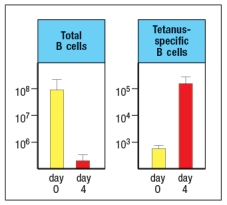 B cells preferentially survive and proliferate because:
A) They are the only B cells that express CD40.
B) They are the only B cells that express the receptor for IL-21.
C) They are the only B cells that proliferate in response to their antigen.
D) They are the only B cells presenting the tetanus peptide to the TFH cells.
E) They are the only B cells that received a TLR stimulus during priming.
B cells preferentially survive and proliferate because:A) They are the only B cells that express CD40.
B) They are the only B cells that express the receptor for IL-21.
C) They are the only B cells that proliferate in response to their antigen.
D) They are the only B cells presenting the tetanus peptide to the TFH cells.
E) They are the only B cells that received a TLR stimulus during priming.
Question
Question
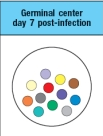
Studies show that about 50-100 different B cells initially seed each germinal center (d7 post-infection). These different B cells are represented by different colored circles in a white oval (germinal center) in Figure. Which of the choices shown best represents the B cell population that would be found in the same germinal center approximately two weeks later?
A)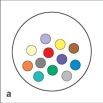
B)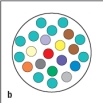
C)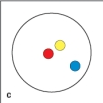
D)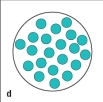
E)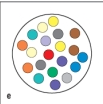
A)
B)
C)
D)
E)
Question
Question
Question
Question
MPSV-4 is a tetravalent polysaccharide vaccine designed to elicit antibodies to four different serotypes of Neisseria meningitidis, a bacterial infection that causes meningitis and sepsis in susceptible individuals. However, the protection induced by this vaccine is short-lived, and normally wanes to undetectable levels by 2-3 years post-vaccination. In addition, MPSV-4 does not induce mucosal immunity to Neisseria meningitidis; instead, it only protects against bacteria that access the bloodstream. Two newly developed vaccine candidates (A and B) are tested in mice for their ability to elicit high concentrations of anti-meningococcal antibodies that would provide mucosal as well as bloodstream protection. Also, the ideal candidate vaccine should also provide long-lasting immunity to the infection. Figure Q29)A is a diagram of the results from the primary immunization with both candidate vaccines:
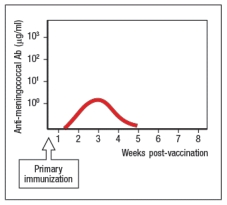
a) what is the predominant antibody isotype elicited by the primary immunization with these candidate vaccines? In which part of the body is that antibody primarily found?
Figure shows the responses to a primary, followed by a secondary immunization to each of the two candidate vaccines.
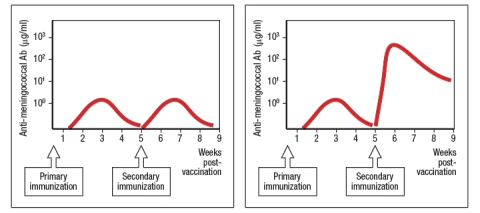
b) Which candidate vaccine elicits the preferred response? What are the three aspects of the preferred response that make it the candidate vaccine of choice?
The vaccine developers refuse to divulge the components of the candidate vaccines A and B.
c) What is the likely composition of each vaccine and what evidence from the information above are used to lead to your conclusions?
d) To confirm the choice of the preferred candidate vaccine, what type of additional information from the vaccine trials in mice shown above would support this conclusion? Name two additional features of the secondary antibody response to each candidate vaccine that could be assessed, and what results would be expected for each of the candidate vaccines.
e) To assess whether either candidate vaccine might provide mucosal immunity in addition to immunity in the bloodstream, what feature of the response to each vaccine should be examined?
a) what is the predominant antibody isotype elicited by the primary immunization with these candidate vaccines? In which part of the body is that antibody primarily found?
Figure shows the responses to a primary, followed by a secondary immunization to each of the two candidate vaccines.
b) Which candidate vaccine elicits the preferred response? What are the three aspects of the preferred response that make it the candidate vaccine of choice?
The vaccine developers refuse to divulge the components of the candidate vaccines A and B.
c) What is the likely composition of each vaccine and what evidence from the information above are used to lead to your conclusions?
d) To confirm the choice of the preferred candidate vaccine, what type of additional information from the vaccine trials in mice shown above would support this conclusion? Name two additional features of the secondary antibody response to each candidate vaccine that could be assessed, and what results would be expected for each of the candidate vaccines.
e) To assess whether either candidate vaccine might provide mucosal immunity in addition to immunity in the bloodstream, what feature of the response to each vaccine should be examined?
Question
Question
Question
Individuals infected with herpes simplex virus (HSV) mount protective antibody responses directed against the surface glycoproteins of the virus. These antibodies are critical to viral clearance, contributing to viral neutralization as well as to complement-mediated and cytotoxic cell-mediated killing of infected target cells. Surprisingly, humans as well as mice deficient in the complement protein, C3, have greatly reduced antibody responses to T cell-dependent antigens, and are impaired in their ability to control HSV infections. When C3-deficient mice are infected with HSV, once at day 0 and then a second time 4 weeks later, their antibody response is altered compared to wild-type mice, as shown in Figure. 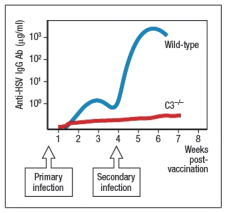
a) What is a likely explanation for the altered antibody response in the absence of complement C3?
To test your hypothesis, the following experiment is performed. Wild-type and C3-/- mice are each inoculated with a replication-defective form of HSV (HSV-rd). This virus infects cells, stimulates innate immune responses, but is not able to replicate and spread in the body. For this experiment, mice are infected with varying doses of the HSV-rd virus, and peak IgG responses to the viral surface glycoproteins are measured. The results are shown in Figure.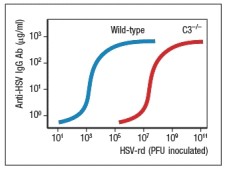
b) What is the most likely explanation for these data? Do these results impact your answer to part (a)? Explain your reasoning.
To further elucidate the function of complement C3 in the humoral immune response, a knockout mouse line lacking the receptor for C3 fragments is generated. This receptor is encoded by the Cr2 gene, so knockout mice lacking this gene are known as Cr2-/-.
Previous studies have indicated that the complement receptor encoded by the Cr2 gene is expressed on B cells and on the follicular dendritic cells that reside in B cell zones of secondary lymphoid organs. To distinguish the functions of the complement receptor on these two cell types, a series of bone marrow chimeras are generated. Wild-type bone marrow is used to reconstitute lethally irradiated Cr2-/- mice (wt Cr2-/-), or vice versa (Cr2-/- wt). As controls, Cr2-/- bone marrow is used to reconstitute Cr2-/- recipients (Cr2-/- Cr2-/-), and wild-type bone marrow used to reconstitute wild-type recipients (wt wt). These mice are then inoculated with the HSV-rd virus at 106 PFU, once at day 0 and then a second time at day 28, and the anti-HSV IgG responses are measured every 7 days, as shown in Figure.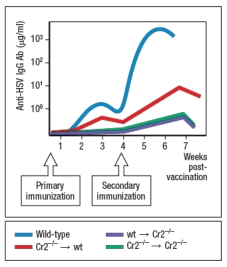
c) From the data shown above, on which cell type is the expression of the complement receptor most important for humoral immunity?
d) For each of the cell types expressing the complement receptor encoded by Cr2, what is the explanation for their importance in humoral immunity to HSV inoculation?
a) What is a likely explanation for the altered antibody response in the absence of complement C3?
To test your hypothesis, the following experiment is performed. Wild-type and C3-/- mice are each inoculated with a replication-defective form of HSV (HSV-rd). This virus infects cells, stimulates innate immune responses, but is not able to replicate and spread in the body. For this experiment, mice are infected with varying doses of the HSV-rd virus, and peak IgG responses to the viral surface glycoproteins are measured. The results are shown in Figure.
b) What is the most likely explanation for these data? Do these results impact your answer to part (a)? Explain your reasoning.
To further elucidate the function of complement C3 in the humoral immune response, a knockout mouse line lacking the receptor for C3 fragments is generated. This receptor is encoded by the Cr2 gene, so knockout mice lacking this gene are known as Cr2-/-.
Previous studies have indicated that the complement receptor encoded by the Cr2 gene is expressed on B cells and on the follicular dendritic cells that reside in B cell zones of secondary lymphoid organs. To distinguish the functions of the complement receptor on these two cell types, a series of bone marrow chimeras are generated. Wild-type bone marrow is used to reconstitute lethally irradiated Cr2-/- mice (wt Cr2-/-), or vice versa (Cr2-/- wt). As controls, Cr2-/- bone marrow is used to reconstitute Cr2-/- recipients (Cr2-/- Cr2-/-), and wild-type bone marrow used to reconstitute wild-type recipients (wt wt). These mice are then inoculated with the HSV-rd virus at 106 PFU, once at day 0 and then a second time at day 28, and the anti-HSV IgG responses are measured every 7 days, as shown in Figure.
c) From the data shown above, on which cell type is the expression of the complement receptor most important for humoral immunity?
d) For each of the cell types expressing the complement receptor encoded by Cr2, what is the explanation for their importance in humoral immunity to HSV inoculation?
Question
Question
Question
Question

Unlock Deck
Sign up to unlock the cards in this deck!
Unlock Deck
Unlock Deck
1/30

Play

Full screen (f)
Deck 10: The Humoral Immune Response
1
Wild-type mice infected with one strain of Influenza A virus (PR8) by intranasal inoculation are protected from intranasal infection by a related Influenza A virus (Beijing), a phenomenon known as cross-protection. These infections are generally localized to the upper respiratory tract. Mice with a homozygous single gene defect in 'gene X' have greatly impaired cross-protection to Influenza A-Beijing following immunization with Influenza A-PR8 by the intranasal route. Gene X likely encodes:
A) Fc receptor, Fc RIIa
B) Complement receptor, CR1
C) TLR adapter protein, MyD88
D) Poly Ig receptor
E) AID
A) Fc receptor, Fc RIIa
B) Complement receptor, CR1
C) TLR adapter protein, MyD88
D) Poly Ig receptor
E) AID
Poly Ig receptor
2
When vesicular stomatitis virus (VSV) is used to infect mice via footpad injection, viral particles are trapped in the draining lymph node (the popliteal lymph node) within 5 minutes of injection. These viral particles are then retained in the lymph node for many hours, where they can be visualized on cells that are interacting with B cells. The cells retaining the viral particles in the lymph node are not tissue-resident dendritic cells that have migrated to the lymph node with the virus, as this process takes much longer than 5 minutes. In which region of the lymph node would you expect to find the trapped viral particles and on which cells?
The virus particles are trapped on macrophages that reside in the subcapsular sinus of the lymph node. These cells can retain antigens on their cell surface without ingesting and degrading the antigen. This allows antigen-specific follicular B cells an opportunity to recognize the antigen via their surface immunoglobulin receptor.
3
In humans, IgA is produced in copious amounts, estimated to be a rate of 3 g/day. Nearly all of the IgA secreting plasma cells are found in the gastrointestinal (GI) tract where the secreted IgA is transported across the GI epithelium into the lumen of the gut. There, this antibody protects the GI epithelium against intestinal pathogens. In contrast, none of the GI resident long-lived antibody secreting cells produce antibodies of the IgG class. The differential localization of long-lived antibody secreting cells producing IgA compared to those producing IgG is likely due to:
A) Their interactions with TFH cells specific for pathogens that infect the gut
B) The lack of germinal centers in the mucosal lymphoid organs
C) The absence of S1PR1 expression on IgA-secreting plasma cells
D) Their priming and differentiation in mucosal lymphoid organs
E) Their inability to access the bone marrow compartment
A) Their interactions with TFH cells specific for pathogens that infect the gut
B) The lack of germinal centers in the mucosal lymphoid organs
C) The absence of S1PR1 expression on IgA-secreting plasma cells
D) Their priming and differentiation in mucosal lymphoid organs
E) Their inability to access the bone marrow compartment
Their priming and differentiation in mucosal lymphoid organs
4
In germinal centers, proliferating B cells undergo a process called somatic hypermutation, in which mutations are introduced into the V regions of the antibody heavy and light chain genes. When this process is complete after several weeks, the overall affinities of the antibodies produced are greatly increased compared to those present early in the primary response. The somatic hypermutation process leads to increased antibody affinity because:
A) Mutations that decrease the antibody affinity lead to an arrest of B cell proliferation.
B) B cells making higher affinity antibodies receive more help from TFH cells.
C) Somatic hypermutations only take place in the sequences encoding the CDR1, CDR2, and CDR3 regions.
D) Mutations that increase antibody affinity lead to an increased rate of B cell proliferation.
E) The majority of nucleotide changes introduced by AID don't change the amino acid coding sequence.
A) Mutations that decrease the antibody affinity lead to an arrest of B cell proliferation.
B) B cells making higher affinity antibodies receive more help from TFH cells.
C) Somatic hypermutations only take place in the sequences encoding the CDR1, CDR2, and CDR3 regions.
D) Mutations that increase antibody affinity lead to an increased rate of B cell proliferation.
E) The majority of nucleotide changes introduced by AID don't change the amino acid coding sequence.
Unlock Deck
Unlock for access to all 30 flashcards in this deck.
Unlock Deck
k this deck
5
CXCR5 is the receptor for the chemokine CXCL13, secreted by follicular stromal cells and follicular dendritic cells in the B cell zones (i.e., lymphoid follicles) of secondary lymphoid organs. A conditional knockout mouse in which CXCR5 was specifically deleted only in T cells would have:
A) No defects in any type of antibody response
B) Defects in the initial activation of all B cells
C) A lack of discrete B cell and T cell zones in the lymphoid organ
D) A defect in T cell-dependent antibody responses
E) An increased number and size of germinal centers
A) No defects in any type of antibody response
B) Defects in the initial activation of all B cells
C) A lack of discrete B cell and T cell zones in the lymphoid organ
D) A defect in T cell-dependent antibody responses
E) An increased number and size of germinal centers
Unlock Deck
Unlock for access to all 30 flashcards in this deck.
Unlock Deck
k this deck
6
The process of somatic hypermutation of antibody V regions sequences is initiated by the enzyme AID. This enzyme targets cytidine residues in the DNA sequence that are normally part of a G:C pair in the double-stranded DNA. Yet the hypermutation process generates mutations at both G:C and A:T base pairs of the original sequence because:
A) Following AID action, a double-stranded DNA break plus chewing back of the ends occurs before re-ligation of the sequence.
B) The error-prone polymerase repairs the sequence by inserting random nucleotides.
C) There are two different pathways of repair target, one targeting G:C and one targeting A:T base pairs.
D) B cells are the only cells to express the enzyme uracil-DNA glycoslyase (UNG).
E) During active transcription both A:T and G:C base pairs are temporarily single-stranded.
A) Following AID action, a double-stranded DNA break plus chewing back of the ends occurs before re-ligation of the sequence.
B) The error-prone polymerase repairs the sequence by inserting random nucleotides.
C) There are two different pathways of repair target, one targeting G:C and one targeting A:T base pairs.
D) B cells are the only cells to express the enzyme uracil-DNA glycoslyase (UNG).
E) During active transcription both A:T and G:C base pairs are temporarily single-stranded.
Unlock Deck
Unlock for access to all 30 flashcards in this deck.
Unlock Deck
k this deck
7
Unlike somatic hypermutation, class switching occurs in discrete sequence regions upstream of the immunoglobulin heavy chain coding sequences (called switch regions). One key element in directing the enzyme AID to a specific switch region is the opening of the DNA duplex combined with polymerase stalling during active transcription in that region. A second key feature of directing AID to a specific switch region is:
A) The processed RNA from the switch region guides AID to this site in the DNA
B) The binding of DNA-PK's to the switch region sequence in the DNA
C) The presence of double-stranded breaks in the DNA in this region
D) The binding of AID to the RNA polymerase that is transcribing the switch region
E) The predominance of G:C base pairs in the switch sequence
A) The processed RNA from the switch region guides AID to this site in the DNA
B) The binding of DNA-PK's to the switch region sequence in the DNA
C) The presence of double-stranded breaks in the DNA in this region
D) The binding of AID to the RNA polymerase that is transcribing the switch region
E) The predominance of G:C base pairs in the switch sequence
Unlock Deck
Unlock for access to all 30 flashcards in this deck.
Unlock Deck
k this deck
8
In cell culture experiments, purified B cells expressing IgM can be induced to switch to producing IgE by stimulating them with an antibody to CD40 (a stimulatory antibody) plus the cytokine IL-4. In an individual undergoing an immune response, these signals would normally be provided by:
A) Germinal center stromal cells
B) Other B cells in the germinal center
C) Follicular dendritic cells in the germinal center
D) Any CD4 T cell in the same lymph node
E) TFH cells in the germinal center
A) Germinal center stromal cells
B) Other B cells in the germinal center
C) Follicular dendritic cells in the germinal center
D) Any CD4 T cell in the same lymph node
E) TFH cells in the germinal center
Unlock Deck
Unlock for access to all 30 flashcards in this deck.
Unlock Deck
k this deck
9
Two different vaccines have been developed that protect vaccinated individuals against pneumococcal disease, a bacterial infection that causes pneumonia, meningitis and sepsis (blood stream infection). This disease is caused by the bacteria, Streptococcus pneumoniae. One vaccine, PPSV23, is a mixture of polysaccharides isolated from 23 different serotypes of S. pneumoniae. The second vaccine, PCV13, is a conjugate vaccine made from polysaccharides of 13 different serotypes of the bacteria conjugated to diphtheria toxoid (inactivated toxin protein). The PPSV23 vaccine is only given to adults, whereas infants and small children are given PCV13. This is because:
A) Adults are likely exposed to more different strains (serotypes) of S. pneumoniae than infants.
B) Adult B cells don't require TFH cells to make antibody responses.
C) Infant B cells are immature and don't respond to TI-2 antigens.
D) Adult B cells respond more robustly than infant B cells to B-cell mitogens.
E) Infant B cells are more dependent on the cytokine BAFF.
A) Adults are likely exposed to more different strains (serotypes) of S. pneumoniae than infants.
B) Adult B cells don't require TFH cells to make antibody responses.
C) Infant B cells are immature and don't respond to TI-2 antigens.
D) Adult B cells respond more robustly than infant B cells to B-cell mitogens.
E) Infant B cells are more dependent on the cytokine BAFF.
Unlock Deck
Unlock for access to all 30 flashcards in this deck.
Unlock Deck
k this deck
10
Once B cells begin secreting antibodies, they cease dividing and have a life-span of only a few days.
Unlock Deck
Unlock for access to all 30 flashcards in this deck.
Unlock Deck
k this deck
11
Irradiation of mice with a dose of 600 rad of total body irradiation eliminates 95% of total lymphocytes from spleen and lymph nodes and also eliminates all antigen-specific memory B cells. Nonetheless, when Influenza A-infected mice are subjected to this irradiation at 60-days post-infection, and then reconstituted with bone marrow cells from a naive mouse (this replenishes all of the lymphocyte populations), the levels of circulating anti-Influenza A IgG antibodies show nearly no decline when mice are monitored for the following year. What is the explanation for this finding?
Unlock Deck
Unlock for access to all 30 flashcards in this deck.
Unlock Deck
k this deck
12
Patients with the disease X-linked lymphoproliferative syndrome (XLP) lack expression of the small adapter protein SAP, which associates with receptors of the SLAM family. One characteristic of this disease is an inability of cytotoxic T cells to control infections with a virus, Epstein-Barr virus (EBV), that replicates in B cells. This defect in control of EBV results from:
A) A defect in antibody responses to EBV due to impaired T cell help for B cells
B) A defect in adhesion of cytotoxic T cells to EBV-infected B cells
C) Impaired migration of activated B cells to the germinal center
D) Impaired survival of activated B cells, normally induced by CD40 stimulation
E) A defect in TFH differentiation, normally induced by ICOS on B cells binding to ICOS-ligand on TFH cells
A) A defect in antibody responses to EBV due to impaired T cell help for B cells
B) A defect in adhesion of cytotoxic T cells to EBV-infected B cells
C) Impaired migration of activated B cells to the germinal center
D) Impaired survival of activated B cells, normally induced by CD40 stimulation
E) A defect in TFH differentiation, normally induced by ICOS on B cells binding to ICOS-ligand on TFH cells
Unlock Deck
Unlock for access to all 30 flashcards in this deck.
Unlock Deck
k this deck
13
Mice and humans with inactivating mutations in the gene encoding activation-induced cytidine deaminase (AID) have an immunodeficiency disease known as 'hyper IgM type 2'. Since AID is the enzyme that catalyzes the conversion of cytosines in the DNA to uracils, thereby initiating the process of somatic hypermutation, why do individuals with this deficiency only produce IgM antibodies?
Unlock Deck
Unlock for access to all 30 flashcards in this deck.
Unlock Deck
k this deck
14
The germinal center is a region within the secondary B cell follicle where sustained B cell proliferation and differentiation take place. The processes of B cell proliferation and differentiation, including affinity maturation and class switching, require periodic interactions of the germinal center B cells with CD4 TFH cells. These periodic interactions between the B cells and TFH cells can occur:
A) When B cells cycle between the dark zone and the light zone of the germinal center
B) When B cells leave the germinal center and migrate through the T-cell zone on their way to the blood
C) When B cells migrate and form a primary focus of antibody-secreting plasmablasts in the medullary cords of the lymph node
D) When B cells migrate to the border between the T-cell zone and the B-cell zone of the lymph node
E) When B cells up-regulate CXCR4 and migrate into the dark zone of the germinal center
A) When B cells cycle between the dark zone and the light zone of the germinal center
B) When B cells leave the germinal center and migrate through the T-cell zone on their way to the blood
C) When B cells migrate and form a primary focus of antibody-secreting plasmablasts in the medullary cords of the lymph node
D) When B cells migrate to the border between the T-cell zone and the B-cell zone of the lymph node
E) When B cells up-regulate CXCR4 and migrate into the dark zone of the germinal center
Unlock Deck
Unlock for access to all 30 flashcards in this deck.
Unlock Deck
k this deck
15
Individuals with a genetic polymorphism in the Fc receptor, Fc RIIa (CD32), have an increased susceptibility to bacterial meningitis (inflammation of the membranes (meninges) surrounding the brain and spinal cord) caused by the encapsulated bacterium, Neisseria meningitidis. This polymorphism reduces the efficiency with which the phagocytes expressing Fc RIIa bind to the constant region of this receptor's target antibody. The reason this Fc RIIa-dependent response it the major form of protection against Neisseria meningitidis is because:
A) T cells are unable to enter the brain and spinal cord.
B) Mast cells are unable to localize to the meninges.
C) IgG antibodies are the major isotype able to diffuse into tissues.
D) IgM antibodies do not have high enough affinity to provide protection.
E) Neutrophils are unable to phagocytose encapsulated bacteria.
A) T cells are unable to enter the brain and spinal cord.
B) Mast cells are unable to localize to the meninges.
C) IgG antibodies are the major isotype able to diffuse into tissues.
D) IgM antibodies do not have high enough affinity to provide protection.
E) Neutrophils are unable to phagocytose encapsulated bacteria.
Unlock Deck
Unlock for access to all 30 flashcards in this deck.
Unlock Deck
k this deck
16
Borrelia hermsii is a spirochete bacterium, transmitted by tick bites, that causes an illness characterized by a relapsing fever. The bacteria enter the host bloodstream and replicate there. Studies in mice show that episodes of bacteremia (bacteria in the blood) are efficiently controlled by anti-bacterial antibodies, but interestingly, follicular B cells are not required for this response, nor is the response impaired by splenectomizing the mice (i.e., removing the spleen). Which B cells are most likely responsible for this antibody response?
Unlock Deck
Unlock for access to all 30 flashcards in this deck.
Unlock Deck
k this deck
17
A mouse is immunized with the tetanus toxoid protein (inactivated toxin) in adjuvant. One week later, the entire population of splenic B cells are isolated from the mouse and mixed with tetanus toxoid-specific CD4 TFH cells plus the purified tetanus toxoid protein. Four days later, the total number of B cells in the culture and the number of tetanus toxoid-specific B cells are determined and compared to the starting population on the day of isolation. The results are shown in Figure Q1). B cells preferentially survive and proliferate because:
A) They are the only B cells that express CD40.
B) They are the only B cells that express the receptor for IL-21.
C) They are the only B cells that proliferate in response to their antigen.
D) They are the only B cells presenting the tetanus peptide to the TFH cells.
E) They are the only B cells that received a TLR stimulus during priming.
B cells preferentially survive and proliferate because:A) They are the only B cells that express CD40.
B) They are the only B cells that express the receptor for IL-21.
C) They are the only B cells that proliferate in response to their antigen.
D) They are the only B cells presenting the tetanus peptide to the TFH cells.
E) They are the only B cells that received a TLR stimulus during priming.
Unlock Deck
Unlock for access to all 30 flashcards in this deck.
Unlock Deck
k this deck
18
The vaccine to Haemophilus influenzae type b is called a conjugate vaccine. It is composed of the tetanus toxoid protein conjugated to the capsular polysaccharide of the H. influenzae type b bacteria. When used to vaccinate infants, the antibody response generated by this vaccine would include:
A) Antibodies to the bacterial polysaccharide and the tetanus toxoid
B) Antibodies to the tetanus toxoid only
C) Antibodies to the bacterial polysaccharide only
D) Antibodies that only bind to the protein-polysaccharide conjugate in the vaccine
E) Antibodies that recognize the polysaccharide capsule when shed by the bacteria
A) Antibodies to the bacterial polysaccharide and the tetanus toxoid
B) Antibodies to the tetanus toxoid only
C) Antibodies to the bacterial polysaccharide only
D) Antibodies that only bind to the protein-polysaccharide conjugate in the vaccine
E) Antibodies that recognize the polysaccharide capsule when shed by the bacteria
Unlock Deck
Unlock for access to all 30 flashcards in this deck.
Unlock Deck
k this deck
19
Studies show that about 50-100 different B cells initially seed each germinal center (d7 post-infection). These different B cells are represented by different colored circles in a white oval (germinal center) in Figure. Which of the choices shown best represents the B cell population that would be found in the same germinal center approximately two weeks later?
A)
B)
C)
D)
E)
A)
B)
C)
D)
E)
Unlock Deck
Unlock for access to all 30 flashcards in this deck.
Unlock Deck
k this deck
20
Infants born with the immunodeficiency disease X-linked agammaglobulinemia (XLA) have a block in B cell development, and fail to produce mature B cells. As a result, these infants lack the ability to produce antibodies. After birth, babies with XLA first begin to show symptoms of recurrent and persistent extracellular bacterial infections due to common environmental pathogens when they are 4-6 months of age. The reason these infants are healthy for the first 4-6 months after birth is because:Newborn infants have high circulating levels of maternal IgG at birth.
A) Newborn infants are not exposed to bacterial pathogens for the first 4-6 months of life.
B) Newborn infants are born with high circulating levels of complement proteins to protect them.
C) Newborn infants are born with high circulating levels of antimicrobial peptides to protect them.
D) Newborn infants are vaccinated against these common bacterial pathogens.
10-18 High-affinity IgG and IgA antibodies can neutralize toxins and block the infectivity of viruses and bacteria
A) Newborn infants are not exposed to bacterial pathogens for the first 4-6 months of life.
B) Newborn infants are born with high circulating levels of complement proteins to protect them.
C) Newborn infants are born with high circulating levels of antimicrobial peptides to protect them.
D) Newborn infants are vaccinated against these common bacterial pathogens.
10-18 High-affinity IgG and IgA antibodies can neutralize toxins and block the infectivity of viruses and bacteria
Unlock Deck
Unlock for access to all 30 flashcards in this deck.
Unlock Deck
k this deck
21
The upper respiratory tract of many individuals is colonized by Streptococcus pneumoniae bacteria. Infections caused by these bacteria, including pneumonia, meningitis, otitis media (ear infections), and sinusitis, are thought to occur in individuals lacking protective antibodies. For many years, IgG was thought to be the major antibody class responsible for protective immunity to S. pneumoniae, due to the ability of anti-bacterial capsule IgG antibodies to opsonize the bacteria and promote phagocytosis. However, in addition to IgG, pneumococcal polysaccharides elicit robust IgA antibody responses. It was traditionally thought that these IgA antibodies functioned in neutralization, by blocking bacterial attachment to mucosal epithelial cells. It is now known that IgA antibodies, like IgG, can function as opsonins, to induce phagocytosis and killing of IgA-coated pathogens. This function of IgA antibodies depends on:
A) The production of high affinity anti-bacterial IgA antibodies
B) The dimeric form of IgA antibodies to bind to multivalent sites on the bacteria
C) The ability of dimeric IgA binding to recruit and activate the complement cascade
D) The presence of IgA-specific Fc receptors on neutrophils and macrophages
E) The ability of IgA antibodies to efficiently cross the epithelial surface and enter the airways
A) The production of high affinity anti-bacterial IgA antibodies
B) The dimeric form of IgA antibodies to bind to multivalent sites on the bacteria
C) The ability of dimeric IgA binding to recruit and activate the complement cascade
D) The presence of IgA-specific Fc receptors on neutrophils and macrophages
E) The ability of IgA antibodies to efficiently cross the epithelial surface and enter the airways
Unlock Deck
Unlock for access to all 30 flashcards in this deck.
Unlock Deck
k this deck
22
Surprisingly, individuals with defects in the early components of the classical complement cascade suffer from an autoimmune type of kidney damage, rather than from an immunodeficiency leading to increased susceptibility to infections. Why do these complement defects lead to autoimmune kidney damage?
Unlock Deck
Unlock for access to all 30 flashcards in this deck.
Unlock Deck
k this deck
23
MPSV-4 is a tetravalent polysaccharide vaccine designed to elicit antibodies to four different serotypes of Neisseria meningitidis, a bacterial infection that causes meningitis and sepsis in susceptible individuals. However, the protection induced by this vaccine is short-lived, and normally wanes to undetectable levels by 2-3 years post-vaccination. In addition, MPSV-4 does not induce mucosal immunity to Neisseria meningitidis; instead, it only protects against bacteria that access the bloodstream. Two newly developed vaccine candidates (A and B) are tested in mice for their ability to elicit high concentrations of anti-meningococcal antibodies that would provide mucosal as well as bloodstream protection. Also, the ideal candidate vaccine should also provide long-lasting immunity to the infection. Figure Q29)A is a diagram of the results from the primary immunization with both candidate vaccines:
a) what is the predominant antibody isotype elicited by the primary immunization with these candidate vaccines? In which part of the body is that antibody primarily found?
Figure shows the responses to a primary, followed by a secondary immunization to each of the two candidate vaccines.
b) Which candidate vaccine elicits the preferred response? What are the three aspects of the preferred response that make it the candidate vaccine of choice?
The vaccine developers refuse to divulge the components of the candidate vaccines A and B.
c) What is the likely composition of each vaccine and what evidence from the information above are used to lead to your conclusions?
d) To confirm the choice of the preferred candidate vaccine, what type of additional information from the vaccine trials in mice shown above would support this conclusion? Name two additional features of the secondary antibody response to each candidate vaccine that could be assessed, and what results would be expected for each of the candidate vaccines.
e) To assess whether either candidate vaccine might provide mucosal immunity in addition to immunity in the bloodstream, what feature of the response to each vaccine should be examined?
a) what is the predominant antibody isotype elicited by the primary immunization with these candidate vaccines? In which part of the body is that antibody primarily found?
Figure shows the responses to a primary, followed by a secondary immunization to each of the two candidate vaccines.
b) Which candidate vaccine elicits the preferred response? What are the three aspects of the preferred response that make it the candidate vaccine of choice?
The vaccine developers refuse to divulge the components of the candidate vaccines A and B.
c) What is the likely composition of each vaccine and what evidence from the information above are used to lead to your conclusions?
d) To confirm the choice of the preferred candidate vaccine, what type of additional information from the vaccine trials in mice shown above would support this conclusion? Name two additional features of the secondary antibody response to each candidate vaccine that could be assessed, and what results would be expected for each of the candidate vaccines.
e) To assess whether either candidate vaccine might provide mucosal immunity in addition to immunity in the bloodstream, what feature of the response to each vaccine should be examined?
Unlock Deck
Unlock for access to all 30 flashcards in this deck.
Unlock Deck
k this deck
24
The W/Wv mouse strain is heterozygous for two different alleles of the gene encoding the growth factor receptor, c-kit, an important receptor expressed on hematopoietic progenitor cells in the bone marrow. The major defect in these mice is the absence of single lineage of hematopoietic cells. When these mice are challenged with larval Haemaphysalis longicornis ticks, they fail to become resistant to the ticks, in spite of generating high titers of anti-tick IgE antibodies. The cell type missing in the W/Wv mice is most likely:Natural Killer (NK) cells
A) Eosinophils
B) Tissue-resident dendritic cells
C) Tissue-resident macrophages
D) Tissue-resident mast cells
A) Eosinophils
B) Tissue-resident dendritic cells
C) Tissue-resident macrophages
D) Tissue-resident mast cells
Unlock Deck
Unlock for access to all 30 flashcards in this deck.
Unlock Deck
k this deck
25
IgM antibodies are much more efficient than IgG at activating the complement cascade. However, under certain circumstances, IgG antibodies will activate the complement pathway. One example of a situation in which IgG binding to its antigen will not trigger the complement cascade is when:
A) The IgG antibodies bind to a multivalent soluble antigen in solution, such as a polysaccharide structure shed from a bacterial pathogen.
B) The IgG antibodies bind to a viral capsid protein that is present in more than 100 copies on the viral particle surface.
C) The IgG antibodies bind to a bacterial surface by recognizing a repetitive polysaccharide component of the bacterial capsule.
D) The IgG antibodies are binding self-antigens such as chromatin released from dead cells.
E) The IgG antibodies are neutralizing a bacterial toxin protein by blocking the receptor-attachment site on the toxin.
A) The IgG antibodies bind to a multivalent soluble antigen in solution, such as a polysaccharide structure shed from a bacterial pathogen.
B) The IgG antibodies bind to a viral capsid protein that is present in more than 100 copies on the viral particle surface.
C) The IgG antibodies bind to a bacterial surface by recognizing a repetitive polysaccharide component of the bacterial capsule.
D) The IgG antibodies are binding self-antigens such as chromatin released from dead cells.
E) The IgG antibodies are neutralizing a bacterial toxin protein by blocking the receptor-attachment site on the toxin.
Unlock Deck
Unlock for access to all 30 flashcards in this deck.
Unlock Deck
k this deck
26
Individuals infected with herpes simplex virus (HSV) mount protective antibody responses directed against the surface glycoproteins of the virus. These antibodies are critical to viral clearance, contributing to viral neutralization as well as to complement-mediated and cytotoxic cell-mediated killing of infected target cells. Surprisingly, humans as well as mice deficient in the complement protein, C3, have greatly reduced antibody responses to T cell-dependent antigens, and are impaired in their ability to control HSV infections. When C3-deficient mice are infected with HSV, once at day 0 and then a second time 4 weeks later, their antibody response is altered compared to wild-type mice, as shown in Figure.
a) What is a likely explanation for the altered antibody response in the absence of complement C3?
To test your hypothesis, the following experiment is performed. Wild-type and C3-/- mice are each inoculated with a replication-defective form of HSV (HSV-rd). This virus infects cells, stimulates innate immune responses, but is not able to replicate and spread in the body. For this experiment, mice are infected with varying doses of the HSV-rd virus, and peak IgG responses to the viral surface glycoproteins are measured. The results are shown in Figure.
b) What is the most likely explanation for these data? Do these results impact your answer to part (a)? Explain your reasoning.
To further elucidate the function of complement C3 in the humoral immune response, a knockout mouse line lacking the receptor for C3 fragments is generated. This receptor is encoded by the Cr2 gene, so knockout mice lacking this gene are known as Cr2-/-.
Previous studies have indicated that the complement receptor encoded by the Cr2 gene is expressed on B cells and on the follicular dendritic cells that reside in B cell zones of secondary lymphoid organs. To distinguish the functions of the complement receptor on these two cell types, a series of bone marrow chimeras are generated. Wild-type bone marrow is used to reconstitute lethally irradiated Cr2-/- mice (wt Cr2-/-), or vice versa (Cr2-/- wt). As controls, Cr2-/- bone marrow is used to reconstitute Cr2-/- recipients (Cr2-/- Cr2-/-), and wild-type bone marrow used to reconstitute wild-type recipients (wt wt). These mice are then inoculated with the HSV-rd virus at 106 PFU, once at day 0 and then a second time at day 28, and the anti-HSV IgG responses are measured every 7 days, as shown in Figure.
c) From the data shown above, on which cell type is the expression of the complement receptor most important for humoral immunity?
d) For each of the cell types expressing the complement receptor encoded by Cr2, what is the explanation for their importance in humoral immunity to HSV inoculation?
a) What is a likely explanation for the altered antibody response in the absence of complement C3?
To test your hypothesis, the following experiment is performed. Wild-type and C3-/- mice are each inoculated with a replication-defective form of HSV (HSV-rd). This virus infects cells, stimulates innate immune responses, but is not able to replicate and spread in the body. For this experiment, mice are infected with varying doses of the HSV-rd virus, and peak IgG responses to the viral surface glycoproteins are measured. The results are shown in Figure.
b) What is the most likely explanation for these data? Do these results impact your answer to part (a)? Explain your reasoning.
To further elucidate the function of complement C3 in the humoral immune response, a knockout mouse line lacking the receptor for C3 fragments is generated. This receptor is encoded by the Cr2 gene, so knockout mice lacking this gene are known as Cr2-/-.
Previous studies have indicated that the complement receptor encoded by the Cr2 gene is expressed on B cells and on the follicular dendritic cells that reside in B cell zones of secondary lymphoid organs. To distinguish the functions of the complement receptor on these two cell types, a series of bone marrow chimeras are generated. Wild-type bone marrow is used to reconstitute lethally irradiated Cr2-/- mice (wt Cr2-/-), or vice versa (Cr2-/- wt). As controls, Cr2-/- bone marrow is used to reconstitute Cr2-/- recipients (Cr2-/- Cr2-/-), and wild-type bone marrow used to reconstitute wild-type recipients (wt wt). These mice are then inoculated with the HSV-rd virus at 106 PFU, once at day 0 and then a second time at day 28, and the anti-HSV IgG responses are measured every 7 days, as shown in Figure.
c) From the data shown above, on which cell type is the expression of the complement receptor most important for humoral immunity?
d) For each of the cell types expressing the complement receptor encoded by Cr2, what is the explanation for their importance in humoral immunity to HSV inoculation?
Unlock Deck
Unlock for access to all 30 flashcards in this deck.
Unlock Deck
k this deck
27
Neutralizing antibodies are effective at preventing infection or toxicity mediated by pathogens or their toxic products. In fact, nearly all vaccines currently in use function by eliciting neutralizing antibodies. One example is the tetanus vaccine, in which neutralizing antibodies are generated against an inactivated form of the tetanus toxin (i.e., the tetanus toxoid). The most important feature of a neutralizing antibody is:
A) Having a high degree of multi-valency, such as being a pentamer or hexamer of immunoglobulin monomers
B) Having high affinity for the antigen
C) Being present at a high concentration in the circulation
D) Being efficient at activating the complement cascade
E) Having a long half-life in the body
A) Having a high degree of multi-valency, such as being a pentamer or hexamer of immunoglobulin monomers
B) Having high affinity for the antigen
C) Being present at a high concentration in the circulation
D) Being efficient at activating the complement cascade
E) Having a long half-life in the body
Unlock Deck
Unlock for access to all 30 flashcards in this deck.
Unlock Deck
k this deck
28
Antibody-dependent cell-mediated cytotoxicity (ADCC) is an important effector mechanism in immunity to virus infections. This immune pathway has also been exploited for clinical applications. For instance, patients with various disorders, including rheumatoid arthritis and some B cell lymphomas, are treated with an antibody directed at CD20, a surface receptor expressed on all B cells. This antibody leads to the depletion of B cells from the patients by the actions of:
A) Natural killer (NK) cells
B) Cytotoxic CD8 T cells
C) Cytotoxic CD4 T cells
D) Activated macrophages
E) The complement cascade membrane attack complex
A) Natural killer (NK) cells
B) Cytotoxic CD8 T cells
C) Cytotoxic CD4 T cells
D) Activated macrophages
E) The complement cascade membrane attack complex
Unlock Deck
Unlock for access to all 30 flashcards in this deck.
Unlock Deck
k this deck
29
Some individuals with repetitive exposure to high doses of Schistosoma mansoni develop resistance to re-infection by this helminthic parasite. In contrast, other individuals remain highly susceptible. Population studies showed that resistant individuals had increased numbers of circulating eosinophils in their blood compared to susceptible individuals, and further, that these eosinophils had increased levels of:
A) Complement receptor, CR1
B) Mannose binding lectin
C) Fc RII, the low affinity IgE receptor
D) Fc RII-B, the inhibitor IgG receptor
E) Anti-microbial ficolins
A) Complement receptor, CR1
B) Mannose binding lectin
C) Fc RII, the low affinity IgE receptor
D) Fc RII-B, the inhibitor IgG receptor
E) Anti-microbial ficolins
Unlock Deck
Unlock for access to all 30 flashcards in this deck.
Unlock Deck
k this deck
30
Individuals with allergies often mount IgE antibody responses to non-infectious environmental antigens. Examples are peanut allergies, allergies to house dust mites, and allergic responses to bee stings. In all of these cases, the allergic response is mediated by the cross-linking of the high affinity IgE receptors on mast cells (Fc RI) which are pre-bound to the allergen-specific IgE antibodies. Yet, the symptoms of these different allergic responses can vary greatly, and can include skin rashes or hives, swelling of the throat and difficulty breathing, to gastrointestinal symptoms such as cramps, diarrhea or vomiting. How can different IgE-mediated allergic responses cause such different symptoms?
Unlock Deck
Unlock for access to all 30 flashcards in this deck.
Unlock Deck
k this deck
Unlock Deck
Unlock for access to all 30 flashcards in this deck.






