







 Chat with AI

Deck 41: Animal Nutrition
Full screen (f)

Question

Question
Question
Question
Question
Question
Question
Question
Question
Question
Question
Question
Question
Question
Question
Question
Examine the digestive system structures in the figure. 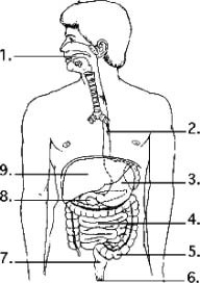 The agents that help emulsify fats are produced in location ________.
A) 1
B) 3
C) 8
D) 9
The agents that help emulsify fats are produced in location ________.A) 1
B) 3
C) 8
D) 9
Question
Question
Examine the digestive system structures in the figure. 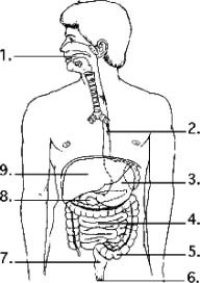 The highest rate of nutrient absorption occurs at location ________.
A) 1
B) 4
C) 5
D) 8
The highest rate of nutrient absorption occurs at location ________.A) 1
B) 4
C) 5
D) 8
Question
Use the graph to answer the following question. 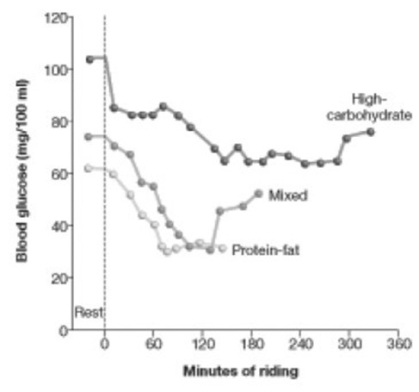 Three groups of cyclists consumed three different types of diets: high-carbohydrate; a diet mixed in carbohydrates, fat, and protein; or a diet higher in protein and fat. The average time each group could spend cycling over a six-hour period is shown in the accompanying graph. What conclusion from the data would help an athlete or trainer improve performance?
A) Endurance is entirely related to diet.
B) Maintaining elevated blood sugar improves performance.
C) An early 50 percent drop in blood glucose is associated with improved endurance.
D) Diet is not at all related to endurance.
Three groups of cyclists consumed three different types of diets: high-carbohydrate; a diet mixed in carbohydrates, fat, and protein; or a diet higher in protein and fat. The average time each group could spend cycling over a six-hour period is shown in the accompanying graph. What conclusion from the data would help an athlete or trainer improve performance?A) Endurance is entirely related to diet.
B) Maintaining elevated blood sugar improves performance.
C) An early 50 percent drop in blood glucose is associated with improved endurance.
D) Diet is not at all related to endurance.
Question
Question
Question
Question
Question
Question
Question
Question
Question
Question
Examine the digestive system structures in the figure.  Bacteria that produce vitamins are found in the greatest concentration in location ________.
A) 3
B) 4
C) 5
D) 8
Bacteria that produce vitamins are found in the greatest concentration in location ________.A) 3
B) 4
C) 5
D) 8
Question
Examine the digestive system structures in the figure.  Most of the digestion of fats occurs in structure(s) ________.
A) 3 only
B) 4 only
C) 1 and 4
D) 3 and 4
Most of the digestion of fats occurs in structure(s) ________.A) 3 only
B) 4 only
C) 1 and 4
D) 3 and 4
Question
Question
Question
Question
Question
Question
Question
Question
Question
Question
Question
Question
Question
Question
Question
Use the graph to answer the following question. 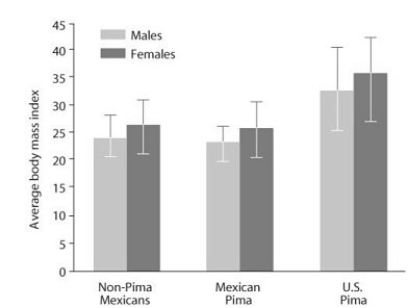 The Pimas are a group of people living in the south-western United States and Mexico. Although Pima Indians living in the United States and Mexico have a similar genetic background, a five-fold increase in the incidence of type II diabetes mellitus among US Pima has been reported. The body mass index of Mexicans of non-Pima descent, Mexicans of Pima descent, and Pimas living in the US is shown in the figure. Based on this information and the graph, what can you infer about the incidence of type II diabetes mellitus?
A) Obesity is a risk factor for development of type II diabetes mellitus.
B) If you maintain a normal body weight (body mass index less than 25), you will not get type II diabetes mellitus.
C) The incidence of type II diabetes mellitus has increased in the past 10 years.
D) People who develop type II diabetes mellitus are typically diagnosed in childhood or adolescence.
The Pimas are a group of people living in the south-western United States and Mexico. Although Pima Indians living in the United States and Mexico have a similar genetic background, a five-fold increase in the incidence of type II diabetes mellitus among US Pima has been reported. The body mass index of Mexicans of non-Pima descent, Mexicans of Pima descent, and Pimas living in the US is shown in the figure. Based on this information and the graph, what can you infer about the incidence of type II diabetes mellitus?A) Obesity is a risk factor for development of type II diabetes mellitus.
B) If you maintain a normal body weight (body mass index less than 25), you will not get type II diabetes mellitus.
C) The incidence of type II diabetes mellitus has increased in the past 10 years.
D) People who develop type II diabetes mellitus are typically diagnosed in childhood or adolescence.
Question
Question
Question
Question
Question
Question
Question
Question
Question
Question
Question
Question
Question
Question
Question
Question
Question
Question
Question

Unlock Deck
Sign up to unlock the cards in this deck!
Unlock Deck
Unlock Deck
1/64

Play

Full screen (f)
Deck 41: Animal Nutrition
1
Fat digestion yields fatty acids and glycerol, whereas protein digestion yields amino acids; both digestive processes ________.
A) are catalysed by the same enzyme
B) use water molecules when breaking bonds (hydrolysis)
C) require the presence of hydrochloric acid to lower the pH
D) require adenosine triphosphate (ATP) as an energy source
A) are catalysed by the same enzyme
B) use water molecules when breaking bonds (hydrolysis)
C) require the presence of hydrochloric acid to lower the pH
D) require adenosine triphosphate (ATP) as an energy source
B
2
Lysine is an essential amino acid for animals. If an animal did not consume lysine in its diet, you might expect that the animal ________.
A) would make lysine from other amino acids
B) could not effectively make many necessary proteins
C) was a carnivore
D) would be very healthy
A) would make lysine from other amino acids
B) could not effectively make many necessary proteins
C) was a carnivore
D) would be very healthy
B
3
Folic acid supplements have become especially important for pregnant women because ________.
A) folic acid supplies vitamins that only pregnant women can use
B) the foetus makes high levels of folic acid
C) folic acid deprivation is associated with neural tube defects in a foetus
D) folic acid deprivation is a cause of heart abnormalities in a newborn
A) folic acid supplies vitamins that only pregnant women can use
B) the foetus makes high levels of folic acid
C) folic acid deprivation is associated with neural tube defects in a foetus
D) folic acid deprivation is a cause of heart abnormalities in a newborn
C
4
The large surface area in the gut directly facilitates ________.
A) secretion
B) absorption
C) filtration
D) temperature regulation
A) secretion
B) absorption
C) filtration
D) temperature regulation
Unlock Deck
Unlock for access to all 64 flashcards in this deck.
Unlock Deck
k this deck
5
If a mammal did not obtain enough iodine in its diet, you might expect ________.
A) a decreased ability to produce thyroid hormones
B) a decrease in enzyme function
C) the animal to have weak bones
D) a decrease in muscle function
A) a decreased ability to produce thyroid hormones
B) a decrease in enzyme function
C) the animal to have weak bones
D) a decrease in muscle function
Unlock Deck
Unlock for access to all 64 flashcards in this deck.
Unlock Deck
k this deck
6
Because the foods eaten by animals are often composed largely of macromolecules, animals need to have mechanisms for ________.
A) dehydration synthesis
B) enzymatic hydrolysis
C) regurgitation
D) demineralisation
A) dehydration synthesis
B) enzymatic hydrolysis
C) regurgitation
D) demineralisation
Unlock Deck
Unlock for access to all 64 flashcards in this deck.
Unlock Deck
k this deck
7
Among mammals, it is generally true that ________.
A) all types of foods begin their enzymatic digestion in the mouth
B) after leaving the oral cavity, the bolus enters the larynx
C) the epiglottis prevents swallowed food from entering the trachea
D) the trachea leads to the oesophagus and then to the stomach
A) all types of foods begin their enzymatic digestion in the mouth
B) after leaving the oral cavity, the bolus enters the larynx
C) the epiglottis prevents swallowed food from entering the trachea
D) the trachea leads to the oesophagus and then to the stomach
Unlock Deck
Unlock for access to all 64 flashcards in this deck.
Unlock Deck
k this deck
8
In the digestive system, "peristalsis" is ________.
A) a process of fat emulsification in the small intestine
B) voluntary control of the rectal sphincters regulating defecation
C) the transport of nutrients to the liver through the hepatic portal vessel
D) smooth muscle contractions that move food along the oesophagus
A) a process of fat emulsification in the small intestine
B) voluntary control of the rectal sphincters regulating defecation
C) the transport of nutrients to the liver through the hepatic portal vessel
D) smooth muscle contractions that move food along the oesophagus
Unlock Deck
Unlock for access to all 64 flashcards in this deck.
Unlock Deck
k this deck
9
In a hydra, digestion is completed ________.
A) intracellularly
B) extracellularly
C) in the alimentary canal
D) in the gastrovascular cavity
A) intracellularly
B) extracellularly
C) in the alimentary canal
D) in the gastrovascular cavity
Unlock Deck
Unlock for access to all 64 flashcards in this deck.
Unlock Deck
k this deck
10
Animals that migrate great distances would obtain the greatest energetic benefit of storing chemical energy as ________.
A) proteins
B) minerals
C) carbohydrates
D) fats
A) proteins
B) minerals
C) carbohydrates
D) fats
Unlock Deck
Unlock for access to all 64 flashcards in this deck.
Unlock Deck
k this deck
11
The process by which digested dietary substances cross cell membranes to be used by the body is known as ________.
A) ingestion
B) digestion
C) hydrolysis
D) absorption
A) ingestion
B) digestion
C) hydrolysis
D) absorption
Unlock Deck
Unlock for access to all 64 flashcards in this deck.
Unlock Deck
k this deck
12
An advantage of a complete digestive system over a gastrovascular cavity is that the complete system ________.
A) excludes the need for extracellular digestion
B) allows for specialised regions with specialised functions
C) allows extensive branching
D) facilitates intracellular digestion
A) excludes the need for extracellular digestion
B) allows for specialised regions with specialised functions
C) allows extensive branching
D) facilitates intracellular digestion
Unlock Deck
Unlock for access to all 64 flashcards in this deck.
Unlock Deck
k this deck
13
The process of obtaining food is known as ________ and requires specialised feeding mechanisms.
A) ingestion
B) digestion
C) absorption
D) excretion
A) ingestion
B) digestion
C) absorption
D) excretion
Unlock Deck
Unlock for access to all 64 flashcards in this deck.
Unlock Deck
k this deck
14
Ticks are parasites that obtain nutrients by ingesting blood from a host animal. Ticks would be classified as ________.
A) filter feeders
B) substrate feeders
C) fluid feeders
D) bulk feeders
A) filter feeders
B) substrate feeders
C) fluid feeders
D) bulk feeders
Unlock Deck
Unlock for access to all 64 flashcards in this deck.
Unlock Deck
k this deck
15
The following table shows the contents of a multivitamin supplement and its percentage of recommended daily values (% DV).
The most likely reason that some of the vitamins and minerals in this supplement are found at less than 100% is that ________.
A) it would be chemically impossible to add more
B) these vitamins and minerals are too large in size to reach 100%
C) it is too easy to overdose on minerals such as phosphorus and calcium
D) it is dangerous to overdose on fat-soluble vitamins such as A and K
The most likely reason that some of the vitamins and minerals in this supplement are found at less than 100% is that ________.
A) it would be chemically impossible to add more
B) these vitamins and minerals are too large in size to reach 100%
C) it is too easy to overdose on minerals such as phosphorus and calcium
D) it is dangerous to overdose on fat-soluble vitamins such as A and K
Unlock Deck
Unlock for access to all 64 flashcards in this deck.
Unlock Deck
k this deck
16
Examine the digestive system structures in the figure. The agents that help emulsify fats are produced in location ________.
A) 1
B) 3
C) 8
D) 9
The agents that help emulsify fats are produced in location ________.A) 1
B) 3
C) 8
D) 9
Unlock Deck
Unlock for access to all 64 flashcards in this deck.
Unlock Deck
k this deck
17
Mechanical digestion, the process of breaking down large chunks of food into smaller pieces, is important because smaller pieces of food ________.
A) do not taste as good as larger pieces of food
B) have more surface area for chemical digestion than do larger pieces of food
C) are easier to excrete than are larger pieces of food
D) are more easily stored in the stomach than are larger pieces of food
A) do not taste as good as larger pieces of food
B) have more surface area for chemical digestion than do larger pieces of food
C) are easier to excrete than are larger pieces of food
D) are more easily stored in the stomach than are larger pieces of food
Unlock Deck
Unlock for access to all 64 flashcards in this deck.
Unlock Deck
k this deck
18
Examine the digestive system structures in the figure. The highest rate of nutrient absorption occurs at location ________.
A) 1
B) 4
C) 5
D) 8
The highest rate of nutrient absorption occurs at location ________.A) 1
B) 4
C) 5
D) 8
Unlock Deck
Unlock for access to all 64 flashcards in this deck.
Unlock Deck
k this deck
19
Use the graph to answer the following question. Three groups of cyclists consumed three different types of diets: high-carbohydrate; a diet mixed in carbohydrates, fat, and protein; or a diet higher in protein and fat. The average time each group could spend cycling over a six-hour period is shown in the accompanying graph. What conclusion from the data would help an athlete or trainer improve performance?
A) Endurance is entirely related to diet.
B) Maintaining elevated blood sugar improves performance.
C) An early 50 percent drop in blood glucose is associated with improved endurance.
D) Diet is not at all related to endurance.
Three groups of cyclists consumed three different types of diets: high-carbohydrate; a diet mixed in carbohydrates, fat, and protein; or a diet higher in protein and fat. The average time each group could spend cycling over a six-hour period is shown in the accompanying graph. What conclusion from the data would help an athlete or trainer improve performance?A) Endurance is entirely related to diet.
B) Maintaining elevated blood sugar improves performance.
C) An early 50 percent drop in blood glucose is associated with improved endurance.
D) Diet is not at all related to endurance.
Unlock Deck
Unlock for access to all 64 flashcards in this deck.
Unlock Deck
k this deck
20
Which of the following is a difference between vitamins and minerals?
A) Vitamins are involved in regulating enzyme activity, but minerals are not.
B) Vitamins are organic molecules, but minerals are inorganic molecules.
C) Minerals are obtained by an animal through dietary sources, but vitamins are made by the animal.
D) Vitamins and minerals are only obtained by digesting plants.
A) Vitamins are involved in regulating enzyme activity, but minerals are not.
B) Vitamins are organic molecules, but minerals are inorganic molecules.
C) Minerals are obtained by an animal through dietary sources, but vitamins are made by the animal.
D) Vitamins and minerals are only obtained by digesting plants.
Unlock Deck
Unlock for access to all 64 flashcards in this deck.
Unlock Deck
k this deck
21
The absorption of fats differs from that of carbohydrates in that ________.
A) fat absorption primarily occurs in the stomach, whereas carbohydrates are absorbed from the small intestine
B) carbohydrates need to be emulsified before they can be digested, whereas fats do not
C) most absorbed fat first enters the lymphatic system, whereas carbohydrates directly enter the blood
D) fats, but not carbohydrates, are digested by bacteria before absorption
A) fat absorption primarily occurs in the stomach, whereas carbohydrates are absorbed from the small intestine
B) carbohydrates need to be emulsified before they can be digested, whereas fats do not
C) most absorbed fat first enters the lymphatic system, whereas carbohydrates directly enter the blood
D) fats, but not carbohydrates, are digested by bacteria before absorption
Unlock Deck
Unlock for access to all 64 flashcards in this deck.
Unlock Deck
k this deck
22
The bile salts ________.
A) are enzymes
B) are manufactured by the pancreas
C) emulsify fats in the duodenum
D) are normally an ingredient of gastric juice
A) are enzymes
B) are manufactured by the pancreas
C) emulsify fats in the duodenum
D) are normally an ingredient of gastric juice
Unlock Deck
Unlock for access to all 64 flashcards in this deck.
Unlock Deck
k this deck
23
Over-the-counter medications for acid reflux or heartburn block the production of stomach acid. Which of the following cells are directly affected by this medication?
A) goblet cells
B) chief cells
C) parietal cells
D) smooth muscle cells
A) goblet cells
B) chief cells
C) parietal cells
D) smooth muscle cells
Unlock Deck
Unlock for access to all 64 flashcards in this deck.
Unlock Deck
k this deck
24
Pepsinogen is converted to its active form in the stomach by ________.
A) HCl
B) chief cells
C) high pH conditions
D) parietal cells
A) HCl
B) chief cells
C) high pH conditions
D) parietal cells
Unlock Deck
Unlock for access to all 64 flashcards in this deck.
Unlock Deck
k this deck
25
If you place a small piece of a cracker on your tongue, what would you expect to happen?
A) The vitamins in the cracker are immediately absorbed.
B) Salivary amylase degrades the starch from the cracker into glucose.
C) The proteins in the cracker begin to be digested.
D) The flavour becomes less noticeable because the sugars are digested.
A) The vitamins in the cracker are immediately absorbed.
B) Salivary amylase degrades the starch from the cracker into glucose.
C) The proteins in the cracker begin to be digested.
D) The flavour becomes less noticeable because the sugars are digested.
Unlock Deck
Unlock for access to all 64 flashcards in this deck.
Unlock Deck
k this deck
26
Why do the cells of the digestive system secrete proteolytic enzymes, such as pepsin, in their inactive forms?
A) These proteolytic enzymes, in active form, would digest the very tissues that synthesise them.
B) By secreting inactive enzymes, the catalytic activity of the enzymes is maintained for a longer time.
C) The stomach is too acidic to maintain these enzymes in their active form.
D) Inactive pepsin and trypsin are more easily transported across the cell membrane.
A) These proteolytic enzymes, in active form, would digest the very tissues that synthesise them.
B) By secreting inactive enzymes, the catalytic activity of the enzymes is maintained for a longer time.
C) The stomach is too acidic to maintain these enzymes in their active form.
D) Inactive pepsin and trypsin are more easily transported across the cell membrane.
Unlock Deck
Unlock for access to all 64 flashcards in this deck.
Unlock Deck
k this deck
27
Constipation can result from the consumption of a substance that ________.
A) promotes water reabsorption in the large intestine
B) speeds up movement of material in the large intestine
C) decreases water reabsorption in the small intestine
D) stimulates peristalsis
A) promotes water reabsorption in the large intestine
B) speeds up movement of material in the large intestine
C) decreases water reabsorption in the small intestine
D) stimulates peristalsis
Unlock Deck
Unlock for access to all 64 flashcards in this deck.
Unlock Deck
k this deck
28
Nutrient-rich blood from the intestine is carried through the ________ to the liver.
A) lacteal vessels
B) hepatic portal artery
C) hepatic portal vein
D) lymphatic system
A) lacteal vessels
B) hepatic portal artery
C) hepatic portal vein
D) lymphatic system
Unlock Deck
Unlock for access to all 64 flashcards in this deck.
Unlock Deck
k this deck
29
Examine the digestive system structures in the figure. Bacteria that produce vitamins are found in the greatest concentration in location ________.
A) 3
B) 4
C) 5
D) 8
Bacteria that produce vitamins are found in the greatest concentration in location ________.A) 3
B) 4
C) 5
D) 8
Unlock Deck
Unlock for access to all 64 flashcards in this deck.
Unlock Deck
k this deck
30
Examine the digestive system structures in the figure. Most of the digestion of fats occurs in structure(s) ________.
A) 3 only
B) 4 only
C) 1 and 4
D) 3 and 4
Most of the digestion of fats occurs in structure(s) ________.A) 3 only
B) 4 only
C) 1 and 4
D) 3 and 4
Unlock Deck
Unlock for access to all 64 flashcards in this deck.
Unlock Deck
k this deck
31
Upon activation by stomach acidity, the secretions of the parietal cells ________.
A) initiate the chemical digestion of protein in the stomach
B) initiate the mechanical digestion of lipids in the stomach
C) initiate the chemical digestion of lipids in the stomach
D) delay digestion until the food arrives in the small intestine
A) initiate the chemical digestion of protein in the stomach
B) initiate the mechanical digestion of lipids in the stomach
C) initiate the chemical digestion of lipids in the stomach
D) delay digestion until the food arrives in the small intestine
Unlock Deck
Unlock for access to all 64 flashcards in this deck.
Unlock Deck
k this deck
32
The digestion of ________ begins in the stomach.
A) protein
B) fat
C) nucleic acids
D) carbohydrates
A) protein
B) fat
C) nucleic acids
D) carbohydrates
Unlock Deck
Unlock for access to all 64 flashcards in this deck.
Unlock Deck
k this deck
33
Stomach cells are moderately well adapted to the acidity and protein-digesting activities in the stomach by having ________.
A) a sufficient colony of H. pylori
B) a thick, mucous secretion and active mitosis of epithelial cells
C) a high level of secretion of enzymes by chief cells
D) a cell wall impermeable to acid
A) a sufficient colony of H. pylori
B) a thick, mucous secretion and active mitosis of epithelial cells
C) a high level of secretion of enzymes by chief cells
D) a cell wall impermeable to acid
Unlock Deck
Unlock for access to all 64 flashcards in this deck.
Unlock Deck
k this deck
34
The function of chylomicrons is to ________.
A) digest nucleic acids in the intestine
B) break down carbohydrates in the mouth
C) transport lipids from the intestine to other organs
D) move proteins across plasma membranes of cells
A) digest nucleic acids in the intestine
B) break down carbohydrates in the mouth
C) transport lipids from the intestine to other organs
D) move proteins across plasma membranes of cells
Unlock Deck
Unlock for access to all 64 flashcards in this deck.
Unlock Deck
k this deck
35
What is the importance of the mucus that are released by salivary glands?
A) They aid in degradation of triglycerides to fatty acids and monoglycerides.
B) They are beginning the process of starch digestion.
C) They are hormonal molecules that stimulate the release of gastric juice by the stomach in anticipation of receipt of the contents of the mouth.
D) They are glycoproteins that make food slippery enough to slide easily through the oesophagus.
A) They aid in degradation of triglycerides to fatty acids and monoglycerides.
B) They are beginning the process of starch digestion.
C) They are hormonal molecules that stimulate the release of gastric juice by the stomach in anticipation of receipt of the contents of the mouth.
D) They are glycoproteins that make food slippery enough to slide easily through the oesophagus.
Unlock Deck
Unlock for access to all 64 flashcards in this deck.
Unlock Deck
k this deck
36
Animals cannot produce enzymes to digest cellulose, yet many white ant species consume cellulose from plant material as a main part of their diet. How do white ants access the nutrients contained in cellulose?
A) White ants have specialised mouthparts to mechanically break down the cellulose.
B) The ingested plant material also contains enzymes for cellulose digestion.
C) Cellulose is digested intracellularly in the white ant hindgut.
D) Mutualistic bacteria in the hindgut of the white ant digest the cellulose into sugars.
A) White ants have specialised mouthparts to mechanically break down the cellulose.
B) The ingested plant material also contains enzymes for cellulose digestion.
C) Cellulose is digested intracellularly in the white ant hindgut.
D) Mutualistic bacteria in the hindgut of the white ant digest the cellulose into sugars.
Unlock Deck
Unlock for access to all 64 flashcards in this deck.
Unlock Deck
k this deck
37
Jahasz-Pocsine and co-workers found a correlation between gastric bypass surgery and neurological complications. Surgeons performed gastric bypass surgery on 150 patients at the University of Arkansas for Medical Sciences Neurology Clinic. Of the 150 patients, 26 experienced neurological complications related to the surgery. What is the most likely cause for the neurological complications?
A) sudden weight loss and caloric deficiency interfering with neurological function
B) nutrient (for example, vitamin and mineral) deficiencies
C) sloppy surgical technique of physicians performing the bypass surgery
D) infections following surgical intervention
A) sudden weight loss and caloric deficiency interfering with neurological function
B) nutrient (for example, vitamin and mineral) deficiencies
C) sloppy surgical technique of physicians performing the bypass surgery
D) infections following surgical intervention
Unlock Deck
Unlock for access to all 64 flashcards in this deck.
Unlock Deck
k this deck
38
After surgical removal of an infected gallbladder, a person must be especially careful to restrict dietary intake of ________.
A) protein
B) sugar
C) fat
D) water
A) protein
B) sugar
C) fat
D) water
Unlock Deck
Unlock for access to all 64 flashcards in this deck.
Unlock Deck
k this deck
39
The active ingredient orlistat acts to decrease the amount of fat that is absorbed by attaching to enzymes that digest fat. Which of the following are potential targets of orlistat?
A) salivary amylase
B) pepsidase
C) pancreatic lipase
D) secretin
A) salivary amylase
B) pepsidase
C) pancreatic lipase
D) secretin
Unlock Deck
Unlock for access to all 64 flashcards in this deck.
Unlock Deck
k this deck
40
Which of the following organs is correctly paired with its function?
A) stomach-fat digestion
B) large intestine-bile production
C) small intestine-polysaccharide digestion
D) pancreas-starch digestion
A) stomach-fat digestion
B) large intestine-bile production
C) small intestine-polysaccharide digestion
D) pancreas-starch digestion
Unlock Deck
Unlock for access to all 64 flashcards in this deck.
Unlock Deck
k this deck
41
When the digestion and absorption of organic carbohydrates results in more energy-rich molecules than are immediately required by an animal, the excess is ________.
A) eliminated in the faeces
B) stored as starch in the liver
C) stored as glycogen in the liver and muscles
D) oxidised and converted to ATP
A) eliminated in the faeces
B) stored as starch in the liver
C) stored as glycogen in the liver and muscles
D) oxidised and converted to ATP
Unlock Deck
Unlock for access to all 64 flashcards in this deck.
Unlock Deck
k this deck
42
A fasting animal whose energy needs exceed those provided in its diet will draw on its stored resources in which order?
A) fat, then glycogen, then protein
B) glycogen, then protein, then fat
C) liver glycogen, then muscle glycogen, then fat
D) muscle glycogen, then fat, then liver glycogen
A) fat, then glycogen, then protein
B) glycogen, then protein, then fat
C) liver glycogen, then muscle glycogen, then fat
D) muscle glycogen, then fat, then liver glycogen
Unlock Deck
Unlock for access to all 64 flashcards in this deck.
Unlock Deck
k this deck
43
Obesity in humans is most clearly linked to ________.
A) type 1 diabetes and prostate cancer
B) type 2 diabetes and muscle hypertrophy
C) type 2 diabetes and cardiovascular disease
D) type 2 diabetes and decreased appetite
A) type 1 diabetes and prostate cancer
B) type 2 diabetes and muscle hypertrophy
C) type 2 diabetes and cardiovascular disease
D) type 2 diabetes and decreased appetite
Unlock Deck
Unlock for access to all 64 flashcards in this deck.
Unlock Deck
k this deck
44
Which of the following organs is incorrectly paired with its function?
A) stomach-protein digestion
B) large intestine-bile production
C) small intestine-nutrient absorption
D) pancreas-enzyme production
A) stomach-protein digestion
B) large intestine-bile production
C) small intestine-nutrient absorption
D) pancreas-enzyme production
Unlock Deck
Unlock for access to all 64 flashcards in this deck.
Unlock Deck
k this deck
45
Use the graph to answer the following question. The Pimas are a group of people living in the south-western United States and Mexico. Although Pima Indians living in the United States and Mexico have a similar genetic background, a five-fold increase in the incidence of type II diabetes mellitus among US Pima has been reported. The body mass index of Mexicans of non-Pima descent, Mexicans of Pima descent, and Pimas living in the US is shown in the figure. Based on this information and the graph, what can you infer about the incidence of type II diabetes mellitus?
A) Obesity is a risk factor for development of type II diabetes mellitus.
B) If you maintain a normal body weight (body mass index less than 25), you will not get type II diabetes mellitus.
C) The incidence of type II diabetes mellitus has increased in the past 10 years.
D) People who develop type II diabetes mellitus are typically diagnosed in childhood or adolescence.
The Pimas are a group of people living in the south-western United States and Mexico. Although Pima Indians living in the United States and Mexico have a similar genetic background, a five-fold increase in the incidence of type II diabetes mellitus among US Pima has been reported. The body mass index of Mexicans of non-Pima descent, Mexicans of Pima descent, and Pimas living in the US is shown in the figure. Based on this information and the graph, what can you infer about the incidence of type II diabetes mellitus?A) Obesity is a risk factor for development of type II diabetes mellitus.
B) If you maintain a normal body weight (body mass index less than 25), you will not get type II diabetes mellitus.
C) The incidence of type II diabetes mellitus has increased in the past 10 years.
D) People who develop type II diabetes mellitus are typically diagnosed in childhood or adolescence.
Unlock Deck
Unlock for access to all 64 flashcards in this deck.
Unlock Deck
k this deck
46
What benefit is gained by intestinal bacteria living in a mutualistic relationship with an animal?
A) The bacteria are provided with a regular source of nutrients.
B) Temperature is always regulated.
C) The bacteria can easily infect the animal's intestinal cells.
D) The bacteria can avoid the animal's immune system.
A) The bacteria are provided with a regular source of nutrients.
B) Temperature is always regulated.
C) The bacteria can easily infect the animal's intestinal cells.
D) The bacteria can avoid the animal's immune system.
Unlock Deck
Unlock for access to all 64 flashcards in this deck.
Unlock Deck
k this deck
47
Cattle are able to survive on a diet consisting almost entirely of plant material because cattle ________.
A) are autotrophic
B) re-ingest their faeces
C) manufacture all 15 amino acids out of sugars in the liver
D) have cellulose-digesting, symbiotic microorganisms in chambers of their stomachs
A) are autotrophic
B) re-ingest their faeces
C) manufacture all 15 amino acids out of sugars in the liver
D) have cellulose-digesting, symbiotic microorganisms in chambers of their stomachs
Unlock Deck
Unlock for access to all 64 flashcards in this deck.
Unlock Deck
k this deck
48
A relatively long cecum is characteristic of animals that are ________.
A) carnivores
B) herbivores
C) autotrophs
D) omnivores
A) carnivores
B) herbivores
C) autotrophs
D) omnivores
Unlock Deck
Unlock for access to all 64 flashcards in this deck.
Unlock Deck
k this deck
49
When used appropriately, antibiotic treatment can effectively reduce bacteria populations and help fight infections. However, antibiotic treatments can have unintended effects. What is one concern when using antibiotics?
A) Antibiotics also damage animal cells, so they can be more harmful than a bacterial infection.
B) Antibiotics cause viruses to become more effective at infecting cells.
C) Each antibiotic is only effective against one type of bacteria, so effects on infection are limited.
D) Antibiotics may also kill the beneficial bacteria of the microbiome, thereby disrupting digestive health.
A) Antibiotics also damage animal cells, so they can be more harmful than a bacterial infection.
B) Antibiotics cause viruses to become more effective at infecting cells.
C) Each antibiotic is only effective against one type of bacteria, so effects on infection are limited.
D) Antibiotics may also kill the beneficial bacteria of the microbiome, thereby disrupting digestive health.
Unlock Deck
Unlock for access to all 64 flashcards in this deck.
Unlock Deck
k this deck
50
If you were to jog one kilometre a few hours after lunch, which stored fuel would you probably tap?
A) muscle proteins
B) liver glycogen and muscle glycogen
C) fat stored in adipose tissue
D) blood proteins
A) muscle proteins
B) liver glycogen and muscle glycogen
C) fat stored in adipose tissue
D) blood proteins
Unlock Deck
Unlock for access to all 64 flashcards in this deck.
Unlock Deck
k this deck
51
A significant contribution of intestinal bacteria to human nutrition is the benefit of bacterial ________.
A) production of vitamins A and C
B) absorption of organic materials
C) production of vitamin K
D) recovery of water from faecal matter
A) production of vitamins A and C
B) absorption of organic materials
C) production of vitamin K
D) recovery of water from faecal matter
Unlock Deck
Unlock for access to all 64 flashcards in this deck.
Unlock Deck
k this deck
52
Feelings of hunger can be stimulated by the hormone ________, but suppressed by the hormone ________.
A) insulin; glucagon
B) secretin; gastrin
C) pepsin; trypsin
D) ghrelin; PYY
A) insulin; glucagon
B) secretin; gastrin
C) pepsin; trypsin
D) ghrelin; PYY
Unlock Deck
Unlock for access to all 64 flashcards in this deck.
Unlock Deck
k this deck
53
If there is a strong genetic link for type II diabetes mellitus in your family, how might you minimise your risk of developing the disorder?
A) monitor your blood glucose levels daily
B) take oral insulin daily
C) maintain a healthy weight, eat a balanced diet, and exercise
D) eat complex carbohydrates like starch instead of sweets
A) monitor your blood glucose levels daily
B) take oral insulin daily
C) maintain a healthy weight, eat a balanced diet, and exercise
D) eat complex carbohydrates like starch instead of sweets
Unlock Deck
Unlock for access to all 64 flashcards in this deck.
Unlock Deck
k this deck
54
Food being digested in the stomach is in a highly acidic environment. When the food is released from the stomach into the small intestine, why is the environment no longer acidic?
A) Secretin increases the flow of bicarbonate ions from the pancreas into the small intestine to neutralise the stomach acid.
B) Trypsinogen is activated, thus neutralising the stomach acid.
C) Bile salts from the gallbladder neutralise the stomach acid.
D) When pepsinogen activates pepsin, one result is the neutralisation of stomach acid in the stomach.
A) Secretin increases the flow of bicarbonate ions from the pancreas into the small intestine to neutralise the stomach acid.
B) Trypsinogen is activated, thus neutralising the stomach acid.
C) Bile salts from the gallbladder neutralise the stomach acid.
D) When pepsinogen activates pepsin, one result is the neutralisation of stomach acid in the stomach.
Unlock Deck
Unlock for access to all 64 flashcards in this deck.
Unlock Deck
k this deck
55
Fat digestion yields fatty acids and glycerol. Protein digestion yields amino acids. Both digestive processes
A) occur inside cells in most animals.
B) add a water molecule to break bonds.
C) require a low pH resulting from HCl production.
D) consume ATP.
A) occur inside cells in most animals.
B) add a water molecule to break bonds.
C) require a low pH resulting from HCl production.
D) consume ATP.
Unlock Deck
Unlock for access to all 64 flashcards in this deck.
Unlock Deck
k this deck
56
A zoologist analyses the jawbones of an extinct mammal and concludes that it was an herbivore. The zoologist most likely came to this conclusion based upon the ________.
A) position of muscle attachment sites
B) shape of the teeth
C) size of the mouth opening
D) angle of the teeth in the mouth
A) position of muscle attachment sites
B) shape of the teeth
C) size of the mouth opening
D) angle of the teeth in the mouth
Unlock Deck
Unlock for access to all 64 flashcards in this deck.
Unlock Deck
k this deck
57
Coprophagy is important for the nutritional balance of ________.
A) ruminants such as cows
B) insects and arthropods
C) rabbits and their relatives
D) possums and some rodents
A) ruminants such as cows
B) insects and arthropods
C) rabbits and their relatives
D) possums and some rodents
Unlock Deck
Unlock for access to all 64 flashcards in this deck.
Unlock Deck
k this deck
58
The mammalian trachea and oesophagus both connect to the
A) pharynx.
B) stomach.
C) large intestine.
D) rectum.
A) pharynx.
B) stomach.
C) large intestine.
D) rectum.
Unlock Deck
Unlock for access to all 64 flashcards in this deck.
Unlock Deck
k this deck
59
If you found a vertebrate skull in the bush and the teeth were sharp and scissor-like, what type of food would you expect this animal to eat?
A) grass
B) flesh of another animal
C) nectar
D) blood
A) grass
B) flesh of another animal
C) nectar
D) blood
Unlock Deck
Unlock for access to all 64 flashcards in this deck.
Unlock Deck
k this deck
60
In a healthy person, after a carbohydrate-rich meal, the production of ________ will increase, causing the uptake of ________ from the blood into liver cells.
A) insulin; glucagon
B) glucagon; protein
C) glucagon; glucose
D) insulin; glucose
A) insulin; glucagon
B) glucagon; protein
C) glucagon; glucose
D) insulin; glucose
Unlock Deck
Unlock for access to all 64 flashcards in this deck.
Unlock Deck
k this deck
61
If you were to jog 1 km a few hours after lunch, which stored fuel would you probably tap?
A) muscle proteins
B) muscle and liver glycogen
C) fat in the liver
D) fat in adipose tissue
A) muscle proteins
B) muscle and liver glycogen
C) fat in the liver
D) fat in adipose tissue
Unlock Deck
Unlock for access to all 64 flashcards in this deck.
Unlock Deck
k this deck
62
After surgical removal of the gallbladder, a person might need to limit his or her dietary intake of
A) starch.
B) protein.
C) sugar.
D) fat.
A) starch.
B) protein.
C) sugar.
D) fat.
Unlock Deck
Unlock for access to all 64 flashcards in this deck.
Unlock Deck
k this deck
63
Which of the following is not a major activity of the stomach?
A) storage
B) HCl production
C) nutrient absorption
D) enzyme secretion
A) storage
B) HCl production
C) nutrient absorption
D) enzyme secretion
Unlock Deck
Unlock for access to all 64 flashcards in this deck.
Unlock Deck
k this deck
64
If you put the following events in the order they occur in the human digestive system, the third event in the series would be:
A) Cells in gastric pits secrete protons.
B) Pepsin activates pepsinogen.
C) HCl activates pepsinogen.
D) Partially digested food enters the small intestine.
A) Cells in gastric pits secrete protons.
B) Pepsin activates pepsinogen.
C) HCl activates pepsinogen.
D) Partially digested food enters the small intestine.
Unlock Deck
Unlock for access to all 64 flashcards in this deck.
Unlock Deck
k this deck
Unlock Deck
Unlock for access to all 64 flashcards in this deck.






