







 Chat with AI

Deck 22: Landscape Ecology, Biogeography, and Global Biodiversity
Full screen (f)

Question

Question
Question
Question
Question
Question
Question
Question
Question
Question
Question
Question
Question
Question
Question
Question
Question
Question
Question
Question
Question
Question
Question
Question
Question
Question
Question
Question
Question
Question
Question
Question
Question
Question
Question
Question
Question
Question
Question
Question
Question
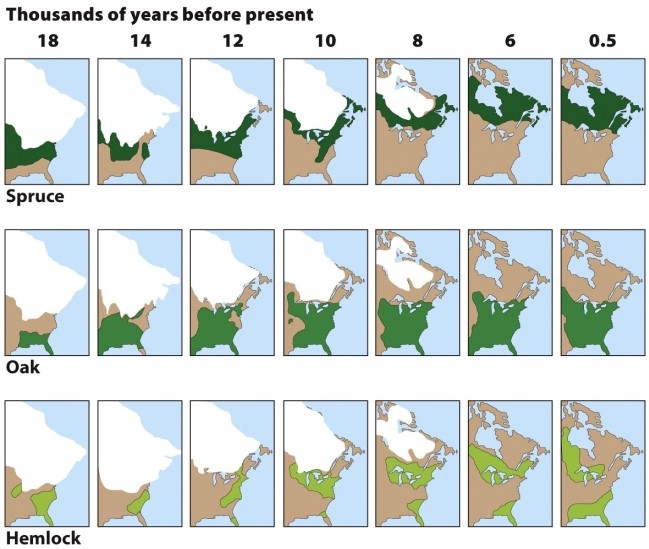
(Figure 22.27) What caused changing tree distributions seen in the figure? As global warming increases temperatures, what can be expected to happen to tree distributions of spruce, hemlock, and oak?
Question
Question
Question
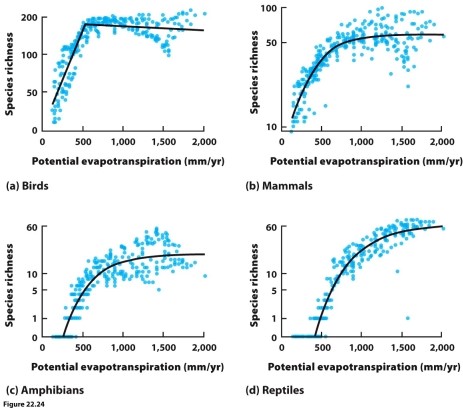
(Figure 22.24) As you can see in the figure, species richness for animals and plants increases with average potential evapotranspiration, but the curves level off at high levels of evapotranspiration. Why are high levels of evapotranspiration associated with a plateau in species richness?
Question
Question
Question
Question
Question
Question
Question
Question
Question
Question
Question
Question
Question
Question

Unlock Deck
Sign up to unlock the cards in this deck!
Unlock Deck
Unlock Deck
1/58

Play

Full screen (f)
Deck 22: Landscape Ecology, Biogeography, and Global Biodiversity
1
The number of species in a relatively small area of homogeneous habitat is called
A) regional diversity.
B) local diversity.
C) regional species pool.
D) gamma diversity.
A) regional diversity.
B) local diversity.
C) regional species pool.
D) gamma diversity.
B
2
A long-lasting influence of historical processes on the current ecology of an area is called a _____ effect.
A) retention
B) landscape
C) legacy
D) spatial
A) retention
B) landscape
C) legacy
D) spatial
C
3
Which of the following describes the log-log form of the species area curve?
A) log S + log c = z log A
B) log S = log c × z log A
C) log S = log c + z log A
D) log S + z log A = log c
A) log S + log c = z log A
B) log S = log c × z log A
C) log S = log c + z log A
D) log S + z log A = log c
C
4
Eskers are legacy effects of
A) volcanic eruptions.
B) asteroid strikes.
C) glaciers.
D) floods.
A) volcanic eruptions.
B) asteroid strikes.
C) glaciers.
D) floods.
Unlock Deck
Unlock for access to all 58 flashcards in this deck.
Unlock Deck
k this deck
5
A regional species pool is the collection of species
A) that differ in occurrence within a region.
B) that differ in occurrence between two habitats.
C) in a relatively small area of homogeneous habitat.
D) in a large area of homogeneous habitat.
A) that differ in occurrence within a region.
B) that differ in occurrence between two habitats.
C) in a relatively small area of homogeneous habitat.
D) in a large area of homogeneous habitat.
Unlock Deck
Unlock for access to all 58 flashcards in this deck.
Unlock Deck
k this deck
6
A classic study by MacArthur and Wilson demonstrated that as the size of islands increases, species
A) richness increases.
B) richness decreases.
C) diversity increases.
D) diversity decreases.
A) richness increases.
B) richness decreases.
C) diversity increases.
D) diversity decreases.
Unlock Deck
Unlock for access to all 58 flashcards in this deck.
Unlock Deck
k this deck
7
Which field considers the spatial arrangement of habitats at different scales?
A) community ecology
B) landscape ecology
C) ecosystem ecology
D) population ecology
A) community ecology
B) landscape ecology
C) ecosystem ecology
D) population ecology
Unlock Deck
Unlock for access to all 58 flashcards in this deck.
Unlock Deck
k this deck
8
Which of the following is NOT an effect of fragmentation of a large contiguous habitat?
A) The amount of edge habitat decreases.
B) The total amount of habitat decreases.
C) The number of habitat patches increases.
D) Patch isolation increases.
A) The amount of edge habitat decreases.
B) The total amount of habitat decreases.
C) The number of habitat patches increases.
D) Patch isolation increases.
Unlock Deck
Unlock for access to all 58 flashcards in this deck.
Unlock Deck
k this deck
9
In species-area curves, S represents
A) number of species.
B) area of the site.
C) species diversity.
D) a constant fitted to the data.
A) number of species.
B) area of the site.
C) species diversity.
D) a constant fitted to the data.
Unlock Deck
Unlock for access to all 58 flashcards in this deck.
Unlock Deck
k this deck
10
In the log-log form of the species-area curve, the slope of the relationship, z, is typically
A) 0.5 to 1.
B) 0.2 to 0.35.
C) 0.1 to 0.15.
D) 1 to 2.
A) 0.5 to 1.
B) 0.2 to 0.35.
C) 0.1 to 0.15.
D) 1 to 2.
Unlock Deck
Unlock for access to all 58 flashcards in this deck.
Unlock Deck
k this deck
11
Which is NOT a way that edge habitat differs from interior habitat?
A) Edge habitat has more sunlight.
B) Edge habitat has warmer temperatures.
C) Edge habitat has higher soil moisture.
D) Edge habitat has higher rates of evaporation.
A) Edge habitat has more sunlight.
B) Edge habitat has warmer temperatures.
C) Edge habitat has higher soil moisture.
D) Edge habitat has higher rates of evaporation.
Unlock Deck
Unlock for access to all 58 flashcards in this deck.
Unlock Deck
k this deck
12
How does fire cause habitat heterogeneity?
Unlock Deck
Unlock for access to all 58 flashcards in this deck.
Unlock Deck
k this deck
13
What do studies of Roman Empire settlements tell us about the legacy effects of humans on the landscape? How do human settlements cause legacy effects?
Unlock Deck
Unlock for access to all 58 flashcards in this deck.
Unlock Deck
k this deck
14
Local species diversity is also called _____ diversity.
A) gamma
B) beta
C) alpha
D) delta
A) gamma
B) beta
C) alpha
D) delta
Unlock Deck
Unlock for access to all 58 flashcards in this deck.
Unlock Deck
k this deck
15
All of the species in all of the habitats that constitute a large geographic area are called
A) regional diversity.
B) alpha diversity.
C) local diversity.
D) regional species pool.
A) regional diversity.
B) alpha diversity.
C) local diversity.
D) regional species pool.
Unlock Deck
Unlock for access to all 58 flashcards in this deck.
Unlock Deck
k this deck
16
As habitat _____, species diversity _____.
A) homogeneity decreases; decreases
B) homogeneity increases; increases
C) heterogeneity decreases; increases
D) heterogeneity increases; increases
A) homogeneity decreases; decreases
B) homogeneity increases; increases
C) heterogeneity decreases; increases
D) heterogeneity increases; increases
Unlock Deck
Unlock for access to all 58 flashcards in this deck.
Unlock Deck
k this deck
17
Which of the following equations describes the species-area curve?
A) S = cAz
B) A = cSz
C) S = czA
D) SA = cz
A) S = cAz
B) A = cSz
C) S = czA
D) SA = cz
Unlock Deck
Unlock for access to all 58 flashcards in this deck.
Unlock Deck
k this deck
18
Arranging species in the regional pool among localities according to their adaptations and interactions is called _____ sorting.
A) biodiversity
B) species
C) gamma
D) alpha
A) biodiversity
B) species
C) gamma
D) alpha
Unlock Deck
Unlock for access to all 58 flashcards in this deck.
Unlock Deck
k this deck
19
Researchers studying soil conditions and plant species between 1 and 500 metres from former Roman settlements found that sites closer to settlements had
A) higher soil PH.
B) more available phosphorus.
C) greater species richness.
D) all of the above.
A) higher soil PH.
B) more available phosphorus.
C) greater species richness.
D) all of the above.
Unlock Deck
Unlock for access to all 58 flashcards in this deck.
Unlock Deck
k this deck
20
Regional species diversity is also called _____ diversity.
A) beta
B) alpha
C) delta
D) gamma
A) beta
B) alpha
C) delta
D) gamma
Unlock Deck
Unlock for access to all 58 flashcards in this deck.
Unlock Deck
k this deck
21
Which of the following would be expected to have the largest population at equilibrium?
A) large near island
B) large far island
C) small near island
D) small far island
A) large near island
B) large far island
C) small near island
D) small far island
Unlock Deck
Unlock for access to all 58 flashcards in this deck.
Unlock Deck
k this deck
22
In the equilibrium theory of island biogeography, occurs where extinction _____ colonization.
A) is greater than
B) equals
C) is less than
D) none of the above
A) is greater than
B) equals
C) is less than
D) none of the above
Unlock Deck
Unlock for access to all 58 flashcards in this deck.
Unlock Deck
k this deck
23
When habitat is fragmented, a(n) _____ forms along the edges.
A) ecotone
B) biome
C) mesocosm
D) microhabitat
A) ecotone
B) biome
C) mesocosm
D) microhabitat
Unlock Deck
Unlock for access to all 58 flashcards in this deck.
Unlock Deck
k this deck
24
MacArthur and Wilson's theory of island biogeography considers both species-area relationships and
A) biomes.
B) productivity.
C) isolation.
D) environment.
A) biomes.
B) productivity.
C) isolation.
D) environment.
Unlock Deck
Unlock for access to all 58 flashcards in this deck.
Unlock Deck
k this deck
25
Given average temperature and humidity, potential evapotranspiration is the amount of water that could be
A) evaporated from the soil.
B) transpired by plants.
C) evaporated from the habitat.
D) evaporated from the soil and transpired by plants.
A) evaporated from the soil.
B) transpired by plants.
C) evaporated from the habitat.
D) evaporated from the soil and transpired by plants.
Unlock Deck
Unlock for access to all 58 flashcards in this deck.
Unlock Deck
k this deck
26
Islands at equilibrium that are farther from the mainland contain fewer species than nearer islands at equilibrium because farther islands have
A) less colonization.
B) greater emigration.
C) less isolation.
D) greater extinction.
A) less colonization.
B) greater emigration.
C) less isolation.
D) greater extinction.
Unlock Deck
Unlock for access to all 58 flashcards in this deck.
Unlock Deck
k this deck
27
Smaller islands at equilibrium contain fewer species than larger islands at equilibrium because smaller islands have
A) less colonization.
B) greater extinction.
C) greater isolation.
D) greater emigration.
A) less colonization.
B) greater extinction.
C) greater isolation.
D) greater emigration.
Unlock Deck
Unlock for access to all 58 flashcards in this deck.
Unlock Deck
k this deck
28
The equilibrium theory of island biogeography states that the number of species on an island reflects a balance between
A) emigration of existing species and extinction of existing species.
B) colonization of new species and extinction of existing species.
C) evolution of new species and emigration of existing species.
D) colonization of new species and emigration of existing species.
A) emigration of existing species and extinction of existing species.
B) colonization of new species and extinction of existing species.
C) evolution of new species and emigration of existing species.
D) colonization of new species and emigration of existing species.
Unlock Deck
Unlock for access to all 58 flashcards in this deck.
Unlock Deck
k this deck
29
For marine organisms, the highest diversity is seen at _____ and the lowest diversity is seen at _____.
A) low longitudes; high longitudes
B) high longitudes; low longitudes
C) low latitudes; high latitudes
D) high latitudes; low latitudes
A) low longitudes; high longitudes
B) high longitudes; low longitudes
C) low latitudes; high latitudes
D) high latitudes; low latitudes
Unlock Deck
Unlock for access to all 58 flashcards in this deck.
Unlock Deck
k this deck
30
PET is a measurement that combines the amount of solar radiation and
A) temperature.
B) precipitation.
C) transpiration.
D) evaporation.
A) temperature.
B) precipitation.
C) transpiration.
D) evaporation.
Unlock Deck
Unlock for access to all 58 flashcards in this deck.
Unlock Deck
k this deck
31
A graph of the number of species observed in relation to the number of individuals sampled is called a species _____ curve.
A) increase
B) accretion
C) accumulation
D) area
A) increase
B) accretion
C) accumulation
D) area
Unlock Deck
Unlock for access to all 58 flashcards in this deck.
Unlock Deck
k this deck
32
Which of the following is NOT associated with low terrestrial diversity?
A) recent glaciation
B) variation in vegetation
C) high temperature
D) low precipitation
A) recent glaciation
B) variation in vegetation
C) high temperature
D) low precipitation
Unlock Deck
Unlock for access to all 58 flashcards in this deck.
Unlock Deck
k this deck
33
How can we apply the theory of island biogeography to determine which characteristics might give a nature reserve the highest probable success rate in preserving a region's biodiversity? Discuss size, number, proximity, spatial arrangement, connectivity, and shape of the reserve.
Unlock Deck
Unlock for access to all 58 flashcards in this deck.
Unlock Deck
k this deck
34
How does habitat fragmentation increase the total edge habitat? Describe the effect of habitat fragmentation on a 600-metre by 600-metre forest plot that has been divided into nine 200-metre by 200-metre sections using calculations of edge size.
Unlock Deck
Unlock for access to all 58 flashcards in this deck.
Unlock Deck
k this deck
35
Small intervening patches that dispersing organisms can use to move between large favourable habitats are called
A) habitat corridors.
B) stepping stones.
C) glades.
D) matrix pathways.
A) habitat corridors.
B) stepping stones.
C) glades.
D) matrix pathways.
Unlock Deck
Unlock for access to all 58 flashcards in this deck.
Unlock Deck
k this deck
36
In the Northern Hemisphere, the number of species of plants generally
A) decreases from east to west.
B) increases from east to west.
C) decreases from north to south.
D) increases from north to south.
A) decreases from east to west.
B) increases from east to west.
C) decreases from north to south.
D) increases from north to south.
Unlock Deck
Unlock for access to all 58 flashcards in this deck.
Unlock Deck
k this deck
37
In North America, amphibian diversity is greatest in the
A) northeast.
B) northwest.
C) southeast.
D) southwest.
A) northeast.
B) northwest.
C) southeast.
D) southwest.
Unlock Deck
Unlock for access to all 58 flashcards in this deck.
Unlock Deck
k this deck
38
Based on the theory of island biogeography, which statement about reserve designs is TRUE?
A) Small reserves are better than large reserves.
B) Oval reserves are better than circular reserves.
C) One large reserve is better than many small reserves.
D) Remote reserves are better than nearby reserves.
A) Small reserves are better than large reserves.
B) Oval reserves are better than circular reserves.
C) One large reserve is better than many small reserves.
D) Remote reserves are better than nearby reserves.
Unlock Deck
Unlock for access to all 58 flashcards in this deck.
Unlock Deck
k this deck
39
In North America, the number of species of mammals generally
A) decreases from east to west.
A) increases from north to south.
B) decreases from north to south.
C) increases from east to west.
A) decreases from east to west.
A) increases from north to south.
B) decreases from north to south.
C) increases from east to west.
Unlock Deck
Unlock for access to all 58 flashcards in this deck.
Unlock Deck
k this deck
40
In North America, reptile diversity is greatest in the
A) south.
B) east.
C) west.
D) north.
A) south.
B) east.
C) west.
D) north.
Unlock Deck
Unlock for access to all 58 flashcards in this deck.
Unlock Deck
k this deck
41
(Figure 22.27) What caused changing tree distributions seen in the figure? As global warming increases temperatures, what can be expected to happen to tree distributions of spruce, hemlock, and oak?
Unlock Deck
Unlock for access to all 58 flashcards in this deck.
Unlock Deck
k this deck
42
Time since glaciation is one possible predictor of species diversity. Explain how time since glaciation leads to differences in terrestrial diversity between polar and tropical regions.
Unlock Deck
Unlock for access to all 58 flashcards in this deck.
Unlock Deck
k this deck
43
According to the _____ hypothesis, sites with higher amounts of energy are able to support more species.
A) energetic-diversity
B) energy-diversity
C) energy-biodiversity
D) bioenergetics-diversity
A) energetic-diversity
B) energy-diversity
C) energy-biodiversity
D) bioenergetics-diversity
Unlock Deck
Unlock for access to all 58 flashcards in this deck.
Unlock Deck
k this deck
44
(Figure 22.24) As you can see in the figure, species richness for animals and plants increases with average potential evapotranspiration, but the curves level off at high levels of evapotranspiration. Why are high levels of evapotranspiration associated with a plateau in species richness?
Unlock Deck
Unlock for access to all 58 flashcards in this deck.
Unlock Deck
k this deck
45
Marine environments are most diverse in _____ environments and most productive in _____ environments.
A) tropical; tropical
B) tropical; temperate
C) temperate; tropical
D) temperate; temperate
A) tropical; tropical
B) tropical; temperate
C) temperate; tropical
D) temperate; temperate
Unlock Deck
Unlock for access to all 58 flashcards in this deck.
Unlock Deck
k this deck
46
Eventually _____ split into South America, Africa, Antarctica, Australia, and India.
A) Gondwana
B) Pangaea
C) Indomalaysia
D) Laurasia
A) Gondwana
B) Pangaea
C) Indomalaysia
D) Laurasia
Unlock Deck
Unlock for access to all 58 flashcards in this deck.
Unlock Deck
k this deck
47
Which of the following is NOT a Southern Hemisphere biogeographic region?
A) Afrotropical
B) Indomalayan
C) Nearctic
D) Neotropical
A) Afrotropical
B) Indomalayan
C) Nearctic
D) Neotropical
Unlock Deck
Unlock for access to all 58 flashcards in this deck.
Unlock Deck
k this deck
48
The movement of landmasses across the surface of Earth is called
A) tectonic spread.
B) Pangaea.
C) continental drift.
D) continental divide.
A) tectonic spread.
B) Pangaea.
C) continental drift.
D) continental divide.
Unlock Deck
Unlock for access to all 58 flashcards in this deck.
Unlock Deck
k this deck
49
About 150 million years ago the single landmass separated into northern and southern landmasses called
A) Laurasia and Gondwana.
B) Gondwana and Afrotropica.
C) Pangaea and Laurasia.
D) Nearctica and Palearctica.
A) Laurasia and Gondwana.
B) Gondwana and Afrotropica.
C) Pangaea and Laurasia.
D) Nearctica and Palearctica.
Unlock Deck
Unlock for access to all 58 flashcards in this deck.
Unlock Deck
k this deck
50
In which biogeographic region is Canada?
A) Neotropical
B) Nearctic
C) Palearctic
D) Indomalayan
A) Neotropical
B) Nearctic
C) Palearctic
D) Indomalayan
Unlock Deck
Unlock for access to all 58 flashcards in this deck.
Unlock Deck
k this deck
51
Which biogeographic region is also called the Oriental region?
A) Indomalayan
B) Afrotropical
C) Australian
D) Palearctic
A) Indomalayan
B) Afrotropical
C) Australian
D) Palearctic
Unlock Deck
Unlock for access to all 58 flashcards in this deck.
Unlock Deck
k this deck
52
About 250 million years ago, all of the Earth's landmasses were joined as a single landmass called
A) Pangaea.
B) Gondwana.
C) Laurasia.
D) Indomalaysia.
A) Pangaea.
B) Gondwana.
C) Laurasia.
D) Indomalaysia.
Unlock Deck
Unlock for access to all 58 flashcards in this deck.
Unlock Deck
k this deck
53
Eventually _____ split into North America, Europe, and Asia.
A) Gondwana
B) Pangaea
C) Laurasia
D) Neotropica
A) Gondwana
B) Pangaea
C) Laurasia
D) Neotropica
Unlock Deck
Unlock for access to all 58 flashcards in this deck.
Unlock Deck
k this deck
54
When the continents divided 60 million years ago, there was a land bridge between
A) Africa and Europe.
B) India and Asia.
C) North America and South America.
D) Asia and North America.
A) Africa and Europe.
B) India and Asia.
C) North America and South America.
D) Asia and North America.
Unlock Deck
Unlock for access to all 58 flashcards in this deck.
Unlock Deck
k this deck
55
In which biogeographic region is Egypt?
A) Neotropical
B) Afrotropical
C) Indomalayan
D) Palearctic
A) Neotropical
B) Afrotropical
C) Indomalayan
D) Palearctic
Unlock Deck
Unlock for access to all 58 flashcards in this deck.
Unlock Deck
k this deck
56
Why does Australia have a wide variety of unique animals and plants? Give examples.
Unlock Deck
Unlock for access to all 58 flashcards in this deck.
Unlock Deck
k this deck
57
Landmass movement occurs because islands of _____ rock are moved by _____ currents of semimolten material.
A) high-density; conduction
A) high-density; convection
A) low-density; convection
B) low-density; conduction
A) high-density; conduction
A) high-density; convection
A) low-density; convection
B) low-density; conduction
Unlock Deck
Unlock for access to all 58 flashcards in this deck.
Unlock Deck
k this deck
58
North and South America were joined by the Isthmus of Panama
A) 3 million to 6 million years ago.
B) 10 million to 12 million years ago.
C) 5 million to 8 million years ago.
D) 1 million to 2 million years ago.
A) 3 million to 6 million years ago.
B) 10 million to 12 million years ago.
C) 5 million to 8 million years ago.
D) 1 million to 2 million years ago.
Unlock Deck
Unlock for access to all 58 flashcards in this deck.
Unlock Deck
k this deck
Unlock Deck
Unlock for access to all 58 flashcards in this deck.






