







 Chat with AI

Deck 20: Public Choice and Special-Interest-Group Politics
Full screen (f)

Question

Question
Question
Question
Question
Question
Question
Exhibit 32-1

Refer to Exhibit 32-1.The exhibit shows the breakdown of benefits and costs for a four-person town of a proposed $1,200 addition in books to the public library.How will each of the four persons,A-D,vote? (The first answer in the list is how person A would vote,the second is how person B would vote,and so on,so that "for" indicates that the individual would be in favor of having the additional books purchased by the library. )
A) for;for;for;for
B) against;for;against;against
C) for;against;against;against
D) for;against;for;for
E) none of the above
Refer to Exhibit 32-1.The exhibit shows the breakdown of benefits and costs for a four-person town of a proposed $1,200 addition in books to the public library.How will each of the four persons,A-D,vote? (The first answer in the list is how person A would vote,the second is how person B would vote,and so on,so that "for" indicates that the individual would be in favor of having the additional books purchased by the library. )
A) for;for;for;for
B) against;for;against;against
C) for;against;against;against
D) for;against;for;for
E) none of the above
Question
Question
Question
Question
Question
Question
Question
Question
Question
Question
Question
Question
Question
Question
Question
Question
Question
Question
Question
Question
Question
Question
Question
Question
Question
Question
Exhibit 32-1
Refer to Exhibit 32-l.The exhibit shows the breakdown of benefits and costs for a four-person town of a proposed $1,200 addition in books to the public library.The members of the community get to vote on the project at hand,and the majority rules.Given the data,the $1,200 will
A) be spent,even though the total benefits are less than the total costs.
B) not be spent,since more persons are against the project than are for it.
C) be spent,since the total benefits are greater than the total costs.
D) not be spent,since the total benefits are less than the total costs.
Refer to Exhibit 32-l.The exhibit shows the breakdown of benefits and costs for a four-person town of a proposed $1,200 addition in books to the public library.The members of the community get to vote on the project at hand,and the majority rules.Given the data,the $1,200 will
A) be spent,even though the total benefits are less than the total costs.
B) not be spent,since more persons are against the project than are for it.
C) be spent,since the total benefits are greater than the total costs.
D) not be spent,since the total benefits are less than the total costs.
Question
Question
Question
Question
Question
Question
Exhibit 32-1
Refer to Exhibit 32-1.The exhibit shows the breakdown of benefits and costs for a four-person town considering the purchase of an additional $1,200 worth of books for the public library.If simple majority voting determines the outcome,the books will
A) be purchased because more persons are for it than against it.
B) be purchased because the total benefits are greater than the total costs.
C) not be purchased even though total benefits exceed total costs.
D) not be purchased because the total costs are greater than the total benefits.
Refer to Exhibit 32-1.The exhibit shows the breakdown of benefits and costs for a four-person town considering the purchase of an additional $1,200 worth of books for the public library.If simple majority voting determines the outcome,the books will
A) be purchased because more persons are for it than against it.
B) be purchased because the total benefits are greater than the total costs.
C) not be purchased even though total benefits exceed total costs.
D) not be purchased because the total costs are greater than the total benefits.
Question
Question
Question
Question
Question
Question
Question
Question
Question
Question
Question
Question
Question
Question
Question
Question
Question
Question
Question
Question
Question
Question
Exhibit 32-2 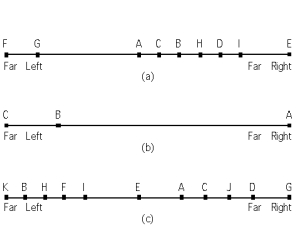
Refer to Exhibit 32-2-(c).Two candidates are competing for an electorate consisting of 11 voters labeled A-K shown positioned with respect to their ideological stands on issues.The median voter theory would predict that candidates will assume the ideological position(s)
A) of voters K and G,respectively.
B) of voters H and J,respectively.
C) of voters I and A,respectively.
D) of voter E.
Refer to Exhibit 32-2-(c).Two candidates are competing for an electorate consisting of 11 voters labeled A-K shown positioned with respect to their ideological stands on issues.The median voter theory would predict that candidates will assume the ideological position(s)
A) of voters K and G,respectively.
B) of voters H and J,respectively.
C) of voters I and A,respectively.
D) of voter E.
Question
Exhibit 32-3

Refer to Exhibit 32-3.The exhibit shows the breakdown of benefits and costs for a five-person community considering whether to purchase a $5,000 statue of Adam Smith to put in the center of the public square.If simple majority voting determines the outcome,the statue _______________ be purchased,and the total costs are ______________ the total benefits of the statue.
A) will;greater than
B) will;less than
C) will not;greater than
D) will not;less than
Refer to Exhibit 32-3.The exhibit shows the breakdown of benefits and costs for a five-person community considering whether to purchase a $5,000 statue of Adam Smith to put in the center of the public square.If simple majority voting determines the outcome,the statue _______________ be purchased,and the total costs are ______________ the total benefits of the statue.
A) will;greater than
B) will;less than
C) will not;greater than
D) will not;less than
Question
Question
Exhibit 32-2
Refer to Exhibit 32-2-(a).Two candidates are competing for an electorate consisting of 9 voters labeled A-I shown positioned with respect to their ideological stands on issues.The median voter theory would predict that candidates will assume the ideological position(s)
A) of voter A.
B) halfway between that of voter G and that of voter A.
C) of voter C.
D) of voter B.
E) of voter G and voter I,respectively.
Refer to Exhibit 32-2-(a).Two candidates are competing for an electorate consisting of 9 voters labeled A-I shown positioned with respect to their ideological stands on issues.The median voter theory would predict that candidates will assume the ideological position(s)
A) of voter A.
B) halfway between that of voter G and that of voter A.
C) of voter C.
D) of voter B.
E) of voter G and voter I,respectively.
Question

Refer to Situation 32-1.Which of the following arguments is least likely to have been used by the U.S.auto industry to argue for import quotas?
A) If the quantity of low-priced import cars is not restricted,foreigners will overtake the U.S.car market.
B) A healthy auto industry is vital to our national security.
C) If import quotas are in place,our profits will increase by about $300 per vehicle.
D) Japan is protecting its market,and so should we;all we want is a level playing field.
Question
Question
Question
Exhibit 32-2
Refer to Exhibit 32-2-(b).Two candidates are competing for an electorate consisting of 3 voters labeled A,B,and C shown positioned with respect to their ideological stands on issues.The median voter theory would predict that candidates will assume the ideological position(s)
A) of voter B.
B) of voters C and A,respectively.
C) halfway between voter C and voter A.
D) halfway between voter B and voter A.
E) halfway between voter C and voter B,for one candidate,and of voter A for the other.
Refer to Exhibit 32-2-(b).Two candidates are competing for an electorate consisting of 3 voters labeled A,B,and C shown positioned with respect to their ideological stands on issues.The median voter theory would predict that candidates will assume the ideological position(s)
A) of voter B.
B) of voters C and A,respectively.
C) halfway between voter C and voter A.
D) halfway between voter B and voter A.
E) halfway between voter C and voter B,for one candidate,and of voter A for the other.
Question
Question
Question
Question
Question
Question
Question
Exhibit 32-3
Refer to Exhibit 32-3.The exhibit shows the breakdown of benefits and costs for a five-person community considering whether to purchase a $5,000 statue of Adam Smith to put in the center of the public square.How will each of the five persons (from Milton to Kenneth,in order)vote?
A) against;against;against;for;for
B) against;against;for;for;against
C) against;for;for;for;for
D) for;for;for;against;against
E) for;for;against;against;for
Refer to Exhibit 32-3.The exhibit shows the breakdown of benefits and costs for a five-person community considering whether to purchase a $5,000 statue of Adam Smith to put in the center of the public square.How will each of the five persons (from Milton to Kenneth,in order)vote?
A) against;against;against;for;for
B) against;against;for;for;against
C) against;for;for;for;for
D) for;for;for;against;against
E) for;for;against;against;for
Question
Question
Refer to Situation 32-l.This episode can be seen as an instance of
A) rational ignorance.
B) logrolling.
C) special interest politics.
D) a zero sum game.
Question
Question
Refer to Situation 32-l.At the time the total yearly salary (including all the benefits)of the average auto worker was no more than $50,000 per year,and the cost per job saved was estimated at $160,000 per worker per year.We can conclude that
A) import quotas are a cost-efficient way of saving jobs.
B) the U.S.auto industry,through its lobbying efforts,managed to promote the general public interest.
C) the net social benefits of import quotas were positive.
D) all of the above
E) none of the above
Question

Unlock Deck
Sign up to unlock the cards in this deck!
Unlock Deck
Unlock Deck
1/131

Play

Full screen (f)
Deck 20: Public Choice and Special-Interest-Group Politics
1
The model predicting victory in a two-person race for the candidate closer to occupying the center of the voter distribution is built on the assumption that
A) people always vote for the Democratic candidate if they are Democrats and for the Republican candidate if they are Republicans.
B) people vote for the candidate who comes closer to matching their own views.
C) most people don't vote unless the election is predicted to be close.
D) none of the above
A) people always vote for the Democratic candidate if they are Democrats and for the Republican candidate if they are Republicans.
B) people vote for the candidate who comes closer to matching their own views.
C) most people don't vote unless the election is predicted to be close.
D) none of the above
people vote for the candidate who comes closer to matching their own views.
2
Politicians will usually
A) prefer to discuss means rather than ends.
B) prefer to discuss the issues in specific terms rather than in general terms.
C) not like to be perceived as either an extreme "right-winger" or an extreme "left-winger."
D) refer to their opponents as "middle-of-the-roaders."
A) prefer to discuss means rather than ends.
B) prefer to discuss the issues in specific terms rather than in general terms.
C) not like to be perceived as either an extreme "right-winger" or an extreme "left-winger."
D) refer to their opponents as "middle-of-the-roaders."
not like to be perceived as either an extreme "right-winger" or an extreme "left-winger."
3
In a simple majority vote on a public project,
A) the project will never be undertaken if the costs exceed the benefits.
B) the project may be undertaken even though the total costs exceed the total benefits.
C) the intensity of individual preferences is taken into account.
D) the project will always be undertaken if the total benefits exceed the total costs.
A) the project will never be undertaken if the costs exceed the benefits.
B) the project may be undertaken even though the total costs exceed the total benefits.
C) the intensity of individual preferences is taken into account.
D) the project will always be undertaken if the total benefits exceed the total costs.
the project may be undertaken even though the total costs exceed the total benefits.
4
Public choice is concerned with
A) relative prices.
B) government decision making.
C) marketing techniques.
D) consumer surveying.
A) relative prices.
B) government decision making.
C) marketing techniques.
D) consumer surveying.
Unlock Deck
Unlock for access to all 131 flashcards in this deck.
Unlock Deck
k this deck
5
A public choice theorist would be most likely to say that government failure is a consequence of the
A) actions of selfish and corrupt politicians.
B) rational behavior of the participants of the political process.
C) irrational behavior of voters.
D) irrational behavior of special interest groups.
A) actions of selfish and corrupt politicians.
B) rational behavior of the participants of the political process.
C) irrational behavior of voters.
D) irrational behavior of special interest groups.
Unlock Deck
Unlock for access to all 131 flashcards in this deck.
Unlock Deck
k this deck
6
Suppose candidate A is conservative and candidate B is liberal and both are currently positioned away from the "middle ground" toward their respective ends of the political spectrum.We would expect that as the campaign draws closer to election day,
A) candidate A will move to the right (more conservative)and candidate B will move to the left (more liberal).
B) both candidates A and B will move to the other's position in an attempt to capture the other's supporters.
C) candidate A will move closer to the middle,and candidate B will stay where he or she is because he or she realizes that Americans are basically liberal.
D) candidate B will move closer to the middle,and candidate A will stay where he or she is because he or she realizes that Americans are basically conservative.
E) both candidates will move toward the middle.
A) candidate A will move to the right (more conservative)and candidate B will move to the left (more liberal).
B) both candidates A and B will move to the other's position in an attempt to capture the other's supporters.
C) candidate A will move closer to the middle,and candidate B will stay where he or she is because he or she realizes that Americans are basically liberal.
D) candidate B will move closer to the middle,and candidate A will stay where he or she is because he or she realizes that Americans are basically conservative.
E) both candidates will move toward the middle.
Unlock Deck
Unlock for access to all 131 flashcards in this deck.
Unlock Deck
k this deck
7
Exhibit 32-1
Refer to Exhibit 32-1.The exhibit shows the breakdown of benefits and costs for a four-person town of a proposed $1,200 addition in books to the public library.How will each of the four persons,A-D,vote? (The first answer in the list is how person A would vote,the second is how person B would vote,and so on,so that "for" indicates that the individual would be in favor of having the additional books purchased by the library. )
A) for;for;for;for
B) against;for;against;against
C) for;against;against;against
D) for;against;for;for
E) none of the above
Refer to Exhibit 32-1.The exhibit shows the breakdown of benefits and costs for a four-person town of a proposed $1,200 addition in books to the public library.How will each of the four persons,A-D,vote? (The first answer in the list is how person A would vote,the second is how person B would vote,and so on,so that "for" indicates that the individual would be in favor of having the additional books purchased by the library. )
A) for;for;for;for
B) against;for;against;against
C) for;against;against;against
D) for;against;for;for
E) none of the above
Unlock Deck
Unlock for access to all 131 flashcards in this deck.
Unlock Deck
k this deck
8
Which of the following statements about a political campaign is false?
A) Candidates often label their opponents as either "too far right" or "too far left."
B) Candidates often call themselves "middle-of-the-roaders" rather than "right-wingers" or "left-wingers."
C) Candidates often tend to talk about ends rather than means.
D) Candidates often tend to talk in specific terms rather than general terms about what needs to be done.
A) Candidates often label their opponents as either "too far right" or "too far left."
B) Candidates often call themselves "middle-of-the-roaders" rather than "right-wingers" or "left-wingers."
C) Candidates often tend to talk about ends rather than means.
D) Candidates often tend to talk in specific terms rather than general terms about what needs to be done.
Unlock Deck
Unlock for access to all 131 flashcards in this deck.
Unlock Deck
k this deck
9
Public choice refers to
A) the decisions and decision-making processes that individuals go through to solve public problems.
B) political decisions made in the interest of the public at large.
C) the application of economic principles and tools to public-sector decision making.
D) the process that individuals undergo to decide what goods and services they will purchase and consume.
E) the process that individuals undergo to decide whether or not they will pursue a career government service.
A) the decisions and decision-making processes that individuals go through to solve public problems.
B) political decisions made in the interest of the public at large.
C) the application of economic principles and tools to public-sector decision making.
D) the process that individuals undergo to decide what goods and services they will purchase and consume.
E) the process that individuals undergo to decide whether or not they will pursue a career government service.
Unlock Deck
Unlock for access to all 131 flashcards in this deck.
Unlock Deck
k this deck
10
Political candidates running for the same office tend to voice
A) the same views on how things should be accomplished so that one candidate does not gain an advantage over the other.
B) the same views on how things should be accomplished,simply because there usually is no difference between their views.
C) quite different views on how things should be accomplished so that voters will see that one approach is better than another.
D) the same views on what things should be accomplished,but not speak specifically on how things should be accomplished.
A) the same views on how things should be accomplished so that one candidate does not gain an advantage over the other.
B) the same views on how things should be accomplished,simply because there usually is no difference between their views.
C) quite different views on how things should be accomplished so that voters will see that one approach is better than another.
D) the same views on what things should be accomplished,but not speak specifically on how things should be accomplished.
Unlock Deck
Unlock for access to all 131 flashcards in this deck.
Unlock Deck
k this deck
11
According to public choice theorists,people in the market sector and people in the public sector behave differently because
A) people in the two sectors have different motives.
B) the two sectors have different institutional arrangements.
C) government employees do not act in their own self-interest.
D) there are economies of scale in the market sector.
A) people in the two sectors have different motives.
B) the two sectors have different institutional arrangements.
C) government employees do not act in their own self-interest.
D) there are economies of scale in the market sector.
Unlock Deck
Unlock for access to all 131 flashcards in this deck.
Unlock Deck
k this deck
12
During an election,a candidate who is not doing as well in the polls as his or her opponent will
A) modify his or her position so that it is more like that of his or her opponent.
B) modify his or her position so that it is less like that of his or her opponent.
C) become more specific in discussing the issues.
D) label his or her opponent as a middle-of-the-roader.
A) modify his or her position so that it is more like that of his or her opponent.
B) modify his or her position so that it is less like that of his or her opponent.
C) become more specific in discussing the issues.
D) label his or her opponent as a middle-of-the-roader.
Unlock Deck
Unlock for access to all 131 flashcards in this deck.
Unlock Deck
k this deck
13
Political candidates in a two-person race prefer to be viewed as occupying the center of the political distribution because
A) occupying the center is a sign of being a leader.
B) political candidates usually prefer to maintain the status quo and the center is the status quo.
C) the electorate is largely in the "wings" (extreme ends)of the political distribution.
D) whoever comes closer to the center usually wins the election.
A) occupying the center is a sign of being a leader.
B) political candidates usually prefer to maintain the status quo and the center is the status quo.
C) the electorate is largely in the "wings" (extreme ends)of the political distribution.
D) whoever comes closer to the center usually wins the election.
Unlock Deck
Unlock for access to all 131 flashcards in this deck.
Unlock Deck
k this deck
14
In a political election,a candidate whose positions are on the left will tend to be labeled __________ by his or her opponent.
A) too far to the left
B) too far to the right
C) too much of a middle-of-the-roader
D) an unknown quantity
A) too far to the left
B) too far to the right
C) too much of a middle-of-the-roader
D) an unknown quantity
Unlock Deck
Unlock for access to all 131 flashcards in this deck.
Unlock Deck
k this deck
15
Candidate X and Candidate Y have a debate.X's advisers believe that one result of the debate is that Y will appear to the voters as further to the left than before.This is good news for X
A) if Y was already left-of-center before the debate.
B) if Y was right-of-center before the debate.
C) no matter what Y's previous position was.
D) under no circumstances.
A) if Y was already left-of-center before the debate.
B) if Y was right-of-center before the debate.
C) no matter what Y's previous position was.
D) under no circumstances.
Unlock Deck
Unlock for access to all 131 flashcards in this deck.
Unlock Deck
k this deck
16
A political candidate running in a two-person race is likely to occupy
A) an extreme end of the political spectrum and hope that his or her opponent will gravitate toward the middle so that he or she can then claim that his or her opponent has flip-flopped.
B) the middle of the political spectrum and label his or her opponent as an extremist (either liberal or conservative).
C) a position somewhere between the middle of the political spectrum and an extreme end so that he or she can move either way shortly before the election.
D) one extreme end of the political spectrum early in the race and the other extreme end near the end of the race.
A) an extreme end of the political spectrum and hope that his or her opponent will gravitate toward the middle so that he or she can then claim that his or her opponent has flip-flopped.
B) the middle of the political spectrum and label his or her opponent as an extremist (either liberal or conservative).
C) a position somewhere between the middle of the political spectrum and an extreme end so that he or she can move either way shortly before the election.
D) one extreme end of the political spectrum early in the race and the other extreme end near the end of the race.
Unlock Deck
Unlock for access to all 131 flashcards in this deck.
Unlock Deck
k this deck
17
"My opponent in this election says she wants a balanced federal budget,but won't say how it would be achieved." This candidate is trying to
A) challenge his or her opponent's commitment to balancing the budget.
B) get his or her opponent to say something that will allow a label of "left-wing" or "right-wing" to be attached on her.
C) accuse the opponent of going exclusively after the median voter,who is never interested in ends,only means.
D) accuse the opponent of going after the votes of the rationally ignorant.
A) challenge his or her opponent's commitment to balancing the budget.
B) get his or her opponent to say something that will allow a label of "left-wing" or "right-wing" to be attached on her.
C) accuse the opponent of going exclusively after the median voter,who is never interested in ends,only means.
D) accuse the opponent of going after the votes of the rationally ignorant.
Unlock Deck
Unlock for access to all 131 flashcards in this deck.
Unlock Deck
k this deck
18
A candidate who understands that in a two-person race the person closer to the center of the voter distribution will win is likely to
A) first take polls to figure out what the voters are thinking and then afterward propose policies that are consistent with the polls.
B) first put forth his or her views on a whole host of issues and then afterward take polls to see if the majority of voters agree with him.
C) speak in specific terms about what needs to be done.
D) a and c
E) b and c
A) first take polls to figure out what the voters are thinking and then afterward propose policies that are consistent with the polls.
B) first put forth his or her views on a whole host of issues and then afterward take polls to see if the majority of voters agree with him.
C) speak in specific terms about what needs to be done.
D) a and c
E) b and c
Unlock Deck
Unlock for access to all 131 flashcards in this deck.
Unlock Deck
k this deck
19
Public choice theorists assert that persons who change jobs from,say,a government position to a business position,sometimes alter their work behavior and attitudes because
A) they want to fit in and be liked by their fellow workers.
B) they are acting rationally by weighing the costs and benefits of certain behavior in different work settings.
C) they feel that if they change jobs,they should also change their behavior.
D) their new boss tells them it is in their best interest.
A) they want to fit in and be liked by their fellow workers.
B) they are acting rationally by weighing the costs and benefits of certain behavior in different work settings.
C) they feel that if they change jobs,they should also change their behavior.
D) their new boss tells them it is in their best interest.
Unlock Deck
Unlock for access to all 131 flashcards in this deck.
Unlock Deck
k this deck
20
Which of the following statements is false?
A) In some instances,simple majority voting leads to a project being undertaken even though the total costs of the project exceed the total benefits.
B) Simple majority voting fails to take into account the intensity of individuals' preferences.
C) Public choice economists often explain low voter turnouts in terms of the individual costs and benefits of voting.
D) If an individual will only vote if he or she feels that his or her vote will make a difference in the election,it is likely that he or she will vote.
A) In some instances,simple majority voting leads to a project being undertaken even though the total costs of the project exceed the total benefits.
B) Simple majority voting fails to take into account the intensity of individuals' preferences.
C) Public choice economists often explain low voter turnouts in terms of the individual costs and benefits of voting.
D) If an individual will only vote if he or she feels that his or her vote will make a difference in the election,it is likely that he or she will vote.
Unlock Deck
Unlock for access to all 131 flashcards in this deck.
Unlock Deck
k this deck
21
Which of the following is false?
A) It is impossible for a person to be uninformed on who is running for president,what the candidates stand for,and on everything else connected with presidential politics and still be rational.
B) Failure to vote in an election is not necessarily a sign of apathy.
C) Informed voters necessarily have a larger impact on elections than uninformed voters.
D) a and c
A) It is impossible for a person to be uninformed on who is running for president,what the candidates stand for,and on everything else connected with presidential politics and still be rational.
B) Failure to vote in an election is not necessarily a sign of apathy.
C) Informed voters necessarily have a larger impact on elections than uninformed voters.
D) a and c
Unlock Deck
Unlock for access to all 131 flashcards in this deck.
Unlock Deck
k this deck
22
A subset of the general population that holds an intense preference with respect to a particular government activity is called a
A) public-service group.
B) special interest group.
C) union.
D) federation.
A) public-service group.
B) special interest group.
C) union.
D) federation.
Unlock Deck
Unlock for access to all 131 flashcards in this deck.
Unlock Deck
k this deck
23
Competition for votes between two political parties will cause those parties to
A) produce quite different policy proposals.
B) have very similar policy proposals.
C) find ways to clearly distinguish themselves in order to give voters a clear choice.
D) a and c
E) none of the above
A) produce quite different policy proposals.
B) have very similar policy proposals.
C) find ways to clearly distinguish themselves in order to give voters a clear choice.
D) a and c
E) none of the above
Unlock Deck
Unlock for access to all 131 flashcards in this deck.
Unlock Deck
k this deck
24
People may vote in a presidential election if
A) they feel it is their civic duty to vote.
B) they believe their vote will matter.
C) the costs of doing so are greater than the benefits received from voting.
D) a or b
E) a,b,or c
A) they feel it is their civic duty to vote.
B) they believe their vote will matter.
C) the costs of doing so are greater than the benefits received from voting.
D) a or b
E) a,b,or c
Unlock Deck
Unlock for access to all 131 flashcards in this deck.
Unlock Deck
k this deck
25
Persons who choose not to become informed on political and governmental matters because they feel that the costs of becoming informed exceed the benefits of becoming informed are
A) rationally ignorant.
B) not acting in their own best interests.
C) members of special interest groups.
D) shortsighted.
A) rationally ignorant.
B) not acting in their own best interests.
C) members of special interest groups.
D) shortsighted.
Unlock Deck
Unlock for access to all 131 flashcards in this deck.
Unlock Deck
k this deck
26
Which of the following predictions is consistent with public choice theory?
A) Voters will sometimes cast votes based on whether they like a candidate's personality,not on hard facts.
B) Many voters will be uninformed on political and government issues.
C) Much legislation will be special interest legislation.
D) b and c
E) a,b,and c
A) Voters will sometimes cast votes based on whether they like a candidate's personality,not on hard facts.
B) Many voters will be uninformed on political and government issues.
C) Much legislation will be special interest legislation.
D) b and c
E) a,b,and c
Unlock Deck
Unlock for access to all 131 flashcards in this deck.
Unlock Deck
k this deck
27
Rational ignorance exists primarily because
A) voters are apathetic.
B) politicians tend to voice the same general views,so there is no reason to learn more about the issues.
C) the costs of becoming informed outweigh the benefits of doing so.
D) any of the above
A) voters are apathetic.
B) politicians tend to voice the same general views,so there is no reason to learn more about the issues.
C) the costs of becoming informed outweigh the benefits of doing so.
D) any of the above
Unlock Deck
Unlock for access to all 131 flashcards in this deck.
Unlock Deck
k this deck
28
Would we expect the "average" person to take more time to learn about the car he or she is considering purchasing or about the issues in the upcoming U.S.Senate race in his or her state?
A) The Senate race,because it is critical that we elect the right people to government.
B) The car,but there is no rational reason for this.
C) The Senate race,because the person who is elected senator today may become president tomorrow.
D) The car,because a mistake here can potentially cause him or her more harm on a day-to-day basis;in addition,a person is unlikely to be able to determine the outcome of a Senate race.
A) The Senate race,because it is critical that we elect the right people to government.
B) The car,but there is no rational reason for this.
C) The Senate race,because the person who is elected senator today may become president tomorrow.
D) The car,because a mistake here can potentially cause him or her more harm on a day-to-day basis;in addition,a person is unlikely to be able to determine the outcome of a Senate race.
Unlock Deck
Unlock for access to all 131 flashcards in this deck.
Unlock Deck
k this deck
29
"Logrolling" is
A) the exchange of votes to gain support for legislation.
B) pressure that special interest groups place on politicians.
C) when politicians refuse to go into detail and speak only in generalities.
D) the process by which government agencies make sure they spend their allotted annual budget.
A) the exchange of votes to gain support for legislation.
B) pressure that special interest groups place on politicians.
C) when politicians refuse to go into detail and speak only in generalities.
D) the process by which government agencies make sure they spend their allotted annual budget.
Unlock Deck
Unlock for access to all 131 flashcards in this deck.
Unlock Deck
k this deck
30
Special interest groups are subsets of the general population that
A) attempt to influence government officials for the benefit of the general population.
B) choose to be rationally ignorant because they are interested only in things that the government is not concerned with.
C) are on the fringes of the political spectrum.
D) a and c
E) none of the above
A) attempt to influence government officials for the benefit of the general population.
B) choose to be rationally ignorant because they are interested only in things that the government is not concerned with.
C) are on the fringes of the political spectrum.
D) a and c
E) none of the above
Unlock Deck
Unlock for access to all 131 flashcards in this deck.
Unlock Deck
k this deck
31
Public choice theory assumes that those involved in the public sector are generally motivated by
A) public spirit.
B) altruism.
C) the desire to achieve allocative efficiency.
D) the same factors involved in the private sector.
E) a and b
A) public spirit.
B) altruism.
C) the desire to achieve allocative efficiency.
D) the same factors involved in the private sector.
E) a and b
Unlock Deck
Unlock for access to all 131 flashcards in this deck.
Unlock Deck
k this deck
32
Rational ignorance is
A) a result of our educational system.
B) the curtain,or wall,of knowledge between the persons that are educated and those that are not.
C) the curtain behind which people choose to hide to avoid knowledge about poverty and,in general,the unequal distribution of income.
D) the curtain separating educated voters from uneducated voters.
E) none of the above
A) a result of our educational system.
B) the curtain,or wall,of knowledge between the persons that are educated and those that are not.
C) the curtain behind which people choose to hide to avoid knowledge about poverty and,in general,the unequal distribution of income.
D) the curtain separating educated voters from uneducated voters.
E) none of the above
Unlock Deck
Unlock for access to all 131 flashcards in this deck.
Unlock Deck
k this deck
33
Exhibit 32-1
Refer to Exhibit 32-l.The exhibit shows the breakdown of benefits and costs for a four-person town of a proposed $1,200 addition in books to the public library.The members of the community get to vote on the project at hand,and the majority rules.Given the data,the $1,200 will
A) be spent,even though the total benefits are less than the total costs.
B) not be spent,since more persons are against the project than are for it.
C) be spent,since the total benefits are greater than the total costs.
D) not be spent,since the total benefits are less than the total costs.
Refer to Exhibit 32-l.The exhibit shows the breakdown of benefits and costs for a four-person town of a proposed $1,200 addition in books to the public library.The members of the community get to vote on the project at hand,and the majority rules.Given the data,the $1,200 will
A) be spent,even though the total benefits are less than the total costs.
B) not be spent,since more persons are against the project than are for it.
C) be spent,since the total benefits are greater than the total costs.
D) not be spent,since the total benefits are less than the total costs.
Unlock Deck
Unlock for access to all 131 flashcards in this deck.
Unlock Deck
k this deck
34
Logrolling refers to the
A) exchange of political favors by corporations.
B) need for the president to veto an entire bill when only certain parts of the bill are objectionable.
C) exchange of votes to gain support for legislation.
D) a and b
E) none of the above
A) exchange of political favors by corporations.
B) need for the president to veto an entire bill when only certain parts of the bill are objectionable.
C) exchange of votes to gain support for legislation.
D) a and b
E) none of the above
Unlock Deck
Unlock for access to all 131 flashcards in this deck.
Unlock Deck
k this deck
35
Which of the following persons is most likely to become informed on the National Endowment for the Arts?
A) an attorney
B) a mayor of a city
C) a farmer
D) a student of agriculture
E) a sculptor
A) an attorney
B) a mayor of a city
C) a farmer
D) a student of agriculture
E) a sculptor
Unlock Deck
Unlock for access to all 131 flashcards in this deck.
Unlock Deck
k this deck
36
Rational (political)ignorance refers to
A) some voters choosing not to vote in elections.
B) the fact that some voters are not smart enough to be informed on political issues.
C) the state of not acquiring information about politics and government because the costs of acquiring the information are greater than the benefits.
D) political candidates deliberately saying "dumb" things during their campaign.
E) none of the above
A) some voters choosing not to vote in elections.
B) the fact that some voters are not smart enough to be informed on political issues.
C) the state of not acquiring information about politics and government because the costs of acquiring the information are greater than the benefits.
D) political candidates deliberately saying "dumb" things during their campaign.
E) none of the above
Unlock Deck
Unlock for access to all 131 flashcards in this deck.
Unlock Deck
k this deck
37
Logrolling
A) is vote trading among elected officials.
B) eliminates the influence of special interest groups.
C) puts downward pressure on federal spending.
D) b and c
E) all of the above
A) is vote trading among elected officials.
B) eliminates the influence of special interest groups.
C) puts downward pressure on federal spending.
D) b and c
E) all of the above
Unlock Deck
Unlock for access to all 131 flashcards in this deck.
Unlock Deck
k this deck
38
A voter will tend to be more informed if the issue in question
A) affects everyone very little.
B) is complicated and difficult to understand.
C) has an intense and a direct effect on the voter.
D) is of special interest to a small group to which the voter does not belong.
A) affects everyone very little.
B) is complicated and difficult to understand.
C) has an intense and a direct effect on the voter.
D) is of special interest to a small group to which the voter does not belong.
Unlock Deck
Unlock for access to all 131 flashcards in this deck.
Unlock Deck
k this deck
39
Exhibit 32-1
Refer to Exhibit 32-1.The exhibit shows the breakdown of benefits and costs for a four-person town considering the purchase of an additional $1,200 worth of books for the public library.If simple majority voting determines the outcome,the books will
A) be purchased because more persons are for it than against it.
B) be purchased because the total benefits are greater than the total costs.
C) not be purchased even though total benefits exceed total costs.
D) not be purchased because the total costs are greater than the total benefits.
Refer to Exhibit 32-1.The exhibit shows the breakdown of benefits and costs for a four-person town considering the purchase of an additional $1,200 worth of books for the public library.If simple majority voting determines the outcome,the books will
A) be purchased because more persons are for it than against it.
B) be purchased because the total benefits are greater than the total costs.
C) not be purchased even though total benefits exceed total costs.
D) not be purchased because the total costs are greater than the total benefits.
Unlock Deck
Unlock for access to all 131 flashcards in this deck.
Unlock Deck
k this deck
40
Suppose U.S.peanut butter producers are facing increased foreign competition.Which argument is least likely to be used by the U.S.firms' lobbyists to urge legislation to restrict imports of peanut butter?
A) Peanut butter is important in military rations,so we cannot risk losing our supply of it.
B) Foreign peanut butter is made by virtual slave labor,working in horrible conditions.
C) Economic profits of the U.S.firms are already at a very low level.
D) Thousands of U.S.peanut farmers face hard times without this protection against imports.
A) Peanut butter is important in military rations,so we cannot risk losing our supply of it.
B) Foreign peanut butter is made by virtual slave labor,working in horrible conditions.
C) Economic profits of the U.S.firms are already at a very low level.
D) Thousands of U.S.peanut farmers face hard times without this protection against imports.
Unlock Deck
Unlock for access to all 131 flashcards in this deck.
Unlock Deck
k this deck
41
Rational ignorance refers to voter-citizens choosing to be uninformed about politics and government on an individual basis because
A) of apathy.
B) of ignorance.
C) of laziness.
D) they believe the benefits of becoming informed are greater than the costs.
E) they believe the benefits of becoming informed are less than the costs.
A) of apathy.
B) of ignorance.
C) of laziness.
D) they believe the benefits of becoming informed are greater than the costs.
E) they believe the benefits of becoming informed are less than the costs.
Unlock Deck
Unlock for access to all 131 flashcards in this deck.
Unlock Deck
k this deck
42
The process whereby votes are exchanged to gain support for legislation is referred to as
A) logrolling.
B) rational ignorance.
C) simple majority voting.
D) special interest voting.
E) a and d
A) logrolling.
B) rational ignorance.
C) simple majority voting.
D) special interest voting.
E) a and d
Unlock Deck
Unlock for access to all 131 flashcards in this deck.
Unlock Deck
k this deck
43
If it is assumed that people vote for the candidate who comes closer to matching their own views,then
A) candidates will label themselves as right-wingers.
B) candidates will label themselves as left-wingers.
C) candidates will label their opponents as middle-of-the-roaders.
D) candidates will discuss the means to accomplishing ends.
E) a candidate who is trailing in the polls will modify his or her position to become more like his or her opponent.
A) candidates will label themselves as right-wingers.
B) candidates will label themselves as left-wingers.
C) candidates will label their opponents as middle-of-the-roaders.
D) candidates will discuss the means to accomplishing ends.
E) a candidate who is trailing in the polls will modify his or her position to become more like his or her opponent.
Unlock Deck
Unlock for access to all 131 flashcards in this deck.
Unlock Deck
k this deck
44
According to public choice theorists,the behavior of people employed in the public sector is likely to differ from the behavior of people employed in the private sector because
A) the two sectors are likely to attract people of different psychological profiles.
B) government employees are likely to exhibit more civic responsibility than private-sector employees.
C) the same objective to maximize one's net benefit will produce different behavior in different institutional settings.
D) all of the above
E) a and b
A) the two sectors are likely to attract people of different psychological profiles.
B) government employees are likely to exhibit more civic responsibility than private-sector employees.
C) the same objective to maximize one's net benefit will produce different behavior in different institutional settings.
D) all of the above
E) a and b
Unlock Deck
Unlock for access to all 131 flashcards in this deck.
Unlock Deck
k this deck
45
The state of choosing not to acquire information because the costs of acquiring the information are greater than the benefits is referred to as
A) logrolling.
B) rational ignorance.
C) market failure.
D) government failure.
A) logrolling.
B) rational ignorance.
C) market failure.
D) government failure.
Unlock Deck
Unlock for access to all 131 flashcards in this deck.
Unlock Deck
k this deck
46
Special interest groups are subsets of __________ that hold (usually)intense preferences for or against a particular government service,activity,or policy.
A) the general population
B) bureaucrats
C) elected officials
D) candidates for political office
E) all of the above
A) the general population
B) bureaucrats
C) elected officials
D) candidates for political office
E) all of the above
Unlock Deck
Unlock for access to all 131 flashcards in this deck.
Unlock Deck
k this deck
47
Congressman A promises to vote for a bill that Congressmen B and C are sponsoring,and in return both B and C promise to vote for a future bill that A is sponsoring.This practice is called
A) cutting "red tape."
B) chasing the median voter.
C) rational ignorance.
D) logrolling.
A) cutting "red tape."
B) chasing the median voter.
C) rational ignorance.
D) logrolling.
Unlock Deck
Unlock for access to all 131 flashcards in this deck.
Unlock Deck
k this deck
48
Public choice is concerned with decision making by
A) consumers.
B) businesses.
C) government.
D) foreigners.
E) consumers and businesses.
A) consumers.
B) businesses.
C) government.
D) foreigners.
E) consumers and businesses.
Unlock Deck
Unlock for access to all 131 flashcards in this deck.
Unlock Deck
k this deck
49
Special interest groups are usually
A) well informed on all political issues.
B) well informed on all economic issues.
C) well informed on issues of interest to them.
D) not well informed on any issues,but appear to be.
A) well informed on all political issues.
B) well informed on all economic issues.
C) well informed on issues of interest to them.
D) not well informed on any issues,but appear to be.
Unlock Deck
Unlock for access to all 131 flashcards in this deck.
Unlock Deck
k this deck
50
Low voter turnouts that appear to be a result of voter apathy may instead be a result of
A) government intervention.
B) special interest group activity.
C) cost-benefit calculations.
D) a and b
E) a,b,and c
A) government intervention.
B) special interest group activity.
C) cost-benefit calculations.
D) a and b
E) a,b,and c
Unlock Deck
Unlock for access to all 131 flashcards in this deck.
Unlock Deck
k this deck
51
A state of rational ignorance
A) is a reflection of too little education.
B) makes sense only if information is a free good.
C) exists only in ideal representative democracies.
D) makes sense when the costs of becoming informed are greater than the benefits.
E) none of the above
A) is a reflection of too little education.
B) makes sense only if information is a free good.
C) exists only in ideal representative democracies.
D) makes sense when the costs of becoming informed are greater than the benefits.
E) none of the above
Unlock Deck
Unlock for access to all 131 flashcards in this deck.
Unlock Deck
k this deck
52
"In two hours the polls will close.I know I should probably vote,but it is raining,and besides,there is a basketball game on TV tonight,so I'll just stay in." This person is exhibiting
A) median voter preferences.
B) rational ignorance.
C) decision making based on cost-benefit considerations.
D) logrolling.
A) median voter preferences.
B) rational ignorance.
C) decision making based on cost-benefit considerations.
D) logrolling.
Unlock Deck
Unlock for access to all 131 flashcards in this deck.
Unlock Deck
k this deck
53
Logrolling refers to
A) choosing political platforms to appeal to special interests.
B) trading votes to gain support for legislation.
C) choosing political platforms to appeal to the "middle-of-the-road" voter.
D) gathering votes by pretending to support policies that appeal to voters.
E) c and d
A) choosing political platforms to appeal to special interests.
B) trading votes to gain support for legislation.
C) choosing political platforms to appeal to the "middle-of-the-road" voter.
D) gathering votes by pretending to support policies that appeal to voters.
E) c and d
Unlock Deck
Unlock for access to all 131 flashcards in this deck.
Unlock Deck
k this deck
54
Special interest groups
A) often gain from public policies that may not be in accord with the interests of the general public.
B) never gain from public policies that are not in accord with the interests of the general public.
C) always gain from public policies that are not in accord with the interests of the general public.
D) never lobby for public policies that are not in accord with the interests of the general public.
E) always lobby for public policies that are not in accord with the interests of the general public.
A) often gain from public policies that may not be in accord with the interests of the general public.
B) never gain from public policies that are not in accord with the interests of the general public.
C) always gain from public policies that are not in accord with the interests of the general public.
D) never lobby for public policies that are not in accord with the interests of the general public.
E) always lobby for public policies that are not in accord with the interests of the general public.
Unlock Deck
Unlock for access to all 131 flashcards in this deck.
Unlock Deck
k this deck
55
According to public choice theory,low voter turnouts are the result of voters
A) being apathetic.
B) being uninformed.
C) being lazy.
D) disliking the candidates.
E) calculating their costs and benefits of voting.
A) being apathetic.
B) being uninformed.
C) being lazy.
D) disliking the candidates.
E) calculating their costs and benefits of voting.
Unlock Deck
Unlock for access to all 131 flashcards in this deck.
Unlock Deck
k this deck
56
According to public choice theorists,people behave differently in the market sector than in the public sector because
A) the more people there are in the market sector the less influence they are able to exert,whereas the more people there are in the public sector the more influence they are able to exert.
B) the fewer people there are in the market sector the less influence they are able to exert,whereas the fewer people there are in the public sector the more influence they are able to exert.
C) self-interest is the motivating force in the market sector,whereas altruism is the motivating force in the public sector.
D) altruism is the motivating force in the market sector,whereas self-interest is the motivating force in the public sector.
E) institutional arrangements are different in the two sectors.
A) the more people there are in the market sector the less influence they are able to exert,whereas the more people there are in the public sector the more influence they are able to exert.
B) the fewer people there are in the market sector the less influence they are able to exert,whereas the fewer people there are in the public sector the more influence they are able to exert.
C) self-interest is the motivating force in the market sector,whereas altruism is the motivating force in the public sector.
D) altruism is the motivating force in the market sector,whereas self-interest is the motivating force in the public sector.
E) institutional arrangements are different in the two sectors.
Unlock Deck
Unlock for access to all 131 flashcards in this deck.
Unlock Deck
k this deck
57
It has often been remarked that Democratic candidates are more liberal in the Democratic primaries and Republican candidates are more conservative in the Republican primaries than either is in the general election.The explanation for this is most probably that
A) they are facing politically different opponents in the two elections.
B) the median voter preferences are more to the left (right)in the primaries than in the general election.
C) more people vote in the general election than in the primaries.
D) candidates are not as likely to locate the position of the median voter in the (earlier)primaries as they are in the (later)general election.
A) they are facing politically different opponents in the two elections.
B) the median voter preferences are more to the left (right)in the primaries than in the general election.
C) more people vote in the general election than in the primaries.
D) candidates are not as likely to locate the position of the median voter in the (earlier)primaries as they are in the (later)general election.
Unlock Deck
Unlock for access to all 131 flashcards in this deck.
Unlock Deck
k this deck
58
Public choice theory predicts candidates will
A) speak in specific instead of general terms.
B) modify their positions to become more like their opponent,if polls show they are not doing as well as their opponent.
C) call themselves right-wingers or left-wingers,not middle-of-the-roaders.
D) label their opponents as too middle-of-the-road.
E) all of the above
A) speak in specific instead of general terms.
B) modify their positions to become more like their opponent,if polls show they are not doing as well as their opponent.
C) call themselves right-wingers or left-wingers,not middle-of-the-roaders.
D) label their opponents as too middle-of-the-road.
E) all of the above
Unlock Deck
Unlock for access to all 131 flashcards in this deck.
Unlock Deck
k this deck
59
If it is assumed that people vote for the candidate who comes closer to matching their own views,to win votes in a two-person race
A) one candidate will move to the far right of the political spectrum while the other moves to the far left.
B) one candidate will move between the middle and far right end of the political spectrum while the other moves between the middle and the far left end.
C) both candidates will move to the far right end of the political spectrum.
D) both candidates will move to the far left end of the political spectrum.
E) both candidates will move toward the middle of the political spectrum.
A) one candidate will move to the far right of the political spectrum while the other moves to the far left.
B) one candidate will move between the middle and far right end of the political spectrum while the other moves between the middle and the far left end.
C) both candidates will move to the far right end of the political spectrum.
D) both candidates will move to the far left end of the political spectrum.
E) both candidates will move toward the middle of the political spectrum.
Unlock Deck
Unlock for access to all 131 flashcards in this deck.
Unlock Deck
k this deck
60
The simple majority decision rule may generate results that are
A) efficient,because the projects undertaken are the ones desired by more than 50 percent of the people.
B) efficient,because projects are undertaken only if total benefits exceed total costs.
C) efficient,because the intensity of individuals' preferences are considered.
D) inefficient when the total benefits of projects undertaken are less than the total costs.
E) inefficient when the intensity of individuals' preferences are considered.
A) efficient,because the projects undertaken are the ones desired by more than 50 percent of the people.
B) efficient,because projects are undertaken only if total benefits exceed total costs.
C) efficient,because the intensity of individuals' preferences are considered.
D) inefficient when the total benefits of projects undertaken are less than the total costs.
E) inefficient when the intensity of individuals' preferences are considered.
Unlock Deck
Unlock for access to all 131 flashcards in this deck.
Unlock Deck
k this deck
61
Exhibit 32-2
Refer to Exhibit 32-2-(c).Two candidates are competing for an electorate consisting of 11 voters labeled A-K shown positioned with respect to their ideological stands on issues.The median voter theory would predict that candidates will assume the ideological position(s)
A) of voters K and G,respectively.
B) of voters H and J,respectively.
C) of voters I and A,respectively.
D) of voter E.
Refer to Exhibit 32-2-(c).Two candidates are competing for an electorate consisting of 11 voters labeled A-K shown positioned with respect to their ideological stands on issues.The median voter theory would predict that candidates will assume the ideological position(s)
A) of voters K and G,respectively.
B) of voters H and J,respectively.
C) of voters I and A,respectively.
D) of voter E.
Unlock Deck
Unlock for access to all 131 flashcards in this deck.
Unlock Deck
k this deck
62
Exhibit 32-3
Refer to Exhibit 32-3.The exhibit shows the breakdown of benefits and costs for a five-person community considering whether to purchase a $5,000 statue of Adam Smith to put in the center of the public square.If simple majority voting determines the outcome,the statue _______________ be purchased,and the total costs are ______________ the total benefits of the statue.
A) will;greater than
B) will;less than
C) will not;greater than
D) will not;less than
Refer to Exhibit 32-3.The exhibit shows the breakdown of benefits and costs for a five-person community considering whether to purchase a $5,000 statue of Adam Smith to put in the center of the public square.If simple majority voting determines the outcome,the statue _______________ be purchased,and the total costs are ______________ the total benefits of the statue.
A) will;greater than
B) will;less than
C) will not;greater than
D) will not;less than
Unlock Deck
Unlock for access to all 131 flashcards in this deck.
Unlock Deck
k this deck
63
Public choice theorists insist that when a person goes from public to private employment,his or her motivations __________ while the institutional arrangements shaping his or her actions __________.
A) remain the same;change
B) remain the same;also remain the same
C) change;also change
D) change;remain the same
A) remain the same;change
B) remain the same;also remain the same
C) change;also change
D) change;remain the same
Unlock Deck
Unlock for access to all 131 flashcards in this deck.
Unlock Deck
k this deck
64
Exhibit 32-2
Refer to Exhibit 32-2-(a).Two candidates are competing for an electorate consisting of 9 voters labeled A-I shown positioned with respect to their ideological stands on issues.The median voter theory would predict that candidates will assume the ideological position(s)
A) of voter A.
B) halfway between that of voter G and that of voter A.
C) of voter C.
D) of voter B.
E) of voter G and voter I,respectively.
Refer to Exhibit 32-2-(a).Two candidates are competing for an electorate consisting of 9 voters labeled A-I shown positioned with respect to their ideological stands on issues.The median voter theory would predict that candidates will assume the ideological position(s)
A) of voter A.
B) halfway between that of voter G and that of voter A.
C) of voter C.
D) of voter B.
E) of voter G and voter I,respectively.
Unlock Deck
Unlock for access to all 131 flashcards in this deck.
Unlock Deck
k this deck
65
Refer to Situation 32-1.Which of the following arguments is least likely to have been used by the U.S.auto industry to argue for import quotas?
A) If the quantity of low-priced import cars is not restricted,foreigners will overtake the U.S.car market.
B) A healthy auto industry is vital to our national security.
C) If import quotas are in place,our profits will increase by about $300 per vehicle.
D) Japan is protecting its market,and so should we;all we want is a level playing field.
Unlock Deck
Unlock for access to all 131 flashcards in this deck.
Unlock Deck
k this deck
66
A public choice theorist believes that
A) men and women in the market sector are fundamentally different people than men and women in the public sector.
B) government is likely to be composed of better people than the market sector.
C) high fixed costs in government influence the behavior of government workers.
D) government workers are generally lazy.
E) none of the above
A) men and women in the market sector are fundamentally different people than men and women in the public sector.
B) government is likely to be composed of better people than the market sector.
C) high fixed costs in government influence the behavior of government workers.
D) government workers are generally lazy.
E) none of the above
Unlock Deck
Unlock for access to all 131 flashcards in this deck.
Unlock Deck
k this deck
67
According to the median voter model,a candidate (in a two-person race)is more likely to label himself or herself a "middle-of-the-roader" than a conservative or liberal because
A) the terms "conservative" and "liberal" are offensive to many people in today's world.
B) the terms "conservative" and "liberal" are considered terms used of people who are in the "wings" or "extremes" of the political distribution,and a candidate can only win an election by being perceived as closer to the center of the political distribution than his or her opponent.
C) they receive better treatment by the press.
D) it is customary and it has become a tradition in American politics.
E) none of the above
A) the terms "conservative" and "liberal" are offensive to many people in today's world.
B) the terms "conservative" and "liberal" are considered terms used of people who are in the "wings" or "extremes" of the political distribution,and a candidate can only win an election by being perceived as closer to the center of the political distribution than his or her opponent.
C) they receive better treatment by the press.
D) it is customary and it has become a tradition in American politics.
E) none of the above
Unlock Deck
Unlock for access to all 131 flashcards in this deck.
Unlock Deck
k this deck
68
Exhibit 32-2
Refer to Exhibit 32-2-(b).Two candidates are competing for an electorate consisting of 3 voters labeled A,B,and C shown positioned with respect to their ideological stands on issues.The median voter theory would predict that candidates will assume the ideological position(s)
A) of voter B.
B) of voters C and A,respectively.
C) halfway between voter C and voter A.
D) halfway between voter B and voter A.
E) halfway between voter C and voter B,for one candidate,and of voter A for the other.
Refer to Exhibit 32-2-(b).Two candidates are competing for an electorate consisting of 3 voters labeled A,B,and C shown positioned with respect to their ideological stands on issues.The median voter theory would predict that candidates will assume the ideological position(s)
A) of voter B.
B) of voters C and A,respectively.
C) halfway between voter C and voter A.
D) halfway between voter B and voter A.
E) halfway between voter C and voter B,for one candidate,and of voter A for the other.
Unlock Deck
Unlock for access to all 131 flashcards in this deck.
Unlock Deck
k this deck
69
Simple majority voting sometimes leads to projects being undertaken whose costs are greater than the benefits.How is this possible?
A) It is not possible,unless the voting results are rigged.
B) Because voters have no way to express the intensity of their preferences.
C) Because many voters choose to be rationally ignorant.
D) Because free riding is pervasive.
A) It is not possible,unless the voting results are rigged.
B) Because voters have no way to express the intensity of their preferences.
C) Because many voters choose to be rationally ignorant.
D) Because free riding is pervasive.
Unlock Deck
Unlock for access to all 131 flashcards in this deck.
Unlock Deck
k this deck
70
In the median voter model,we assume that
A) voters will vote for the friendlier of two candidates.
B) voters will vote for the candidate who comes closer to matching their views.
C) the candidate who occupies the far right has a better chance of winning the election than the candidate who occupies the far left.
D) there are three candidates running for the same office.
E) b and c
A) voters will vote for the friendlier of two candidates.
B) voters will vote for the candidate who comes closer to matching their views.
C) the candidate who occupies the far right has a better chance of winning the election than the candidate who occupies the far left.
D) there are three candidates running for the same office.
E) b and c
Unlock Deck
Unlock for access to all 131 flashcards in this deck.
Unlock Deck
k this deck
71
There is evidence that __________ were the main lobbyists behind passage of the Factory Acts which put restrictions on women and children working in early 19th century England.
A) male workers
B) female workers
C) child-care advocates
D) factory owners
A) male workers
B) female workers
C) child-care advocates
D) factory owners
Unlock Deck
Unlock for access to all 131 flashcards in this deck.
Unlock Deck
k this deck
72
Which of the following is a prediction of the median voter model for a two person political race?
A) Candidates will try to present themselves as extremists.
B) Candidates who are behind in the polls will try to move closer to the position of their opponents.
C) Candidates will try to label their opponents as "too middle-of-the-road."
D) Candidates will try to be specific and clear about their own programs and the means of achieving them.
A) Candidates will try to present themselves as extremists.
B) Candidates who are behind in the polls will try to move closer to the position of their opponents.
C) Candidates will try to label their opponents as "too middle-of-the-road."
D) Candidates will try to be specific and clear about their own programs and the means of achieving them.
Unlock Deck
Unlock for access to all 131 flashcards in this deck.
Unlock Deck
k this deck
73
Public choice deals with
A) negative and positive externalities.
B) public-sector decision making.
C) how people choose between several mutually exclusive options.
D) bond,stock,and money markets.
E) none of the above
A) negative and positive externalities.
B) public-sector decision making.
C) how people choose between several mutually exclusive options.
D) bond,stock,and money markets.
E) none of the above
Unlock Deck
Unlock for access to all 131 flashcards in this deck.
Unlock Deck
k this deck
74
Congressperson A: "If you approve that new water treatment plant in my district,I'll vote to keep the Air Force base open in your district." Congressperson B: "It's a deal." This is an example of
A) logrolling.
B) lobbying.
C) median voting.
D) logtumbling.
A) logrolling.
B) lobbying.
C) median voting.
D) logtumbling.
Unlock Deck
Unlock for access to all 131 flashcards in this deck.
Unlock Deck
k this deck
75
Exhibit 32-3
Refer to Exhibit 32-3.The exhibit shows the breakdown of benefits and costs for a five-person community considering whether to purchase a $5,000 statue of Adam Smith to put in the center of the public square.How will each of the five persons (from Milton to Kenneth,in order)vote?
A) against;against;against;for;for
B) against;against;for;for;against
C) against;for;for;for;for
D) for;for;for;against;against
E) for;for;against;against;for
Refer to Exhibit 32-3.The exhibit shows the breakdown of benefits and costs for a five-person community considering whether to purchase a $5,000 statue of Adam Smith to put in the center of the public square.How will each of the five persons (from Milton to Kenneth,in order)vote?
A) against;against;against;for;for
B) against;against;for;for;against
C) against;for;for;for;for
D) for;for;for;against;against
E) for;for;against;against;for
Unlock Deck
Unlock for access to all 131 flashcards in this deck.
Unlock Deck
k this deck
76
Public choice theorists say that the greater the number of potential voters in an election,the __________ the perceived benefits of voting held by each voter,and so the __________ the likely percentage turnout of voters.
A) greater;lower
B) greater;higher
C) smaller;lower
D) smaller;higher
A) greater;lower
B) greater;higher
C) smaller;lower
D) smaller;higher
Unlock Deck
Unlock for access to all 131 flashcards in this deck.
Unlock Deck
k this deck
77
Refer to Situation 32-l.This episode can be seen as an instance of
A) rational ignorance.
B) logrolling.
C) special interest politics.
D) a zero sum game.
Unlock Deck
Unlock for access to all 131 flashcards in this deck.
Unlock Deck
k this deck
78
Public choice economists often explain low voter turnouts in terms of
A) dissatisfaction of many voters with the limited choice of candidates.
B) lack of civic responsibility of the electorate.
C) net costs of voting that many voters perceive.
D) rational ignorance of many voters of the actual date of the elections.
A) dissatisfaction of many voters with the limited choice of candidates.
B) lack of civic responsibility of the electorate.
C) net costs of voting that many voters perceive.
D) rational ignorance of many voters of the actual date of the elections.
Unlock Deck
Unlock for access to all 131 flashcards in this deck.
Unlock Deck
k this deck
79
Refer to Situation 32-l.At the time the total yearly salary (including all the benefits)of the average auto worker was no more than $50,000 per year,and the cost per job saved was estimated at $160,000 per worker per year.We can conclude that
A) import quotas are a cost-efficient way of saving jobs.
B) the U.S.auto industry,through its lobbying efforts,managed to promote the general public interest.
C) the net social benefits of import quotas were positive.
D) all of the above
E) none of the above
Unlock Deck
Unlock for access to all 131 flashcards in this deck.
Unlock Deck
k this deck
80
According to public choice theorists,people in the market sector and people in the public sector have __________,and (but)sometimes act differently because of different __________ arrangements in the two sectors.
A) different motives;institutional
B) the same motives;institutional
C) different views of politics;equilibrium
D) the same motives;equilibrium
E) none of the above
A) different motives;institutional
B) the same motives;institutional
C) different views of politics;equilibrium
D) the same motives;equilibrium
E) none of the above
Unlock Deck
Unlock for access to all 131 flashcards in this deck.
Unlock Deck
k this deck
Unlock Deck
Unlock for access to all 131 flashcards in this deck.






