







 Chat with AI

Deck 44: Animal Diversity
Full screen (f)

Question

Question
Question
Question
Question
Question
Question
Question
Question
Question
Question
Question
Examine Figure 44.1, below. 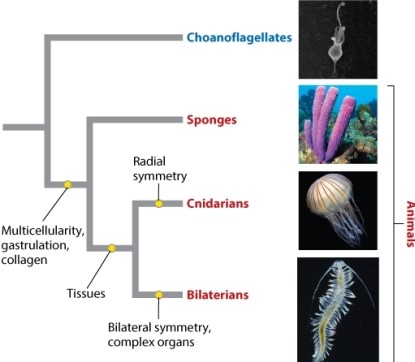 According to this phylogeny, which of the following CORRECTLY lists the sequence in which multicellularity, tissues, and bilateral symmetry arose, from the oldest characteristic to the most recent?
A)multicellularity, tissues, bilateral symmetry
B)multicellularity, bilateral symmetry, tissues
C)tissues, bilateral symmetry, multicellularity
D)tissues, multicellularity, bilateral symmetry
E)That information cannot be determined from the phylogeny.
According to this phylogeny, which of the following CORRECTLY lists the sequence in which multicellularity, tissues, and bilateral symmetry arose, from the oldest characteristic to the most recent?A)multicellularity, tissues, bilateral symmetry
B)multicellularity, bilateral symmetry, tissues
C)tissues, bilateral symmetry, multicellularity
D)tissues, multicellularity, bilateral symmetry
E)That information cannot be determined from the phylogeny.
Question
Question
Question
Examine Figure 44.1, below. According to this phylogeny, bilaterians (animals with bilateral symmetry) are most closely related to: 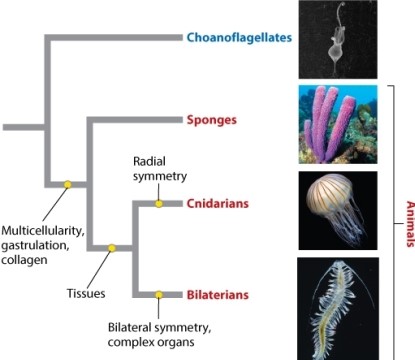
A)cnidarians.
B)sponges.
C)the group containing sponges and cnidarians.
D)the group containing choanoflagellates, sponges, and cnidarians.
E)None of the answer options is correct.
A)cnidarians.
B)sponges.
C)the group containing sponges and cnidarians.
D)the group containing choanoflagellates, sponges, and cnidarians.
E)None of the answer options is correct.
Question
Question
Question
Question
Question
Question
Question
Examine Figure 44.1, below. To which group are sponges more closely related? 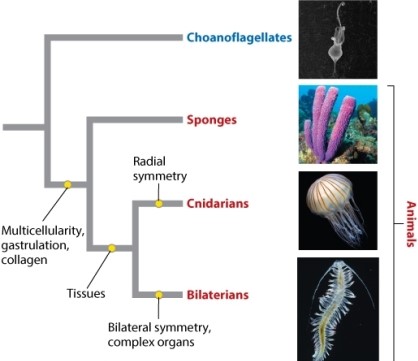
A)choanoflagellates
B)bilaterians
C)equal relationship to both choanoflagellates and bilaterians.
A)choanoflagellates
B)bilaterians
C)equal relationship to both choanoflagellates and bilaterians.
Question
Question
Question
Question
Question
Question
Question
Question
Question
Question
Question
Question
Question
Question
Question
Question
Question
Question
Question
Question
Question
Question
Question
Question
Question
Question
Question
Question
Question
Question
Question
Question
Question
Examine Figure 44.7 below, paying attention to the phylogenetic position of sponges in the two phylogenies presented. If the hypothesis represented by the tree on the right is correct, as some molecular evidence suggests, which of the following can you conclude? 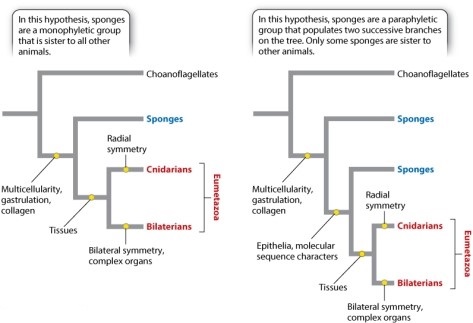
A)sponges are monophyletic.
B)sponges are paraphyletic.
C)the common ancestor of all animals was spongelike in appearance.
D)we don't know what the common ancestor of all animals looked like.
E)None of the answer options is correct.
A)sponges are monophyletic.
B)sponges are paraphyletic.
C)the common ancestor of all animals was spongelike in appearance.
D)we don't know what the common ancestor of all animals looked like.
E)None of the answer options is correct.
Question
Question
Question
Question
Question
Question
Question
Question
Question
Question
Consider the following phylogeny of protostomes. 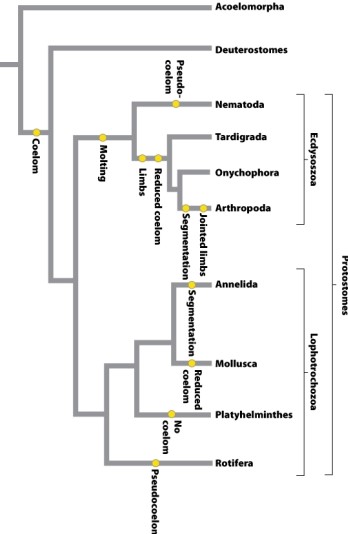 One of the traits used to describe animals is the type of body cavity (coelom) that is present. According to the phylogeny, how many times did a coelom evolve in protostomes?
A)one
B)two
C)three
D)four
E)five
One of the traits used to describe animals is the type of body cavity (coelom) that is present. According to the phylogeny, how many times did a coelom evolve in protostomes?A)one
B)two
C)three
D)four
E)five
Question
Question
Question
Question
Question
Question
Question
Question
Question
Question
Question
Question
Question
Question
Question

Unlock Deck
Sign up to unlock the cards in this deck!
Unlock Deck
Unlock Deck
1/195

Play

Full screen (f)
Deck 44: Animal Diversity
1
Animals with bilateral symmetry typically have:
A)distinct front (head)and back (tail)ends.
B)specialized sensory organs clustered at the front, or head, end.
C)specialized appendages along both sides for locomotion.
D)specializations for rapid locomotion in all directions.
E)complex behavior.
A)distinct front (head)and back (tail)ends.
B)specialized sensory organs clustered at the front, or head, end.
C)specialized appendages along both sides for locomotion.
D)specializations for rapid locomotion in all directions.
E)complex behavior.
A, B
2
If continuing analyses confirm that ctenophores are the sister group to sponges plus eumetazoans, which of the following conclusions would be supported?
A)Nervous systems evolved convergently in ctenophores and eumetazoans.
B)Flow-through guts evolved convergently in eumetazoans.
C)Nematocysts evolved convergently in ctenophores and eumetazoans.
D)Sexual reproduction evolved convergently in ctenophores and eumetazoans.
A)Nervous systems evolved convergently in ctenophores and eumetazoans.
B)Flow-through guts evolved convergently in eumetazoans.
C)Nematocysts evolved convergently in ctenophores and eumetazoans.
D)Sexual reproduction evolved convergently in ctenophores and eumetazoans.
A, B
3
Sponges have _____ symmetry.
A)no
B)radial
C)bilateral
D)circular
A)no
B)radial
C)bilateral
D)circular
A
4
Comparative embryology helped clarify the relationships among major groups of animals. The bilaterians, for example, can be divided into the _____ based on the developmental fate of the blastopore.
A)protostomes and deuterostomes
B)coelomates and acoelomates
C)coelomates and pseudocoelomates
D)cnidarians and radiolarians
E)protostomes and coelomates
A)protostomes and deuterostomes
B)coelomates and acoelomates
C)coelomates and pseudocoelomates
D)cnidarians and radiolarians
E)protostomes and coelomates
Unlock Deck
Unlock for access to all 195 flashcards in this deck.
Unlock Deck
k this deck
5
Biologists have described about _____ species of eukaryotic organisms, of which about _____ are animals. The majority of eukaryotic species are _____.
A)1)8 million; 1.3 million; insects
B)500,000; 300,000; insects
C)1)8 million, 1.3 million; vertebrates
D)30 million; 500,000; plants
E)1)8 million; 500,000; plants
A)1)8 million; 1.3 million; insects
B)500,000; 300,000; insects
C)1)8 million, 1.3 million; vertebrates
D)30 million; 500,000; plants
E)1)8 million; 500,000; plants
Unlock Deck
Unlock for access to all 195 flashcards in this deck.
Unlock Deck
k this deck
6
As in many other animals, the endoderm in ctenophores functions in:
A)respiration.
B)prey capture.
C)digestion.
D)locomotion.
A)respiration.
B)prey capture.
C)digestion.
D)locomotion.
Unlock Deck
Unlock for access to all 195 flashcards in this deck.
Unlock Deck
k this deck
7
Comparative embryology helped clarify the relationships among major groups of animals. Bilaterians, for example, are:
A)diploblastic.
B)triploblastic.
C)coelomates.
D)acoelomates.
E)protostomates.
A)diploblastic.
B)triploblastic.
C)coelomates.
D)acoelomates.
E)protostomates.
Unlock Deck
Unlock for access to all 195 flashcards in this deck.
Unlock Deck
k this deck
8
The division of bilaterians into coelomate, acoelomate, and pseudocoelomate groups is supported by molecular studies.
Unlock Deck
Unlock for access to all 195 flashcards in this deck.
Unlock Deck
k this deck
9
Speciation is the divergence of two populations from a common ancestor. How does it contribute to biological diversity?
A)Speciation increases biological diversity.
B)Speciation decreases biological diversity.
C)Speciation has no effect on biological diversity.
A)Speciation increases biological diversity.
B)Speciation decreases biological diversity.
C)Speciation has no effect on biological diversity.
Unlock Deck
Unlock for access to all 195 flashcards in this deck.
Unlock Deck
k this deck
10
Traits used to group animals in a simple phylogenetic tree include:
A)presence of collagen.
B)body symmetry.
C)photosynthetic capabilities.
D)complex organs.
A)presence of collagen.
B)body symmetry.
C)photosynthetic capabilities.
D)complex organs.
Unlock Deck
Unlock for access to all 195 flashcards in this deck.
Unlock Deck
k this deck
11
Linnaeus sorted animals into groups based on body plans. Today, these groupings are called:
A)families.
B)branches on the phylogenetic tree.
C)phyla.
A)families.
B)branches on the phylogenetic tree.
C)phyla.
Unlock Deck
Unlock for access to all 195 flashcards in this deck.
Unlock Deck
k this deck
12
Examine Figure 44.1, below. According to this phylogeny, which of the following CORRECTLY lists the sequence in which multicellularity, tissues, and bilateral symmetry arose, from the oldest characteristic to the most recent?
A)multicellularity, tissues, bilateral symmetry
B)multicellularity, bilateral symmetry, tissues
C)tissues, bilateral symmetry, multicellularity
D)tissues, multicellularity, bilateral symmetry
E)That information cannot be determined from the phylogeny.
According to this phylogeny, which of the following CORRECTLY lists the sequence in which multicellularity, tissues, and bilateral symmetry arose, from the oldest characteristic to the most recent?A)multicellularity, tissues, bilateral symmetry
B)multicellularity, bilateral symmetry, tissues
C)tissues, bilateral symmetry, multicellularity
D)tissues, multicellularity, bilateral symmetry
E)That information cannot be determined from the phylogeny.
Unlock Deck
Unlock for access to all 195 flashcards in this deck.
Unlock Deck
k this deck
13
Which of the following characteristics would you expect to find in a member of the bilateria?
A)specialized head region
B)segmentation
C)coelom
D)two tissue layers (diploblastic)
A)specialized head region
B)segmentation
C)coelom
D)two tissue layers (diploblastic)
Unlock Deck
Unlock for access to all 195 flashcards in this deck.
Unlock Deck
k this deck
14
A phylogenetic tree is a hypothesis of the:
A)genetics of trees.
B)evolutionary relationships among groups of trees.
C)evolutionary relationships among different species.
D)genetics of a single species.
A)genetics of trees.
B)evolutionary relationships among groups of trees.
C)evolutionary relationships among different species.
D)genetics of a single species.
Unlock Deck
Unlock for access to all 195 flashcards in this deck.
Unlock Deck
k this deck
15
Examine Figure 44.1, below. According to this phylogeny, bilaterians (animals with bilateral symmetry) are most closely related to:
A)cnidarians.
B)sponges.
C)the group containing sponges and cnidarians.
D)the group containing choanoflagellates, sponges, and cnidarians.
E)None of the answer options is correct.
A)cnidarians.
B)sponges.
C)the group containing sponges and cnidarians.
D)the group containing choanoflagellates, sponges, and cnidarians.
E)None of the answer options is correct.
Unlock Deck
Unlock for access to all 195 flashcards in this deck.
Unlock Deck
k this deck
16
Early scientists used morphological characteristics to create a phylogeny of animals, but recently, DNA sequence data have helped in the revision of phylogenies of taxa within the larger groups (i.e., bilaterians, sponges, cnidarians). Why are morphological characteristics like "fate of the blastopore" or "body symmetry" relatively good at predicting larger-scale branching patterns on phylogenies?
A)The development of these characteristics is controlled genetically, therefore similarities in DNA sequence would be expected in more closely related taxa.
B)Characteristics like those described are necessary for living, therefore all organisms must have those traits.
C)All animals are descended from a common ancestor that had the traits described above.
D)These features reflect adaptations to life on land.
A)The development of these characteristics is controlled genetically, therefore similarities in DNA sequence would be expected in more closely related taxa.
B)Characteristics like those described are necessary for living, therefore all organisms must have those traits.
C)All animals are descended from a common ancestor that had the traits described above.
D)These features reflect adaptations to life on land.
Unlock Deck
Unlock for access to all 195 flashcards in this deck.
Unlock Deck
k this deck
17
Which of the following is NOT a characteristic exclusively found in animals?
A)multicellularity
B)chitin
C)collagen
D)gastrula
A)multicellularity
B)chitin
C)collagen
D)gastrula
Unlock Deck
Unlock for access to all 195 flashcards in this deck.
Unlock Deck
k this deck
18
Compared with sponges, cnidarians have a wider array of cell types permitting more sophisticated tissue functions. These functions include:
A)secretion of digestive enzymes.
B)muscle contraction/movement.
C)the ability to sense the environment via a network of nerve cells.
D)the ability to communicate within the organism using hormones.
E)None of the answer options is correct.
A)secretion of digestive enzymes.
B)muscle contraction/movement.
C)the ability to sense the environment via a network of nerve cells.
D)the ability to communicate within the organism using hormones.
E)None of the answer options is correct.
Unlock Deck
Unlock for access to all 195 flashcards in this deck.
Unlock Deck
k this deck
19
Animals are distinguished from other groups of eukaryotic organisms in that they:
A)are multicellular heterotrophs lacking cell walls.
B)have embryos that include a gastrula stage.
C)produce collagen.
D)are mobile.
A)are multicellular heterotrophs lacking cell walls.
B)have embryos that include a gastrula stage.
C)produce collagen.
D)are mobile.
Unlock Deck
Unlock for access to all 195 flashcards in this deck.
Unlock Deck
k this deck
20
Echinoderms are unique in their:
A)five-fold symmetry.
B)skeletons made of interlocking plates of protein.
C)water vascular system.
D)skeletons made of interlocking plates of calcite.
E)filter feeding.
A)five-fold symmetry.
B)skeletons made of interlocking plates of protein.
C)water vascular system.
D)skeletons made of interlocking plates of calcite.
E)filter feeding.
Unlock Deck
Unlock for access to all 195 flashcards in this deck.
Unlock Deck
k this deck
21
A protostome is distinguished by a(n):
A)endoderm that becomes a mouth.
B)mesoderm that becomes an anus.
C)blastopore that becomes a mouth.
D)blastopore that becomes an anus.
A)endoderm that becomes a mouth.
B)mesoderm that becomes an anus.
C)blastopore that becomes a mouth.
D)blastopore that becomes an anus.
Unlock Deck
Unlock for access to all 195 flashcards in this deck.
Unlock Deck
k this deck
22
Examine Figure 44.1, below. To which group are sponges more closely related?
A)choanoflagellates
B)bilaterians
C)equal relationship to both choanoflagellates and bilaterians.
A)choanoflagellates
B)bilaterians
C)equal relationship to both choanoflagellates and bilaterians.
Unlock Deck
Unlock for access to all 195 flashcards in this deck.
Unlock Deck
k this deck
23
A deuterostome is distinguished by a(n):
A)endoderm that becomes a mouth.
B)mesoderm that becomes an anus.
C)blastopore that becomes a mouth.
D)blastopore that becomes an anus.
A)endoderm that becomes a mouth.
B)mesoderm that becomes an anus.
C)blastopore that becomes a mouth.
D)blastopore that becomes an anus.
Unlock Deck
Unlock for access to all 195 flashcards in this deck.
Unlock Deck
k this deck
24
Because they lack well-defined and complex organ systems, we hypothesize that _____ diverged from all other animals early in the evolution of animals.
A)poriferans
B)choanoflagellates
C)bilaterians
D)None of the answer options is correct.
A)poriferans
B)choanoflagellates
C)bilaterians
D)None of the answer options is correct.
Unlock Deck
Unlock for access to all 195 flashcards in this deck.
Unlock Deck
k this deck
25
Larval characters sometimes tell us more about phylogenetic relationships than adult characters.
Unlock Deck
Unlock for access to all 195 flashcards in this deck.
Unlock Deck
k this deck
26
An avid naturalist diver has decided to vacation on a remote island, possibly never visited by a human before, with a rocky intertidal zone. While out exploring he comes across what looks like a jellyfish but has bilateral symmetry. He considers what he knows of the simple phylogeny of animals. He would like to place this species into the group Bilateria. Name one other characteristic that would lend support to his placing this organism in the group Bilateria.
A)the presence of collagen in its tissues
B)the presence of an oral cavity
C)the presence of digestive tissues
D)the presence of three different tissue layers
A)the presence of collagen in its tissues
B)the presence of an oral cavity
C)the presence of digestive tissues
D)the presence of three different tissue layers
Unlock Deck
Unlock for access to all 195 flashcards in this deck.
Unlock Deck
k this deck
27
Many groups of organisms are defined by the unique characteristics they possess. The relative timing of when a particular characteristic arose can be estimated by determining:
A)shared presence of the characteristic in descendants of the population who did not have the characteristic.
B)presence of the characteristic in only the most recent species to have it.
C)how long the characteristic was in the population.
D)shared presence of the characteristic in descendants of the population in which the characteristic first arose.
A)shared presence of the characteristic in descendants of the population who did not have the characteristic.
B)presence of the characteristic in only the most recent species to have it.
C)how long the characteristic was in the population.
D)shared presence of the characteristic in descendants of the population in which the characteristic first arose.
Unlock Deck
Unlock for access to all 195 flashcards in this deck.
Unlock Deck
k this deck
28
Which of the following numbered statements describes what phylogenetic trees help us understand?
1) the genetic relationships among a species
2) the evolutionary relationships among a species
3) the relationships of symmetry among related species
4) the level of complexity among related species
1) the genetic relationships among a species
2) the evolutionary relationships among a species
3) the relationships of symmetry among related species
4) the level of complexity among related species
Unlock Deck
Unlock for access to all 195 flashcards in this deck.
Unlock Deck
k this deck
29
Which of these characters differentiates animals from all other groups of organisms?
A)multicellularity
B)heterotrophy
C)mitochondria
D)gastrulation
A)multicellularity
B)heterotrophy
C)mitochondria
D)gastrulation
Unlock Deck
Unlock for access to all 195 flashcards in this deck.
Unlock Deck
k this deck
30
On a phylogenetic tree, distantly related species diverge from branch points nearer to the tree's:
A)branches.
B)base.
C)tips.
D)nodes.
A)branches.
B)base.
C)tips.
D)nodes.
Unlock Deck
Unlock for access to all 195 flashcards in this deck.
Unlock Deck
k this deck
31
_____ are helpful for reconstructing evolutionary relationships because they show the evolutionary development of characteristics among groups.
A)Analogies
B)Homologies
C)Similes
D)Homilies
A)Analogies
B)Homologies
C)Similes
D)Homilies
Unlock Deck
Unlock for access to all 195 flashcards in this deck.
Unlock Deck
k this deck
32
What are the advantages of having a true coelom?
A)cushions organs from hard blows
B)allows body to twist without twisting organs
C)cushions organs from hard blows and allows body to twist without twisting organs
D)None of the answer options is correct.
A)cushions organs from hard blows
B)allows body to twist without twisting organs
C)cushions organs from hard blows and allows body to twist without twisting organs
D)None of the answer options is correct.
Unlock Deck
Unlock for access to all 195 flashcards in this deck.
Unlock Deck
k this deck
33
Bilaterians are distinguished by:
A)radial symmetry that results in multiple planes of symmetry.
B)no symmetry, which allows for a distinct head and tail.
C)circular symmetry, which allows for multiple planes of symmetry and a head and tail.
D)mirror symmetry that results in a distinct head and tail and one plane of symmetry.
A)radial symmetry that results in multiple planes of symmetry.
B)no symmetry, which allows for a distinct head and tail.
C)circular symmetry, which allows for multiple planes of symmetry and a head and tail.
D)mirror symmetry that results in a distinct head and tail and one plane of symmetry.
Unlock Deck
Unlock for access to all 195 flashcards in this deck.
Unlock Deck
k this deck
34
What feature of animals enabled them to diversify in ways that plants, fungi, algae, and protozoans have not?
A)radial symmetry
B)bilateral symmetry
C)phylogenetic analysis
D)organ systems
A)radial symmetry
B)bilateral symmetry
C)phylogenetic analysis
D)organ systems
Unlock Deck
Unlock for access to all 195 flashcards in this deck.
Unlock Deck
k this deck
35
Triploblastic organisms give rise to _____ germ layers, called the _____.
A)two; ectoderm and endoderm
B)two; endoderm and mesoderm
C)three; ectoderm, mesoderm, and endoderm
D)three; ectoderm, metoderm, and endoderm
A)two; ectoderm and endoderm
B)two; endoderm and mesoderm
C)three; ectoderm, mesoderm, and endoderm
D)three; ectoderm, metoderm, and endoderm
Unlock Deck
Unlock for access to all 195 flashcards in this deck.
Unlock Deck
k this deck
36
_____ are not helpful for reconstructing evolutionary relationships because they do not show the evolutionary development of characteristics among groups.
A)Homologies
B)Similes
C)Homilies
D)Analogies
A)Homologies
B)Similes
C)Homilies
D)Analogies
Unlock Deck
Unlock for access to all 195 flashcards in this deck.
Unlock Deck
k this deck
37
Frogs, birds, rabbits, and lizards all have different forelimbs, which makes sense when you consider their different lifestyles. Interestingly, all of their forelimbs share the same set of bones-the ulna, the radius, and the humerus. These same bones are also seen in fossils of the extinct animal Eusthenopteron, which demonstrates common ancestry among these four groups of animals. Hence, these forelimbs are an example of:
A)analogies.
B)homologies.
C)similes.
D)homilies.
A)analogies.
B)homologies.
C)similes.
D)homilies.
Unlock Deck
Unlock for access to all 195 flashcards in this deck.
Unlock Deck
k this deck
38
On a phylogenetic tree, more closely related species branch from points _____ the tips of the tree.
A)closer to
B)farther from
C)equally distant from
D)unrelated to
A)closer to
B)farther from
C)equally distant from
D)unrelated to
Unlock Deck
Unlock for access to all 195 flashcards in this deck.
Unlock Deck
k this deck
39
Comb-jellies, or ctenophores, are similar to cnidarians in that they:
A)are radially symmetrical.
B)have two tissue layers surrounding a gelatinous interior.
C)differentiate muscle cells and a simple nerve net.
D)digest prey within their gastric cavity.
E)None of the answer options is correct.
A)are radially symmetrical.
B)have two tissue layers surrounding a gelatinous interior.
C)differentiate muscle cells and a simple nerve net.
D)digest prey within their gastric cavity.
E)None of the answer options is correct.
Unlock Deck
Unlock for access to all 195 flashcards in this deck.
Unlock Deck
k this deck
40
The development of wings on a fly, a moth, and a bird are _____ because they developed independently as adaptations to perform the common function of flying.
A)homologous
B)related
C)analogous
D)identical
A)homologous
B)related
C)analogous
D)identical
Unlock Deck
Unlock for access to all 195 flashcards in this deck.
Unlock Deck
k this deck
41
Not all sponges have skeletons. If they do, their skeletons may be made of:
A)silica.
B)calcium carbonate.
C)bone.
D)protein.
E)carbohydrate.
A)silica.
B)calcium carbonate.
C)bone.
D)protein.
E)carbohydrate.
Unlock Deck
Unlock for access to all 195 flashcards in this deck.
Unlock Deck
k this deck
42
Cnidarians and ctenophores are included in the animals. Based on our current understanding of the evolution of these groups, neither is classified as protostome or deuterostome. Which of the following is the MOST likely explanation?
A)These groups do not undergo gastrulation therefore the timing of mouth development cannot be determined.
B)These groups do not have an anus, therefore the timing of mouth development (first or second)cannot be determined.
C)These groups only have two tissue layers; currently only triploblastic organisms are classified based on the fate of the blastopore.
D)These two groups do not have an axis of orientation for their bodies; they are radially symmetric.
A)These groups do not undergo gastrulation therefore the timing of mouth development cannot be determined.
B)These groups do not have an anus, therefore the timing of mouth development (first or second)cannot be determined.
C)These groups only have two tissue layers; currently only triploblastic organisms are classified based on the fate of the blastopore.
D)These two groups do not have an axis of orientation for their bodies; they are radially symmetric.
Unlock Deck
Unlock for access to all 195 flashcards in this deck.
Unlock Deck
k this deck
43
One of the earliest-evolving groups of organisms was the placozoans. Placozoans have some similar characteristics to fungi. Which of the following is not a characteristic that is shared by fungi and placazoans?
A)upper and lower epithelial layers
B)high surface area to volume ratio
C)gas exchange via diffusion
D)extracellular digestion
A)upper and lower epithelial layers
B)high surface area to volume ratio
C)gas exchange via diffusion
D)extracellular digestion
Unlock Deck
Unlock for access to all 195 flashcards in this deck.
Unlock Deck
k this deck
44
Cnidarians form true epithelial tissue.
Unlock Deck
Unlock for access to all 195 flashcards in this deck.
Unlock Deck
k this deck
45
The phylum Cnidaria includes:
A)sponges.
B)jellyfish.
C)corals.
D)placozoans.
E)comb-jellies.
A)sponges.
B)jellyfish.
C)corals.
D)placozoans.
E)comb-jellies.
Unlock Deck
Unlock for access to all 195 flashcards in this deck.
Unlock Deck
k this deck
46
In sponges, cells differentiate into sperm or eggs in the _____. Only _____ are released into the water.
A)mesohyl; sperm
B)mesohyl; choanocytes
C)mesohyl; spicules
D)cavity; sperm
E)cavity; choanocytes
A)mesohyl; sperm
B)mesohyl; choanocytes
C)mesohyl; spicules
D)cavity; sperm
E)cavity; choanocytes
Unlock Deck
Unlock for access to all 195 flashcards in this deck.
Unlock Deck
k this deck
47
Cnidarians share a common body plan that takes two forms. The free-floating form is called a medusa, whereas the sessile form is called a:
A)polyp.
B)cnidarian.
C)larva.
D)ctenophore.
E)mesoglea.
A)polyp.
B)cnidarian.
C)larva.
D)ctenophore.
E)mesoglea.
Unlock Deck
Unlock for access to all 195 flashcards in this deck.
Unlock Deck
k this deck
48
In cnidarians, the mouth of both the medusa and polyp form opens into an internal _____ where _____ digestion takes place.
A)gastric cavity; extracellular
B)gastric cavity; intracellular
C)mesoglea; extracellular
D)mesoglea; intracellular
E)None of the answer options is correct.
A)gastric cavity; extracellular
B)gastric cavity; intracellular
C)mesoglea; extracellular
D)mesoglea; intracellular
E)None of the answer options is correct.
Unlock Deck
Unlock for access to all 195 flashcards in this deck.
Unlock Deck
k this deck
49
In the past, species of sponges, cnidarians, and ctenophores were referred to as "lower" or "primitive" animals because of their relatively simple body plans and lack of any sophisticated organ differentiation. Which of the following suggest that the terms "lower" or "primitive" are NOT useful as descriptors for these organisms?
A)Many members of these groups are active predators and feed on other organisms.
B)These groups have been around for millions of years, therefore their evolutionary path has been successful in spite of limited complexity.
C)These groups are not primary producers, therefore should not be classified as "lower" because they occur higher on the trophic pyramid.
D)These groups harbor a lot of genetic variation, "lower" groups would have less evolved genomes.
A)Many members of these groups are active predators and feed on other organisms.
B)These groups have been around for millions of years, therefore their evolutionary path has been successful in spite of limited complexity.
C)These groups are not primary producers, therefore should not be classified as "lower" because they occur higher on the trophic pyramid.
D)These groups harbor a lot of genetic variation, "lower" groups would have less evolved genomes.
Unlock Deck
Unlock for access to all 195 flashcards in this deck.
Unlock Deck
k this deck
50
Which of the following statements accurately describe characteristics of placozoans?
A)Placozoans are tiny animals containing only a few thousand cells.
B)Placozoans are simple animals, consisting of only two tissue layers that sandwich an interior fluid layer.
C)Placozoans are, in spite of their morphological simplicity, genetically complex, sharing many genes for transcription factors, signaling molecules, and structural proteins with both cnidarians and bilaterian animals.
D)Placozoans are a highly diverse group, consisting of many species occupying a wide range of habitats.
E)Placozoans are large radially symmetrical animals superficially similar to cnidarians and ctenophores.
A)Placozoans are tiny animals containing only a few thousand cells.
B)Placozoans are simple animals, consisting of only two tissue layers that sandwich an interior fluid layer.
C)Placozoans are, in spite of their morphological simplicity, genetically complex, sharing many genes for transcription factors, signaling molecules, and structural proteins with both cnidarians and bilaterian animals.
D)Placozoans are a highly diverse group, consisting of many species occupying a wide range of habitats.
E)Placozoans are large radially symmetrical animals superficially similar to cnidarians and ctenophores.
Unlock Deck
Unlock for access to all 195 flashcards in this deck.
Unlock Deck
k this deck
51
Multicellularity allows sponges to:
A)reproduce.
B)access nutrients.
C)form a protective skin.
D)None of the answer options is correct.
A)reproduce.
B)access nutrients.
C)form a protective skin.
D)None of the answer options is correct.
Unlock Deck
Unlock for access to all 195 flashcards in this deck.
Unlock Deck
k this deck
52
In sponges, the cells responsible for generating water currents that facilitate gas exchange and nutrition are the:
A)choanocytes.
B)spicules.
C)mesohyl.
D)sperm.
E)symbionts
A)choanocytes.
B)spicules.
C)mesohyl.
D)sperm.
E)symbionts
Unlock Deck
Unlock for access to all 195 flashcards in this deck.
Unlock Deck
k this deck
53
Many biologists were surprised by molecular data supporting the hypothesis that ctenophores are the sister group to all other animals. What anatomical and morphological features of ctenophores are conventionally thought to support a close relationship with bilaterian animals?
A)the rudimentary flow through gut
B)the presence of what many take to be a rudimentary mesoderm
C)the presence of an outer epithelium
D)the presence of gelatinous material in the interior of the ctenophore body
A)the rudimentary flow through gut
B)the presence of what many take to be a rudimentary mesoderm
C)the presence of an outer epithelium
D)the presence of gelatinous material in the interior of the ctenophore body
Unlock Deck
Unlock for access to all 195 flashcards in this deck.
Unlock Deck
k this deck
54
One of the hypotheses for the relationship of sponges to all other animals shows the sponges as paraphyletic. What would this suggest about the evolution of sponges?
A)Sponges are actually more diverse than we previously thought.
B)The ancestor of sponges gave rise to a minimum of two lineages, one of which was the ancestor of sponges sister to all other animals.
C)Only certain types of sponges are capable of evolution.
D)Sponges that are sister to all other animals must have more cell types than other sponges.
A)Sponges are actually more diverse than we previously thought.
B)The ancestor of sponges gave rise to a minimum of two lineages, one of which was the ancestor of sponges sister to all other animals.
C)Only certain types of sponges are capable of evolution.
D)Sponges that are sister to all other animals must have more cell types than other sponges.
Unlock Deck
Unlock for access to all 195 flashcards in this deck.
Unlock Deck
k this deck
55
Examine Figure 44.7 below, paying attention to the phylogenetic position of sponges in the two phylogenies presented. If the hypothesis represented by the tree on the right is correct, as some molecular evidence suggests, which of the following can you conclude?
A)sponges are monophyletic.
B)sponges are paraphyletic.
C)the common ancestor of all animals was spongelike in appearance.
D)we don't know what the common ancestor of all animals looked like.
E)None of the answer options is correct.
A)sponges are monophyletic.
B)sponges are paraphyletic.
C)the common ancestor of all animals was spongelike in appearance.
D)we don't know what the common ancestor of all animals looked like.
E)None of the answer options is correct.
Unlock Deck
Unlock for access to all 195 flashcards in this deck.
Unlock Deck
k this deck
56
Unlike Cnidarians, a comb-jelly's anterior-posterior axis allows for:
A)directed gas exchange.
B)more efficient nutrient digestion.
C)differentiated muscle cells.
D)tentacles.
A)directed gas exchange.
B)more efficient nutrient digestion.
C)differentiated muscle cells.
D)tentacles.
Unlock Deck
Unlock for access to all 195 flashcards in this deck.
Unlock Deck
k this deck
57
Which of the following traits, if found in Dendrogramma, would be the MOST helpful in placing it in the same phylum as ctenophores?
A)an exit pore for digestive waste
B)radial symmetry
C)two tissue layers
D)the presence of gastrulation during embryonic development
A)an exit pore for digestive waste
B)radial symmetry
C)two tissue layers
D)the presence of gastrulation during embryonic development
Unlock Deck
Unlock for access to all 195 flashcards in this deck.
Unlock Deck
k this deck
58
Sponges move huge volumes of water through their bodies every day. Although this serves the function of filter feeding for the organism, how might this also provide an "ecosystem" service (something that affects and/or benefits other organisms in their environment)?
A)They can filter small poisonous fish out of the water that may harm other organisms.
B)They create small currents in their microenvironment that help to circulate and clean water locally for other organisms.
C)They produce large numbers of gametes that will become food for other sponges.
D)Their body chambers serve as places where smaller organisms can live and be protected from certain predators.
A)They can filter small poisonous fish out of the water that may harm other organisms.
B)They create small currents in their microenvironment that help to circulate and clean water locally for other organisms.
C)They produce large numbers of gametes that will become food for other sponges.
D)Their body chambers serve as places where smaller organisms can live and be protected from certain predators.
Unlock Deck
Unlock for access to all 195 flashcards in this deck.
Unlock Deck
k this deck
59
Sponge cells capture nutrients in the form of _____ by the process of _____.
A)macromolecules; diffusion and active transport
B)food particles; diffusion and active transport
C)food particles; endocytosis
D)micromolecules; diffusion and active transport
A)macromolecules; diffusion and active transport
B)food particles; diffusion and active transport
C)food particles; endocytosis
D)micromolecules; diffusion and active transport
Unlock Deck
Unlock for access to all 195 flashcards in this deck.
Unlock Deck
k this deck
60
If, as some molecular data suggest, comb-jellies turn out to be the sister group of all other animals, which of the following statements would then be considered FALSE?
A)Choanoflagellates are the sister group to animals.
B)Triplobastic animals evolved from diploblastic ancestors.
C)Cnidarians and comb-jellies share a common ancestor that had a gut and nervous system.
D)Sponges evolved their simple structure by losing features of complex anatomy.
A)Choanoflagellates are the sister group to animals.
B)Triplobastic animals evolved from diploblastic ancestors.
C)Cnidarians and comb-jellies share a common ancestor that had a gut and nervous system.
D)Sponges evolved their simple structure by losing features of complex anatomy.
Unlock Deck
Unlock for access to all 195 flashcards in this deck.
Unlock Deck
k this deck
61
A researcher has just discovered a new marine organism that appears very similar to jellyfish. However, on closer inspection, this organism possesses both a mouth and anal pore, and a single set of tentacles. This animal is MOST likely a:
A)placozoan.
B)sea anemone.
C)sponge.
D)comb-jelly.
E)choanoflagellate.
A)placozoan.
B)sea anemone.
C)sponge.
D)comb-jelly.
E)choanoflagellate.
Unlock Deck
Unlock for access to all 195 flashcards in this deck.
Unlock Deck
k this deck
62
If you've ever read any stories about Sherlock Holmes, you may remember that he once solved a mystery in which a man died due to injuries sustained from a lion's mane jellyfish. Apparently, the victim encountered this free-floating jellyfish in a pool of water, was stung, and died suddenly. From this information, you can deduce that the victim encountered the jellyfish in what form?
A)polyp
B)medusa
C)anemone
D)trocophore
E)placozoan
A)polyp
B)medusa
C)anemone
D)trocophore
E)placozoan
Unlock Deck
Unlock for access to all 195 flashcards in this deck.
Unlock Deck
k this deck
63
Which of the following is NOT a component of some sponge skeletons?
A)cartilage
B)protein
C)glasslike silica (SiO2)
D)calcium carbonate (CaCO3)
A)cartilage
B)protein
C)glasslike silica (SiO2)
D)calcium carbonate (CaCO3)
Unlock Deck
Unlock for access to all 195 flashcards in this deck.
Unlock Deck
k this deck
64
Which of the following are cnidarians?
A)sponges and jellyfish
B)jellyfish and sea anemones
C)sea anemones and mollusks
D)mollusks and sponges
A)sponges and jellyfish
B)jellyfish and sea anemones
C)sea anemones and mollusks
D)mollusks and sponges
Unlock Deck
Unlock for access to all 195 flashcards in this deck.
Unlock Deck
k this deck
65
Consider the following phylogeny of protostomes. One of the traits used to describe animals is the type of body cavity (coelom) that is present. According to the phylogeny, how many times did a coelom evolve in protostomes?
A)one
B)two
C)three
D)four
E)five
One of the traits used to describe animals is the type of body cavity (coelom) that is present. According to the phylogeny, how many times did a coelom evolve in protostomes?A)one
B)two
C)three
D)four
E)five
Unlock Deck
Unlock for access to all 195 flashcards in this deck.
Unlock Deck
k this deck
66
Which of the following statements is TRUE of the gastric cavity of cnidarians?
A)Digestion takes place in the stomach after storage in the gastric cavity.
B)Excretion occurs through an anus opposite the mouth opening.
C)Digestive enzymes allow the consumption of prey such as fish whole.
A)Digestion takes place in the stomach after storage in the gastric cavity.
B)Excretion occurs through an anus opposite the mouth opening.
C)Digestive enzymes allow the consumption of prey such as fish whole.
Unlock Deck
Unlock for access to all 195 flashcards in this deck.
Unlock Deck
k this deck
67
Cnidarians are able to capture prey with the aid of _____, harpoon-like organelles that are often tipped with neurotoxins.
A)choanocytes
B)nematocysts
C)mesoglea
D)polyps
E)None of the answer options is correct.
A)choanocytes
B)nematocysts
C)mesoglea
D)polyps
E)None of the answer options is correct.
Unlock Deck
Unlock for access to all 195 flashcards in this deck.
Unlock Deck
k this deck
68
Comb-jellies are similar to bilaterians in that they:
A)have a "flow-through" gut with both a mouth and an anus.
B)develop muscle cells from a rudimentary mesoderm.
C)have an anterior-posterior body axis.
D)None of the answer options is correct.
A)have a "flow-through" gut with both a mouth and an anus.
B)develop muscle cells from a rudimentary mesoderm.
C)have an anterior-posterior body axis.
D)None of the answer options is correct.
Unlock Deck
Unlock for access to all 195 flashcards in this deck.
Unlock Deck
k this deck
69
If ctenophores are sister to all animal taxa, excluding cnidarians and placazoans, then:
A)the anatomical complexity of ctenophores arose independently of what is found in other Eumetazoan groups.
B)the nervous system of ctenophores evolved independently of other animals.
C)radial symmetry was lost in placazoans.
D)ancestral sponges exhibited morphologic complexity seen in other Eumetazoans.
E)None of the answer options is correct.
A)the anatomical complexity of ctenophores arose independently of what is found in other Eumetazoan groups.
B)the nervous system of ctenophores evolved independently of other animals.
C)radial symmetry was lost in placazoans.
D)ancestral sponges exhibited morphologic complexity seen in other Eumetazoans.
E)None of the answer options is correct.
Unlock Deck
Unlock for access to all 195 flashcards in this deck.
Unlock Deck
k this deck
70
Which of the following statements is TRUE of sponges?
A)Sponges have nerve cells that enable them to sense their environment.
B)Like cnidarians, many sponges produce toxin-generating nematocysts. These cells typically line the pores of sponges.
C)The choanocytes of sponges and choanoflagellates share no morphological similarities.
D)Like comb-jellies, sponges possess both a mouth and an anal pore; however, the anal pore is distinctly smaller than the mouth.
E)None of the answer options is correct.
A)Sponges have nerve cells that enable them to sense their environment.
B)Like cnidarians, many sponges produce toxin-generating nematocysts. These cells typically line the pores of sponges.
C)The choanocytes of sponges and choanoflagellates share no morphological similarities.
D)Like comb-jellies, sponges possess both a mouth and an anal pore; however, the anal pore is distinctly smaller than the mouth.
E)None of the answer options is correct.
Unlock Deck
Unlock for access to all 195 flashcards in this deck.
Unlock Deck
k this deck
71
Ctenopores (comb-jellies):
A)have a separate epidermis and endodermis, which cnidarians lack.
B)are usually filter feeders that attach themselves to the ocean bottom.
C)are a type of bilaterian.
D)have a separate mouth and anal pore, unlike cnidarians.
A)have a separate epidermis and endodermis, which cnidarians lack.
B)are usually filter feeders that attach themselves to the ocean bottom.
C)are a type of bilaterian.
D)have a separate mouth and anal pore, unlike cnidarians.
Unlock Deck
Unlock for access to all 195 flashcards in this deck.
Unlock Deck
k this deck
72
Which of the following is FALSE regarding cnidarians?
A)They have an outer epidermis and inner endodermis, in between which is a gelatinous mesoglea.
B)Cnidarians have a wider variety of cells types than sponges-allowing more sophisticated tissue function.
C)Many cnidarians are predators rather than passive filter feeders
D)Cnidarians have a separate opening for the anus and the mouth.
A)They have an outer epidermis and inner endodermis, in between which is a gelatinous mesoglea.
B)Cnidarians have a wider variety of cells types than sponges-allowing more sophisticated tissue function.
C)Many cnidarians are predators rather than passive filter feeders
D)Cnidarians have a separate opening for the anus and the mouth.
Unlock Deck
Unlock for access to all 195 flashcards in this deck.
Unlock Deck
k this deck
73
Placozoans:
A)are remarkable for their tissue complexity and organ development.
B)can reproduce sexually or asexually.
C)bear little to no resemblance to animals such as cnidarians on the basis of genetic analysis.
A)are remarkable for their tissue complexity and organ development.
B)can reproduce sexually or asexually.
C)bear little to no resemblance to animals such as cnidarians on the basis of genetic analysis.
Unlock Deck
Unlock for access to all 195 flashcards in this deck.
Unlock Deck
k this deck
74
Compared to cnidarians, bilaterally symmetrical animals have _____ nervous systems.
A)simple
B)compound
C)centralized
D)no
A)simple
B)compound
C)centralized
D)no
Unlock Deck
Unlock for access to all 195 flashcards in this deck.
Unlock Deck
k this deck
75
A researcher is culturing cells in a petri dish. After a few weeks, she notices that these cells have formed a "sheet," with junctions visible between individual cells. Which of the following statements is NOT true regarding these cultured cells?
A)These cells have formed mesoglea.
B)These cells have formed an epithelium.
C)These cells have formed a structure similar to the epidermis or endodermis of jellyfish.
D)These cells may secrete enzymes or extracellular matrix proteins into their environment.
E)None of the answer options is false.
A)These cells have formed mesoglea.
B)These cells have formed an epithelium.
C)These cells have formed a structure similar to the epidermis or endodermis of jellyfish.
D)These cells may secrete enzymes or extracellular matrix proteins into their environment.
E)None of the answer options is false.
Unlock Deck
Unlock for access to all 195 flashcards in this deck.
Unlock Deck
k this deck
76
Which of the following is NOT a cell or structure found in sponges?
A)mesohyl
B)choanocyte
C)gastric cavity
D)pore
A)mesohyl
B)choanocyte
C)gastric cavity
D)pore
Unlock Deck
Unlock for access to all 195 flashcards in this deck.
Unlock Deck
k this deck
77
Placozoans, which were first discovered in an aquarium, are by far the most diverse of the eumetazoans, with approximately 10,000 documented species.
Unlock Deck
Unlock for access to all 195 flashcards in this deck.
Unlock Deck
k this deck
78
Placazoans are thought to branch early on the animal tree. Which of the following features of placozoans are consistent with this phylogenetic placement?
A)Placozoans have no differentiated gut cavity.
B)Placozoans have no nerve cells.
C)Placozoans exchange gases by diffusion.
D)Placozoans have low species diversity.
A)Placozoans have no differentiated gut cavity.
B)Placozoans have no nerve cells.
C)Placozoans exchange gases by diffusion.
D)Placozoans have low species diversity.
Unlock Deck
Unlock for access to all 195 flashcards in this deck.
Unlock Deck
k this deck
79
Cnidarians have _____ symmetry.
A)no
B)radial
C)bilateral
D)circular
A)no
B)radial
C)bilateral
D)circular
Unlock Deck
Unlock for access to all 195 flashcards in this deck.
Unlock Deck
k this deck
80
Which of the following is NOT true of sponges?
A)Mesohyl is mostly noncellular and provides structural support.
B)Choanocytes have flagella that beat in a coordinated fashion.
C)Sponges are among the most primitive organisms to have developed reproductive organs.
D)Gas exchange of oxygen and carbon dioxide occurs through diffusion.
A)Mesohyl is mostly noncellular and provides structural support.
B)Choanocytes have flagella that beat in a coordinated fashion.
C)Sponges are among the most primitive organisms to have developed reproductive organs.
D)Gas exchange of oxygen and carbon dioxide occurs through diffusion.
Unlock Deck
Unlock for access to all 195 flashcards in this deck.
Unlock Deck
k this deck
Unlock Deck
Unlock for access to all 195 flashcards in this deck.






