







 Chat with AI

Deck 42: Animal Reproduction and Development
Full screen (f)

Question

Question
Question
Question
Question
Question
Question
Question
Question
Question
Question
Question
Question
Question
Question
Question
Question
Question
Question
Question
Question
Question
Question
Question
Question
Question
Question
Question
Question
Question
Question
Question
Question
Question
Question
Question
Question
Question
Question
Question
Question
Question
Question
Question
Question
Question
Question
Question
Question
Question
Question
Question
Question
Question
Question
Question
Question
Question
Question
Question
Question
Question
Question
Question
At which point on the phylogeny shown did the amnion FIRST appear? 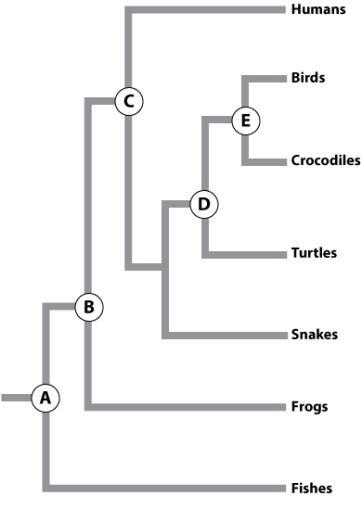
A)node A
B)node B
C)node C
D)node D
E)node E
A)node A
B)node B
C)node C
D)node D
E)node E
Question
Question
Question
Question
Question
Question
Question
Question
Question
Question
Question
Question
Question
Question
Question
Question

Unlock Deck
Sign up to unlock the cards in this deck!
Unlock Deck
Unlock Deck
1/196

Play

Full screen (f)
Deck 42: Animal Reproduction and Development
1
In mammals, some genes are expressed differently depending on their parent of origin. This ensures that mammals develop from embryos with one maternal and one paternal genome.
True
2
One of the advantages of sexual reproduction is the production of novel arrangements of genes on chromosomes due to recombination during meiosis. This effect is further magnified upon fertilization because offspring:
A)may have allele combinations of genes that are not seen in either parent.
B)will have higher fitness than either parent because of the union of gametes.
C)will have more alleles than either parent.
D)will have more chromosomes than either parent.
A)may have allele combinations of genes that are not seen in either parent.
B)will have higher fitness than either parent because of the union of gametes.
C)will have more alleles than either parent.
D)will have more chromosomes than either parent.
A
3
_____ is a form of asexual reproduction in which a new individual arises by the splitting of one organism into pieces.
A)Fragmentation
B)Budding
C)Parthenogenesis
A)Fragmentation
B)Budding
C)Parthenogenesis
A
4
Compared to sexual reproduction, asexual reproduction:
A)requires less investment in attracting mates.
B)allows much more rapid population growth.
C)is rarely found as the sole mechanism of reproduction.
D)results in the production of genetically identical cells or individuals.
E)involves meiosis and fertilization as core processes.
A)requires less investment in attracting mates.
B)allows much more rapid population growth.
C)is rarely found as the sole mechanism of reproduction.
D)results in the production of genetically identical cells or individuals.
E)involves meiosis and fertilization as core processes.
Unlock Deck
Unlock for access to all 196 flashcards in this deck.
Unlock Deck
k this deck
5
Komodo dragons (Varanus komodoensis) are an endangered species. One of the ways that conservationists are working to maintain their numbers is through captive breeding programs in zoos. Typically females are housed alone, and males are transported between zoos to mate with females and produce offspring. In some cases, females produce offspring even though they are not in contact with a male. Which term below BEST describes the production of offspring by female Komodo dragons housed alone in zoos?
A)sexual reproduction
B)fission
C)budding
D)parthenogenesis
A)sexual reproduction
B)fission
C)budding
D)parthenogenesis
Unlock Deck
Unlock for access to all 196 flashcards in this deck.
Unlock Deck
k this deck
6
Prokaryotes reproducing by binary fission can increase genetic variation by:
A)mutation.
B)DNA transfer during conjugation.
C)obtaining DNA from the environment.
D)obtaining DNA through viral infection.
E)exchange of genetic material between homologous chromosomes.
A)mutation.
B)DNA transfer during conjugation.
C)obtaining DNA from the environment.
D)obtaining DNA through viral infection.
E)exchange of genetic material between homologous chromosomes.
Unlock Deck
Unlock for access to all 196 flashcards in this deck.
Unlock Deck
k this deck
7
In parthenogenesis:
A)unfertilized eggs develop into adults.
B)adults may be haploid or diploid.
C)adults may develop via mitosis or meiosis.
D)the parent may be either maternal or paternal.
E)eggs may be fertilized or unfertilized.
A)unfertilized eggs develop into adults.
B)adults may be haploid or diploid.
C)adults may develop via mitosis or meiosis.
D)the parent may be either maternal or paternal.
E)eggs may be fertilized or unfertilized.
Unlock Deck
Unlock for access to all 196 flashcards in this deck.
Unlock Deck
k this deck
8
Sexual reproduction produces genetically unique individuals by:
A)recombination during gamete formation.
B)independent assortment during gamete formation.
C)mutation during gamete formation.
D)the combination of genetically unique gametes to form a new individual.
E)DNA transfer during conjugation.
A)recombination during gamete formation.
B)independent assortment during gamete formation.
C)mutation during gamete formation.
D)the combination of genetically unique gametes to form a new individual.
E)DNA transfer during conjugation.
Unlock Deck
Unlock for access to all 196 flashcards in this deck.
Unlock Deck
k this deck
9
A male and female for each of two species, species A and species B, are placed in an experimental pond. Both species have the same generation time of two weeks, produce one offspring with each round of reproduction, are the same relative size, and have the same energetic requirements. You come back after one year and notice that there are 20 times more individuals of species A than species B. Which of the two species is likely breeding asexually?
A)species A
B)species B
C)They both reproduce asexually; species A is simply faster at reproducing.
D)Neither; they both reproduce sexually. Species A is simply faster at reproducing.
A)species A
B)species B
C)They both reproduce asexually; species A is simply faster at reproducing.
D)Neither; they both reproduce sexually. Species A is simply faster at reproducing.
Unlock Deck
Unlock for access to all 196 flashcards in this deck.
Unlock Deck
k this deck
10
Daphnia alter their reproductive mode based on food availability. Why might it be adaptive for Daphnia to reproduce asexually in the spring?
A)When food is in excess, asexual reproduction allows for more rapid rates of reproduction.
B)When food is in excess, natural selection cannot act on variation because all individuals can get the food they need.
C)When food is in excess, asexual reproduction results in variable offspring.
D)When food is in excess, reproductive rates will slow so that more energy can be put into growth by the individual Daphnia.
A)When food is in excess, asexual reproduction allows for more rapid rates of reproduction.
B)When food is in excess, natural selection cannot act on variation because all individuals can get the food they need.
C)When food is in excess, asexual reproduction results in variable offspring.
D)When food is in excess, reproductive rates will slow so that more energy can be put into growth by the individual Daphnia.
Unlock Deck
Unlock for access to all 196 flashcards in this deck.
Unlock Deck
k this deck
11
In general, sexual reproduction is more likely found in species that live in:
A)environments with constant conditions than in species that live in environments with variable conditions.
B)environments with variable conditions than in species that live in environments with constant conditions.
A)environments with constant conditions than in species that live in environments with variable conditions.
B)environments with variable conditions than in species that live in environments with constant conditions.
Unlock Deck
Unlock for access to all 196 flashcards in this deck.
Unlock Deck
k this deck
12
Komodo dragons (Varanus komodoensis) are an endangered species. One of the ways that conservationists are working to maintain their numbers is through captive breeding programs in zoos. Typically females are housed alone, and males are transported between zoos to mate with females and produce offspring. In some cases, females produce offspring even though they are not in contact with a male. When females do not interact with males but still produced offspring, reproduction is asexual.
Unlock Deck
Unlock for access to all 196 flashcards in this deck.
Unlock Deck
k this deck
13
Bacteria can take up DNA from the environment, providing a way for bacteria to increase genetic variation and acquire new genes and DNA sequences. Similarly, bdelloid rotifers can incorporate DNA from the environment into their genomes. The similar means of achieving genetic diversity in these two groups of organisms is a good example of:
A)coevolution.
B)convergent evolution.
C)homology.
D)analogy.
E)horizontal gene transfer.
A)coevolution.
B)convergent evolution.
C)homology.
D)analogy.
E)horizontal gene transfer.
Unlock Deck
Unlock for access to all 196 flashcards in this deck.
Unlock Deck
k this deck
14
One of the disadvantages of sexual reproduction compared to asexual reproduction is that:
A)individuals have lower relatedness to their offspring than asexually reproducing species.
B)new genotypes can be introduced into the population.
C)deleterious mutations can be removed from the population more easily.
D)there is greater variation introduced each generation in sexually reproducing species.
A)individuals have lower relatedness to their offspring than asexually reproducing species.
B)new genotypes can be introduced into the population.
C)deleterious mutations can be removed from the population more easily.
D)there is greater variation introduced each generation in sexually reproducing species.
Unlock Deck
Unlock for access to all 196 flashcards in this deck.
Unlock Deck
k this deck
15
When a species produces gametes of different sizes:
A)the smaller are designated as male and are called sperm, or spermatozoa.
B)the larger are designated as female and are called eggs, or ova.
C)the smaller are designated as female and are called eggs, or ova.
D)the larger are designated as male and are called sperm, or spermatozoa.
A)the smaller are designated as male and are called sperm, or spermatozoa.
B)the larger are designated as female and are called eggs, or ova.
C)the smaller are designated as female and are called eggs, or ova.
D)the larger are designated as male and are called sperm, or spermatozoa.
Unlock Deck
Unlock for access to all 196 flashcards in this deck.
Unlock Deck
k this deck
16
There are a few species of whiptail lizard in the wild that exhibit facultative parthenogenesis. In which types of environments would you expect to find these species of whiptail lizard?
A)In habitats where environmental variables are relatively stable.
B)In habitats where environmental variables change rapidly, and have little predictability.
A)In habitats where environmental variables are relatively stable.
B)In habitats where environmental variables change rapidly, and have little predictability.
Unlock Deck
Unlock for access to all 196 flashcards in this deck.
Unlock Deck
k this deck
17
If the pattern seen in Daphnia is representative of other species that combine both sexual and asexual reproduction, we would expect asexual reproduction in other species to be MOST common:
A)when environmental conditions are favorable for that species.
B)when environmental conditions are unfavorable for that species.
C)in the summer.
D)in the winter.
E)in the fall.
A)when environmental conditions are favorable for that species.
B)when environmental conditions are unfavorable for that species.
C)in the summer.
D)in the winter.
E)in the fall.
Unlock Deck
Unlock for access to all 196 flashcards in this deck.
Unlock Deck
k this deck
18
Budding:
A)is a form of asexual reproduction.
B)is found in fungi, plants, and some animals.
C)involves an unequal division between a mother and daughter cell or organism.
D)leads to a mother cell and a daughter cell that are genetically very different.
E)occurs when one organism is divided into many pieces called buds.
A)is a form of asexual reproduction.
B)is found in fungi, plants, and some animals.
C)involves an unequal division between a mother and daughter cell or organism.
D)leads to a mother cell and a daughter cell that are genetically very different.
E)occurs when one organism is divided into many pieces called buds.
Unlock Deck
Unlock for access to all 196 flashcards in this deck.
Unlock Deck
k this deck
19
Which of the following accurately characterizes the early cleavage divisions in MOST animals?
A)They do not involve an increase in the size of the zygote.
B)They are directed by the zygote's genome.
C)They are relatively slow.
D)They do not occur at the same time, so at any given moment the zygote may have an odd number of cells.
E)All of these choices are correct.
A)They do not involve an increase in the size of the zygote.
B)They are directed by the zygote's genome.
C)They are relatively slow.
D)They do not occur at the same time, so at any given moment the zygote may have an odd number of cells.
E)All of these choices are correct.
Unlock Deck
Unlock for access to all 196 flashcards in this deck.
Unlock Deck
k this deck
20
Each of the major hypotheses proposed to explain why sexual reproduction is more widespread than asexual reproduction ultimately bases its explanation on the adaptive benefit of:
A)forming gametes of different sizes.
B)forming genetically distinct offspring.
C)forming large populations.
D)forming relatively slow-growing populations.
E)reducing mutation rates.
A)forming gametes of different sizes.
B)forming genetically distinct offspring.
C)forming large populations.
D)forming relatively slow-growing populations.
E)reducing mutation rates.
Unlock Deck
Unlock for access to all 196 flashcards in this deck.
Unlock Deck
k this deck
21
Which of the following BEST explains the expectation that asexually reproducing rotifers would have greater sequence differences in the two alleles of a gene than sexually reproducing rotifers?
A)The two alleles of a gene do not recombine in asexual reproduction and thus different mutations accumulate on the two alleles.
B)Mutations occur more frequently in asexually reproducing animals than sexually reproducing animals.
C)Sexually reproducing organisms evolve more rapidly than asexually reproducing organisms.
D)Asexual reproduction increases population sizes more rapidly than sexual reproduction, so more differences accrue.
E)All of these choices are correct.
A)The two alleles of a gene do not recombine in asexual reproduction and thus different mutations accumulate on the two alleles.
B)Mutations occur more frequently in asexually reproducing animals than sexually reproducing animals.
C)Sexually reproducing organisms evolve more rapidly than asexually reproducing organisms.
D)Asexual reproduction increases population sizes more rapidly than sexual reproduction, so more differences accrue.
E)All of these choices are correct.
Unlock Deck
Unlock for access to all 196 flashcards in this deck.
Unlock Deck
k this deck
22
Which of the following statements is CORRECT?
A)Human sperm carries 23 chromosomes, whereas a human zygote carries 46 chromosomes.
B)Human sperm carries 23 chromosomes, whereas a human ovum carries 46 chromosomes.
C)Human zygotes and ova both carry 46 chromosomes.
D)A human ovum carries 46 chromosomes, whereas a human zygote carries 23 chromosomes.
E)Haploid human cells carry 46 chromosomes.
A)Human sperm carries 23 chromosomes, whereas a human zygote carries 46 chromosomes.
B)Human sperm carries 23 chromosomes, whereas a human ovum carries 46 chromosomes.
C)Human zygotes and ova both carry 46 chromosomes.
D)A human ovum carries 46 chromosomes, whereas a human zygote carries 23 chromosomes.
E)Haploid human cells carry 46 chromosomes.
Unlock Deck
Unlock for access to all 196 flashcards in this deck.
Unlock Deck
k this deck
23
Which of the following are forms of asexual reproduction?
A)budding
B)fragmentation
C)parthenogenesis
D)All of these choices are correct.
A)budding
B)fragmentation
C)parthenogenesis
D)All of these choices are correct.
Unlock Deck
Unlock for access to all 196 flashcards in this deck.
Unlock Deck
k this deck
24
What is the importance of fertilization in sexual reproduction?
A)It helps restore the full complement and number of chromosomes.
B)It keeps certain organisms from having to reproduce via parthenogenesis.
C)It is necessary to make sure that the offspring will have at least half of one parent's DNA.
D)It is required for any organism that reproduces so variation can increase in a population.
A)It helps restore the full complement and number of chromosomes.
B)It keeps certain organisms from having to reproduce via parthenogenesis.
C)It is necessary to make sure that the offspring will have at least half of one parent's DNA.
D)It is required for any organism that reproduces so variation can increase in a population.
Unlock Deck
Unlock for access to all 196 flashcards in this deck.
Unlock Deck
k this deck
25
Which of the following does NOT result in increased genetic diversity?
A)All of these choices are correct.
B)recombination of alleles between homologous chromosomes during meiosis
C)random sorting of homologous chromosomes into different gametes during meiosis
D)fusion of unique gametes during fertilization
E)conjugation in prokaryotes
A)All of these choices are correct.
B)recombination of alleles between homologous chromosomes during meiosis
C)random sorting of homologous chromosomes into different gametes during meiosis
D)fusion of unique gametes during fertilization
E)conjugation in prokaryotes
Unlock Deck
Unlock for access to all 196 flashcards in this deck.
Unlock Deck
k this deck
26
Meiosis halves the chromosome number, whereas mitosis maintains the same chromosome number.
Unlock Deck
Unlock for access to all 196 flashcards in this deck.
Unlock Deck
k this deck
27
_____ involves combining genetic information from two individuals to make a new genetically unique individual.
A)Asexual reproduction
B)Sexual reproduction
C)Fertilization
D)Oviparity
E)Viviparity
A)Asexual reproduction
B)Sexual reproduction
C)Fertilization
D)Oviparity
E)Viviparity
Unlock Deck
Unlock for access to all 196 flashcards in this deck.
Unlock Deck
k this deck
28
The fusion of gametes, resulting in the formation of a zygote, is called:
A)mitosis.
B)meiosis.
C)fertilization.
D)implantation.
E)cloning.
A)mitosis.
B)meiosis.
C)fertilization.
D)implantation.
E)cloning.
Unlock Deck
Unlock for access to all 196 flashcards in this deck.
Unlock Deck
k this deck
29
Many organisms that reproduce asexually are also capable of reproducing sexually at least part of the time.
Unlock Deck
Unlock for access to all 196 flashcards in this deck.
Unlock Deck
k this deck
30
Gametes or spores are produced during the cellular process referred to as:
A)mitosis.
B)meiosis.
C)budding.
D)fragmentation.
E)parthenogenesis.
A)mitosis.
B)meiosis.
C)budding.
D)fragmentation.
E)parthenogenesis.
Unlock Deck
Unlock for access to all 196 flashcards in this deck.
Unlock Deck
k this deck
31
Under which of the following conditions would you expect to find Daphnia reproducing sexually?
A)warm temperatures
B)decreased food supply
C)cool temperatures
D)accumulation of wastes
A)warm temperatures
B)decreased food supply
C)cool temperatures
D)accumulation of wastes
Unlock Deck
Unlock for access to all 196 flashcards in this deck.
Unlock Deck
k this deck
32
_____ produces genetically identical cells or individuals called clones.
A)Asexual reproduction
B)Sexual reproduction
C)Fertilization
D)Oviparity
E)Viviparity
A)Asexual reproduction
B)Sexual reproduction
C)Fertilization
D)Oviparity
E)Viviparity
Unlock Deck
Unlock for access to all 196 flashcards in this deck.
Unlock Deck
k this deck
33
The products of meiosis in sexually reproducing species are always haploid.
Unlock Deck
Unlock for access to all 196 flashcards in this deck.
Unlock Deck
k this deck
34
In which of the following forms of reproduction does an unfertilized egg develop into a new individual?
A)parthenogenesis
B)budding
C)fragmentation
D)conjugation
E)binary fission
A)parthenogenesis
B)budding
C)fragmentation
D)conjugation
E)binary fission
Unlock Deck
Unlock for access to all 196 flashcards in this deck.
Unlock Deck
k this deck
35
Which of the following statements is FALSE?
A)Individuals produced by asexual reproduction are always haploid because fertilization does not occur to restore the diploid chromosome number.
B)Individuals produced by asexual reproduction are clones of the parent.
C)Mitosis is the basis of asexual reproduction in many eukaryotes.
D)Budding can occur in both unicellular and multicellular organisms.
E)None of the statements is false.
A)Individuals produced by asexual reproduction are always haploid because fertilization does not occur to restore the diploid chromosome number.
B)Individuals produced by asexual reproduction are clones of the parent.
C)Mitosis is the basis of asexual reproduction in many eukaryotes.
D)Budding can occur in both unicellular and multicellular organisms.
E)None of the statements is false.
Unlock Deck
Unlock for access to all 196 flashcards in this deck.
Unlock Deck
k this deck
36
Meiosis is a form of cell division that:
A)halves the chromosome number.
B)doubles the chromosome number.
C)allows asexual reproduction.
A)halves the chromosome number.
B)doubles the chromosome number.
C)allows asexual reproduction.
Unlock Deck
Unlock for access to all 196 flashcards in this deck.
Unlock Deck
k this deck
37
Which of the following would NOT result in an offspring produced by parthenogenesis?
A)A sea star is cut in half and each side regrows the missing parts.
B)Haploid cells double the number of chromosomes and grow into a diploid individual.
C)Haploid cells are able to grow through mitosis and give rise to haploid adults.
D)An egg cell resulting from mitosis grows into a diploid adult.
A)A sea star is cut in half and each side regrows the missing parts.
B)Haploid cells double the number of chromosomes and grow into a diploid individual.
C)Haploid cells are able to grow through mitosis and give rise to haploid adults.
D)An egg cell resulting from mitosis grows into a diploid adult.
Unlock Deck
Unlock for access to all 196 flashcards in this deck.
Unlock Deck
k this deck
38
Which of the following statements is NOT true?
A)Asexual reproduction does not occur in vertebrates.
B)The variation produced by sexual reproduction allows for more rapid evolution.
C)Asexual reproduction requires less energy than sexual reproduction.
D)Not all of the offspring of sexually reproducing individuals can produce more offspring.
E)Population growth is more rapid in asexually reproducing organisms than in sexually reproducing organisms.
A)Asexual reproduction does not occur in vertebrates.
B)The variation produced by sexual reproduction allows for more rapid evolution.
C)Asexual reproduction requires less energy than sexual reproduction.
D)Not all of the offspring of sexually reproducing individuals can produce more offspring.
E)Population growth is more rapid in asexually reproducing organisms than in sexually reproducing organisms.
Unlock Deck
Unlock for access to all 196 flashcards in this deck.
Unlock Deck
k this deck
39
Which is NOT an advantage of asexual reproduction?
A)Asexual reproduction does not involve finding a mate.
B)Asexual reproduction allows rapid reproduction and population increases.
C)Asexual reproduction increases genetic diversity within the population.
D)Asexual reproduction can occur despite low population density.
A)Asexual reproduction does not involve finding a mate.
B)Asexual reproduction allows rapid reproduction and population increases.
C)Asexual reproduction increases genetic diversity within the population.
D)Asexual reproduction can occur despite low population density.
Unlock Deck
Unlock for access to all 196 flashcards in this deck.
Unlock Deck
k this deck
40
Haploid individuals produced through parthenogenesis will be clones of their parent.
Unlock Deck
Unlock for access to all 196 flashcards in this deck.
Unlock Deck
k this deck
41
The amniotic egg was a key adaptation allowing vertebrates to make the transition to life on land where diffusion to/from a watery environment could not allow a developing embryo to meet its metabolic needs. Its three membranes are the _____, which surrounds the embryo in a watery sac; the _____, which sequesters metabolic waste away from the developing embryo; and the _____, which surrounds the embryo and other sacs.
A)amnion; chorion; allantois
B)chorion; amnion; allantois
C)chorion; allantois; amnion
D)amnion; allantois; chorion
E)allantois; chorion; amnion
A)amnion; chorion; allantois
B)chorion; amnion; allantois
C)chorion; allantois; amnion
D)amnion; allantois; chorion
E)allantois; chorion; amnion
Unlock Deck
Unlock for access to all 196 flashcards in this deck.
Unlock Deck
k this deck
42
Which of the following species is most likely a K-strategist?
A)butterfly
B)frog
C)fish
D)chimpanzee
A)butterfly
B)frog
C)fish
D)chimpanzee
Unlock Deck
Unlock for access to all 196 flashcards in this deck.
Unlock Deck
k this deck
43
Which of the following structures is responsible for containing waste in the amniotic egg?
A)amnion
B)chorion
C)allantois
D)yolk sac
E)shell
A)amnion
B)chorion
C)allantois
D)yolk sac
E)shell
Unlock Deck
Unlock for access to all 196 flashcards in this deck.
Unlock Deck
k this deck
44
Salamanders are amphibians with very interesting mating rituals. The males perform species-specific dances that attract females to mate. Male salamanders deposit spermatophores (mucous packets filled with sperm) on leaves, twigs, or the ground and guide females over them so females can take them up into their cloaca. Mating dances like this result in internal fertilization in many salamander species. Which of the following statements BEST explains why salamanders are not entirely terrestrial in spite of exhibiting internal fertilization in many species?
A)Salamanders require water for gas exchange.
B)Salamanders simply lay their eggs near the water in which they live.
C)Internal fertilization is the first necessary step towards nondependence of water for reproduction.
D)Salamanders do not produce amniotic eggs; therefore they require water for reproduction because eggs need protection from desiccation.
E)Internal fertilization only occurs in species where reproduction does not require water. Salamanders simply lay their eggs near the water in which they live.
A)Salamanders require water for gas exchange.
B)Salamanders simply lay their eggs near the water in which they live.
C)Internal fertilization is the first necessary step towards nondependence of water for reproduction.
D)Salamanders do not produce amniotic eggs; therefore they require water for reproduction because eggs need protection from desiccation.
E)Internal fertilization only occurs in species where reproduction does not require water. Salamanders simply lay their eggs near the water in which they live.
Unlock Deck
Unlock for access to all 196 flashcards in this deck.
Unlock Deck
k this deck
45
The lock-and-key fit of the genitalia of many male and female insects of the same species is an important part of ensuring reproductive success. Which of the following statements provides an explanation for the fit and shape of insect genitalia?
A)In order to achieve high reproductive success males choose to have genitalia that fit only into the reproductive tracts of females from different species so that they can start new species.
B)In order to be successful on land and ensure fertilization, males choose genitalia that only fit into female genitalia of the same species.
C)Success in terrestrial environments was increased because sperm were deposited within a female of the same species and increased the probability of fertilization.
D)Success in terrestrial environments was increased because males who deposited sperm within females helped to ensure survival of the species once they had colonized land.
A)In order to achieve high reproductive success males choose to have genitalia that fit only into the reproductive tracts of females from different species so that they can start new species.
B)In order to be successful on land and ensure fertilization, males choose genitalia that only fit into female genitalia of the same species.
C)Success in terrestrial environments was increased because sperm were deposited within a female of the same species and increased the probability of fertilization.
D)Success in terrestrial environments was increased because males who deposited sperm within females helped to ensure survival of the species once they had colonized land.
Unlock Deck
Unlock for access to all 196 flashcards in this deck.
Unlock Deck
k this deck
46
Vertebrates with external fertilization produce eggs that:
A)have a yolk to provide nutrients to the developing embryo.
B)obtain oxygen by diffusion from the environment.
C)eliminate wastes by diffusion into the environment.
D)obtain water by diffusion from the environment.
E)have hard shells that prevent them from drying out on land.
A)have a yolk to provide nutrients to the developing embryo.
B)obtain oxygen by diffusion from the environment.
C)eliminate wastes by diffusion into the environment.
D)obtain water by diffusion from the environment.
E)have hard shells that prevent them from drying out on land.
Unlock Deck
Unlock for access to all 196 flashcards in this deck.
Unlock Deck
k this deck
47
Which of the following statements is a potential problem for sexually reproducing species?
A)Sexual reproduction may not always result in novel genetic combinations.
B)Inbreeding depression is more likely to occur in sexually reproducing species than asexually reproducing species.
C)Each individual has to expend energy to find another individual of the same species to reproduce.
D)Natural selection is not effective in producing adaptation in sexually reproducing species.
A)Sexual reproduction may not always result in novel genetic combinations.
B)Inbreeding depression is more likely to occur in sexually reproducing species than asexually reproducing species.
C)Each individual has to expend energy to find another individual of the same species to reproduce.
D)Natural selection is not effective in producing adaptation in sexually reproducing species.
Unlock Deck
Unlock for access to all 196 flashcards in this deck.
Unlock Deck
k this deck
48
The amniotic egg is present in reptiles, birds, and mammals. It is a good example of:
A)coevolution.
B)convergent evolution.
C)homology.
D)analogy.
E)horizontal gene transfer.
A)coevolution.
B)convergent evolution.
C)homology.
D)analogy.
E)horizontal gene transfer.
Unlock Deck
Unlock for access to all 196 flashcards in this deck.
Unlock Deck
k this deck
49
Viviparity (a form of live birth) is present in some sharks, snakes, and mammals. As a result, viviparity is a good example of:
A)coevolution.
B)convergent evolution.
C)homology.
D)analogy.
E)horizontal gene transfer.
A)coevolution.
B)convergent evolution.
C)homology.
D)analogy.
E)horizontal gene transfer.
Unlock Deck
Unlock for access to all 196 flashcards in this deck.
Unlock Deck
k this deck
50
Among animals, viviparity may be found in:
A)mammals.
B)reptiles.
C)sharks.
D)insects.
E)birds.
A)mammals.
B)reptiles.
C)sharks.
D)insects.
E)birds.
Unlock Deck
Unlock for access to all 196 flashcards in this deck.
Unlock Deck
k this deck
51
Together, the membranes of the amniotic egg are called the _____ membranes.
A)chorionic
B)amniotic
C)yolk
D)allantoic
E)extraembryonic
A)chorionic
B)amniotic
C)yolk
D)allantoic
E)extraembryonic
Unlock Deck
Unlock for access to all 196 flashcards in this deck.
Unlock Deck
k this deck
52
Which of the following animals is NOT oviparous?
A)fish
B)bird
C)platypus
D)mouse
A)fish
B)bird
C)platypus
D)mouse
Unlock Deck
Unlock for access to all 196 flashcards in this deck.
Unlock Deck
k this deck
53
In what groups of vertebrates can you find reproduction that primarily occurs by internal fertilization?
A)mammals
B)reptiles
C)birds
D)fish
E)frogs
A)mammals
B)reptiles
C)birds
D)fish
E)frogs
Unlock Deck
Unlock for access to all 196 flashcards in this deck.
Unlock Deck
k this deck
54
Each of the following is something that prokaryotes can do to increase genetic variation EXCEPT:
A)incorporate viral DNA into their genome.
B)conjugation.
C)transformation.
D)take in plasmids from the environment.
E)transfer an entire chromosome from one prokaryote to another.
A)incorporate viral DNA into their genome.
B)conjugation.
C)transformation.
D)take in plasmids from the environment.
E)transfer an entire chromosome from one prokaryote to another.
Unlock Deck
Unlock for access to all 196 flashcards in this deck.
Unlock Deck
k this deck
55
Among animals, oviparity and amniotic eggs can be found in:
A)birds.
B)reptiles.
C)mammals.
D)amphibians.
E)insects.
A)birds.
B)reptiles.
C)mammals.
D)amphibians.
E)insects.
Unlock Deck
Unlock for access to all 196 flashcards in this deck.
Unlock Deck
k this deck
56
Among vertebrates, external fertilization:
A)is common among mammals.
B)cannot occur in marine (salt water)conditions.
C)is found in some fish and amphibians.
D)involves releasing gametes directly into a wet environment.
E)is a form of asexual reproduction.
A)is common among mammals.
B)cannot occur in marine (salt water)conditions.
C)is found in some fish and amphibians.
D)involves releasing gametes directly into a wet environment.
E)is a form of asexual reproduction.
Unlock Deck
Unlock for access to all 196 flashcards in this deck.
Unlock Deck
k this deck
57
Many male insects have specific structures (intromittent organs) that allow transfer of sperm internally to a female's reproductive tract. These structures have a specific morphology that only fits into the reproductive tract of a female of the same species, and results in internal fertilization. Having the lock-and-key fit also provides a:
A)pre-zygotic isolating mechanism.
B)post-zygotic isolating mechanism.
A)pre-zygotic isolating mechanism.
B)post-zygotic isolating mechanism.
Unlock Deck
Unlock for access to all 196 flashcards in this deck.
Unlock Deck
k this deck
58
In mammals such as humans, the chorion and allantois fuse to form the _____, an organ that allows the embryo to obtain nutrients directly from the mother.
A)amnion
B)yolk
C)shell
D)placenta
E)embryo
A)amnion
B)yolk
C)shell
D)placenta
E)embryo
Unlock Deck
Unlock for access to all 196 flashcards in this deck.
Unlock Deck
k this deck
59
In general, external fertilization is found in animals living in stable, predictable environments.
Unlock Deck
Unlock for access to all 196 flashcards in this deck.
Unlock Deck
k this deck
60
Animals faced challenges when moving from water to land. What was the single most important adaptation that led to the uncoupling of reproduction and the need for an aquatic habitat?
A)amniotic egg
B)internal fertilization
C)flagellated sperm
A)amniotic egg
B)internal fertilization
C)flagellated sperm
Unlock Deck
Unlock for access to all 196 flashcards in this deck.
Unlock Deck
k this deck
61
Typically r-strategists are more likely to be found in relatively stable environments than in variable environments.
Unlock Deck
Unlock for access to all 196 flashcards in this deck.
Unlock Deck
k this deck
62
Many birth-control pills release a constant amount of synthetic estradiols and progesterone for 21 days, followed by 7 days when no hormones are ingested. Which of the following statements MOST accurately describes the effects of birth-control pills?
A)Birth-control pills inhibit the development of the uterine lining so implantation of a fertilized oocyte cannot occur.
B)Birth-control pills maintain constant levels of estrogens and/or progesterone so there is no surge in FSH and ovulation does not occur.
C)The 7 days with no hormones does not allow a thick enough uterine lining to form so a fertilized oocyte cannot implant.
D)Birth-control pills maintain constant levels of estrogens and/or progesterones and mask the release of the oocyte from the follicle.
A)Birth-control pills inhibit the development of the uterine lining so implantation of a fertilized oocyte cannot occur.
B)Birth-control pills maintain constant levels of estrogens and/or progesterone so there is no surge in FSH and ovulation does not occur.
C)The 7 days with no hormones does not allow a thick enough uterine lining to form so a fertilized oocyte cannot implant.
D)Birth-control pills maintain constant levels of estrogens and/or progesterones and mask the release of the oocyte from the follicle.
Unlock Deck
Unlock for access to all 196 flashcards in this deck.
Unlock Deck
k this deck
63
Which of the following statements about K-strategists is FALSE?
A)They give birth frequently.
B)They produce few offspring.
C)There is a lot of parental investment in the offspring.
D)They evolve in stable environments.
E)They evolve in environments with intense competition for limited food.
A)They give birth frequently.
B)They produce few offspring.
C)There is a lot of parental investment in the offspring.
D)They evolve in stable environments.
E)They evolve in environments with intense competition for limited food.
Unlock Deck
Unlock for access to all 196 flashcards in this deck.
Unlock Deck
k this deck
64
At which point on the phylogeny shown did the amnion FIRST appear?
A)node A
B)node B
C)node C
D)node D
E)node E
A)node A
B)node B
C)node C
D)node D
E)node E
Unlock Deck
Unlock for access to all 196 flashcards in this deck.
Unlock Deck
k this deck
65
Which of the following is NOT a correct pairing?
A)amnion: collection of metabolic wastes
B)shell: protection
C)yolk: nutrition
D)chorion: surrounds the entire embryo, yolk, and allantois
E)All of the answer options are correct pairings.
A)amnion: collection of metabolic wastes
B)shell: protection
C)yolk: nutrition
D)chorion: surrounds the entire embryo, yolk, and allantois
E)All of the answer options are correct pairings.
Unlock Deck
Unlock for access to all 196 flashcards in this deck.
Unlock Deck
k this deck
66
The evolution of the amniotic egg was a significant event in vertebrates because it allowed for development in a fully terrestrial environment.
Unlock Deck
Unlock for access to all 196 flashcards in this deck.
Unlock Deck
k this deck
67
Which structure stores motile sperm?
A)epididymis
B)seminal vesicle
C)testis
D)vas deferens
E)prostate gland
A)epididymis
B)seminal vesicle
C)testis
D)vas deferens
E)prostate gland
Unlock Deck
Unlock for access to all 196 flashcards in this deck.
Unlock Deck
k this deck
68
Which of the following would be MOST affected if the chorion were absent from an amniotic egg?
A)protection from the physical environment
B)protection from desiccation
C)protection of the embryo
D)presence of food
A)protection from the physical environment
B)protection from desiccation
C)protection of the embryo
D)presence of food
Unlock Deck
Unlock for access to all 196 flashcards in this deck.
Unlock Deck
k this deck
69
Why might you expect that organisms that produce amniotic eggs will also have internal fertilization?
A)Because internal fertilization is only found in more advanced organisms that have amniotic eggs.
B)Because internal fertilization requires more refined behaviors to attract mates, those behaviors only evolved in organisms with internal fertilization.
C)Because some amniotic eggs have a hardened shell, they must be fertilized before the shell is deposited around the egg.
D)Because in mammals the amniotic egg eventually evolved into the placenta, there must be internal fertilization so the embryo can develop in utero.
A)Because internal fertilization is only found in more advanced organisms that have amniotic eggs.
B)Because internal fertilization requires more refined behaviors to attract mates, those behaviors only evolved in organisms with internal fertilization.
C)Because some amniotic eggs have a hardened shell, they must be fertilized before the shell is deposited around the egg.
D)Because in mammals the amniotic egg eventually evolved into the placenta, there must be internal fertilization so the embryo can develop in utero.
Unlock Deck
Unlock for access to all 196 flashcards in this deck.
Unlock Deck
k this deck
70
Which part of the amniotic egg is a fluid filled sac that allows the embryo to develop in a watery environment?
A)allantois
B)amnion
C)chorion
D)yolk sac
E)shell
A)allantois
B)amnion
C)chorion
D)yolk sac
E)shell
Unlock Deck
Unlock for access to all 196 flashcards in this deck.
Unlock Deck
k this deck
71
Which structure in the male reproductive system produces an alkaline fluid that helps maintain sperm motility and counteracts the acidity of the female reproductive tract?
A)epididymis
B)seminal vesicle
C)testis
D)vas deferens
E)prostate gland
A)epididymis
B)seminal vesicle
C)testis
D)vas deferens
E)prostate gland
Unlock Deck
Unlock for access to all 196 flashcards in this deck.
Unlock Deck
k this deck
72
External fertilization is generally associated with large numbers of offspring and low levels of parental care.
Unlock Deck
Unlock for access to all 196 flashcards in this deck.
Unlock Deck
k this deck
73
External fertilization occurs in all of the following groups EXCEPT:
A)whales.
B)frogs.
C)salmon.
D)perch.
A)whales.
B)frogs.
C)salmon.
D)perch.
Unlock Deck
Unlock for access to all 196 flashcards in this deck.
Unlock Deck
k this deck
74
Which of the following is NOT paired correctly?
A)All of the answer options are correct pairings.
B)r-strategists: production of large numbers of offspring
C)r-strategists: low probability of offspring survival
D)K-strategists: evolve in stable environments
E)K-strategists: reproduce less frequently
A)All of the answer options are correct pairings.
B)r-strategists: production of large numbers of offspring
C)r-strategists: low probability of offspring survival
D)K-strategists: evolve in stable environments
E)K-strategists: reproduce less frequently
Unlock Deck
Unlock for access to all 196 flashcards in this deck.
Unlock Deck
k this deck
75
All organisms that are viviparous give many resources to their offspring as they develop in utero. This high energy and resource investment in the young means that they are K-strategists.
Unlock Deck
Unlock for access to all 196 flashcards in this deck.
Unlock Deck
k this deck
76
A key difference between hormonal regulation of the reproductive systems of males and females is that:
A)LH and FSH are released only in females.
B)LH and FSH are released only in males.
C)LH and FSH are released cyclically in females but nearly continuously in males.
D)LH is released in males and FSH is released in females.
E)LH is released continuously in males and FSH is released cyclically in females.
A)LH and FSH are released only in females.
B)LH and FSH are released only in males.
C)LH and FSH are released cyclically in females but nearly continuously in males.
D)LH is released in males and FSH is released in females.
E)LH is released continuously in males and FSH is released cyclically in females.
Unlock Deck
Unlock for access to all 196 flashcards in this deck.
Unlock Deck
k this deck
77
Which of the following animals is NOT oviparous?
A)All of these choices are correct.
B)a frog
C)a platypus
D)an owl
E)a crocodile
A)All of these choices are correct.
B)a frog
C)a platypus
D)an owl
E)a crocodile
Unlock Deck
Unlock for access to all 196 flashcards in this deck.
Unlock Deck
k this deck
78
Which of the following statements is FALSE?
A)Internal fertilization occurs only in terrestrial animals.
B)External fertilization occurs outside of an animal's body, whereas internal fertilization takes place inside an animal's body.
C)External fertilization usually involves the production of large numbers of gametes to increase the chances of successful fertilization.
D)Internal fertilization prevents the gametes from drying out.
E)None of the answer options is true.
A)Internal fertilization occurs only in terrestrial animals.
B)External fertilization occurs outside of an animal's body, whereas internal fertilization takes place inside an animal's body.
C)External fertilization usually involves the production of large numbers of gametes to increase the chances of successful fertilization.
D)Internal fertilization prevents the gametes from drying out.
E)None of the answer options is true.
Unlock Deck
Unlock for access to all 196 flashcards in this deck.
Unlock Deck
k this deck
79
Some species of hedgehogs live to be 5-7 years old, have a gestation period that lasts around 4 weeks, and have litters of four to six individuals. Half of all newborns of these species die in the first year of life. Based on this information would you predict that hedgehogs are selected for:
A)r-strategists.
B)K-strategists.
A)r-strategists.
B)K-strategists.
Unlock Deck
Unlock for access to all 196 flashcards in this deck.
Unlock Deck
k this deck
80
During reproduction, male scorpions release a spermatophore (packet of sperm) into the environment. The female scorpion will take the spermatophore up into her body where it will be used to fertilize her eggs. This is an example of internal fertilization.
Unlock Deck
Unlock for access to all 196 flashcards in this deck.
Unlock Deck
k this deck
Unlock Deck
Unlock for access to all 196 flashcards in this deck.






