







 Chat with AI

Deck 24: Human Origins and Evolution
Full screen (f)

Question

Question
Consider the following diagram: 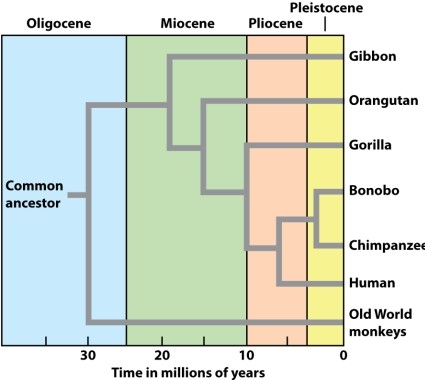 The divergence in the tree seen at 30 million years ago represents the:
A)split between New and Old World monkeys.
B)split between Old World monkeys and apes.
C)divergence between chimpanzees and humans.
D)speciation event caused by a split in the common ancestor.
The divergence in the tree seen at 30 million years ago represents the:A)split between New and Old World monkeys.
B)split between Old World monkeys and apes.
C)divergence between chimpanzees and humans.
D)speciation event caused by a split in the common ancestor.
Question
Question
Consider the figure below showing the arrangement of homologous genes in several great apes relative to human chromosome 2. Red and blue lines between chromosomes connect homologous regions. Do these data reject or support the sister group relationship between humans and chimps? 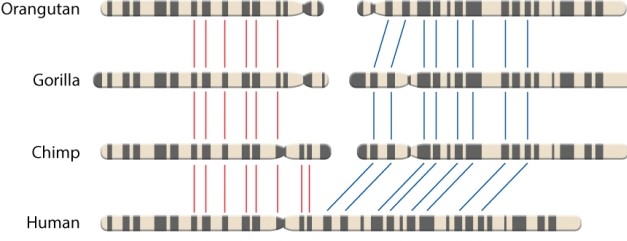 Data source: Yunis, J. J., and O. Prakash. 19 March 1982 "The Origin of Man: A Chromosomal Pictorial Legacy." Science 215:1525-1530.
A)These data reject the sister taxa relationship because humans only have a single chromosome and all other great apes have two; these data cannot be used to infer relatedness.
B)These data reject the sister taxa relationship because all the genes that are connected by the blue lines are the same in all great apes.
C)These data support the sister taxa relationship because all genes indicated by red and blue lines in chimpanzees are also in humans.
D)These data support the sister taxa relationship because it shows how the human chromosome was divided in two to give rise to all other great ape taxa.
Data source: Yunis, J. J., and O. Prakash. 19 March 1982 "The Origin of Man: A Chromosomal Pictorial Legacy." Science 215:1525-1530.A)These data reject the sister taxa relationship because humans only have a single chromosome and all other great apes have two; these data cannot be used to infer relatedness.
B)These data reject the sister taxa relationship because all the genes that are connected by the blue lines are the same in all great apes.
C)These data support the sister taxa relationship because all genes indicated by red and blue lines in chimpanzees are also in humans.
D)These data support the sister taxa relationship because it shows how the human chromosome was divided in two to give rise to all other great ape taxa.
Question
Question
Examine Figure 24.2.  Photo sources: (left to right) Zoonar/K. Jorgensen/age fotostock; S Sailer/A Sailer/age fotostock; J & C Sohns/age fotostock; Michael Dick/ Animals Animals-Earth Scenes; FLPA/Jurgen & Christi/age fotostock; Yellow Dog Productions/Getty Images.
Which of the following groups is monophyletic?
A)humans plus chimpanzees and bonobos
B)gorillas plus chimpanzees and bonobos
C)gibbons plus Old World monkeys
D)gibbons plus orangutans
E)gibbons plus orangutans plus gorillas
Photo sources: (left to right) Zoonar/K. Jorgensen/age fotostock; S Sailer/A Sailer/age fotostock; J & C Sohns/age fotostock; Michael Dick/ Animals Animals-Earth Scenes; FLPA/Jurgen & Christi/age fotostock; Yellow Dog Productions/Getty Images.Which of the following groups is monophyletic?
A)humans plus chimpanzees and bonobos
B)gorillas plus chimpanzees and bonobos
C)gibbons plus Old World monkeys
D)gibbons plus orangutans
E)gibbons plus orangutans plus gorillas
Question
Question
Examine Figures 24.1 and 24.2. 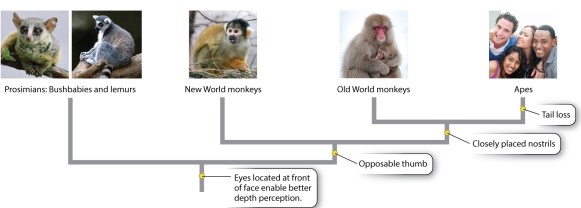 Photo sources: (left to right) George Holton/Science Source; Penelope Dearman/Getty Images; Daily Mail/Rex/Alamy; Patrick Shyu/Getty Images; Yellow Dog Productions/Getty Images.
 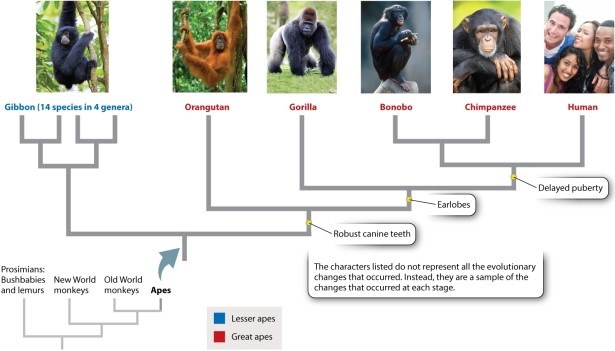 Photo sources: (left to right) Zoonar/K. Jorgensen/age fotostock; S Sailer/A Sailer/age fotostock; J & C Sohns/age fotostock; Michael Dick/ Animals Animals-Earth Scenes; FLPA/Jurgen & Christi/age fotostock; Yellow Dog Productions/Getty Images.
According to the figures, humans are members of the monophyletic:
A)primate group.
B)monkey group (includes both New World and Old World monkeys and their relatives).
C)ape group.
D)great ape group.
E)prosimians group.
Photo sources: (left to right) George Holton/Science Source; Penelope Dearman/Getty Images; Daily Mail/Rex/Alamy; Patrick Shyu/Getty Images; Yellow Dog Productions/Getty Images. Photo sources: (left to right) Zoonar/K. Jorgensen/age fotostock; S Sailer/A Sailer/age fotostock; J & C Sohns/age fotostock; Michael Dick/ Animals Animals-Earth Scenes; FLPA/Jurgen & Christi/age fotostock; Yellow Dog Productions/Getty Images.According to the figures, humans are members of the monophyletic:
A)primate group.
B)monkey group (includes both New World and Old World monkeys and their relatives).
C)ape group.
D)great ape group.
E)prosimians group.
Question
Question
Question
Examine Figure 24.1. 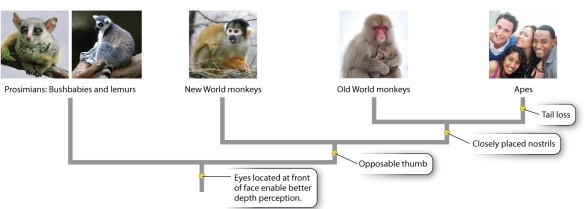 Photo sources: (left to right) George Holton/Science Source; Penelope Dearman/Getty Images; Daily Mail/Rex/Alamy; Patrick Shyu/Getty Images; Yellow Dog Productions/Getty Images. Based on the tree shown above, which of the following groups is monophyletic?
A)Old World monkeys and New World monkeys
B)Old World monkeys and apes
C)New World monkeys and Prosimians
D)Prosimians and apes
E)Prosimians, New World monkeys, and Old World monkeys
Photo sources: (left to right) George Holton/Science Source; Penelope Dearman/Getty Images; Daily Mail/Rex/Alamy; Patrick Shyu/Getty Images; Yellow Dog Productions/Getty Images. Based on the tree shown above, which of the following groups is monophyletic?A)Old World monkeys and New World monkeys
B)Old World monkeys and apes
C)New World monkeys and Prosimians
D)Prosimians and apes
E)Prosimians, New World monkeys, and Old World monkeys
Question
Question
Examine Figure 24.6 below. 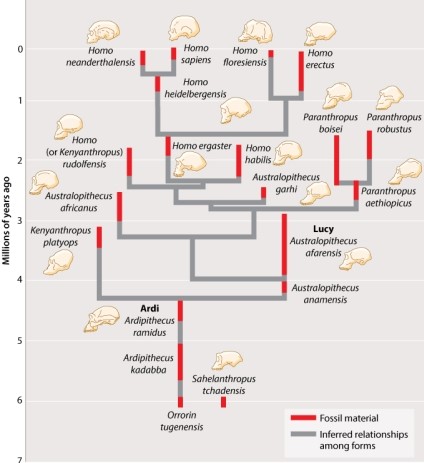 The time of GREATEST hominin radiation was approximately:
A)6-5 million years ago.
B)5-4 million years ago.
C)4-3 million years ago.
D)3-2 million years ago.
E)1 million years ago-present.
The time of GREATEST hominin radiation was approximately:A)6-5 million years ago.
B)5-4 million years ago.
C)4-3 million years ago.
D)3-2 million years ago.
E)1 million years ago-present.
Question
Question
Consider the following diagram: 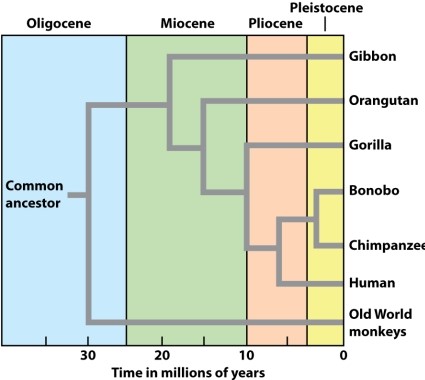 Which of the following represents a character that is useful in separating apes from Old World monkeys?
A)loss of tail
B)closely spaced nostrils
C)prehensile thumb
D)All of these choices are correct.
Which of the following represents a character that is useful in separating apes from Old World monkeys?A)loss of tail
B)closely spaced nostrils
C)prehensile thumb
D)All of these choices are correct.
Question
Evidence on chromosomal fusion, homology of genes, and gene order on chromosome 2 in humans is often used to support their sister taxa relationship to chimpanzees. Based on these lines of evidence, does the phylogeny below represent the most parsimonious explanation of the evolution of the number of chromosomes in humans and other apes? 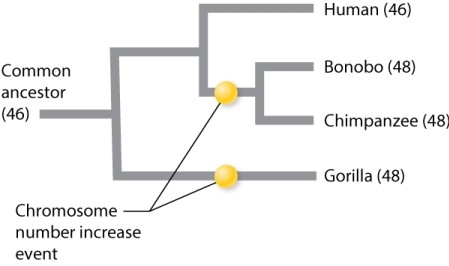
A)yes
B)no
A)yes
B)no
Question
Question
Question
Question
Question
Question
Question
Question
Consider the phylogenetic tree shown below. Geographic labels indicate the origin of humans whose mtDNA was sampled for sequence analysis. The chimp branch serves as the outgroup for the phylogeny. 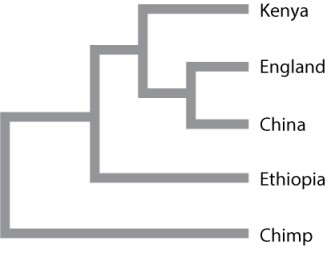 Which of the following statements is CORRECT?
A)The tree supports the out-of-Africa hypothesis for the origin humans because it implies that the common ancestor of all the humans is of African origin.
B)The tree does not reveal anything about the geographic origin of humans.
C)The tree supports the multiregional hypothesis because there are four independent populations.
D)The closest relative to the Kenyans are the English.
E)The Chinese share a more recent common ancestor with the Ethiopians than the Kenyans.
Which of the following statements is CORRECT?A)The tree supports the out-of-Africa hypothesis for the origin humans because it implies that the common ancestor of all the humans is of African origin.
B)The tree does not reveal anything about the geographic origin of humans.
C)The tree supports the multiregional hypothesis because there are four independent populations.
D)The closest relative to the Kenyans are the English.
E)The Chinese share a more recent common ancestor with the Ethiopians than the Kenyans.
Question
Question
Question
Question
Question
Question
Question
Question
Question
Question
Question
Question
Question
Question
Question
Question
Question
Question
Question
Based on Figure 24.10, which of the following statements is TRUE? 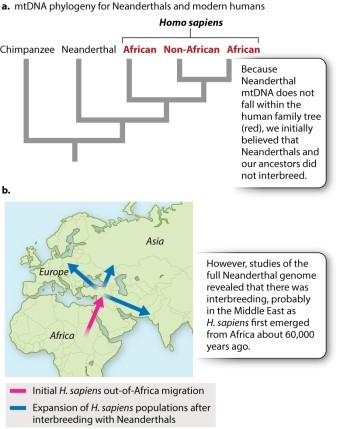
A)Neanderthals are more closely related to the French than to other groups.
B)Neanderthals are more closely related to the Chinese than to other groups.
C)Neanderthals are more closely related to the Nigerians than to other groups.
D)Neanderthals are more closely related to some African groups than others.
E)Neanderthals are equally related to all non-African groups.
A)Neanderthals are more closely related to the French than to other groups.
B)Neanderthals are more closely related to the Chinese than to other groups.
C)Neanderthals are more closely related to the Nigerians than to other groups.
D)Neanderthals are more closely related to some African groups than others.
E)Neanderthals are equally related to all non-African groups.
Question
Question
Question
Question
Question
Question
Question
Question
Question
Question
Question
Question
Question
Question
Question
Question
Question
Question
Question
Question
Consider the following figure (Figure 24.7): 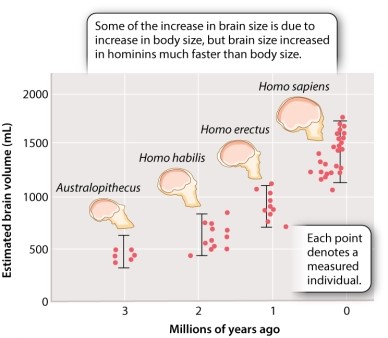 From these data you can infer:
A)that braincase volume is correlated with body size in the Homo lineage.
B)that each species in the Homo lineage has larger brain size than Australopithecines.
C)that the extant members of the Homo lineage show the greatest amount of range in brain size.
D)that the Homo lineage, on average, shows very little increase in brain size.
From these data you can infer:A)that braincase volume is correlated with body size in the Homo lineage.
B)that each species in the Homo lineage has larger brain size than Australopithecines.
C)that the extant members of the Homo lineage show the greatest amount of range in brain size.
D)that the Homo lineage, on average, shows very little increase in brain size.
Question
Question
Question
Question
Question
Question
Question
Question
Question
Question
Question
Based on the phylogeny below, does FOXP2 provide an accurate molecular clock for timing of divergence events between mammals and primates, and between humans and chimps? 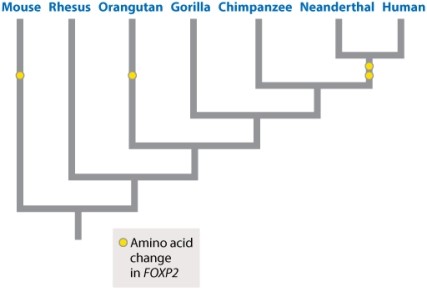
A)Yes, because we can plot the amino acid changes on the phylogeny, which shows the relationship between mice and all other primates including humans and chimps.
B)Yes, because there is one change on average for every three branches on the tree.
C)No, because the changes in amino acids do not occur at regular intervals.
D)No, because we do not know if Neanderthals had spoken language.
A)Yes, because we can plot the amino acid changes on the phylogeny, which shows the relationship between mice and all other primates including humans and chimps.
B)Yes, because there is one change on average for every three branches on the tree.
C)No, because the changes in amino acids do not occur at regular intervals.
D)No, because we do not know if Neanderthals had spoken language.
Question
Question
Question
Question
Question
Question

Unlock Deck
Sign up to unlock the cards in this deck!
Unlock Deck
Unlock Deck
1/178

Play

Full screen (f)
Deck 24: Human Origins and Evolution
1
Researchers use the denaturation temperatures of hybrid double helices to compare evolutionary relatedness. Complementary strands denature at 95 degrees. A researcher engineers a hybrid strand from two species and it denatures at 93 degrees. What does this mean?
A)The hybrid double helices are more complementary than the non-hybrid.
B)The hybrid double helices are less complementary than the non-hybrid.
C)The species are more closely related than any other two species.
D)The hybrid strands' base pairs had fewer mismatches.
A)The hybrid double helices are more complementary than the non-hybrid.
B)The hybrid double helices are less complementary than the non-hybrid.
C)The species are more closely related than any other two species.
D)The hybrid strands' base pairs had fewer mismatches.
B
2
Consider the following diagram: The divergence in the tree seen at 30 million years ago represents the:
A)split between New and Old World monkeys.
B)split between Old World monkeys and apes.
C)divergence between chimpanzees and humans.
D)speciation event caused by a split in the common ancestor.
The divergence in the tree seen at 30 million years ago represents the:A)split between New and Old World monkeys.
B)split between Old World monkeys and apes.
C)divergence between chimpanzees and humans.
D)speciation event caused by a split in the common ancestor.
B
3
_____ was the first hominin to leave Africa and did so around _____ million years ago.
A)Homo ergaster (H. erectus); 2
B)Ardipithecus ramidus; 4
C)Australopithecus afarensis; 3.2
D)H) neanderthalensis; 0.6
E)H) habilis; 1.7
A)Homo ergaster (H. erectus); 2
B)Ardipithecus ramidus; 4
C)Australopithecus afarensis; 3.2
D)H) neanderthalensis; 0.6
E)H) habilis; 1.7
A
4
Consider the figure below showing the arrangement of homologous genes in several great apes relative to human chromosome 2. Red and blue lines between chromosomes connect homologous regions. Do these data reject or support the sister group relationship between humans and chimps? Data source: Yunis, J. J., and O. Prakash. 19 March 1982 "The Origin of Man: A Chromosomal Pictorial Legacy." Science 215:1525-1530.
A)These data reject the sister taxa relationship because humans only have a single chromosome and all other great apes have two; these data cannot be used to infer relatedness.
B)These data reject the sister taxa relationship because all the genes that are connected by the blue lines are the same in all great apes.
C)These data support the sister taxa relationship because all genes indicated by red and blue lines in chimpanzees are also in humans.
D)These data support the sister taxa relationship because it shows how the human chromosome was divided in two to give rise to all other great ape taxa.
Data source: Yunis, J. J., and O. Prakash. 19 March 1982 "The Origin of Man: A Chromosomal Pictorial Legacy." Science 215:1525-1530.A)These data reject the sister taxa relationship because humans only have a single chromosome and all other great apes have two; these data cannot be used to infer relatedness.
B)These data reject the sister taxa relationship because all the genes that are connected by the blue lines are the same in all great apes.
C)These data support the sister taxa relationship because all genes indicated by red and blue lines in chimpanzees are also in humans.
D)These data support the sister taxa relationship because it shows how the human chromosome was divided in two to give rise to all other great ape taxa.
Unlock Deck
Unlock for access to all 178 flashcards in this deck.
Unlock Deck
k this deck
5
Humans and chimpanzees last shared a common ancestor around _____ million years ago, and our genomes now differ by about _____%.
A)5-7; 1
B)5-7; 10
C)10-20; 1
D)10-20; 10
E)20-50; 50
A)5-7; 1
B)5-7; 10
C)10-20; 1
D)10-20; 10
E)20-50; 50
Unlock Deck
Unlock for access to all 178 flashcards in this deck.
Unlock Deck
k this deck
6
Examine Figure 24.2. Photo sources: (left to right) Zoonar/K. Jorgensen/age fotostock; S Sailer/A Sailer/age fotostock; J & C Sohns/age fotostock; Michael Dick/ Animals Animals-Earth Scenes; FLPA/Jurgen & Christi/age fotostock; Yellow Dog Productions/Getty Images.
Which of the following groups is monophyletic?
A)humans plus chimpanzees and bonobos
B)gorillas plus chimpanzees and bonobos
C)gibbons plus Old World monkeys
D)gibbons plus orangutans
E)gibbons plus orangutans plus gorillas
Photo sources: (left to right) Zoonar/K. Jorgensen/age fotostock; S Sailer/A Sailer/age fotostock; J & C Sohns/age fotostock; Michael Dick/ Animals Animals-Earth Scenes; FLPA/Jurgen & Christi/age fotostock; Yellow Dog Productions/Getty Images.Which of the following groups is monophyletic?
A)humans plus chimpanzees and bonobos
B)gorillas plus chimpanzees and bonobos
C)gibbons plus Old World monkeys
D)gibbons plus orangutans
E)gibbons plus orangutans plus gorillas
Unlock Deck
Unlock for access to all 178 flashcards in this deck.
Unlock Deck
k this deck
7
As a human, 99% of my _____ is (are) the same as a chimpanzee's, 60% of my _____ is/are the same as a banana's, but only 50% of my _____ is/are the same as my biological daughter's.
A)alleles; alleles; alleles
B)alleles; genes; genes
C)nucleotide sequence; nucleotide sequence; nucleotide sequence
D)nucleotide sequence; genes; alleles
E)genes; alleles; nucleotide sequence
A)alleles; alleles; alleles
B)alleles; genes; genes
C)nucleotide sequence; nucleotide sequence; nucleotide sequence
D)nucleotide sequence; genes; alleles
E)genes; alleles; nucleotide sequence
Unlock Deck
Unlock for access to all 178 flashcards in this deck.
Unlock Deck
k this deck
8
Examine Figures 24.1 and 24.2. Photo sources: (left to right) George Holton/Science Source; Penelope Dearman/Getty Images; Daily Mail/Rex/Alamy; Patrick Shyu/Getty Images; Yellow Dog Productions/Getty Images. Photo sources: (left to right) Zoonar/K. Jorgensen/age fotostock; S Sailer/A Sailer/age fotostock; J & C Sohns/age fotostock; Michael Dick/ Animals Animals-Earth Scenes; FLPA/Jurgen & Christi/age fotostock; Yellow Dog Productions/Getty Images.
According to the figures, humans are members of the monophyletic:
A)primate group.
B)monkey group (includes both New World and Old World monkeys and their relatives).
C)ape group.
D)great ape group.
E)prosimians group.
Photo sources: (left to right) George Holton/Science Source; Penelope Dearman/Getty Images; Daily Mail/Rex/Alamy; Patrick Shyu/Getty Images; Yellow Dog Productions/Getty Images. Photo sources: (left to right) Zoonar/K. Jorgensen/age fotostock; S Sailer/A Sailer/age fotostock; J & C Sohns/age fotostock; Michael Dick/ Animals Animals-Earth Scenes; FLPA/Jurgen & Christi/age fotostock; Yellow Dog Productions/Getty Images.According to the figures, humans are members of the monophyletic:
A)primate group.
B)monkey group (includes both New World and Old World monkeys and their relatives).
C)ape group.
D)great ape group.
E)prosimians group.
Unlock Deck
Unlock for access to all 178 flashcards in this deck.
Unlock Deck
k this deck
9
Hominins are defined as:
A)members of species in the lineage leading to humans.
B)having a common ancestor.
C)human ancestors that survived to the present day (none are now extinct).
D)None of the other answer options is correct.
A)members of species in the lineage leading to humans.
B)having a common ancestor.
C)human ancestors that survived to the present day (none are now extinct).
D)None of the other answer options is correct.
Unlock Deck
Unlock for access to all 178 flashcards in this deck.
Unlock Deck
k this deck
10
If your nucleotide sequence is 99% the same as a chimpanzee's and only 50% of your alleles are the same as your biological daughter's, why aren't you more closely related to the chimpanzee than your own daughter?
Unlock Deck
Unlock for access to all 178 flashcards in this deck.
Unlock Deck
k this deck
11
Examine Figure 24.1. Photo sources: (left to right) George Holton/Science Source; Penelope Dearman/Getty Images; Daily Mail/Rex/Alamy; Patrick Shyu/Getty Images; Yellow Dog Productions/Getty Images. Based on the tree shown above, which of the following groups is monophyletic?
A)Old World monkeys and New World monkeys
B)Old World monkeys and apes
C)New World monkeys and Prosimians
D)Prosimians and apes
E)Prosimians, New World monkeys, and Old World monkeys
Photo sources: (left to right) George Holton/Science Source; Penelope Dearman/Getty Images; Daily Mail/Rex/Alamy; Patrick Shyu/Getty Images; Yellow Dog Productions/Getty Images. Based on the tree shown above, which of the following groups is monophyletic?A)Old World monkeys and New World monkeys
B)Old World monkeys and apes
C)New World monkeys and Prosimians
D)Prosimians and apes
E)Prosimians, New World monkeys, and Old World monkeys
Unlock Deck
Unlock for access to all 178 flashcards in this deck.
Unlock Deck
k this deck
12
Our species, H. sapiens, derived from:
A)H) floresiensis.
B)H) ergaster.
C)H) habilis.
D)H) rudolfensis.
A)H) floresiensis.
B)H) ergaster.
C)H) habilis.
D)H) rudolfensis.
Unlock Deck
Unlock for access to all 178 flashcards in this deck.
Unlock Deck
k this deck
13
Examine Figure 24.6 below. The time of GREATEST hominin radiation was approximately:
A)6-5 million years ago.
B)5-4 million years ago.
C)4-3 million years ago.
D)3-2 million years ago.
E)1 million years ago-present.
The time of GREATEST hominin radiation was approximately:A)6-5 million years ago.
B)5-4 million years ago.
C)4-3 million years ago.
D)3-2 million years ago.
E)1 million years ago-present.
Unlock Deck
Unlock for access to all 178 flashcards in this deck.
Unlock Deck
k this deck
14
Our ancestors were bipedal by at least _____ million years ago, as evidenced by the Lucy skeleton.
A)1)2
B)2)4
C)3)2
D)4)5
A)1)2
B)2)4
C)3)2
D)4)5
Unlock Deck
Unlock for access to all 178 flashcards in this deck.
Unlock Deck
k this deck
15
Consider the following diagram: Which of the following represents a character that is useful in separating apes from Old World monkeys?
A)loss of tail
B)closely spaced nostrils
C)prehensile thumb
D)All of these choices are correct.
Which of the following represents a character that is useful in separating apes from Old World monkeys?A)loss of tail
B)closely spaced nostrils
C)prehensile thumb
D)All of these choices are correct.
Unlock Deck
Unlock for access to all 178 flashcards in this deck.
Unlock Deck
k this deck
16
Evidence on chromosomal fusion, homology of genes, and gene order on chromosome 2 in humans is often used to support their sister taxa relationship to chimpanzees. Based on these lines of evidence, does the phylogeny below represent the most parsimonious explanation of the evolution of the number of chromosomes in humans and other apes?
A)yes
B)no
A)yes
B)no
Unlock Deck
Unlock for access to all 178 flashcards in this deck.
Unlock Deck
k this deck
17
In addition to the shift to bipedalism, what major trend or trends do we see in hominin evolution as we look across our entire fossil record?
A)increase in body size
B)increase in brain size
C)significant increase in the difference in size between males and females
D)increase in tooth size
E)None of the other answer options is correct.
A)increase in body size
B)increase in brain size
C)significant increase in the difference in size between males and females
D)increase in tooth size
E)None of the other answer options is correct.
Unlock Deck
Unlock for access to all 178 flashcards in this deck.
Unlock Deck
k this deck
18
Gibbons and orangutans are from Asia. Gorillas and chimpanzees are from Africa. How was Charles Darwin able to hypothesize that humans evolved in Africa?
A)He understood that humans and great apes were closely related.
B)He understood that humans and gorillas/chimpanzees are more closely related than humans and orangutans based on anatomical criteria.
C)He understood that humans and orangutans are more closely related than humans and gorillas based on anatomical criteria.
A)He understood that humans and great apes were closely related.
B)He understood that humans and gorillas/chimpanzees are more closely related than humans and orangutans based on anatomical criteria.
C)He understood that humans and orangutans are more closely related than humans and gorillas based on anatomical criteria.
Unlock Deck
Unlock for access to all 178 flashcards in this deck.
Unlock Deck
k this deck
19
The fossil Lucy (Australopithecus afarensis) is significant because, at _____ years old, hers is the first hominin species to _____.
A)20 million; have been fully bipedal
B)1)3 million; have hominin brow ridges
C)1)3 million; migrate out of Africa
D)600,000; have hominin brow ridges
A)20 million; have been fully bipedal
B)1)3 million; have hominin brow ridges
C)1)3 million; migrate out of Africa
D)600,000; have hominin brow ridges
Unlock Deck
Unlock for access to all 178 flashcards in this deck.
Unlock Deck
k this deck
20
Which is a major trend in the evolution of modern humans?
A)body size increase
B)cranium size increase
C)thumb dexterity increase
D)All of these choices are correct.
A)body size increase
B)cranium size increase
C)thumb dexterity increase
D)All of these choices are correct.
Unlock Deck
Unlock for access to all 178 flashcards in this deck.
Unlock Deck
k this deck
21
The common phrase "Humans evolved from chimpanzees" is inaccurate. In reality, the evolutionary relationship between chimpanzees and humans is:
A)that there was a population of chimpanzees that had mutations that made them human.
B)that humans and chimpanzees share a relatively recent common ancestor.
C)that chimpanzees are the next group that will turn into humans.
D)that chimpanzees are bipedal.
A)that there was a population of chimpanzees that had mutations that made them human.
B)that humans and chimpanzees share a relatively recent common ancestor.
C)that chimpanzees are the next group that will turn into humans.
D)that chimpanzees are bipedal.
Unlock Deck
Unlock for access to all 178 flashcards in this deck.
Unlock Deck
k this deck
22
Studies of the denaturation temperatures of hybrids of human and different apes' DNA provided us with what new information, after morphological studies fell short of resolving the primate phylogenetic tree?
A)that the bonobo and chimpanzee are two different species
B)that the gorilla is more closely related to humans than the orangutan
C)that the chimpanzees are more closely related to humans than gorillas are
D)that Old World monkeys are separate from the apes
E)None of the other answer options is correct.
A)that the bonobo and chimpanzee are two different species
B)that the gorilla is more closely related to humans than the orangutan
C)that the chimpanzees are more closely related to humans than gorillas are
D)that Old World monkeys are separate from the apes
E)None of the other answer options is correct.
Unlock Deck
Unlock for access to all 178 flashcards in this deck.
Unlock Deck
k this deck
23
Humans are included in which of the following groups?
A)great apes
B)prosimians
C)gorillas
D)chimpanzees
A)great apes
B)prosimians
C)gorillas
D)chimpanzees
Unlock Deck
Unlock for access to all 178 flashcards in this deck.
Unlock Deck
k this deck
24
Consider the phylogenetic tree shown below. Geographic labels indicate the origin of humans whose mtDNA was sampled for sequence analysis. The chimp branch serves as the outgroup for the phylogeny. Which of the following statements is CORRECT?
A)The tree supports the out-of-Africa hypothesis for the origin humans because it implies that the common ancestor of all the humans is of African origin.
B)The tree does not reveal anything about the geographic origin of humans.
C)The tree supports the multiregional hypothesis because there are four independent populations.
D)The closest relative to the Kenyans are the English.
E)The Chinese share a more recent common ancestor with the Ethiopians than the Kenyans.
Which of the following statements is CORRECT?A)The tree supports the out-of-Africa hypothesis for the origin humans because it implies that the common ancestor of all the humans is of African origin.
B)The tree does not reveal anything about the geographic origin of humans.
C)The tree supports the multiregional hypothesis because there are four independent populations.
D)The closest relative to the Kenyans are the English.
E)The Chinese share a more recent common ancestor with the Ethiopians than the Kenyans.
Unlock Deck
Unlock for access to all 178 flashcards in this deck.
Unlock Deck
k this deck
25
Which of the following is NOT a piece of genetic evidence that supports the out-of-Africa hypothesis for the origin of humans?
A)mtDNA sequences from African and non-African samples indicates a divergence time of approximately 200,000 years.
B)Genetic diversity of mtDNA sequences among African samples is greater than genetic diversity of mtDNA sequences among non-African samples.
C)mtDNA alleles present in Europe are a subset of mtDNA alleles derived from those present in Africa.
D)mtDNA alleles among samples from Africa are more similar than mtDNA alleles among samples from Europe
A)mtDNA sequences from African and non-African samples indicates a divergence time of approximately 200,000 years.
B)Genetic diversity of mtDNA sequences among African samples is greater than genetic diversity of mtDNA sequences among non-African samples.
C)mtDNA alleles present in Europe are a subset of mtDNA alleles derived from those present in Africa.
D)mtDNA alleles among samples from Africa are more similar than mtDNA alleles among samples from Europe
Unlock Deck
Unlock for access to all 178 flashcards in this deck.
Unlock Deck
k this deck
26
Where did Homo sapiens originate?
A)Asia
B)Middle East
C)Africa
D)independently in multiple regions of the world
E)North America
A)Asia
B)Middle East
C)Africa
D)independently in multiple regions of the world
E)North America
Unlock Deck
Unlock for access to all 178 flashcards in this deck.
Unlock Deck
k this deck
27
There is some debate about whether Homo floresiensis is a separate species or an aberrant form of Homo sapiens. Regardless, what we do know is that H. floresiensis were only found on an Indonesian island and adults were only 3 feet tall. What factors would have selected for this distinct phenotype on an island habitat, specifically?
A)Height is only advantageous if there are predators present on the island.
B)Plants on that island never grew tall, so it was advantageous to be short.
C)The smaller body size was advantageous for living on an island, as food is often limited on islands.
D)The smaller body size made swimming easier.
E)The smaller body size made conserving heat easier.
A)Height is only advantageous if there are predators present on the island.
B)Plants on that island never grew tall, so it was advantageous to be short.
C)The smaller body size was advantageous for living on an island, as food is often limited on islands.
D)The smaller body size made swimming easier.
E)The smaller body size made conserving heat easier.
Unlock Deck
Unlock for access to all 178 flashcards in this deck.
Unlock Deck
k this deck
28
Consider the following hypothetical hominin lineage: Homo ergaster Homo heidelbergensis Homo sapiens. This is currently the accepted hypothesis because H. ergaster evolved into H. heidelbergensis.
Unlock Deck
Unlock for access to all 178 flashcards in this deck.
Unlock Deck
k this deck
29
"Hominins" refers to members of all the different species in the lineage leading to humans.
Unlock Deck
Unlock for access to all 178 flashcards in this deck.
Unlock Deck
k this deck
30
The first DNA comparison studies between humans and chimpanzees relied on which of the following?
A)The more complementary two strands of DNA are, the higher the melting point.
B)The more complementary two strands of DNA are, the lower the melting point.
C)DNA from different organisms won't combine to form a double helix.
D)Proteins from chimpanzees would have a higher melting point than similar proteins from humans.
E)Proteins from chimpanzees would have a lower melting point than similar proteins from humans.
A)The more complementary two strands of DNA are, the higher the melting point.
B)The more complementary two strands of DNA are, the lower the melting point.
C)DNA from different organisms won't combine to form a double helix.
D)Proteins from chimpanzees would have a higher melting point than similar proteins from humans.
E)Proteins from chimpanzees would have a lower melting point than similar proteins from humans.
Unlock Deck
Unlock for access to all 178 flashcards in this deck.
Unlock Deck
k this deck
31
Which of the following explains how chimpanzees and humans can be so different with such similar genomes?
A)The anatomical and behavioral differences between chimpanzees and humans aren't that large.
B)Different environments between the two populations influenced the anatomical and behavioral differences.
C)The human population is so much larger than the chimpanzee population that we benefit from more genetic variation.
D)The genetic differences could have occurred in genes responsible for development.
E)None of the other answer options is correct.
A)The anatomical and behavioral differences between chimpanzees and humans aren't that large.
B)Different environments between the two populations influenced the anatomical and behavioral differences.
C)The human population is so much larger than the chimpanzee population that we benefit from more genetic variation.
D)The genetic differences could have occurred in genes responsible for development.
E)None of the other answer options is correct.
Unlock Deck
Unlock for access to all 178 flashcards in this deck.
Unlock Deck
k this deck
32
Charles Darwin noted that the human lineage probably arose out of Africa. Which of the following was MOST likely the reason behind his hypothesis?
A)Africa has warmer temperatures, which allows for greater diversity.
B)Gorillas and chimpanzees, which are the primates most closely related to humans, only live in Africa.
C)Africa was the first land mass that was suitable for life.
D)This was before the advent of molecular analysis, so Charles Darwin was incorrect.
E)None of the answer options is correct.
A)Africa has warmer temperatures, which allows for greater diversity.
B)Gorillas and chimpanzees, which are the primates most closely related to humans, only live in Africa.
C)Africa was the first land mass that was suitable for life.
D)This was before the advent of molecular analysis, so Charles Darwin was incorrect.
E)None of the answer options is correct.
Unlock Deck
Unlock for access to all 178 flashcards in this deck.
Unlock Deck
k this deck
33
Why do we think that male Neanderthals mated with non-African ancestral Homo sapiens?
A)Because Neanderthal mtDNA sequences are present in the human gene pool, and Neanderthal nuclear DNA sequences are not.
B)Because neither Neanderthal mtDNA sequences nor nuclear DNA sequences are present in the modern human gene pool.
C)Because Neanderthal nuclear DNA sequences are present in the human gene pool, and Neanderthal mtDNA sequences are not.
D)Because both Neanderthal mtDNA sequences and nuclear DNA sequences are present in the modern human gene pool.
A)Because Neanderthal mtDNA sequences are present in the human gene pool, and Neanderthal nuclear DNA sequences are not.
B)Because neither Neanderthal mtDNA sequences nor nuclear DNA sequences are present in the modern human gene pool.
C)Because Neanderthal nuclear DNA sequences are present in the human gene pool, and Neanderthal mtDNA sequences are not.
D)Because both Neanderthal mtDNA sequences and nuclear DNA sequences are present in the modern human gene pool.
Unlock Deck
Unlock for access to all 178 flashcards in this deck.
Unlock Deck
k this deck
34
Which of the following primates is the MOST closely related to humans?
A)gorillas
B)orangutans
C)monkeys
D)chimpanzees
E)lemurs
A)gorillas
B)orangutans
C)monkeys
D)chimpanzees
E)lemurs
Unlock Deck
Unlock for access to all 178 flashcards in this deck.
Unlock Deck
k this deck
35
Consider the following mtDNA sequences obtained from chimpanzees and from humans in the following geographic regions: Which of the following statements is NOT correct?
A)These data depict a higher level of sequence divergence between human and chimp than is to be expected based on overall levels of genetic similarity between humans and chimps.
B)These data are consistent with the multiregional hypothesis for the origin of humans because the Asian and European sequences are more closely related to each other than either is to the African sequences.
C)These data are consistent with the out-of-Africa hypothesis for the origin of humans because the Kenyan and Ethiopian samples exhibit an ancestral character state at position 7.
D)The African sequences represent older evolutionary lineages than the European sequences because they have one polymorphic site.
A)These data depict a higher level of sequence divergence between human and chimp than is to be expected based on overall levels of genetic similarity between humans and chimps.
B)These data are consistent with the multiregional hypothesis for the origin of humans because the Asian and European sequences are more closely related to each other than either is to the African sequences.
C)These data are consistent with the out-of-Africa hypothesis for the origin of humans because the Kenyan and Ethiopian samples exhibit an ancestral character state at position 7.
D)The African sequences represent older evolutionary lineages than the European sequences because they have one polymorphic site.
Unlock Deck
Unlock for access to all 178 flashcards in this deck.
Unlock Deck
k this deck
36
Which of the following statements about great apes is CORRECT?
A)Orangutans are more closely related to chimpanzees than to gorillas.
B)Chimpanzees are more closely related to humans than to bonobos.
C)Gorillas are more closely related to humans than to orangutans.
D)Bonobos are more closely related to humans than to chimpanzees.
A)Orangutans are more closely related to chimpanzees than to gorillas.
B)Chimpanzees are more closely related to humans than to bonobos.
C)Gorillas are more closely related to humans than to orangutans.
D)Bonobos are more closely related to humans than to chimpanzees.
Unlock Deck
Unlock for access to all 178 flashcards in this deck.
Unlock Deck
k this deck
37
Which of the following characteristics separates primates from other mammals?
A)Primates are all placental animals, whereas other mammals are not.
B)Primates all have tails, whereas other mammals do not.
C)Primates have nails instead of claws.
D)Primates can regulate their body temperature.
E)Primates are the only mammals that have eyes on the front of the face.
A)Primates are all placental animals, whereas other mammals are not.
B)Primates all have tails, whereas other mammals do not.
C)Primates have nails instead of claws.
D)Primates can regulate their body temperature.
E)Primates are the only mammals that have eyes on the front of the face.
Unlock Deck
Unlock for access to all 178 flashcards in this deck.
Unlock Deck
k this deck
38
Which of the following statements describes Neanderthals?
A)They are also called Cro-Magnons for the site where they were first discovered.
B)They are believed to have given rise to Homo sapiens.
C)They were the first bipedal hominins discovered.
D)They are a species that is closely related to, but distinct from, Homo sapiens.
A)They are also called Cro-Magnons for the site where they were first discovered.
B)They are believed to have given rise to Homo sapiens.
C)They were the first bipedal hominins discovered.
D)They are a species that is closely related to, but distinct from, Homo sapiens.
Unlock Deck
Unlock for access to all 178 flashcards in this deck.
Unlock Deck
k this deck
39
What continent was the starting point for the origination of humans?
A)Africa
B)Asia
C)Europe
D)Australia
E)North America
A)Africa
B)Asia
C)Europe
D)Australia
E)North America
Unlock Deck
Unlock for access to all 178 flashcards in this deck.
Unlock Deck
k this deck
40
Which one of the following is an advantage of using the fossil record to obtain information about our evolutionary history?
A)The fossil record gives us examples of the extinct intermediate stages of evolution.
B)There is no advantage that the fossil record provides that DNA analysis doesn't also provide.
C)The fossil record gives us the information necessary to define species.
D)The fossil record gives us the information needed to confirm that the Neanderthals were the first bipedal humans.
A)The fossil record gives us examples of the extinct intermediate stages of evolution.
B)There is no advantage that the fossil record provides that DNA analysis doesn't also provide.
C)The fossil record gives us the information necessary to define species.
D)The fossil record gives us the information needed to confirm that the Neanderthals were the first bipedal humans.
Unlock Deck
Unlock for access to all 178 flashcards in this deck.
Unlock Deck
k this deck
41
When Rebecca Cann decided to conduct research on the evolution of humans, she chose to study mitochondrial DNA. Which of the following explains why she chose this type of DNA?
A)because mitochondrial DNA is more abundant and therefore easier to extract
B)because mitochondrial DNA is recombined from generation to generation and offers a look at the lineage of the human population
C)because mitochondrial DNA is circular
D)because mitochondrial DNA lasts longer in the tissues
A)because mitochondrial DNA is more abundant and therefore easier to extract
B)because mitochondrial DNA is recombined from generation to generation and offers a look at the lineage of the human population
C)because mitochondrial DNA is circular
D)because mitochondrial DNA lasts longer in the tissues
Unlock Deck
Unlock for access to all 178 flashcards in this deck.
Unlock Deck
k this deck
42
Comparison of mtDNA sequences revealed that all humans shared a common mtDNA ancestor around 200,000 years ago. What was the predicted date of the common ancestor under the multiregional hypothesis of modern human origins?
A)50,000 years ago
B)100,000 years ago
C)2,000,000 years ago
D)500,000 years ago
A)50,000 years ago
B)100,000 years ago
C)2,000,000 years ago
D)500,000 years ago
Unlock Deck
Unlock for access to all 178 flashcards in this deck.
Unlock Deck
k this deck
43
Based on Figure 24.10, which of the following statements is TRUE?
A)Neanderthals are more closely related to the French than to other groups.
B)Neanderthals are more closely related to the Chinese than to other groups.
C)Neanderthals are more closely related to the Nigerians than to other groups.
D)Neanderthals are more closely related to some African groups than others.
E)Neanderthals are equally related to all non-African groups.
A)Neanderthals are more closely related to the French than to other groups.
B)Neanderthals are more closely related to the Chinese than to other groups.
C)Neanderthals are more closely related to the Nigerians than to other groups.
D)Neanderthals are more closely related to some African groups than others.
E)Neanderthals are equally related to all non-African groups.
Unlock Deck
Unlock for access to all 178 flashcards in this deck.
Unlock Deck
k this deck
44
All evidence suggests that the Neanderthals did not interbreed with our ancestors.
Unlock Deck
Unlock for access to all 178 flashcards in this deck.
Unlock Deck
k this deck
45
Interbreeding between Neanderthals and modern H. sapiens likely took place in _____ around _____ years ago, before H. sapiens spread around the world.
A)the Middle East; 60,000
B)Africa; 60,000
C)the Middle East; 200,000
D)Africa; 200,000
E)the Middle East; 1.4 million
A)the Middle East; 60,000
B)Africa; 60,000
C)the Middle East; 200,000
D)Africa; 200,000
E)the Middle East; 1.4 million
Unlock Deck
Unlock for access to all 178 flashcards in this deck.
Unlock Deck
k this deck
46
Many researchers hypothesize that modern humans have derived from the Homo ergaster populations that spread around the world starting about 2 million years ago. This hypothesis is known as the:
A)out-of-Africa hypothesis.
B)into-Africa hypothesis.
C)multiregional hypothesis.
D)uniregional hypothesis.
E)None of the answer options is correct.
A)out-of-Africa hypothesis.
B)into-Africa hypothesis.
C)multiregional hypothesis.
D)uniregional hypothesis.
E)None of the answer options is correct.
Unlock Deck
Unlock for access to all 178 flashcards in this deck.
Unlock Deck
k this deck
47
Approximately what percentage of non-African human nuclear DNA genomes are Neanderthal derived?
A)0%
B)1-4%
C)5-10%
D)15-20%
A)0%
B)1-4%
C)5-10%
D)15-20%
Unlock Deck
Unlock for access to all 178 flashcards in this deck.
Unlock Deck
k this deck
48
Approximately what percentage of modern human mtDNA is Neanderthal derived?
A)0%
B)1-4%
C)5-10%
D)15-20%
A)0%
B)1-4%
C)5-10%
D)15-20%
Unlock Deck
Unlock for access to all 178 flashcards in this deck.
Unlock Deck
k this deck
49
The mitochondrial DNA study indicated that there was no genetic input from Neanderthals in modern humans, but the whole-genome study suggests that in fact there was. One suggestion to explain this discrepancy is that the Neanderthal input into modern human populations was from males only. Which of the following strategies could be employed to test this hypothesis?
A)Look at the Y chromosome because it is paternally inherited.
B)Look at the X chromosome because that is bi-parentally inherited.
C)Look at genomic DNA only in modern humans that are females.
D)Look at genomic DNA only in modern humans that are male.
A)Look at the Y chromosome because it is paternally inherited.
B)Look at the X chromosome because that is bi-parentally inherited.
C)Look at genomic DNA only in modern humans that are females.
D)Look at genomic DNA only in modern humans that are male.
Unlock Deck
Unlock for access to all 178 flashcards in this deck.
Unlock Deck
k this deck
50
Genetic sequence data from mitochondrial and Y chromosome DNA agree that the human family is _____ and it arose _____.
A)young; in Africa
B)young; in Europe
C)old; in Africa
D)old; in Europe
E)old; in many regions around the world
A)young; in Africa
B)young; in Europe
C)old; in Africa
D)old; in Europe
E)old; in many regions around the world
Unlock Deck
Unlock for access to all 178 flashcards in this deck.
Unlock Deck
k this deck
51
Mitochondrial DNA studies were used to determine that Homo sapiens evolved in Africa and only later did they become established elsewhere.
Unlock Deck
Unlock for access to all 178 flashcards in this deck.
Unlock Deck
k this deck
52
If the out-of-Africa hypothesis of human origins is correct, which of the following BEST describes the pattern of hominin migration from Africa?
A)H) ergaster migrated 2 million years ago; H. sapiens migrated 60,000 years ago.
B)H) sapiens migrated once 2 million years ago and again 60,000 years ago.
C)H) ergaster migrated once 2 million years ago and again 60,000 years ago.
D)H) neanderthalensis migrated once 1.3 million years ago and H. sapiens migrated 60,000 years ago.
E)H) heidelbergensis migrated 2 million years ago and H. sapiens migrated 60,000 years ago.
A)H) ergaster migrated 2 million years ago; H. sapiens migrated 60,000 years ago.
B)H) sapiens migrated once 2 million years ago and again 60,000 years ago.
C)H) ergaster migrated once 2 million years ago and again 60,000 years ago.
D)H) neanderthalensis migrated once 1.3 million years ago and H. sapiens migrated 60,000 years ago.
E)H) heidelbergensis migrated 2 million years ago and H. sapiens migrated 60,000 years ago.
Unlock Deck
Unlock for access to all 178 flashcards in this deck.
Unlock Deck
k this deck
53
Why do we only see Neanderthal input in non-African genomes?
A)Neanderthals never interbred with Homo sapiens in Africa.
B)Only mtDNA can be transmitted from Neanderthal genomes.
C)Only Y chromosome DNA can be transmitted from Neanderthal genomes.
D)Neanderthals were adapted to a cold European climate.
A)Neanderthals never interbred with Homo sapiens in Africa.
B)Only mtDNA can be transmitted from Neanderthal genomes.
C)Only Y chromosome DNA can be transmitted from Neanderthal genomes.
D)Neanderthals were adapted to a cold European climate.
Unlock Deck
Unlock for access to all 178 flashcards in this deck.
Unlock Deck
k this deck
54
Which of the following properties of mitochondrial DNA (mtDNA) is NOT helpful in using mtDNA to infer the geographic origin and timing of the evolution of modern humans?
A)Mitochondrial DNA is uniparentally inherited from the mother.
B)Mitochondrial DNA incurs mutations at a constant rate over time.
C)In rare cases, some cells contain more than one mitochondrial genotype.
D)Mitochondrial DNA in animals does not undergo recombination.
E)There are a large number of mitochondria in a typical cell.
A)Mitochondrial DNA is uniparentally inherited from the mother.
B)Mitochondrial DNA incurs mutations at a constant rate over time.
C)In rare cases, some cells contain more than one mitochondrial genotype.
D)Mitochondrial DNA in animals does not undergo recombination.
E)There are a large number of mitochondria in a typical cell.
Unlock Deck
Unlock for access to all 178 flashcards in this deck.
Unlock Deck
k this deck
55
According to the multiregional hypothesis of human origins, modern H. sapiens evolved by _____ from _____ of H. ergaster.
A)convergent evolution; multiple Old World populations
B)adaptive radiation; a single Old World population
C)allopatric speciation; multiple Old World populations
D)allopatric speciation; a single Old World population
E)peripatric speciation; a single Old World population
A)convergent evolution; multiple Old World populations
B)adaptive radiation; a single Old World population
C)allopatric speciation; multiple Old World populations
D)allopatric speciation; a single Old World population
E)peripatric speciation; a single Old World population
Unlock Deck
Unlock for access to all 178 flashcards in this deck.
Unlock Deck
k this deck
56
According to genetic analyses, approximately _____% of the genome of every non-African is derived from Neanderthals.
A)0)05-0.01
B)0)5-1
C)1-4
D)5-10
E)15-25
A)0)05-0.01
B)0)5-1
C)1-4
D)5-10
E)15-25
Unlock Deck
Unlock for access to all 178 flashcards in this deck.
Unlock Deck
k this deck
57
Sequences in mtDNA and the Y chromosome provide an interesting perspective on the early migratory routes of H. sapiens. Both mtDNA and Y chromosome data are useful because these molecules do not undergo recombination. Which of the following statements also provides support for their utility in estimating origins of various groups within H. sapiens?
A)Mutation rates are lower in mtDNA and the Y chromosome so rates of evolution are slower than rates across the genome of H. sapiens.
B)mtDNA and the Y chromosome can give information about interbreeding between different species of the genus Homo.
C)mtDNA provides less information on origins of H. sapiens than Y chromosome data because it is only inherited through mothers.
D)mtDNA and Y chromosome data don't hold as much data as the genome because they are so small and have a small relative number of base pairs.
A)Mutation rates are lower in mtDNA and the Y chromosome so rates of evolution are slower than rates across the genome of H. sapiens.
B)mtDNA and the Y chromosome can give information about interbreeding between different species of the genus Homo.
C)mtDNA provides less information on origins of H. sapiens than Y chromosome data because it is only inherited through mothers.
D)mtDNA and Y chromosome data don't hold as much data as the genome because they are so small and have a small relative number of base pairs.
Unlock Deck
Unlock for access to all 178 flashcards in this deck.
Unlock Deck
k this deck
58
Of the taxa listed below, which of the following nonmodern humans was the LAST to go extinct?
A)Cro-Magnon
B)Neanderthals
C)Homo floresiensis
D)Homo habilis
A)Cro-Magnon
B)Neanderthals
C)Homo floresiensis
D)Homo habilis
Unlock Deck
Unlock for access to all 178 flashcards in this deck.
Unlock Deck
k this deck
59
Which of the following statements is NOT correct regarding the multiregional and out-of-Africa hypotheses for the origin of modern humans?
A)The multiregional hypothesis predicts an approximately 2-million-year divergence time among African and non-African mitochondrial DNA sequences.
B)The out-of-Africa hypothesis is consistent with an approximately 200,000-year divergence time among African and non-African mitochondrial DNA sequences.
C)The multiregional hypothesis predicts that African samples would form a monophyletic group in a phylogenetic analysis including African and non-African samples.
D)The out-of-Africa hypothesis predicts that African samples should form a paraphyletic group in a phylogenetic analysis including African and non-African samples.
A)The multiregional hypothesis predicts an approximately 2-million-year divergence time among African and non-African mitochondrial DNA sequences.
B)The out-of-Africa hypothesis is consistent with an approximately 200,000-year divergence time among African and non-African mitochondrial DNA sequences.
C)The multiregional hypothesis predicts that African samples would form a monophyletic group in a phylogenetic analysis including African and non-African samples.
D)The out-of-Africa hypothesis predicts that African samples should form a paraphyletic group in a phylogenetic analysis including African and non-African samples.
Unlock Deck
Unlock for access to all 178 flashcards in this deck.
Unlock Deck
k this deck
60
Cro-Magnon is the name of the group of the first Neanderthals found in Europe.
Unlock Deck
Unlock for access to all 178 flashcards in this deck.
Unlock Deck
k this deck
61
Which of the following statements regarding the gene FOXP2 is NOT true?
A)FOXP2 encodes a protein that is a member of a large family of evolutionarily conserved transcription factors that play an important role in development.
B)Humans with mutations in FOXP2 often have problems with speech and language.
C)A molecular clock analysis of the FOXP2 gene in chimpanzees and humans strongly suggests that the evolution of novel function in FOXP2 of humans led to the evolution of language.
D)FOXP2 is involved in the development of many tissues, therefore it must have pleiotropic effects (additional functions that are independent of language ability).
A)FOXP2 encodes a protein that is a member of a large family of evolutionarily conserved transcription factors that play an important role in development.
B)Humans with mutations in FOXP2 often have problems with speech and language.
C)A molecular clock analysis of the FOXP2 gene in chimpanzees and humans strongly suggests that the evolution of novel function in FOXP2 of humans led to the evolution of language.
D)FOXP2 is involved in the development of many tissues, therefore it must have pleiotropic effects (additional functions that are independent of language ability).
Unlock Deck
Unlock for access to all 178 flashcards in this deck.
Unlock Deck
k this deck
62
There is a phenomenon called parental leakage, in which a small amount of the mitochondrial DNA from the father is found in the offspring. If parental leakage is assumed to occur in most matings, how would it change our interpretation of studies of mitochondrial DNA in human ancestors and in groups of different modern humans?
A)Every conclusion reached would be erroneous.
B)The conclusion that Homo sapiens evolved in Africa and then later migrated would have to be reversed.
C)If it is truly a small amount, then those deviations shouldn't influence the conclusions generated from the study
D)Mitochondrial DNA coming from the father would change all of the advantages of using it in the first place, therefore the whole study would be useless.
E)None of the other answer options is correct.
A)Every conclusion reached would be erroneous.
B)The conclusion that Homo sapiens evolved in Africa and then later migrated would have to be reversed.
C)If it is truly a small amount, then those deviations shouldn't influence the conclusions generated from the study
D)Mitochondrial DNA coming from the father would change all of the advantages of using it in the first place, therefore the whole study would be useless.
E)None of the other answer options is correct.
Unlock Deck
Unlock for access to all 178 flashcards in this deck.
Unlock Deck
k this deck
63
Consider the following figure (Figure 24.7): From these data you can infer:
A)that braincase volume is correlated with body size in the Homo lineage.
B)that each species in the Homo lineage has larger brain size than Australopithecines.
C)that the extant members of the Homo lineage show the greatest amount of range in brain size.
D)that the Homo lineage, on average, shows very little increase in brain size.
From these data you can infer:A)that braincase volume is correlated with body size in the Homo lineage.
B)that each species in the Homo lineage has larger brain size than Australopithecines.
C)that the extant members of the Homo lineage show the greatest amount of range in brain size.
D)that the Homo lineage, on average, shows very little increase in brain size.
Unlock Deck
Unlock for access to all 178 flashcards in this deck.
Unlock Deck
k this deck
64
Which of the following statements does NOT support the hypothesis that neoteny contributed to the evolution of modern humans from our common ancestor with chimpanzees?
A)Juvenile great apes have large heads (relative to body size)and are less hairy than adult great apes.
B)Neoteny involves changes in the developmental timing of gene regulation over the course of evolution, consistent with the observation that the genome sequence of human and chimp are 99% identical.
C)It has been suggested that the human mentality, characterized by questioning and playfulness, is characteristic of juvenile great apes.
D)Sexual maturity occurs earlier in great apes than in humans.
A)Juvenile great apes have large heads (relative to body size)and are less hairy than adult great apes.
B)Neoteny involves changes in the developmental timing of gene regulation over the course of evolution, consistent with the observation that the genome sequence of human and chimp are 99% identical.
C)It has been suggested that the human mentality, characterized by questioning and playfulness, is characteristic of juvenile great apes.
D)Sexual maturity occurs earlier in great apes than in humans.
Unlock Deck
Unlock for access to all 178 flashcards in this deck.
Unlock Deck
k this deck
65
What does it mean when it is said that the tree of human evolution is shallow?
A)that only humans that have the same ethnicity will share a recent common ancestor
B)that humans haven't evolved much
C)that all humans, no matter how distantly related they are, share a recent common ancestor
D)that only humans on the same continent will share a recent common ancestor
E)None of the answer options is correct.
A)that only humans that have the same ethnicity will share a recent common ancestor
B)that humans haven't evolved much
C)that all humans, no matter how distantly related they are, share a recent common ancestor
D)that only humans on the same continent will share a recent common ancestor
E)None of the answer options is correct.
Unlock Deck
Unlock for access to all 178 flashcards in this deck.
Unlock Deck
k this deck
66
Neoteny is invoked to help explain:
A)how relatively little genetic change could lead to the significant differences we see between ourselves and chimps.
B)how our large brains evolved.
C)why selection favored relative hairlessness in humans compared to our great ape-like ancestors.
D)skin color variation among human populations.
E)None of the answer options is correct.
A)how relatively little genetic change could lead to the significant differences we see between ourselves and chimps.
B)how our large brains evolved.
C)why selection favored relative hairlessness in humans compared to our great ape-like ancestors.
D)skin color variation among human populations.
E)None of the answer options is correct.
Unlock Deck
Unlock for access to all 178 flashcards in this deck.
Unlock Deck
k this deck
67
What is the definition of neoteny?
A)retention of juvenile characteristics in an adult
B)reaching reproductive maturity in a juvenile
C)the acquisition of complex language skills in an adult
D)acquisition of adult characteristics in a juvenile
E)accelerated aging in the adult
A)retention of juvenile characteristics in an adult
B)reaching reproductive maturity in a juvenile
C)the acquisition of complex language skills in an adult
D)acquisition of adult characteristics in a juvenile
E)accelerated aging in the adult
Unlock Deck
Unlock for access to all 178 flashcards in this deck.
Unlock Deck
k this deck
68
Which of the following, if true, would force us to reevaluate the findings that Cann discovered with regard to the human family tree?
A)if early human material was discovered in Australia that had DNA similar to the DNA found in early Homo sapiens in Africa
B)if Neanderthal genomic DNA was found in our genome
C)if early human material was discovered that had genomic DNA different from its mitochondrial DNA
D)if early human material was discovered in Asia that had DNA completely different from the DNA found in early Homo sapiens in Africa
E)None of the answer options is correct.
A)if early human material was discovered in Australia that had DNA similar to the DNA found in early Homo sapiens in Africa
B)if Neanderthal genomic DNA was found in our genome
C)if early human material was discovered that had genomic DNA different from its mitochondrial DNA
D)if early human material was discovered in Asia that had DNA completely different from the DNA found in early Homo sapiens in Africa
E)None of the answer options is correct.
Unlock Deck
Unlock for access to all 178 flashcards in this deck.
Unlock Deck
k this deck
69
Which of the following factors likely did NOT contribute to the evolution of distinctive human characteristics relative to great apes?
A)alteration of developmental timing so that certain juvenile characteristics are retained in the sexually mature adult
B)the evolution of bipedalism followed by evolutionary modifications to the skull, pelvic structure, foot, and legs
C)the evolution of bipedalism followed by increasingly sophisticated tool use, cognitive ability, and social organization
D)the evolution of the FOXP2 gene associated with more sophisticated language
E)the evolutionary loss of a tail, allowing the adoption of a fully upright and bipedal stance
A)alteration of developmental timing so that certain juvenile characteristics are retained in the sexually mature adult
B)the evolution of bipedalism followed by evolutionary modifications to the skull, pelvic structure, foot, and legs
C)the evolution of bipedalism followed by increasingly sophisticated tool use, cognitive ability, and social organization
D)the evolution of the FOXP2 gene associated with more sophisticated language
E)the evolutionary loss of a tail, allowing the adoption of a fully upright and bipedal stance
Unlock Deck
Unlock for access to all 178 flashcards in this deck.
Unlock Deck
k this deck
70
Which of the following hypotheses is the MOST current and accepted one with regard to modern human origins?
A)the multiregional hypothesis
B)the out-of-Africa hypothesis
C)the convergent hypothesis
D)the single regional hypothesis
A)the multiregional hypothesis
B)the out-of-Africa hypothesis
C)the convergent hypothesis
D)the single regional hypothesis
Unlock Deck
Unlock for access to all 178 flashcards in this deck.
Unlock Deck
k this deck
71
Cann's studies involving mitochondrial DNA showed that the two deepest branches of the human family tree are African. Which of the following observations explains this statement?
A)that all humans evolved in Africa and only later migrated to other places
B)that our closest ancestors moved out of Africa and then evolved into humans
C)that our closest ancestors migrated to two other continents
D)that all the humans that evolved in Africa only migrated to two continents
E)None of the answer options is correct.
A)that all humans evolved in Africa and only later migrated to other places
B)that our closest ancestors moved out of Africa and then evolved into humans
C)that our closest ancestors migrated to two other continents
D)that all the humans that evolved in Africa only migrated to two continents
E)None of the answer options is correct.
Unlock Deck
Unlock for access to all 178 flashcards in this deck.
Unlock Deck
k this deck
72
Why is the advent of bipedalism considered such a significant event in human evolution?
A)Because only bipedal organisms have large brains, indicating that they are capable of becoming intelligent
B)Because bipedalism initiated a cascade of evolutionary events that resulted in the evolution of our large brains
C)Because standing upright helped our ancestors evade predators
D)Because the morphological adjustments required for bipedalism resulted from genetic changes that also resulted in cranial evolution, allowing for a larger brain case.
A)Because only bipedal organisms have large brains, indicating that they are capable of becoming intelligent
B)Because bipedalism initiated a cascade of evolutionary events that resulted in the evolution of our large brains
C)Because standing upright helped our ancestors evade predators
D)Because the morphological adjustments required for bipedalism resulted from genetic changes that also resulted in cranial evolution, allowing for a larger brain case.
Unlock Deck
Unlock for access to all 178 flashcards in this deck.
Unlock Deck
k this deck
73
Which of the following statements MOST accurately describes the inference that can be made regarding the possible functional significance of FOXP2 in the evolution of human language?
A)FOXP2 encodes a highly conserved transcription factor that is a "language gene." Changes in the function of this transcription factor in the human lineage were the key event that allowed language to evolve.
B)FOXP2 is a developmental gene with pleiotropic effects. Because this gene is highly conserved among a group organisms that are capable of acoustic communication it must be involved in the evolution of human language.
C)FOXP2 encodes a highly conserved transcription factor. Because songbirds whose FOXP2 gene has been knocked out are less capable of learning new songs, this gene is likely involved in the evolution of human language.
D)FOXP2 is a developmental gene that affects acoustic communication in a range of animal species. Because there were more nonsynonymous than synonymous mutations in the human lineage, changes to the function of this gene in the humans may have contributed to the evolution of language.
A)FOXP2 encodes a highly conserved transcription factor that is a "language gene." Changes in the function of this transcription factor in the human lineage were the key event that allowed language to evolve.
B)FOXP2 is a developmental gene with pleiotropic effects. Because this gene is highly conserved among a group organisms that are capable of acoustic communication it must be involved in the evolution of human language.
C)FOXP2 encodes a highly conserved transcription factor. Because songbirds whose FOXP2 gene has been knocked out are less capable of learning new songs, this gene is likely involved in the evolution of human language.
D)FOXP2 is a developmental gene that affects acoustic communication in a range of animal species. Because there were more nonsynonymous than synonymous mutations in the human lineage, changes to the function of this gene in the humans may have contributed to the evolution of language.
Unlock Deck
Unlock for access to all 178 flashcards in this deck.
Unlock Deck
k this deck
74
Based on the phylogeny below, does FOXP2 provide an accurate molecular clock for timing of divergence events between mammals and primates, and between humans and chimps?
A)Yes, because we can plot the amino acid changes on the phylogeny, which shows the relationship between mice and all other primates including humans and chimps.
B)Yes, because there is one change on average for every three branches on the tree.
C)No, because the changes in amino acids do not occur at regular intervals.
D)No, because we do not know if Neanderthals had spoken language.
A)Yes, because we can plot the amino acid changes on the phylogeny, which shows the relationship between mice and all other primates including humans and chimps.
B)Yes, because there is one change on average for every three branches on the tree.
C)No, because the changes in amino acids do not occur at regular intervals.
D)No, because we do not know if Neanderthals had spoken language.
Unlock Deck
Unlock for access to all 178 flashcards in this deck.
Unlock Deck
k this deck
75
Imagine that one of your friends has just learned about the multiregional hypothesis, and she is astonished that humans evolved independently on different continents. What evidence would you provide your friend that contradicts the multiregional hypothesis?
A)The multiregional hypothesis has been corroborated several times over the last five decades. Most striking is research evaluating Y chromosome sequences, which contradicts the work of Rebecca Cann.
B)Cann's work contradicted the multiregional hypothesis by demonstrating that the last common ancestor of (modern)humans lived 3 million years ago.
C)Cann's research using mitochondrial DNA demonstrated that humans originated in Africa, and subsequently migrated to other continents.
D)Y chromosome data contradicted the multiregional hypothesis by demonstrating that the last common ancestor of modern humans originated in central Asia.
A)The multiregional hypothesis has been corroborated several times over the last five decades. Most striking is research evaluating Y chromosome sequences, which contradicts the work of Rebecca Cann.
B)Cann's work contradicted the multiregional hypothesis by demonstrating that the last common ancestor of (modern)humans lived 3 million years ago.
C)Cann's research using mitochondrial DNA demonstrated that humans originated in Africa, and subsequently migrated to other continents.
D)Y chromosome data contradicted the multiregional hypothesis by demonstrating that the last common ancestor of modern humans originated in central Asia.
Unlock Deck
Unlock for access to all 178 flashcards in this deck.
Unlock Deck
k this deck
76
Describe the process by which neoteny may have contributed to the evolution of the differences between how some characters are manifested in humans and in great apes.
Unlock Deck
Unlock for access to all 178 flashcards in this deck.
Unlock Deck
k this deck
77
There are seemingly conflicting studies that have taken a look at whether Neanderthals interbred with human ancestors. One study of mitochondrial DNA suggests that the two groups did not interbreed. Another study, of the whole genome, suggests that they did. Which of the following could explain these results?
A)Taking a look at the whole genome is much more reliable than looking at mitochondrial DNA.
B)Mitochondrial DNA is more susceptible to mutations than nuclear DNA therefore more change would be expected.
C)Mitochondrial DNA is maternally inherited, therefore if Neanderthal females did not interbreed with our ancestors, Neanderthal mitochondrial DNA would never have entered the modern human gene pool.
D)Genomic DNA is more susceptible to mutations than mitochondrial DNA, therefore more change would be expected.
E)None of the answer options is correct.
A)Taking a look at the whole genome is much more reliable than looking at mitochondrial DNA.
B)Mitochondrial DNA is more susceptible to mutations than nuclear DNA therefore more change would be expected.
C)Mitochondrial DNA is maternally inherited, therefore if Neanderthal females did not interbreed with our ancestors, Neanderthal mitochondrial DNA would never have entered the modern human gene pool.
D)Genomic DNA is more susceptible to mutations than mitochondrial DNA, therefore more change would be expected.
E)None of the answer options is correct.
Unlock Deck
Unlock for access to all 178 flashcards in this deck.
Unlock Deck
k this deck
78
There is a phenomenon called parental leakage, in which a small amount of the mitochondrial DNA (mtDNA) from the father is found in the offspring. If parental leakage is assumed to have occurred throughout human history, how does it change our interpretation of Matthias Krings and Svante Päabo's studies of mitochondrial DNA in specimens of Neanderthals and modern humans?
A)If paternal mtDNA with Neanderthal sequences did show up in the offspring alongside maternal mtDNA, these would have immediately indicated that the two groups interbred.
B)The results would have been exactly the same because researchers were looking at only female modern humans in this study.
C)mtDNA coming from the father would negate all of the advantages of using mtDNA as the source for genetic information in the first place, therefore the whole study would be useless.
D)The results would have been exactly the same because researchers were looking at only modern humans that were males for this study. This means it wouldn't have mattered if paternal leakage occurred or not.
A)If paternal mtDNA with Neanderthal sequences did show up in the offspring alongside maternal mtDNA, these would have immediately indicated that the two groups interbred.
B)The results would have been exactly the same because researchers were looking at only female modern humans in this study.
C)mtDNA coming from the father would negate all of the advantages of using mtDNA as the source for genetic information in the first place, therefore the whole study would be useless.
D)The results would have been exactly the same because researchers were looking at only modern humans that were males for this study. This means it wouldn't have mattered if paternal leakage occurred or not.
Unlock Deck
Unlock for access to all 178 flashcards in this deck.
Unlock Deck
k this deck
79
All of the following statements are evidence that evolution of the FOXP2 gene may have contributed to the evolution of language in humans EXCEPT:
A)Humans with mutations in FOXP2 have problems with speech and language.
B)Differences in the FOXP2 gene between humans and chimps are mostly due to synonymous mutations, whereas differences between mice and chimps are mostly due to nonsynonymous mutations.
C)Studies of Neanderthal DNA have shown that Neanderthals possessed the modern human version of FOXP2.
D)FOXP2 encodes an evolutionarily conserved transcription factor that plays an important role in development, including brain development.
A)Humans with mutations in FOXP2 have problems with speech and language.
B)Differences in the FOXP2 gene between humans and chimps are mostly due to synonymous mutations, whereas differences between mice and chimps are mostly due to nonsynonymous mutations.
C)Studies of Neanderthal DNA have shown that Neanderthals possessed the modern human version of FOXP2.
D)FOXP2 encodes an evolutionarily conserved transcription factor that plays an important role in development, including brain development.
Unlock Deck
Unlock for access to all 178 flashcards in this deck.
Unlock Deck
k this deck
80
Why don't all animals that group hunt show the same evolutionary trajectory?
Unlock Deck
Unlock for access to all 178 flashcards in this deck.
Unlock Deck
k this deck
Unlock Deck
Unlock for access to all 178 flashcards in this deck.






