Solved

Suppose the Productivity Function Is Given by

Question 106

Essay

Suppose the productivity function is given by
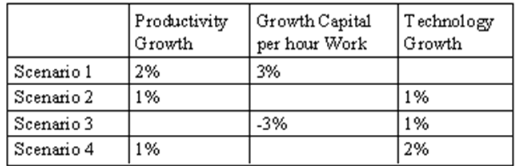
Suppose the productivity function is given by    . (A)Draw a graph that shows the relationship between productivity and capital per hour of work. What assumption are you making about the returns to capital? Please explain. (B)Pick an initial point on your productivity function and label the points    and     (C)	Fill in the four blanks in the following table.     D) For growth scenario 1, label the new levels of productivity and capital per hour of work on your graph. Explain briefly.  (E)For growth scenario 3, label the new levels of productivity and capital per hour of work on your graph. Please draw a separate graph for this part. Explain briefly.  (F)For each of the four scenarios, identify whether labor and capital are growing at the same rate, whether labor is growing faster than capital, or whether capital is growing faster than labor. .
(A)Draw a graph that shows the relationship between productivity and capital per hour of work. What assumption are you making about the returns to capital? Please explain.
(B)Pick an initial point on your productivity function and label the points
Suppose the productivity function is given by    . (A)Draw a graph that shows the relationship between productivity and capital per hour of work. What assumption are you making about the returns to capital? Please explain. (B)Pick an initial point on your productivity function and label the points    and     (C)	Fill in the four blanks in the following table.     D) For growth scenario 1, label the new levels of productivity and capital per hour of work on your graph. Explain briefly.  (E)For growth scenario 3, label the new levels of productivity and capital per hour of work on your graph. Please draw a separate graph for this part. Explain briefly.  (F)For each of the four scenarios, identify whether labor and capital are growing at the same rate, whether labor is growing faster than capital, or whether capital is growing faster than labor. and Suppose the productivity function is given by    . (A)Draw a graph that shows the relationship between productivity and capital per hour of work. What assumption are you making about the returns to capital? Please explain. (B)Pick an initial point on your productivity function and label the points    and     (C)	Fill in the four blanks in the following table.     D) For growth scenario 1, label the new levels of productivity and capital per hour of work on your graph. Explain briefly.  (E)For growth scenario 3, label the new levels of productivity and capital per hour of work on your graph. Please draw a separate graph for this part. Explain briefly.  (F)For each of the four scenarios, identify whether labor and capital are growing at the same rate, whether labor is growing faster than capital, or whether capital is growing faster than labor.

(C) Fill in the four blanks in the following table.
Suppose the productivity function is given by    . (A)Draw a graph that shows the relationship between productivity and capital per hour of work. What assumption are you making about the returns to capital? Please explain. (B)Pick an initial point on your productivity function and label the points    and     (C)	Fill in the four blanks in the following table.     D) For growth scenario 1, label the new levels of productivity and capital per hour of work on your graph. Explain briefly.  (E)For growth scenario 3, label the new levels of productivity and capital per hour of work on your graph. Please draw a separate graph for this part. Explain briefly.  (F)For each of the four scenarios, identify whether labor and capital are growing at the same rate, whether labor is growing faster than capital, or whether capital is growing faster than labor.
D) For growth scenario 1, label the new levels of productivity and capital per hour of work on your graph. Explain briefly.

(E)For growth scenario 3, label the new levels of productivity and capital per hour of work on your graph. Please draw a separate graph for this part. Explain briefly.

(F)For each of the four scenarios, identify whether labor and capital are growing at the same rate, whether labor is growing faster than capital, or whether capital is growing faster than labor.

Correct Answer:

verifed

Verified

(A)See graph below. The shape of the cur...

View Answer

Unlock this answer now
Get Access to more Verified Answers free of charge

Related Questions

Unlock this Answer For Free Now!

View this answer and more for free by performing one of the following actions

qr-code

Scan the QR code to install the App and get 2 free unlocks

upload documents

Unlock quizzes for free by uploading documents