Use the following to answer questions :
Scenario II
The scenario contains fabricated results consistent with the following study:
Petty,R.E. ,Cacioppo,J.T. ,& Goldman,R.(1981) .Personal involvement as a determinant of argument-based persuasion.Journal of Personality and Social Psychology,41,847-855.
Every day,consumers are exposed to scientifically based sales,marketing,and public relations strategies designed to influence purchasing decisions,change opinions,or win votes.One common sales strategy is the foot-in-the-door technique,a method that involves first making a smaller request that consumers are likely to grant and then following it with a larger request.Another common strategy is the door-in-the-face technique,which involves making an unreasonably large request that consumers will reject and then following it with a smaller request.When persuasion is necessary,it usually takes one of two forms: heuristic persuasion,which involves an appeal to habits or emotion,and systematic persuasion,which involves an appeal to facts and reason.Often,people will rely more on heuristics-simple shortcuts or "rules of thumb"-to make decisions instead of systematically weighing the evidence.
Petty and colleagues (1981) investigated some of these techniques in university students listening to arguments in favour of their university requiring an institution-level comprehensive final examination for graduation.Some students were led to believe that,if adopted,this policy would take place right away,and some were led to believe that the change would take place in a decade.In addition,some of the students were led to believe that they were listening to an argument from a Princeton professor,and others were led to believe that they were listening to an argument from a high school student.Finally,some students heard strong arguments in favour of the policy,and some heard weak arguments.Thus,the experiment arranged six groups of students.For example,one group of students heard strong arguments from a high school student about a far-removed policy change.Figure 13.1 shows fabricated results illustrating the major findings of this experiment.
Figure 13.1 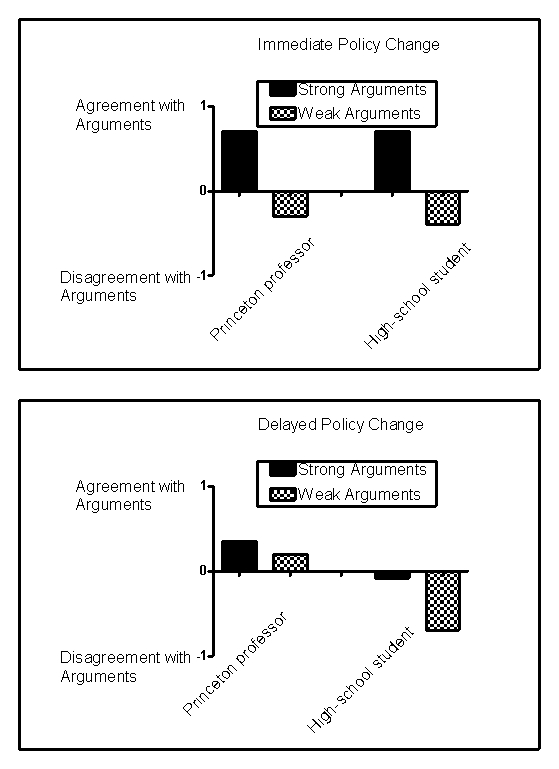
-(Scenario II) Which example describes systematic persuasion?
A) a political party first asking for an e-mail address,then a $5 donation,then a $25 donation,and finally a $100 donation
B) a car manufacturer marketing its car with commercials suggesting that driving it will increase one's sexual appeal
C) a university student trying to convince his professor to excuse an absence by reminding her of her own teenage years
D) a teenager trying to convince his parents that marijuana is not dangerous by showing them a number of scientific studies that support his argument while conveniently not presenting the ones that show the drug is far from harmless
Correct Answer:

Verified
Q3: Men with unrealistically high self-esteem are most
Q5: Most murders are motivated by trying to
Q10: Use the following to answer questions
Scenario
Q11: Use the following to answer questions
Scenario
Q12: Use the following to answer questions
Scenario
Q17: The frustration-aggression hypothesis states that suppressed aggressive
Q18: There is a negative correlation between testosterone
Q24: Attractive people tend to have better social
Q254: Use the following to answer questions :
Scenario
Q257: Men commit the majority of violent crimes
Unlock this Answer For Free Now!
View this answer and more for free by performing one of the following actions

Scan the QR code to install the App and get 2 free unlocks

Unlock quizzes for free by uploading documents