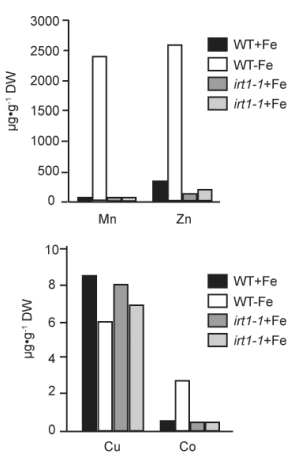
 } \text { of iron for 5 days. DW = dry weight} Figure 36.2 -The IRT1 gene is responsible for most of the iron uptake activity in roots Vert et al., Plant Cell 14 [2002]:1223- 33) . To determine the specificity of the IRT1 transporter in Arabidopsis plants, researchers measured the concentration of manganese, zinc, copper, and cobalt contained in wild- type and irt1- 1 mutant plants. What conclusions about IRT1 specificity can you draw from the above data? A) IRT1 participates in the transport of iron, zinc, manganese, and cobalt independent of iron concentration. B) Under iron- deficient conditions, IRT1 is important for the transport of iron and copper. C) IRT1 is important for the transport of iron and copper independent of iron concentration. D) Under iron- deficient conditions, IRT1 is highly specific for Fe. E) Under iron- deficient conditions, IRT1 is necessary for the transport of iron, zinc, manganese, and cobalt. " class="answers-bank-image d-inline" rel="preload" >
Figure 36.2
-The IRT1 gene is responsible for most of the iron uptake activity in roots Vert et al., Plant Cell 14
[2002]:1223- 33) . To determine the specificity of the IRT1 transporter in Arabidopsis plants, researchers measured the concentration of manganese, zinc, copper, and cobalt contained in wild- type and irt1- 1 mutant plants.
What conclusions about IRT1 specificity can you draw from the above data?
A) IRT1 participates in the transport of iron, zinc, manganese, and cobalt independent of iron concentration.
B) Under iron- deficient conditions, IRT1 is important for the transport of iron and copper.
C) IRT1 is important for the transport of iron and copper independent of iron concentration.
D) Under iron- deficient conditions, IRT1 is highly specific for Fe.
E) Under iron- deficient conditions, IRT1 is necessary for the transport of iron, zinc, manganese, and cobalt.
Correct Answer:

Verified
Q23: Give two reasons that relatively few plants
Q25: After mutagenesis and screening, you have found
Q27: What is the right sequence of steps
Q28: Both ectomycorrhizal fungi and rhizobia are able
Q29: Why is nitrogen fixation an essential process?
A)
Q30: Figure 38.1 Q31: Where are ion channels localized?

A) in the
Unlock this Answer For Free Now!
View this answer and more for free by performing one of the following actions

Scan the QR code to install the App and get 2 free unlocks

Unlock quizzes for free by uploading documents