Ireland and Japan are assumed to produce only wool and steel, to have full employment and complete mobility of resources. Their production possibilities boundaries before trade are drawn in solid lines. It is assumed that the two countries have the same amount of resources. Their consumption possibilities after trade are shown by the dotted line. The outputs of wool and steel are given in physical units. 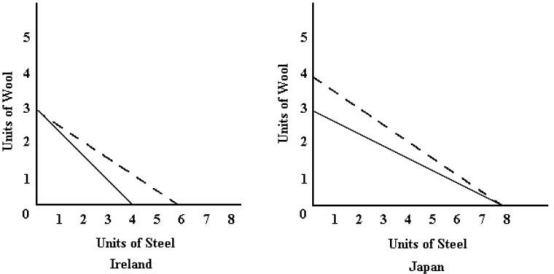 FIGURE 33- 1
-Refer to Figure 33- 1. Before any trade takes place, the opportunity cost of a unit of steel is
A) 3/4 unit of wool in Ireland; 3/8 unit of wool in Japan.
B) 4/3 unit of wool in Ireland; 8/3 unit of wool in Japan.
C) 3 units of wool in Ireland; 3 units of wool in Japan.
D) 4 units of wool in Ireland; 8 units of wool in Japan.
E) 4 units of wool in Ireland; 4 units of wool in Japan.
Correct Answer:

Verified
Q22: The diagram below shows the domestic demand
Q23: According to David Ricardo's principle of comparative
Q24: If Country A has a comparative advantage
Q28: Canadians consume millions of cups of Tim
Q34: The diagram below shows the domestic demand
Q39: Consider two countries that can produce rice
Q44: When opportunity costs differ between countries,
A)comparative advantages

Unlock this Answer For Free Now!
View this answer and more for free by performing one of the following actions

Scan the QR code to install the App and get 2 free unlocks

Unlock quizzes for free by uploading documents