You are interested in understanding the gene regulation of Lkp1, a protein that is normally produced in liver and kidney cells in mice.Interestingly, you find that the LKP1 gene is not expressed in heart cells.You isolate the DNA upstream of the LKP1 gene, place it upstream of the gene for green fluorescent protein (GFP) , and insert this entire piece of recombinant DNA into mice.You find GFP expressed in liver and kidney cells but not in heart cells, an expression pattern similar to the normal expression of the LKP1 gene.Further experiments demonstrate that there are three regions in the promoter, labeled A, B, and C in Figure 8-16, that contribute to this expression pattern.Assume that a single and unique transcription factor binds each site such that protein X binds site A, protein Y binds site B, and protein Z binds site C.You want to determine which region is responsible for tissue-specific expression, and create mutations in the promoter to determine the function of each of these regions.In Figure 8-16, if the site is missing, it is mutated such that it cannot bind its corresponding transcription factor. 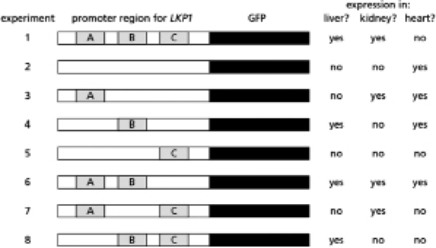 Figure 8-16
Experiment 1 in Figure 8-18 is the positive control, demonstrating that the region of DNA upstream of the gene for GFP results in a pattern of expression that we normally find for the LKP1 gene.Experiment 2 shows what happens when the sites for binding factors X, Y, and Z are removed.Which experiment above demonstrates that factor X alone is sufficient for expression of LPK1 in the kidney?
A) experiment 3
B) experiment 5
C) experiment 6
D) experiment 7
Correct Answer:

Verified
Q8: You are interested in understanding the gene
Q9: You are interested in examining the
Q10: The human genome encodes about 21,000 protein-coding
Q11: You are interested in the regulation
Q12: A neuron and a white blood cell
Q14: The distinct characteristics of different cell types
Q15: The tryptophan operator
A)is an allosteric protein.
B)binds to
Q16: You are interested in understanding the gene
Q17: You are interested in examining the
Q18: Operons
A)are commonly found in eukaryotic cells.
B)are transcribed
Unlock this Answer For Free Now!
View this answer and more for free by performing one of the following actions

Scan the QR code to install the App and get 2 free unlocks

Unlock quizzes for free by uploading documents