Figure 19-24 diagrams one of Mendel's experiments using the round and wrinkled seed traits. 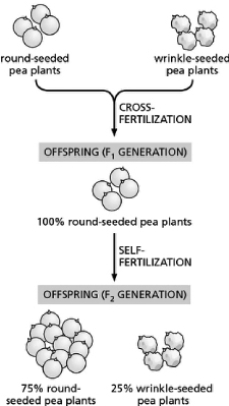 Figure 19-24
Which of the following statements about the experiment diagrammed in Figure 19-28 is TRUE?
A) If you crossed all the round-seeded pea plants from the F2 generation with true-breeding wrinkle-seeded pea plants, you would get more round-seeded pea plants in the next generation than if you crossed all the round-seeded pea plants from the F1 generation with true-breeding wrinkle-seeded pea plants.
B) The reason you do not see wrinkle-seeded pea plants in the F1 generation is because the round-seeded pea plants used to create the F1 generation were not true-breeding strains.
C) The gene for round-seeded pea plants is on a different chromosome from the gene for wrinkle-seeded pea plants, which is why you get 25% wrinkle-seeded pea plants in the F2 generation.
D) If you crossed the round-seeded pea plants from the F2 generation with the wrinkle-seeded pea plants from the F2 generation, you should get 100% round-seeded pea plants.
Correct Answer:

Verified
Q26: The single-nucleotide polymorphisms found in the human
Q27: Haplotype blocks can be seen in humans
Q28: Finding co-inheritance of an SNP variant and
Q29: Which of the following statements about genome-wide
Q30: During fertilization in humans,
A)a wave of Ca2+
Q32: Figure 19-24 diagrams one of Mendel's experiments
Q33: Which of the following reasons was essential
Q34: Figure 19-24 diagrams one of Mendel's experiments
Q35: Which of the following reasons was essential
Q36: Which of the following statements about Mendel's
Unlock this Answer For Free Now!
View this answer and more for free by performing one of the following actions

Scan the QR code to install the App and get 2 free unlocks

Unlock quizzes for free by uploading documents