Body fat and lean body mass can be estimated in living animals by measuring the total body electrical conductivity (TOBEC). This technique is useful when attempting to determine if "diet drugs" are working on laboratory rats over time--the researchers need not sacrifice the animals to measure the amount of adipose body fat after periods of drug usage. However, the procedure requires that the animal be totally inside the measurement chamber, which is fairly small. Some rats are so big that their tails must be tucked under their bodies before putting them into the measurement chamber. This is causing concern among the researchers, because there is a possibility the tail position might alter the measurements. To see if the TOBEC measurement is altered by the tail position of the rats, an experiment was run on 16 rats ranging in weight from 210 to 505 g.
The rats were randomly assigned the order of measurement, with 8 rats measured in the tail-under position first, and 8 rats in the tail-extended position. The data for the body fat measures, and the differences, are presented in the table below.
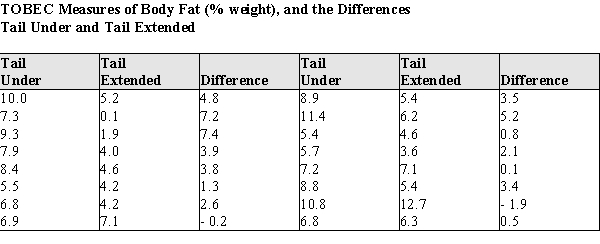
a)
Using graphical display(s) of your choice show that the assumptions necessary for the paired t-test are plausible.
b)
Test the hypothesis that there is no difference between the population mean TOBEC body fat measurements of rats in the tail-under vs. the tail-extended positions. For purposes of the statistics you may assume that these rats are a random sample of laboratory rats.
c)
Write a short paragraph based on your analysis above, explaining your results for laboratory technicians. Your paragraph should advise them whether or not it is necessary to make sure the tail positions of the rats are the same when replicating the lean mass body measurements during the experiment.
Correct Answer:

Verified
View Answer
Unlock this answer now
Get Access to more Verified Answers free of charge
Q12: For two independent samples, Q13: Researchers have hypothesized that female Downy Woodpeckers Q14: In 1992 Hurricane Andrew struck Florida causing Q15: As part of the foraging behavior assessment Q16: The number of degrees of freedom used Q18: Two samples are said to be independent Q19: For both large and small samples the Q20: When testing hypotheses about and constructing confidence Q21: In many animal societies, a role assumed Q22: The teacher noticed that 15 out of
Unlock this Answer For Free Now!
View this answer and more for free by performing one of the following actions

Scan the QR code to install the App and get 2 free unlocks

Unlock quizzes for free by uploading documents