Scenario
While radioactive isotopes are used in medicine to identify tumors and other diseases, they can also be used to treat diseases such as cancer. One method to treat cancerous tumors is to expose them to radiation which can kill the cancerous cells and the tumor. In 2013, the U.S. Food and Drug Administration approved a new cancer treatment based on the radioactive isotope radium-223; this isotope has a half-life of 11.4 days. The radioactive drug, known as Xofigo®, is injected into the patient's bloodstream and travels to certain regions of the body. Because it emits high-energy radiation over short distances, it can kill cancerous cells in the sites where it localizes.
After the drug was injected into a person, the following data were collected regarding the amount of radiation measured in different organs in the person's body.
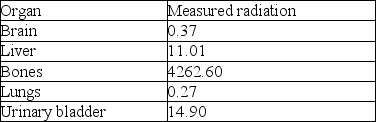
-A cancer patient receives an injection of the drug on March 1. Suppose that the patient must receive a second injection once the amount of the drug decreases to less than 6% in his or her body. On approximately what day should the cancer patient schedule an appointment to receive another injection?
A) March 13
B) March 23
C) April 3
D) April 25
Correct Answer:

Verified
Q40: A fossil was found and determined by
Q41: The data below are from three separate
Q42: The data below are from three separate
Q43: Scenario
While radioactive isotopes are used in medicine
Q44: The graph below shows data regarding radioactive
Q45: Scenario
While radioactive isotopes are used in medicine
Q46: Examine the pH scale below. How does
Q48: In the following figure, all of the
Q49: Scenario
Please read the following scenario to answer
Q50: Scenario
Please read the following scenario to answer
Unlock this Answer For Free Now!
View this answer and more for free by performing one of the following actions

Scan the QR code to install the App and get 2 free unlocks

Unlock quizzes for free by uploading documents