Phylogenetic trees based on nucleotide or amino acid sequences can be constructed using various algorithms. One simple algorithm is based on a matrix of pairwise genetic distances (divergences) calculated after multiple alignment of the sequences. Imagine you have aligned a particular gene from different hominids (humans and the great apes), and have estimated the normalized number of nucleotide substitutions that have occurred in this gene in each pair of organisms since their divergence from their last common ancestor. You have obtained the following distance matrix.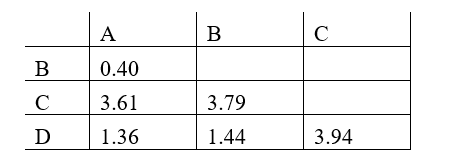
Answer the following question(s) based on this matrix.
-If species A in the distance matrix represents human, indicate which of the other species (B to D) represents chimpanzee, gorilla, and orangutan, respectively. Your answer would be a three-letter string composed of letters B, C, and D only, e.g. DCB.
Correct Answer:

Verified
View Answer
Unlock this answer now
Get Access to more Verified Answers free of charge
Q45: Fill in the blanks in the following
Q46: In each of the following comparisons, indicate
Q47: Assume two isolated human communities with 500
Q48: The genetic information carried by a cell
Q49: The globin gene family in mammals, birds,
Q51: To discover genes that have undergone accelerated
Q52: Indicate true (T) and false (F) statements
Q53: Indicate true (T) and false (F) statements
Q54: The copy number of some human genes,
Q55: Phylogenetic trees based on nucleotide or amino
Unlock this Answer For Free Now!
View this answer and more for free by performing one of the following actions

Scan the QR code to install the App and get 2 free unlocks

Unlock quizzes for free by uploading documents