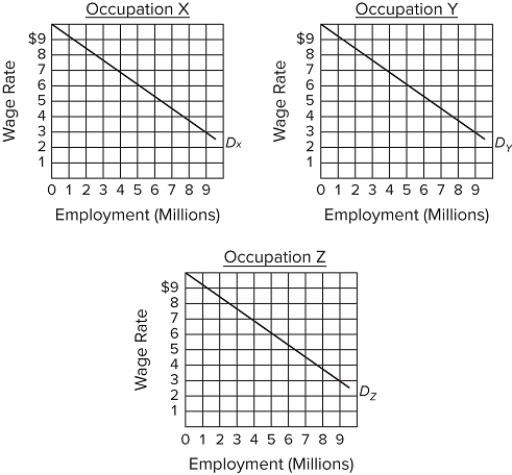
 Assumptions: (1) the labor force comprises 9 million men and 9 million women workers; (2) the economy has 3 occupations, X, Y, and Z, each having identical demand curves for labor; (3) male and female workers are homogeneous with respect to their labor-market capabilities; (4) women are discriminated against by being excluded from occupations X and Y and are confined to Z; and (5) aside from discrimination, the economy is competitive, and workers seek to maximize their earnings.Refer to the diagram and list of assumptions. If discrimination is ended,
A) men will leave occupations X and Y and enter occupation Z.
B) 4 million women will leave occupation Z, with 2 million entering occupation X and 2 million entering occupation Y.
C) 3 million women will leave occupation Z, with 1.5 million entering occupation X and 1.5 million entering occupation Y.
D) 3 million women will leave occupation Z, all of whom will enter industry X.
Correct Answer:

Verified
Q194: Q195: Discrimination Q196: The percentage of total before-tax household income Q197: Economic discrimination puts the economy inside its Q198: Q200: In 2017, the portion of the U.S. Q201: The Gini ratio is calculated by dividing Q202: The Gini ratio, or Gini coefficient, is Q203: A Lorenz curve showing perfect equality in Q204: Unlock this Answer For Free Now! View this answer and more for free by performing one of the following actions Scan the QR code to install the App and get 2 free unlocks Unlock quizzes for free by uploading documents
A)affects the distribution of domestic output and

