A 10-year-old boy is brought to the emergency department by his parents due to increasing lethargy and high fever for the past 12 hours. The boy was well last night but was sluggish this morning. Over the day, his activity level and responsiveness diminished. The patient was treated for Neisseria meningitidis bacteremia 2 years ago. He has received all routine vaccinations and is developing normally. Temperature is 39.6 C (103.3 F) . On examination, the patient appears ill and is poorly responsive. He is tachycardic, but heart sounds are otherwise unremarkable. Lungs are clear to auscultation. Numerous purple bruise-like markings and petechiae are noted over his extremities, which have diminished capillary refill. Blood samples are drawn for total complement (CH50) and alternative complement (AH50) measurement. Which of the following sets of results is most likely to be found in this patient?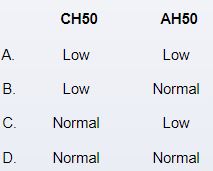
A) A
B) B
C) C
D) D
Correct Answer:

Verified
Q20: A 1-year-old boy is brought to the
Q21: An 18-year-old college student is hospitalized due
Q22: Once the patient recovers from his acute
Q23: A 15-month-old boy is brought to the
Q24: A 55-year-old man with end-stage hepatitis C
Q26: An 8-year-old boy is brought to the
Q27: A 28-year-old woman is treated with high-dose
Q28: An 18-month-old, partially vaccinated boy is brought
Q29: A 35-year-old woman comes to the office
Q30: A 2-year-old boy is brought to the
Unlock this Answer For Free Now!
View this answer and more for free by performing one of the following actions

Scan the QR code to install the App and get 2 free unlocks

Unlock quizzes for free by uploading documents