An 83-year-old woman is brought to the emergency department from a nursing home with fever and altered mental status. The patient has a history of hypertension, dementia, and fecal incontinence. Her temperature is 38.3 C (100.9 F) , blood pressure is 100/68 mm Hg, and pulse is 114/min. She is lethargic and unable to answer questions. Her abdomen is soft, with suprapubic tenderness. Lungs are clear bilaterally. There is no cardiac murmur or skin rash. Laboratory results are as follows: 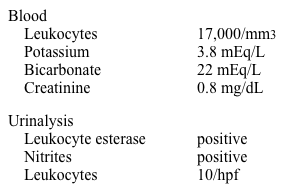 A chest x-ray reveals normal-appearing lungs. Blood and urine cultures are performed, and empiric antibiotics are initiated. Urine cultures grow gram-negative rods that are lactose-fermenting and indole-positive. Which of the following is the most likely organism causing this patient's infection?
A) Enterobacter cloacae
B) Escherichia coli
C) Haemophilus influenzae
D) Proteus mirabilis
E) Pseudomonas aeruginosa
Correct Answer:

Verified
Q226: A 4-year-old boy is brought to the
Q227: A 43-year-old man comes to the office
Q228: During the course of a week at
Q229: A 52-year-old man is hospitalized due to
Q230: A 66-year-old man comes to the emergency
Q232: A 6-year-old previously healthy girl is brought
Q233: A 32-year-old man comes to the office
Q234: A 35-year-old man comes to the emergency
Q235: A 72-year-old man is brought to the
Q236: A 39-year-old paraplegic man with an indwelling
Unlock this Answer For Free Now!
View this answer and more for free by performing one of the following actions

Scan the QR code to install the App and get 2 free unlocks

Unlock quizzes for free by uploading documents