A 42-year-old man comes to the office for evaluation of progressive generalized edema and weight gain for the past several weeks. He has no chest pain or shortness of breath. The patient has no chronic medical conditions and takes no medications. He last saw a physician a year ago for an upper respiratory infection. The patient does not use tobacco, alcohol, or illicit drugs. Blood pressure is 130/80 mm Hg and pulse is 84/min. Mild ascites is present. There is bilateral lower extremity pitting edema to the knees.Laboratory results are as follows: 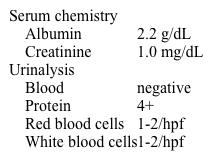 Urinary protein excretion is 6.0 g/24 hr. A kidney biopsy is performed, and electron microscopy of a glomerular capillary is shown below:
 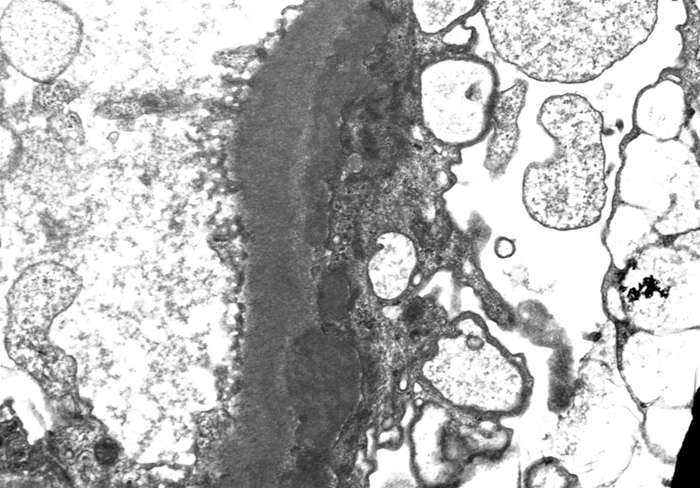 Which of the following is the most likely diagnosis?
A) Crescentic glomerulonephritis
B) Focal segmental glomerulosclerosis
C) Membranous nephropathy
D) Minimal change disease
E) Poststreptococcal glomerulonephritis
Correct Answer:

Verified
Q721: A 5-year-old boy is brought to the
Q722: A 42-year-old man comes to the office
Q723: A 60-year-old woman is being evaluated for
Q724: A 4-year-old girl developed acute-onset colicky abdominal
Q725: A 67-year-old man comes to the office
Q727: A 7-year-old boy is brought to the
Q728: A 15-year-old girl is brought to the
Q729: A 20-year-old woman comes to the office
Q730: A 44-year-old woman comes to the emergency
Q731: A 54-year-old man comes to the physician
Unlock this Answer For Free Now!
View this answer and more for free by performing one of the following actions

Scan the QR code to install the App and get 2 free unlocks

Unlock quizzes for free by uploading documents