A new drug has been developed to treat cardiac arrhythmias. The drug has high affinity for activated and inactivated sodium channels but relatively little affinity for resting sodium channels. An experiment is devised to maintain sodium channels in the inactivated state for a prolonged period, during which they are exposed to the new drug. After allowing the sodium channels to return to the resting state, the speed of the drug's dissociation from the sodium channels is recorded and shown below. The dissociation curve for quinidine is given for comparison. 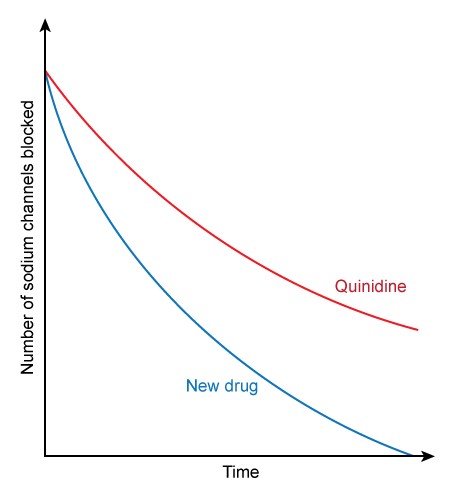 The pharmacologic action of the new drug is most similar to which of the following drugs?
A) Disopyramide
B) Flecainide
C) Lidocaine
D) Propranolol
E) Sotalol
F) Verapamil
Correct Answer:

Verified
Q34: A 47-year-old man with known coronary artery
Q35: A 65-year-old man comes to the emergency
Q36: A 55-year-old man comes to the emergency
Q37: A 50-year-old man has recurrent episodes of
Q38: A 49-year-old woman is brought to the
Q40: A 34-year-old man diagnosed with advanced non-Hodgkin
Q41: A 54-year-old man with nonischemic cardiomyopathy comes
Q42: A 64-year-old man comes to the office
Q43: A 62-year-old man who underwent mitral valve
Q44: A 68-year-old man comes to the office
Unlock this Answer For Free Now!
View this answer and more for free by performing one of the following actions

Scan the QR code to install the App and get 2 free unlocks

Unlock quizzes for free by uploading documents