A 47-year-old man comes to the office for follow-up of his elevated blood pressure. The patient's medical history is significant for stable angina pectoris, for which he takes sublingual nitroglycerin as needed. He has no orthopnea, paroxysmal nocturnal dyspnea, or lower extremity swelling. His blood pressure is 154/107 mm Hg and pulse is 86/min. Physical examination shows no abnormalities. The patient is started on a low dose of atenolol. Which of the following cellular changes will most likely occur as a direct effect of this medication?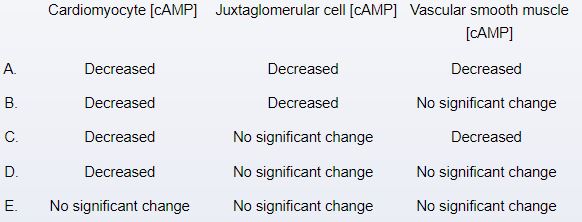
A) A
B) B
C) C
D) D
E) E
Correct Answer:

Verified
Q18: A 67-year-old man with nonischemic cardiomyopathy comes
Q19: A 57-year-old male with suspected bacterial pneumonia
Q20: A 56-year-old man comes to the hospital
Q21: A 56-year-old man comes to the emergency
Q22: A new antiarrhythmic medication (drug A) is
Q24: A 45-year-old man comes to the clinic
Q25: A 24-year-old man comes to the emergency
Q26: A 65-year-old man is brought to the
Q27: A 44-year-old man reports exertional shortness of
Q28: A 40-year-old female with a history of
Unlock this Answer For Free Now!
View this answer and more for free by performing one of the following actions

Scan the QR code to install the App and get 2 free unlocks

Unlock quizzes for free by uploading documents