A 76-year-old man is brought to the emergency department after having 6 hours of shortness of breath and chest pain. His initial blood pressure is 102/72 mm Hg and pulse is 102/min. His oxygen saturation is 82% on 15 liters of oxygen via face mask. Bilateral rales are heard over the lower to middle lung fields. His initial ECG shows sinus tachycardia and a left bundle branch block. He is intubated and rushed to the cardiac catheterization lab.
He is found to have an occluded proximal left anterior descending artery and mild atherosclerosis involving the other coronary arteries. He has successful percutaneous revascularization with restoration of coronary flow. A pulmonary artery catheter is placed at the end of the procedure for hemodynamic monitoring and he is transferred to the coronary care unit. His current medications include aspirin, clopidogrel, intravenous unfractionated heparin, eptifibatide, furosemide, and propofol. Six hours after the procedure, his blood pressure is 78/48 mm Hg, and his pulse is 120/min and regular. His ECG shows sinus tachycardia and left bundle branch block pattern.
Hemodynamic readings from the pulmonary artery catheter show the following: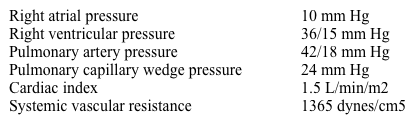
Which of the following is the most likely cause of this patient's hypotension?
A) Cardiogenic shock
B) Early sepsis
C) Hypovolemia
D) Pericardial tamponade
E) Pulmonary embolism
Correct Answer:

Verified
Q20: An 83-year-old woman is brought to the
Q21: A 45-year-old man with known HIV infection
Q22: A 78-year-old woman is brought to the
Q23: A 65-year-old woman is brought to the
Q24: A 43-year-old man comes to the emergency
Q26: A 72-year-old man comes to the emergency
Q27: A 38-year-old man comes to the emergency
Q28: A 47-year-old man is brought to the
Q29: A 72-year-old man is brought to the
Q30: A 76-year-old man is seen in the
Unlock this Answer For Free Now!
View this answer and more for free by performing one of the following actions

Scan the QR code to install the App and get 2 free unlocks

Unlock quizzes for free by uploading documents