Solved

A 60-Year-Old Man Comes to the Office Due to 3

Question 450

Multiple Choice

A 60-year-old man comes to the office due to 3 months of progressive weakness and fatigue.  The patient could previously walk 1-2 miles with no difficulty but now gets tired walking across his house.  He has had no excessive daytime sleepiness and feels refreshed after a full night of sleep.  The patient reports no fever, night sweats, dyspnea, cough, feelings of depression, or anhedonia but has lost 7 kg (15.4 lb) in the last 3 months.  His appetite is unchanged, and he is eating the same food as usual but finds that he gets full more quickly than usual.  The patient also reports vague abdominal discomfort but has had no dysphagia, melena, or changes in bowel habits.  His medical problems include hypertension and hyperlipidemia.  The patient is a former smoker with a 30-pack-year history, and he drinks alcohol occasionally.  He has not recently traveled.
Vital signs are within normal limits.  BMI is 26 kg/m2.  There is no scleral icterus, lymphadenopathy, rash, or extremity edema.  The thyroid is normal to palpation.  Cardiopulmonary examination shows no abnormalities.  A firm, nontender mass is palpable in the left upper abdominal quadrant down to the level of the umbilicus.  There is no hepatomegaly.  Stool test for occult blood is negative.
Laboratory results are as follows:

A 60-year-old man comes to the office due to 3 months of progressive weakness and fatigue.  The patient could previously walk 1-2 miles with no difficulty but now gets tired walking across his house.  He has had no excessive daytime sleepiness and feels refreshed after a full night of sleep.  The patient reports no fever, night sweats, dyspnea, cough, feelings of depression, or anhedonia but has lost 7 kg (15.4 lb)  in the last 3 months.  His appetite is unchanged, and he is eating the same food as usual but finds that he gets full more quickly than usual.  The patient also reports vague abdominal discomfort but has had no dysphagia, melena, or changes in bowel habits.  His medical problems include hypertension and hyperlipidemia.  The patient is a former smoker with a 30-pack-year history, and he drinks alcohol occasionally.  He has not recently traveled. Vital signs are within normal limits.  BMI is 26 kg/m<sup>2</sup>.  There is no scleral icterus, lymphadenopathy, rash, or extremity edema.  The thyroid is normal to palpation.  Cardiopulmonary examination shows no abnormalities.  A firm, nontender mass is palpable in the left upper abdominal quadrant down to the level of the umbilicus.  There is no hepatomegaly.  Stool test for occult blood is negative. Laboratory results are as follows:   The peripheral blood smear is shown in the exhibit.  Which of the following is the most appropriate next step in management of this patient? A) Gastrointestinal endoscopy B) Heterophile antibody testing C) JAK2 mutation analysis D) Peripheral blood flow cytometry E) Serum protein electrophoresis The peripheral blood smear is shown in the exhibit.A 60-year-old man comes to the office due to 3 months of progressive weakness and fatigue.  The patient could previously walk 1-2 miles with no difficulty but now gets tired walking across his house.  He has had no excessive daytime sleepiness and feels refreshed after a full night of sleep.  The patient reports no fever, night sweats, dyspnea, cough, feelings of depression, or anhedonia but has lost 7 kg (15.4 lb)  in the last 3 months.  His appetite is unchanged, and he is eating the same food as usual but finds that he gets full more quickly than usual.  The patient also reports vague abdominal discomfort but has had no dysphagia, melena, or changes in bowel habits.  His medical problems include hypertension and hyperlipidemia.  The patient is a former smoker with a 30-pack-year history, and he drinks alcohol occasionally.  He has not recently traveled. Vital signs are within normal limits.  BMI is 26 kg/m<sup>2</sup>.  There is no scleral icterus, lymphadenopathy, rash, or extremity edema.  The thyroid is normal to palpation.  Cardiopulmonary examination shows no abnormalities.  A firm, nontender mass is palpable in the left upper abdominal quadrant down to the level of the umbilicus.  There is no hepatomegaly.  Stool test for occult blood is negative. Laboratory results are as follows:   The peripheral blood smear is shown in the exhibit.  Which of the following is the most appropriate next step in management of this patient? A) Gastrointestinal endoscopy B) Heterophile antibody testing C) JAK2 mutation analysis D) Peripheral blood flow cytometry E) Serum protein electrophoresis
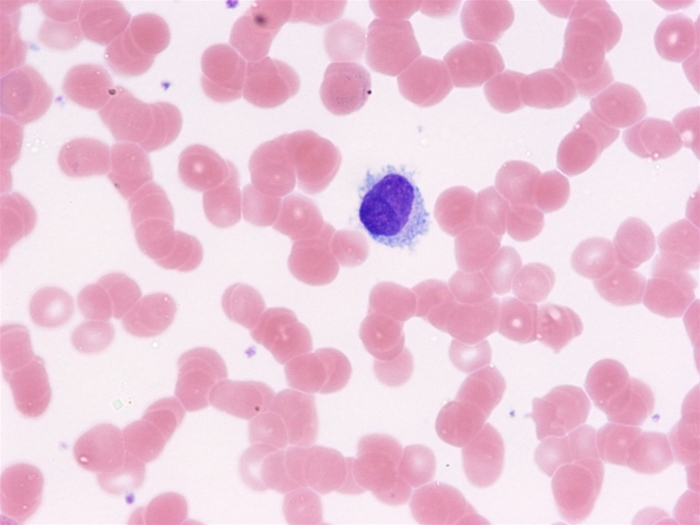
Which of the following is the most appropriate next step in management of this patient?


A) Gastrointestinal endoscopy
B) Heterophile antibody testing
C) JAK2 mutation analysis
D) Peripheral blood flow cytometry
E) Serum protein electrophoresis

Correct Answer:

verifed

Verified

Unlock this answer now
Get Access to more Verified Answers free of charge

Related Questions

Unlock this Answer For Free Now!

View this answer and more for free by performing one of the following actions

qr-code

Scan the QR code to install the App and get 2 free unlocks

upload documents

Unlock quizzes for free by uploading documents