A 66-year-old man comes to the hospital due to 2 days of fever, chills, fatigue, and malaise. He has had no chest pain, cough, diarrhea, or dysuria. The patient has a history of lymphoma and underwent a splenectomy 6 years ago. Prior to the splenectomy, he received vaccinations against Neisseria meningitidis and Streptococcus pneumoniae. Six months ago, the patient returned from a 2-week trip to India during which he did not take antimalarial prophylaxis. He has no known ill contacts. The patient lives in Massachusetts and is a professor at a local college.
Temperature is 38.6 C (101.5 F) , blood pressure is 122/70 mm Hg, and pulse is 110/min and regular. The patient has mild respiratory distress. The oropharynx is dry without lesions. Lung examination reveals bilateral coarse crackles. The abdomen is soft and mildly tender throughout. He has no skin rash.
Laboratory results are as follows: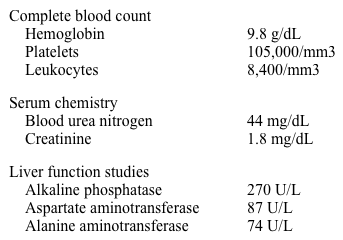
A chest x-ray reveals diffuse bilateral infiltrates. A peripheral blood smear shows intraerythrocytic inclusions (see exhibit) .
Which of the following is the most likely organism causing this patient's illness?
A) Anaplasma phagocytophilum
B) Babesia microti
C) Borrelia burgdorferi
D) Ehrlichia chaffeensis
E) Plasmodium falciparum
Correct Answer:

Verified
Q513: A 24-year-old man comes to the office
Q514: A 62-year-old woman undergoing chemotherapy through a
Q515: A 70-year-old man seeks advice regarding testosterone
Q516: A 32-year-old man comes to the clinic
Q517: A 24-year-old man comes to the urgent
Q519: A 72-year-old man comes to the office
Q520: A patient consults the physician regarding her
Q521: A 78-year-old woman comes to the physician
Q522: A 43-year-old man seeks care for a
Q523: A 67-year-old man seeks medical attention because
Unlock this Answer For Free Now!
View this answer and more for free by performing one of the following actions

Scan the QR code to install the App and get 2 free unlocks

Unlock quizzes for free by uploading documents