A 67-year-old woman comes to the office due to progressive fatigue and anorexia over the last 6 months. She has lost 4 kg (8.8 lb) , which she attributes to early satiety. She has had no abdominal pain, night sweats, or fevers. The patient's past medical history is significant for hypothyroidism, hypertension, and gout. She does not use tobacco, alcohol, or illicit drugs and is compliant with her medications. Temperature is 37.3 C (99.2 F) , blood pressure is 128/82 mm Hg, and pulse is 88/min. The patient is slightly thin but well nourished. Mild mucosal pallor is present. There is no lymphadenopathy in the cervical or supraclavicular chains. Cardiopulmonary examination is normal. A spleen tip is palpable with deep exhalation. Laboratory results are as follows: 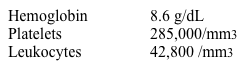 Florescence in situ hybridization reveals an abnormality in chromosome 22. Which of the following is the most important target in treating this patient's disease?
A) DNA methylation mutations
B) Folic acid metabolism
C) Retinoic acid receptor
D) Thymidine synthesis
E) Tyrosine kinase
Correct Answer:

Verified
Q68: A 25-year-old African American woman comes to
Q69: A 62-year-old man comes to the office
Q70: A 32-year-old woman comes to the office
Q71: A 70-year-old man comes to the office
Q72: A 52-year-old woman comes to the office
Q74: A 54-year-old woman comes to the office
Q75: A 58-year-old man comes to the office
Q76: A 43-year-old woman comes to the office
Q77: A 56-year-old man comes to the office
Q78: A 53-year-old man comes to the office
Unlock this Answer For Free Now!
View this answer and more for free by performing one of the following actions

Scan the QR code to install the App and get 2 free unlocks

Unlock quizzes for free by uploading documents