A 58-year-old man, who has not seen a physician in 10 years, comes to the office to establish care. He reports dry itchy skin over his legs and increased leg discomfort at the end of the day. He also has had steady weight gain of about 9 kg (20 lb) over the last 5 years. The patient has no history of chronic medical conditions and takes no medications. He has smoked a pack of cigarettes a day for 30 years but is trying to quit because his brother was recently diagnosed with lung cancer. Blood pressure is 150/84 mm Hg, pulse is 80/min, respirations are 16/min, and pulse oximetry is 98% on room air. BMI is 34 kg/m2. Neck examination shows no jugular venous distention and a normal thyroid gland. Cardiopulmonary examination reveals normal heart sounds and mild end-expiratory wheezing. The lower extremities are warm to the touch below the knees bilaterally and have weakly palpable peripheral pulses. Intertrigo is present in inguinal creases. Skin findings are shown in the image below. 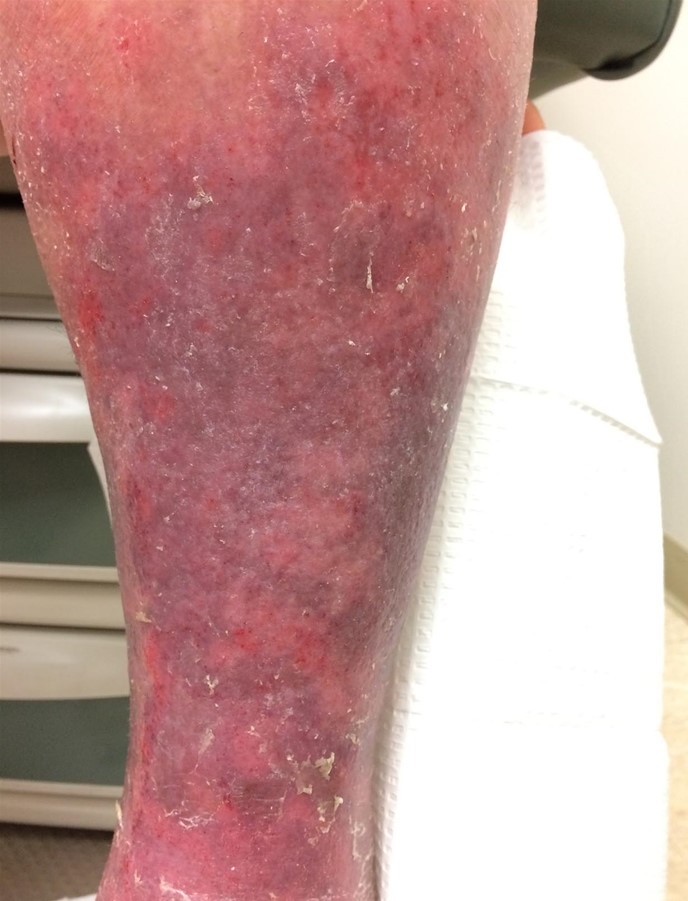 Which of the following is most likely to identify the cause of this patient's skin condition?
A) Ankle brachial index
B) Hemoglobin A1c
C) Inguinal lymph node biopsy
D) Serum TSH level
E) Skin allergy testing
F) Skin biopsy
G) Venous Doppler ultrasonography
Correct Answer:

Verified
Q510: A 46-year-old man comes to the office
Q511: A new test has been devised to
Q512: A 40-year-old woman presents to the office
Q513: A 47-year-old man comes to the office
Q514: A group of scientists developed a new
Q516: A 38-year-old woman comes to the office
Q517: A 37-year-old woman comes to the clinic
Q518: A 50-year-old man comes to the office
Q519: In a large clinical trial, patients with
Q520: A 43-year-old man comes to the office
Unlock this Answer For Free Now!
View this answer and more for free by performing one of the following actions

Scan the QR code to install the App and get 2 free unlocks

Unlock quizzes for free by uploading documents