A 74-year-old man comes to the office with increasing shortness of breath, especially on exertion. He also has cough with mucoid expectoration, especially in the morning. He has no orthopnea, paroxysmal nocturnal dyspnea, or chest pain. The patient was hospitalized for community-acquired pneumonia 2 years ago. His other medical problems include glaucoma, benign prostatic hyperplasia, and hypertension. He smoked a pack of cigarettes daily for 40 years and quit 2 years ago. His temperature is 37.2 C (98.9 F) , blood pressure is 144/96 mm Hg, pulse is 82/min, and respirations are 16/min. Pulse oximetry shows an oxygen saturation of 89% on room air at rest. His face appears plethoric. The chest is barrel shaped. Breath sounds are diminished throughout, and the expiratory phase is prolonged. Heart sounds are distant but regular, and there are no murmurs or gallops. There is no peripheral edema or jugular venous distension. Laboratory results are as follows: 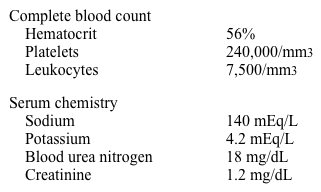 Which of the following interventions will have the maximum impact on this patient's survival?
A) Influenza and pneumococcal vaccinations
B) Long-term beta blocker therapy
C) Long-term supplemental oxygen at home
D) Maintenance low-dose oral corticosteroids
E) Mucoactive agents to thin sputum
F) Periodic phlebotomy
G) Prophylactic antibiotics to reduce exacerbations
Correct Answer:

Verified
Q653: A 45-year-old woman comes to the office
Q654: A 56-year-old man comes to the office
Q655: A 25-year-old graduate student comes to the
Q656: A 52-year-old nursing home worker comes to
Q657: A 36-year-old man comes in for evaluation
Q659: A 53-year-old man comes to the office
Q660: A 66-year-old man complains of exertional dyspnea
Q661: A 33-year-old man comes to the hospital
Q662: A 55-year-old woman comes to the hospital
Q663: A 35-year-old, previously healthy woman comes to
Unlock this Answer For Free Now!
View this answer and more for free by performing one of the following actions

Scan the QR code to install the App and get 2 free unlocks

Unlock quizzes for free by uploading documents