A 35-year-old man comes to the office after a year of weakness, fatigue, and weight loss. He has experienced reduced appetite and intermittent diarrhea. The patient had no improvement after several sessions with a clinical psychologist, who suggested evaluation for a physiological cause of his symptoms. His medical history is unremarkable, and he takes no regularly scheduled medications. The patient does not use tobacco, alcohol, or illicit drugs. Family history is notable for hypothyroidism (sister) . Temperature is 37.2 C (99 F) , blood pressure is 106/66 mm Hg, pulse is 94/min, and respirations are 14/min. On physical examination, the patient does not appear to be in acute distress. His neck shows no thyromegaly or lymphadenopathy. Cardiopulmonary examination is normal, and the abdomen is soft with normal bowel sounds and no organomegaly. Motor strength and deep tendon reflexes are normal and symmetric. Laboratory results are as follows: 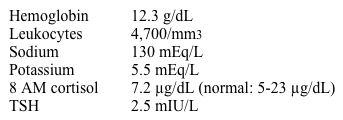 Which of the following is the most appropriate next step in management of this patient?
A) 24-hour urine free cortisol
B) ACTH stimulation test
C) Insulin-induced hypoglycemia test
D) Intravenous hydrocortisone
E) Low-dose overnight dexamethasone suppression test
Correct Answer:

Verified
Q1007: An 82-year-old woman with Alzheimer dementia is
Q1008: A 70-year-old man comes to the emergency
Q1009: A 58-year-old man comes to the office
Q1010: A 45-year-old man comes to the emergency
Q1011: A 32-year-old man comes to the office
Q1013: A 40-year-old man comes to the clinic
Q1014: A 30-year-old woman comes to the physician
Q1015: A 31-year-old woman comes to the office
Q1016: A 21-year-old college student comes to the
Q1017: A 49-year-old man comes to the office
Unlock this Answer For Free Now!
View this answer and more for free by performing one of the following actions

Scan the QR code to install the App and get 2 free unlocks

Unlock quizzes for free by uploading documents