A 66-year-old man comes to the office due to several months of progressive lower back pain. The pain is constant and dull and often bothers him during sleep. Initially, acetaminophen provided temporary relief but has not adequately controlled the pain lately. He has had no leg weakness, sensory loss, or bowel dysfunction. The patient is anuric due to end-stage renal disease from hypertensive nephrosclerosis, and he receives intermittent hemodialysis. He does not use tobacco, alcohol, or illicit drugs. Temperature is 37.1 C (98.8 F) , blood pressure is 130/86 mm Hg, and pulse is 88/min. Back examination shows midline tenderness over the lumbar area. Lower extremity deep tendon reflexes are normal, and flexor plantar response is present bilaterally. Spine radiography reveals irregular and hyperdense areas of bony sclerosis in the L1 and L2 vertebrae. There are no other bony lesions, fractures, or dislocations. Laboratory results are as follows: 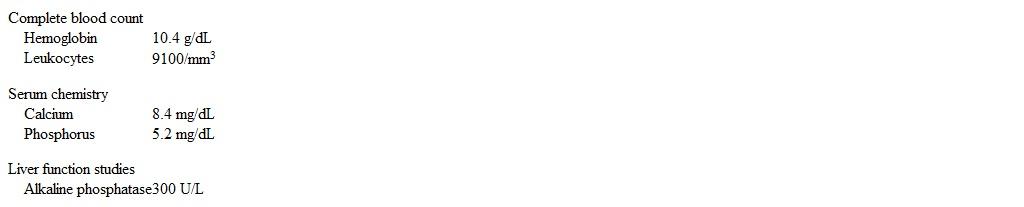 Which of the following is the most likely cause of this patient's lower back pain?
A) Colon adenocarcinoma
B) Metastatic prostate cancer
C) Multiple myeloma
D) Paget disease of bone
E) Renal osteodystrophy
F) Vertebral osteomyelitis
Correct Answer:

Verified
Q1198: A 63-year-old man comes to the physician
Q1199: A 65-year-old man is brought to the
Q1200: A 59-year-old woman comes to the emergency
Q1201: A 47-year-old man comes to the office
Q1202: A 35-year-old man comes to the office
Q1204: A 43-year-old woman comes to the emergency
Q1205: A 66-year-old woman comes to the office
Q1206: A 56-year-old man is being evaluated for increased
Q1207: A 66-year-old man comes to the office
Q1208: A 68-year-old man is evaluated for exertional
Unlock this Answer For Free Now!
View this answer and more for free by performing one of the following actions

Scan the QR code to install the App and get 2 free unlocks

Unlock quizzes for free by uploading documents