A 32-year-old man comes to the emergency department due to 5 days of intermittent high fever, chills, and drenching sweats. He also has malaise, fatigue, and dark urine. The patient has no medical history other than a splenectomy after a motor vehicle collision 10 years ago. He drinks alcohol on social occasions and does not use tobacco or illicit drugs. He is married and in a monogamous relationship with his wife. The patient lives on Long Island, New York, and works in Manhattan as a software programmer. He has not traveled outside the country but likes to hike and explore the woods. He recently camped in New England and found 2 ticks on his legs when he returned home. Temperature is 39.5 C (103 F) , blood pressure is 110/70 mm Hg, and pulse is 116/min. Mild scleral icterus is present. There are no enlarged lymph nodes or skin rash. A mildly tender liver edge is palpable 3 cm below the right costal margin. Laboratory results are as follows: 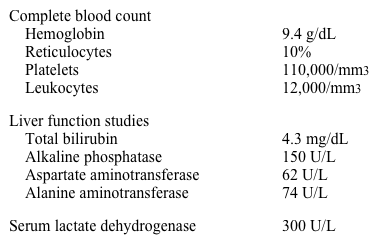 Which of the following is most likely to yield the diagnosis in this patient?
A) Antirickettsial antibody assay
B) Blood smear examination
C) Lyme serology
D) Polymerase chain reaction for Ehrlichia
E) Tourniquet test
F) Viral hepatitis serology
Correct Answer:

Verified
Q1228: A 35-year-old man is brought to the
Q1229: A 64-year-old woman comes to the office
Q1230: A 30-year-old man comes to the office
Q1231: A 30-year-old man comes to the office
Q1232: A 45-year-old woman comes to the emergency
Q1234: A 24-year-old woman at 10 weeks gestation
Q1235: A 32-year-old man comes to the emergency
Q1236: A 54-year-old woman comes to the office
Q1237: A 54-year-old woman comes to the office
Q1238: A 23-year-old man comes to the emergency
Unlock this Answer For Free Now!
View this answer and more for free by performing one of the following actions

Scan the QR code to install the App and get 2 free unlocks

Unlock quizzes for free by uploading documents