A 38-year-old man comes to the emergency department with high-grade fever, shaking chills, productive cough, and shortness of breath. He has had 2 hospital admissions for alcohol-withdrawal seizures in the past year but continues to drink alcohol every day. The patient has no other medical problems and takes no medications. Temperature is 39.7 C (103.5 F) , blood pressure is 100/70 mm Hg, pulse is 110/min, and respirations are 20/min. Skin and mucous membranes are dry. Physical examination reveals crackles and bronchial breath sounds in the right lower lung field. Cardiac examination is unremarkable. Chest x-ray reveals right lower lobe consolidation. The patient is prescribed intravenous antibiotics. Twelve hours later, he develops significant shortness of breath. Respirations are 38/min. Oxygen saturation is 80% on a nonrebreather mask. A repeat chest x-ray is shown in the image below. 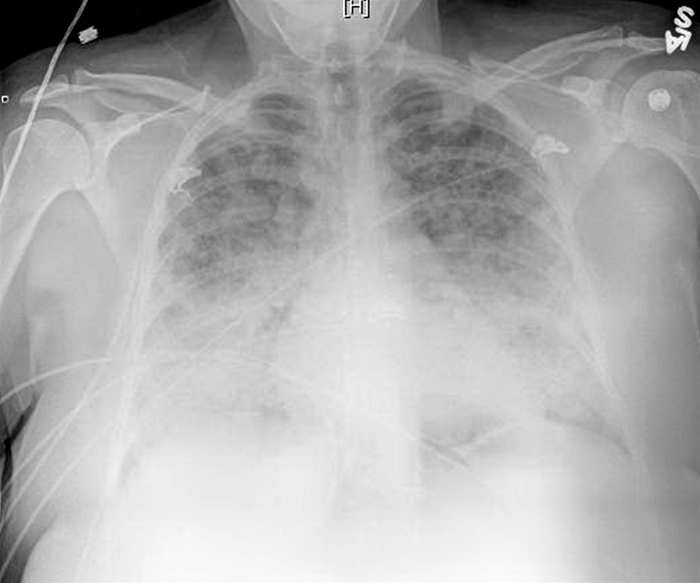 The patient is intubated immediately. Which of the following is most likely to be present in this patient just prior to intubation?
A) Decreased lung compliance
B) Increased left ventricular end-diastolic pressure
C) Increased ratio of PaO2 to FiO2
D) Normal alveolar-arterial oxygen gradient
E) Normal pulmonary arterial pressure
Correct Answer:

Verified
Q1391: A 45-year-old man with mild persistent asthma
Q1392: A 55-year-old woman comes to the office
Q1393: A 44-year-old man is admitted to the
Q1394: A 56-year-old man comes to the office
Q1395: A 64-year-old man comes to the emergency
Q1397: A 45-year-old woman with type 2 diabetes
Q1398: A 50-year-old man comes to the office
Q1399: A 66-year-old man comes to the emergency
Q1400: A 76-year-old man is brought to the
Q1401: A 32-year-old woman complains of a "nagging"
Unlock this Answer For Free Now!
View this answer and more for free by performing one of the following actions

Scan the QR code to install the App and get 2 free unlocks

Unlock quizzes for free by uploading documents