A 65-year-old woman is brought to the physician due to 6 months of dry cough and worsening dyspnea. Her dyspnea has progressed so that she is now able to walk only a few steps. She has no fever, chest pain, or hemoptysis. Her only medication is hydrochlorothiazide for hypertension. The patient is a retired schoolteacher and does not use tobacco or alcohol. She has no pets and has never traveled abroad. Temperature is 37.2 C (99 F) , blood pressure is 140/86 mm Hg, pulse is 84/min, and respirations are 18/min. Chest examination shows dry, late inspiratory crackles and digital clubbing. There is no peripheral edema. Serology is negative for antinuclear antibodies and antineutrophil cytoplasmic antibodies. Chest x-ray shows diffuse reticular opacities. A high-resolution computed tomography scan is shown below. 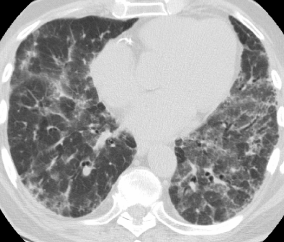 Which of the following abnormalities is most likely to be present in this patient?
A) Decreased FEV1/FVC ratio
B) Increased alveolar-arterial gradient
C) Increased diffusion capacity of carbon monoxide
D) Increased PaCO2
E) Increased residual volume
Correct Answer:

Verified
Q1398: A 50-year-old man comes to the office
Q1399: A 66-year-old man comes to the emergency
Q1400: A 76-year-old man is brought to the
Q1401: A 32-year-old woman complains of a "nagging"
Q1402: A 45-year-old man is evaluated for recurrent
Q1404: A 16-year-old girl is brought to the
Q1405: A 55-year-old man comes to the emergency
Q1406: An 85-year-old man comes to the emergency
Q1407: A 68-year-old man is brought to the
Q1408: A 65-year-old man comes to the emergency
Unlock this Answer For Free Now!
View this answer and more for free by performing one of the following actions

Scan the QR code to install the App and get 2 free unlocks

Unlock quizzes for free by uploading documents