A 71-year-old man is brought to the office by his daughter due to a change in behavior over the past year. He began having memory problems several years ago and frequently forgot his grandchildren's names. Also, the patient often had difficulty finding words. Several times recently, he was found roaming his apartment building because he was lost. The patient insists that there is nothing wrong with him and jokingly makes excuses for the symptoms his daughter is reporting. He has never used alcohol or illicit drugs. Blood pressure is 155/85 mm Hg, pulse is 90/min, and respirations are 15/min. Plantar reflexes are downgoing bilaterally. The remainder of the neurologic examination is within normal limits. Montreal Cognitive Assessment score is 15 on a scale of 30 (normal: ≥26) . Laboratory results are as follows: 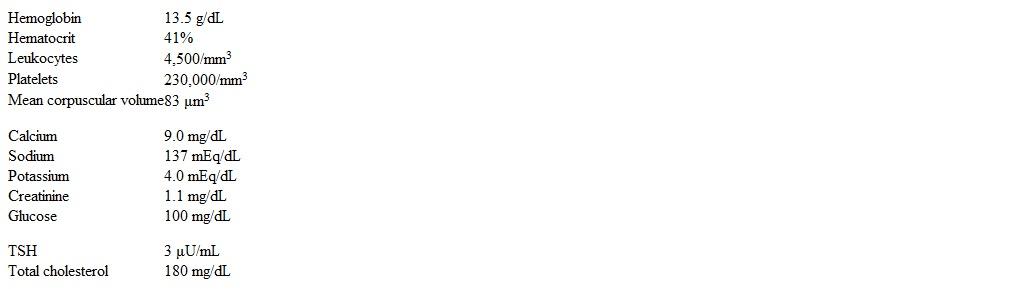 Which of the following abnormalities is most likely to be seen on this patient's MRI?
A) Diffuse cortical and subcortical infarctions
B) Enlarged lateral ventricles without cortical atrophy
C) Frontal lobe atrophy
D) Parietal lobe atrophy
E) Temporal lobe atrophy
Correct Answer:

Verified
Q46: A 74-year-old man comes to the emergency
Q47: A 69-year-old man is evaluated shortly after
Q48: A 23-year-old man is found unconscious at
Q49: A 3-month-old full-term boy is brought to
Q50: A 45-year-old woman comes to the office
Q52: A 28-year-old woman comes to the emergency
Q53: A 9-year-old boy is brought to the
Q54: A 58-year-old man is brought to the
Q55: A 10-year-old boy is brought to the
Q56: A 40-year-old man comes to the office
Unlock this Answer For Free Now!
View this answer and more for free by performing one of the following actions

Scan the QR code to install the App and get 2 free unlocks

Unlock quizzes for free by uploading documents