A 17-year-old boy with chronic immune thrombocytopenia (ITP) comes to the clinic for follow-up. The patient was initially diagnosed with ITP over a year ago when he developed prolonged epistaxis after colliding with another player during a soccer game. This past school year the patient has been unable to participate in sports due to frequent episodes of mucosal bleeding after mild trauma warranting pharmacologic intervention. He has received treatment with multiple medications, including intravenous immunoglobulin and prednisone. His response to treatment has been transient, with platelet counts that have decreased rapidly to the 10,000/mm3 range at follow-up visits. Physical examination shows diffuse petechiae and a few areas of ecchymosis along the thighs but is otherwise normal. Laboratory results are as follows: 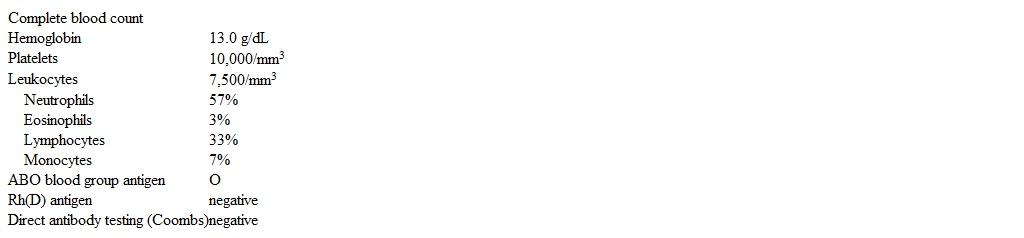 Workup for autoimmune disorders and chronic viral infections is negative. Bone marrow evaluation reveals a normocellular marrow with slightly increased megakaryocytes. Which of the following is the best next step in management of this patient?
A) Anti-D immune globulin
B) Desmopressin
C) Epoetin alfa
D) Granulocyte colony-stimulating factor
E) Scheduled platelet transfusion
F) Splenectomy
Correct Answer:

Verified
Q458: A 1-year-old boy is brought to the
Q459: A 12-year-old boy with cystic fibrosis is
Q460: A 7-year-old boy is brought to the
Q461: An 18-month-old boy is brought to the
Q462: A 6-hour-old girl is evaluated in the
Q464: A 9-year-old African-American boy is brought to
Q465: A 3-year-old boy is brought to the
Q466: A previously healthy 1-year-old girl is brought
Q467: A 2-year-old boy is brought to clinic
Q468: A 1-year-old African American girl is brought
Unlock this Answer For Free Now!
View this answer and more for free by performing one of the following actions

Scan the QR code to install the App and get 2 free unlocks

Unlock quizzes for free by uploading documents