A 14-year-old girl is brought to the emergency department after throwing a notebook at her teacher, rambling about "bats on the ceiling," and trying to run out of school. Medical history is significant for asthma, for which she uses albuterol as needed, and attention-deficit hyperactivity disorder, for which she takes extended-release mixed amphetamine salts on school days. There has been no recent change in the patient's medications. Family history is significant for Graves disease in her mother and schizophrenia in her maternal aunt. The patient says, "There are bats everywhere. They can hurt me now that all sorts are involved." She is alert but appears fearful and distracted and makes poor eye contact. Her father says that this behavior is uncharacteristic but that she has been behaving "oddly" for a few days, sleeping poorly, appearing anxious, and staring at her bedroom walls. Several weeks ago, the patient started missing multiple days of school and did not want to go out with friends, saying that her joints hurt too much. She has also recently experienced headaches and poor concentration. Temperature is 37.2 C (99 F) , blood pressure is 110/70 mm Hg, pulse is 98/min, and respirations are 18/min. Laboratory results are as follows: 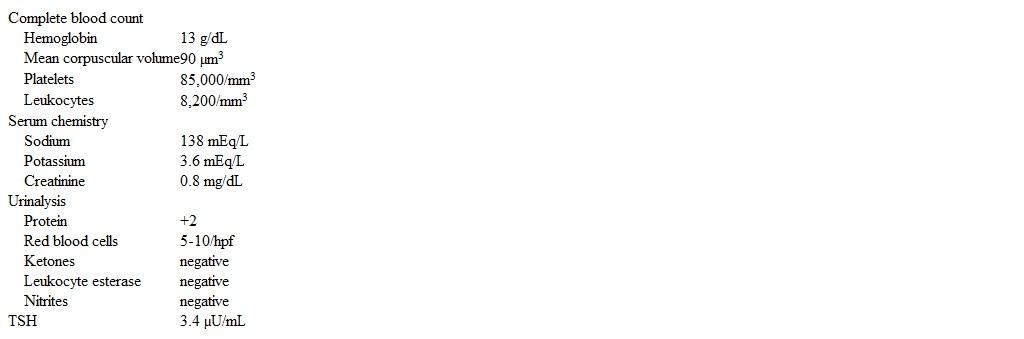 Urine and blood toxicology are negative. Which of the following is the most appropriate next step in management of this patient?
A) Begin low-dose antipsychotic for brief psychotic disorder
B) Discontinue amphetamines
C) Obtain antinuclear antibodies
D) Obtain free T4 and T3
E) Perform urethral swab culture
Correct Answer:

Verified
Q616: A 1-year-old boy is brought to the
Q617: A 5-month-old girl is brought to the
Q618: A 2-year-old boy is brought to the
Q619: A 3-day-old girl is brought to the
Q620: A 4-year-old boy is brought to the
Q622: A boy is brought to the nursery
Q623: An 18-month-old girl is brought to the
Q624: A 12-year-old boy is brought to the
Q625: A 5-hour-old boy is evaluated in the
Q626: You are called to the nursery to
Unlock this Answer For Free Now!
View this answer and more for free by performing one of the following actions

Scan the QR code to install the App and get 2 free unlocks

Unlock quizzes for free by uploading documents