A 4-year-old girl is brought to the office due to painful urination. For the past 2 days, the patient has cried during urination; only a small amount comes out each time. She has no vomiting, nausea, or fever. Medical history is unremarkable except for functional constipation since starting day care at age 2 and 3 episodes of cystitis in the past year. The patient completed a 3-day course of trimethoprim-sulfamethoxazole 6 weeks ago for the prior episode of cystitis. Temperature is 37.2 C (99 F) , blood pressure is 98/56 mm Hg, and pulse is 110/min. On examination, the patient is not in acute distress. The suprapubic region is moderately tender to palpation. There is no back pain. Genitalia are normal. Anal fissures are present at the 12 o'clock and 2 o'clock positions. Rectal examination shows normal tone and hard stool in the rectal vault. Urinalysis results are as follows: 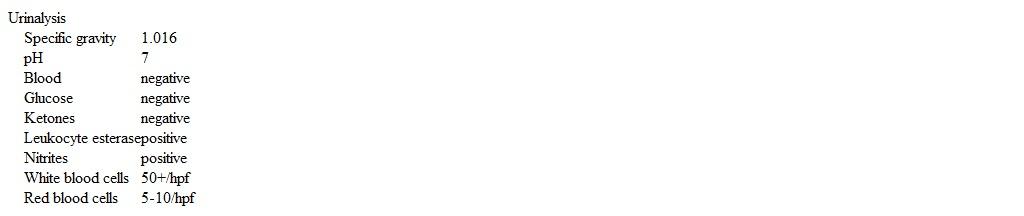 Urine culture shows 100,000 colonies of Escherichia coli. Which of the following most likely contributed to this patient's current illness?
A) Inadequate treatment of prior infection
B) Primary immunodeficiency
C) Sexual abuse
D) Urinary stasis
E) Vesicoureteral reflux
Correct Answer:

Verified
Q674: A 9-year-old boy is brought to the
Q675: A 5-year-old girl is brought to the
Q676: A 7-year-old boy is brought to the
Q677: A 9-year-old boy is brought to the
Q678: A 3-year-old boy is brought to the
Q680: A 12-year-old boy is brought to the
Q681: A 32-year-old woman, gravida 1 para 0,
Q682: A 6-month-old boy is brought to the
Q683: A 3-year-old girl is brought to the
Q684: A 3-year-old boy is brought to the
Unlock this Answer For Free Now!
View this answer and more for free by performing one of the following actions

Scan the QR code to install the App and get 2 free unlocks

Unlock quizzes for free by uploading documents