A 36-year-old woman comes to the office due to difficulty losing weight over the past several months. The patient says, "I typically lose 1 or 2 pounds in the first week of dieting, but by the second week I lose control and start eating bags of cookies and potato chips." These episodes are followed by a few days of fasting and exercising excessively. The patient is upset about her weight and appearance but has no persistent sadness. She enjoys her work and socializing with friends and family. The patient has no medical conditions, but her menstrual cycle is irregular. Weight is 67 kg (147.7 lb) and height is 160 cm (5 ft 3 in) . BMI is 26.2 kg/m2. Blood pressure is 100/70 mm Hg and pulse is 86/min. Physical examination shows dry skin but is otherwise unremarkable. The patient has a full range of affect and no suicidal ideation. Laboratory results are as follows: 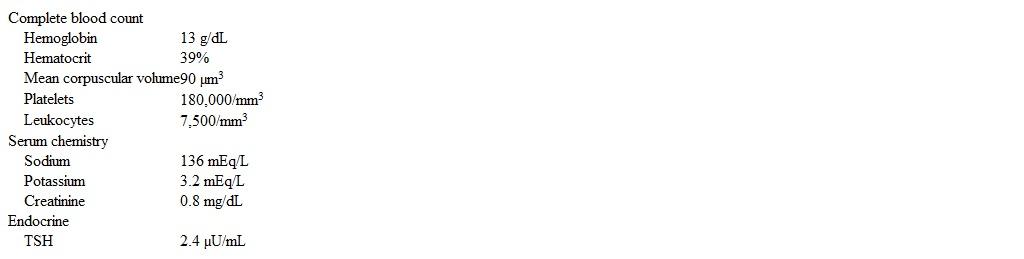 The diagnosis is discussed, and the patient asks if any medications are available for treatment. Which of the following is the most appropriate recommendation?
A) Bupropion
B) Fluoxetine
C) Methylphenidate
D) No pharmacological therapy is effective
E) Olanzapine
F) Orlistat
Correct Answer:

Verified
Q64: A 32-year-old woman comes to the office
Q65: A 32-year-old physician comes to the office
Q66: A 44-year-old woman comes to the office
Q67: A 66-year-old man comes to the office
Q68: A 33-year-old woman comes to the office
Q70: A 54-year-old man comes to the office
Q71: A 33-year-old man comes to the office
Q72: A 38-year-old man is evaluated for a
Q73: A 25-year-old woman comes to the office
Q74: A 38-year-old man comes to the office
Unlock this Answer For Free Now!
View this answer and more for free by performing one of the following actions

Scan the QR code to install the App and get 2 free unlocks

Unlock quizzes for free by uploading documents